
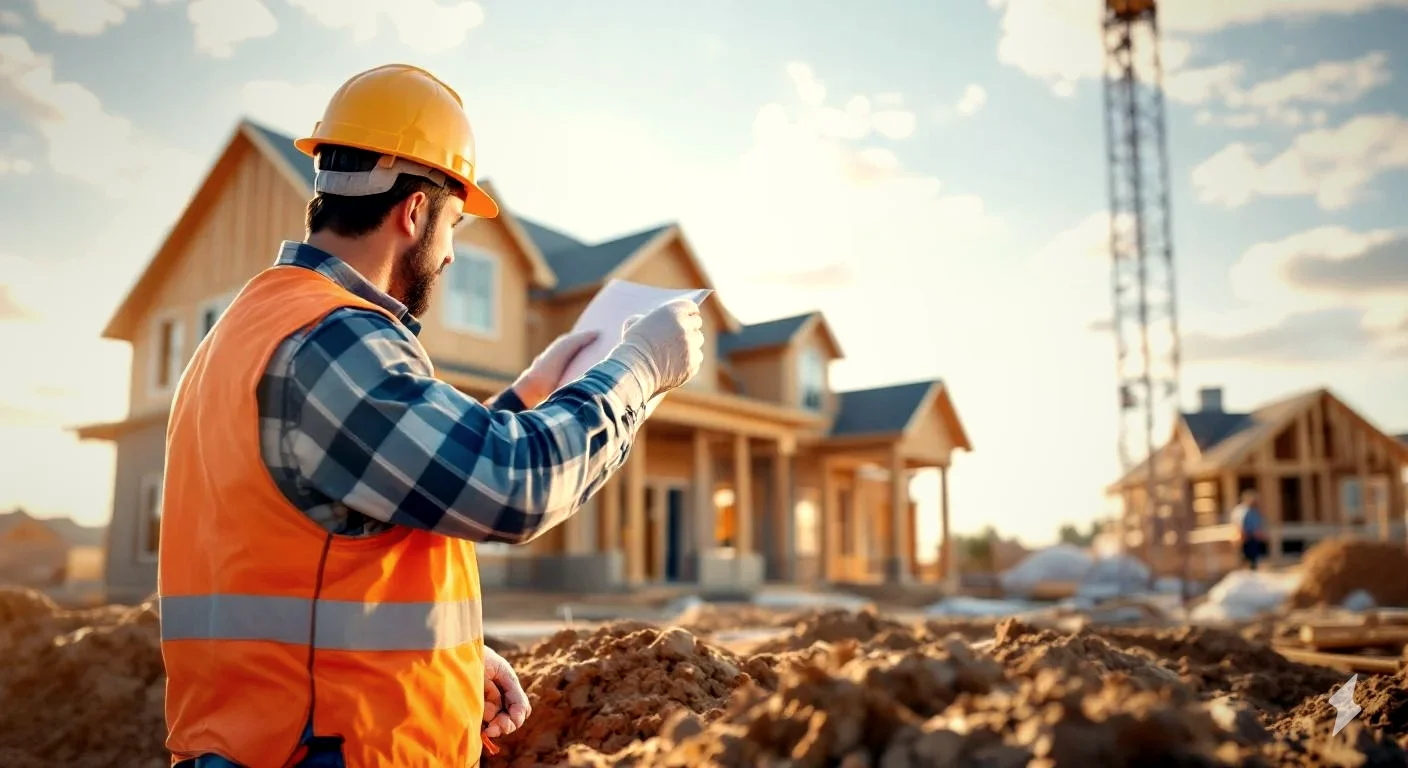
$162 a square foot. That is the median cost to build a single-family home in the US based on NAHB’s most recent Cost of Constructing a Home study, and that number is already two years old. Add inflation, add labor shortages, add the permit backlog in most counties, and you land somewhere north of $200 a square foot for any real-world 2026 build.
I’ve been in and around new construction for 20+ years. I don’t build ground-up homes anymore (I stick to remodels with Pacific Remodeling), but the cost structure is the same math I work with every day. Homeowners asking “what does it cost per square foot to build a house?” want one number. There isn’t one. There are three, and the difference between them is six figures.
Planning a build or putting together numbers for a client? Use our cost to build a house calculator to see what your specific square footage and tier combo should land at, or Try EstimationPro free and run a full line-item estimate before you talk tiers.
Quick Answer
New home construction in 2026 runs $150 to $500 per square foot depending on tier. Tract builds land at $150 to $200, semi-custom at $200 to $350, and fully custom starts around $350 and climbs past $500 in high-cost metros. A 2,500 sq ft semi-custom home typically hits $500,000 to $875,000 all-in, including land prep, permits, and contractor markup. Regional pricing swings that range up 35% in the Northeast and down 10% in the Sun Belt.
What “Cost Per Square Foot” Actually Includes
This is where most homeowners get burned. One builder quotes $180 a square foot, another quotes $260, and they look totally different until you realize they cover different scopes.
A real “turnkey” price per sq ft includes:
- Site prep, grading, and utility hookups
- Foundation (slab, crawl, or full basement)
- Framing (walls, floors, roof)
- Roofing and exterior cladding
- Windows and exterior doors
- Plumbing rough-in and finish
- Electrical rough-in and finish
- HVAC system
- Insulation and drywall
- Interior trim, cabinets, counters, flooring
- Paint inside and out
- Permits, plans, and inspections
- General contractor overhead and profit
What it almost never includes: the land itself, land clearing beyond basic grading, a well or septic system (rural lots), long driveways, landscaping, fences, decks, or any appliances beyond basic range and dishwasher. Those live outside the per-square-foot number.
If a bid quotes you $160 a square foot but strips out the driveway, septic, and landscaping, that’s a $40,000 to $80,000 gap. It is the same trick shady remodelers use on kitchen bids, just scaled up.
2026 Cost Ranges by Build Tier
Here’s how the three tiers break down in real numbers. These are national averages. Apply the regional multiplier in the next section for your area.
| Build Tier | Per Sq Ft | 2,000 Sq Ft Home | 2,500 Sq Ft Home | 3,500 Sq Ft Home |
|---|---|---|---|---|
| Tract / production | $150 to $200 | $300,000 to $400,000 | $375,000 to $500,000 | $525,000 to $700,000 |
| Semi-custom | $200 to $350 | $400,000 to $700,000 | $500,000 to $875,000 | $700,000 to $1,225,000 |
| Full custom | $350 to $500+ | $700,000 to $1,000,000+ | $875,000 to $1,250,000+ | $1,225,000 to $1,750,000+ |
Sources: NAHB Cost of Constructing a Home 2024, US Census Bureau Survey of Construction 2024, HomeAdvisor 2026 new home cost data, and Brad field experience on remodel cost structures that mirror new-build inputs.
Tract builders keep costs down by running the same floor plan a hundred times. They buy trusses, cabinets, and windows by the truckload. Their framers can walk a house in their sleep. That efficiency is real and it saves the buyer money, but you pay for it in flexibility.
Custom builds flip that. Every plan is new. Every supplier gets a one-off order. Every sub has to read new prints. The cost climbs because the inefficiency is baked in, and that is before you touch the fact that custom clients want higher-grade finishes.
Regional Pricing: Where You Build Changes Everything
| Metro | Multiplier vs National Avg | Typical Semi-Custom /Sq Ft |
|---|---|---|
| New York / NJ / CT | +35% | $270 to $470 |
| San Francisco / Bay Area | +30% | $260 to $455 |
| Seattle / PNW | +20% | $240 to $420 |
| Denver | +10% | $220 to $385 |
| Austin | +5% | $210 to $365 |
| Phoenix | -10% | $180 to $315 |
| Dallas / Fort Worth | -8% | $185 to $320 |
| Atlanta | -12% | $175 to $310 |
Sources: BLS regional construction wage data May 2024, RSMeans 2025 City Cost Indexes, NAHB regional cost factors.
Labor is the biggest driver. A framer in Seattle bills $55 to $70 an hour. That same framer in Phoenix might be $35 to $45. Same trade, same skill, wildly different labor rates. Multiply that across every trade on the project and the math gets ugly fast.
Material costs vary too, but less than people think. A 2x4 stud costs about the same in Dallas as it does in Denver because lumber moves on rail cars. What changes is how much it costs to put that stud on a wall.
Worked Example #1: 2,200 Sq Ft Tract Home in Phoenix
Here is what a builder’s job cost sheet actually looks like for a base-tier build.
| Line Item | Cost |
|---|---|
| Site prep and grading | $14,000 |
| Slab foundation | $24,000 |
| Framing (walls, floors, roof trusses) | $38,000 |
| Roofing (asphalt shingles) | $11,000 |
| Windows and exterior doors | $14,000 |
| Stucco and exterior trim | $22,000 |
| Plumbing (rough and finish) | $18,000 |
| Electrical (rough and finish) | $14,000 |
| HVAC system | $12,000 |
| Insulation and drywall | $22,000 |
| Stock cabinets and counters | $14,000 |
| Vinyl plank and tile flooring | $10,000 |
| Interior trim and paint | $13,000 |
| Permits, plans, utility tap fees | $18,000 |
| Builder overhead and profit (20%) | $48,000 |
| Total | $292,000 |
That works out to about $133 per sq ft, which is a hair under the national tract range because Phoenix runs below the average. Add the lot ($60,000 to $120,000 in the metro area) and the buyer writes a check for somewhere between $352,000 and $412,000.
Worked Example #2: 2,800 Sq Ft Semi-Custom in the Pacific Northwest
Same layout, different zip code, different finish level.
| Line Item | Cost |
|---|---|
| Site prep, grading, silt fence | $22,000 |
| Full basement foundation | $68,000 |
| Framing (2x6 walls, engineered floor) | $58,000 |
| Composition roof and gutters | $16,000 |
| Fiber cement siding and trim | $32,000 |
| Vinyl windows and solid-core doors | $22,000 |
| Plumbing (high-efficiency fixtures) | $26,000 |
| Electrical (including 200A service) | $22,000 |
| Gas furnace and A/C | $18,000 |
| R-49 ceiling, R-21 wall insulation | $14,000 |
| Drywall and level 4 finish | $18,000 |
| Semi-custom cabinets and quartz | $38,000 |
| Engineered hardwood and tile | $24,000 |
| Interior doors, trim, paint | $22,000 |
| Appliances (base package) | $8,000 |
| Permits, design, engineering | $28,000 |
| Builder O&P (22%) | $95,000 |
| Total | $531,000 |
That lands at about $190 per sq ft, right at the bottom of the PNW semi-custom range. A fancier finish package on the same floor plan easily pushes this to $240 to $270 per sq ft.
See what numbers your build should land at with the construction cost estimator or check our whole-home remodel cost per sq ft guide for renovation pricing that uses the same math.
What Actually Drives the Per Sq Ft Number
Three factors move this number more than anything else.
1. Site conditions. A flat lot with municipal water and sewer at the curb is cheap to build on. A sloped lot with a long driveway, a well, and a septic system can add $60,000 to $150,000 before you ever swing a hammer. I’ve seen rural builds where the site work alone ran $85,000 because the soil needed imported structural fill and the power company wanted $22,000 to trench in service.
2. Finish level. Cabinets, counters, flooring, and trim swing the price harder than most people realize. Stock maple cabinets at $180 a linear foot vs custom rift-cut white oak at $850 a linear foot is a $40,000 swing on a typical kitchen. Same room. Same layout. Almost 5x the cabinet cost.
3. Home size. Smaller homes cost more per sq ft. A 1,500 sq ft build might run $210 a sq ft while a 3,500 sq ft build on the same lot with the same finishes runs $180 a sq ft. Why? Because the expensive rooms (kitchens and bathrooms) stay about the same size regardless of total square footage, so they get spread over more sq ft as the house grows.
Where Homeowners Lose Money
- Trusting a per-sq-ft quote without a line-item scope. Two bids at $220 and $265 a sq ft look different until the cheaper one is missing the septic, the driveway, and the appliance allowance. Always get the scope on paper.
- Underbudgeting the land prep. A pretty lot can hide $30,000 in drainage, clearing, and access work. Walk the lot with the builder before you sign.
- Forgetting the soft costs. Permits, plans, engineering, surveys, utility taps, impact fees. These run 5% to 10% of hard cost and they are not optional.
- Skipping the contingency. Every build has surprises. 10% minimum. 15% on a custom or rural build. If the builder’s contract doesn’t include one, build it into your own budget.
- Chasing the cheapest builder. Same game shady remodelers play. Lowball the bid, win the job, change-order the homeowner to death. If you were my mom, I’d tell you to pick the middle bid from a builder with references you can actually call.
Tips From the Jobsite
- Ask the builder how many times they’ve built this exact plan. Tract builders have built it dozens of times, semi-custom maybe 3 to 5, fully custom is always new. The first build of a custom plan runs 10% to 15% over the estimate on average.
- Get the allowances in writing. “$8,000 cabinet allowance” means the builder includes $8,000. If you pick $18,000 cabinets, the $10,000 gap is yours. Allowances hide the real cost of the house.
- Walk the house at framing, before insulation, before drywall, and before closing. These are the four cheapest moments to catch a problem. Waiting until closing to notice the can lights are wrong costs 10x what catching it at framing does.
- Pay attention to the warranty. A real builder offers 1 year workmanship, 2 year systems, 10 year structural at minimum. Anything less is a red flag.
FAQ
Is it cheaper to buy or build a house in 2026? In most metros, buying existing is still cheaper per square foot than building new. Resale homes nationally run $160 to $220 per sq ft while new builds run $200 to $350 per sq ft for comparable finishes. Build if you want a specific floor plan, lot, or finish level you can’t find on the resale market. Buy if you want the cheaper path to ownership.
What is the cheapest type of house to build per sq ft? A single-story rectangle on a slab foundation with a gable roof is the cheapest shape to build. Every corner you add costs money. Every bump-out costs money. Every roof valley costs money. A simple rectangle with a straight-run gable roof can come in 15% to 25% under a comparable square footage home with a complex floor plan.
How much does it cost to build a 2,000 sq ft house? A 2,000 sq ft home in 2026 runs $300,000 to $700,000 in hard construction cost, not counting land. Tract build: $300,000 to $400,000. Semi-custom: $400,000 to $600,000. Custom: $700,000+. Add land (highly variable by market) and soft costs for the all-in number.
Does cost per sq ft include the garage? Depends on the builder. Some include the garage sq ft in the total and price accordingly (with the garage costing maybe 40% of living space per sq ft). Others quote only heated square footage and list the garage separately. Always ask the builder which method they use before comparing bids.
How much do permits and plans add to the cost? Soft costs (permits, plans, engineering, surveys, utility taps, impact fees) run 5% to 10% of hard construction cost in most jurisdictions. On a $500,000 hard-cost build, expect $25,000 to $50,000 in soft costs. High-regulation metros like California and the PNW can push that to 12% or higher.
Why is my per-sq-ft quote higher than the national average? Three likely reasons: you’re in a high-cost labor market (Northeast, Bay Area, PNW), your finish level is above mid-range, or your plan has a complex footprint (lots of corners, roof valleys, or high ceilings). Ask the builder to break the quote into materials, labor, and overhead so you can see where the money is actually going.
The Numbers That Matter
Building a house in 2026 is not a one-price game. A tract home in Phoenix and a custom home in Seattle can both “cost a house,” but the math behind them has almost nothing in common. The per-square-foot number is useful for planning, useless for contracting. Get a line-item scope, get a real contingency, and get a builder whose past clients you can actually talk to.
Cost ranges reflect 2026 pricing and national averages. Prices vary by region because local labor, materials, and permit fees are all different. Get local quotes from at least two local contractors before you commit, and verify with local subs on your specific lot.
Contractors using EstimationPro report building full new-home bids in under an hour, down from the 6 to 8 hours a typical spreadsheet workflow takes. Try EstimationPro free and put together your next bid with real line items, regional pricing, and built-in contingency math. The platform doesn’t stop at the estimate. Automated follow-up sequences check in with the homeowner after the proposal goes out, and when they approve the bid, the invoicing flow carries straight through to payment. One tool, start to finish, so you can get the bid out of your hands and get back to building.
Pricing a job like this?
Get every line item priced for your area in a full estimate
Describe the job or snap a few photos. Send it from EstimationPro and it follows up with your client for you.
3 free estimates. No credit card.
2,500 Sq Ft Semi-Custom Home Cost Breakdown
House Building Cost by Build Tier
- Builder-selected plans, limited options
- Stock cabinets and fixtures
- Vinyl or laminate flooring
- Standard 8 ft ceilings
- 6 to 9 month timeline
- Modified stock plans or lot-specific design
- Mid-range cabinets, quartz counters
- Engineered hardwood or LVP
- 9 ft ceilings, some upgrades
- 9 to 14 month timeline
- Architect-designed from scratch
- Custom cabinets, stone counters
- Hardwood, tile, premium trim
- Vaulted ceilings, high-end systems
- 12 to 24 month timeline
Get Free Estimating Tips
Enter your email and we'll send you pro tips, cost data, and useful resources for contractors.
We'll send helpful resources and occasional tips. Unsubscribe anytime.
 EstimationPro AI For Contractors, By Contractors
 Price Every Job With Confidence
Stop second-guessing your numbers. EstimationPro prices every line with labor and material rates adjusted for your region.