
$200 per square foot. That’s the ballpark number most builders quote for mid-range new construction in 2026. But “ballpark” doesn’t cut it when you’re writing the check. You need to know exactly where every dollar goes, and more importantly, how to calculate it for your specific project.
Whether you’re a contractor building the estimate or a homeowner trying to understand the bid, this guide breaks down how to calculate construction cost of a house with real numbers. No fluff. No “it depends” without explaining what it depends on.
Use our Construction Cost Estimator to run your own numbers, or Try EstimationPro free to build a full line-item estimate in minutes.
Quick Answer
New home construction costs $100-$400+ per square foot in 2026, depending on build quality, location, and finishes. A typical 2,000 SF mid-range home runs $300,000 to $500,000 for construction alone (not including land). To calculate your project, break costs into eight categories: site work, foundation, framing, exterior, mechanical systems, interior finishes, permits, and contractor overhead. Each category has predictable cost-per-square-foot ranges you can plug into your estimate.
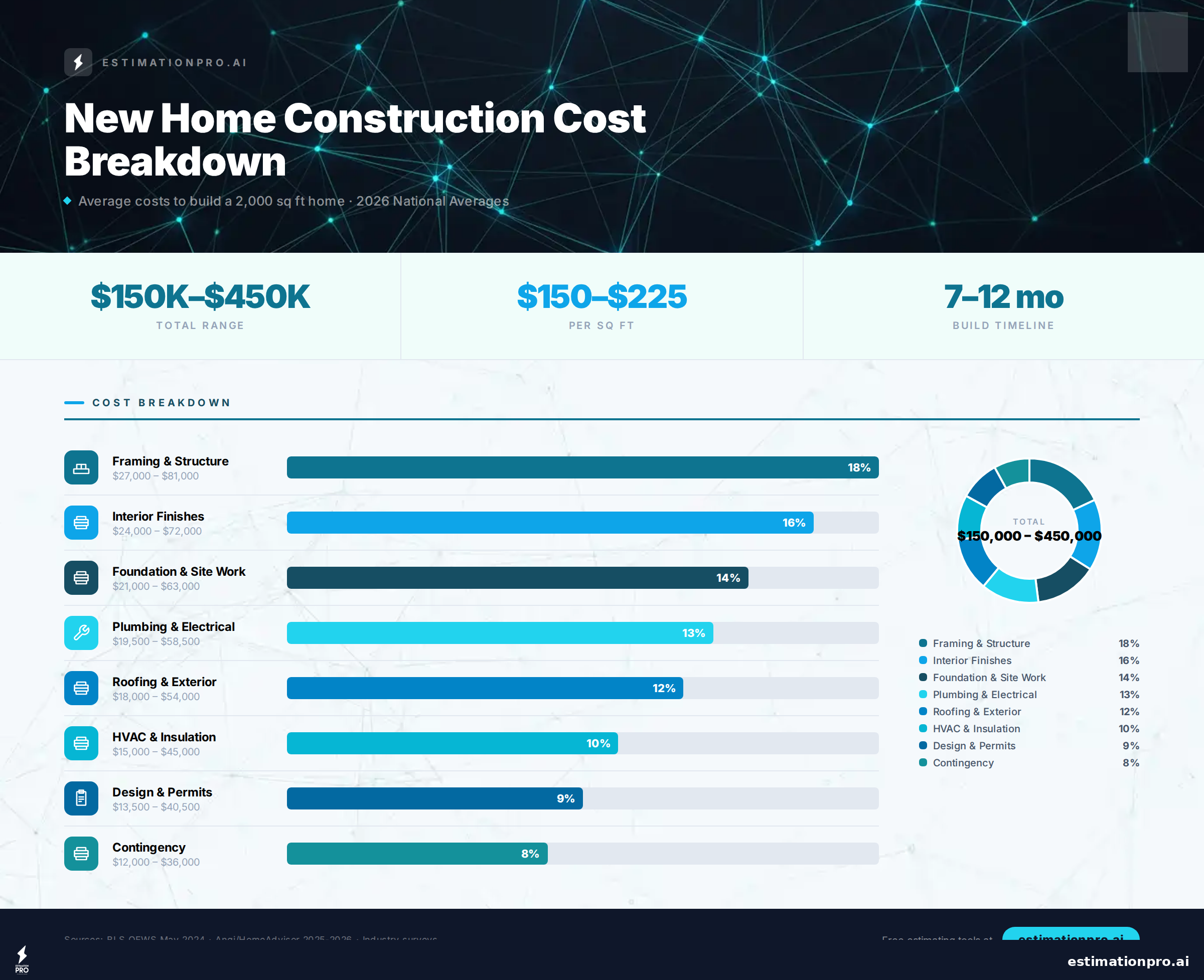
Share This Infographic
Feel free to share this infographic on your website. Just copy the embed code below:
Copy this embed code:
<a href="https://estimationpro.ai/tools/blog/calculate-construction-cost-of-house" target="_blank" rel="noopener">
  <img src="https://estimationpro.ai/tools/blog/infographics/calculate-construction-cost-of-house-infographic.png" alt="How to Calculate Construction Cost of a House (2026) infographic by EstimationPro.AI" style="max-width:100%;height:auto" loading="lazy" />
</a>
<p style="font-size:12px;color:#64748B;margin-top:8px">Source: <a href="https://estimationpro.ai/tools/blog/calculate-construction-cost-of-house">EstimationPro.AI</a></p>
What Goes Into Construction Cost
Every house, regardless of size, breaks down into the same core categories. The percentages shift based on quality and design, but the categories don’t change.
| Cost Category | % of Total | Cost Per SF (Mid-Range) |
|---|---|---|
| Site work & grading | 5-8% | $8-$16 |
| Foundation | 8-12% | $12-$24 |
| Framing & rough carpentry | 15-20% | $24-$40 |
| Roofing | 5-7% | $8-$14 |
| Exterior (siding, windows, doors) | 12-16% | $18-$32 |
| Mechanical (HVAC, plumbing, electrical) | 16-22% | $25-$44 |
| Interior finishes (drywall, paint, flooring, cabinets) | 20-28% | $30-$56 |
| Permits, fees, GC overhead | 10-15% | $15-$30 |
Sources: NAHB 2024 Construction Cost Survey, RSMeans 2025 residential data.
These ranges are national averages. Your region, soil conditions, and material choices will push you higher or lower within each band.
How to Calculate Construction Cost: Step by Step
Here’s the process I use for every new construction estimate. You can follow the same method whether you’re pricing your own project or checking a builder’s numbers.
Step 1: Measure Total Square Footage
Count every finished square foot of the home. Include the garage separately since it costs less per square foot than living space. If the home has a basement, calculate that as its own line item too.
Step 2: Choose Your Build Quality
This is the biggest single decision affecting cost. The difference between budget and custom is 2-3x per square foot.
Step 3: Apply Cost-Per-SF Ranges by Category
Multiply your square footage by the per-SF rate for each category. Use the table above as your starting point, then adjust for local conditions. Each trade has its own rate. Don’t use one blanket number for the whole house.
Step 4: Add Site-Specific Costs
These are the items that don’t scale with square footage:
- Permits and impact fees: $2,000-$15,000+ depending on jurisdiction
- Utility connections: $5,000-$20,000 (water, sewer, electric, gas)
- Driveway and landscaping: $5,000-$25,000
- Survey, soil testing, engineering: $2,000-$8,000
Step 5: Apply Contractor Overhead and Profit
General contractors typically add 15-35% overhead and profit (O&P) on top of direct costs, with 25% being the industry standard according to NAHB benchmarks. This covers supervision, insurance, warranty, and the builder’s margin.
Step 6: Build in Contingency
Add 10-15% contingency for unknowns. Every project hits surprises. Rock below grade, code changes, material price spikes, weather delays. If you don’t plan for it, you’ll pay for it.
Worked Example 1: 1,500 SF Starter Home (Budget Build)
A basic single-story, 3-bed/2-bath on a slab foundation in a mid-cost market.
| Category | Calculation | Cost |
|---|---|---|
| Site work & grading | 1,500 SF x $8/SF | $12,000 |
| Foundation (slab) | 1,500 SF x $14/SF | $21,000 |
| Framing & carpentry | 1,500 SF x $24/SF | $36,000 |
| Roofing (asphalt) | 1,500 SF x $8/SF | $12,000 |
| Exterior (vinyl siding) | 1,500 SF x $18/SF | $27,000 |
| Mechanical systems | 1,500 SF x $26/SF | $39,000 |
| Interior finishes (builder grade) | 1,500 SF x $32/SF | $48,000 |
| Subtotal | $195,000 | |
| Permits & fees | $5,000 | |
| GC overhead & profit (25%) | $50,000 | |
| Total construction cost | $250,000 | |
| Cost per finished SF | $167/SF |
That puts you at roughly $167 per square foot for a budget build. This assumes builder-grade finishes, standard layouts, and no significant site complications.
Worked Example 2: 2,400 SF Custom Home (Mid-Range Build)
A two-story, 4-bed/2.5-bath with a crawlspace foundation, covered porch, and upgraded finishes.
| Category | Calculation | Cost |
|---|---|---|
| Site work & grading | 2,400 SF x $14/SF | $33,600 |
| Foundation (crawlspace) | 1,200 SF footprint x $22/SF | $26,400 |
| Framing & carpentry | 2,400 SF x $35/SF | $84,000 |
| Roofing (architectural shingles) | 1,400 SF roof x $12/SF | $16,800 |
| Exterior (fiber cement, vinyl windows) | 2,400 SF x $28/SF | $67,200 |
| Mechanical systems | 2,400 SF x $38/SF | $91,200 |
| Interior finishes (mid-grade) | 2,400 SF x $48/SF | $115,200 |
| Subtotal | $434,400 | |
| Permits & fees | $8,500 | |
| GC overhead & profit (25%) | $110,700 | |
| Total construction cost | $553,600 | |
| Cost per finished SF | $231/SF |
At $231 per square foot, this mid-range custom home reflects the reality of 2026 material costs, skilled labor rates, and code requirements. Notice how the per-SF cost climbs with quality, not just size.
Regional Cost Adjustments
Construction costs swing dramatically by market. A house that costs $250,000 to build in rural Texas might run $450,000 in Seattle or $600,000+ in the San Francisco Bay Area.
| Region | Cost Multiplier | Notes |
|---|---|---|
| Rural South/Midwest | 0.75-0.85x | Lower labor rates, fewer regulations |
| Mid-cost metro (Phoenix, Nashville, Charlotte) | 0.90-1.00x | National average range |
| Pacific Northwest | 1.10-1.25x | Higher labor, more code requirements |
| Northeast/Mid-Atlantic | 1.15-1.30x | Union labor, stricter energy codes |
| California/Hawaii | 1.30-1.60x | Highest labor, seismic/energy requirements |
Source: RSMeans 2025 City Cost Index.
To adjust, multiply your base estimate by the regional factor. A $250,000 base estimate in the PNW becomes roughly $275,000 to $312,500 after the multiplier.
Pricing varies by region, season, and local labor markets. These ranges reflect 2026 national data and should be verified with local contractors.
Hidden Costs That Blow Budgets
I’ve seen too many projects go sideways because these costs weren’t in the original estimate.
- Soil conditions. Clay, rock, or high water table adds $5,000 to $30,000 or more to foundation work. A $2,500 soil test before you break ground is money well spent.
- Utility runs. If the lot is far from existing water, sewer, or power, the run costs add up fast. I’ve seen $15,000+ just for a 200-foot sewer connection.
- Grading and drainage. Sloped lots or poor drainage require engineered solutions. Retaining walls alone can run $10,000 to $40,000.
- Code upgrades. Energy codes change every few years. The 2024 building code requirements for insulation, windows, and HVAC add roughly $3,000-$8,000 versus what the same house cost five years ago.
- Change orders. Every “while you’re at it” adds up. The average new construction project sees 8-12% in change orders according to NAHB data. That’s $30,000-$50,000 on a mid-range home.
Common Mistakes When Estimating Construction Costs
Mistake 1: Using one blanket per-SF rate. A bathroom costs 2-3x more per square foot than a bedroom. Your estimate needs to account for the mix of room types, not just total area.
Mistake 2: Forgetting the land development costs. Raw land isn’t build-ready. Tree clearing, grading, utility connections, and permits can add $25,000-$75,000 before a single board gets nailed.
Mistake 3: Skipping the contingency. No project goes exactly to plan. Without 10-15% contingency, the first surprise eats your profit (if you’re the builder) or blows your budget (if you’re the owner).
Mistake 4: Pricing materials at today’s rates for a build starting in six months. Lumber, copper, and concrete prices shift quarterly. Build in a 3-5% escalation buffer for projects starting more than 90 days out.
Mistake 5: Comparing bids that don’t cover the same scope. One builder includes landscaping and driveway. Another doesn’t. One includes appliances. Another quotes them separately. Always compare line by line, not just the bottom number.
Pro Tips for Accurate Estimates
-
Get three bids minimum for every major trade. Not just three GC bids, but three plumbing bids, three electrical bids, three framing bids. This is how you find the real market rate.
-
Use your local building department’s per-SF valuation as a sanity check. Most jurisdictions publish the per-SF cost they use for permit valuation. It’s not perfect, but it flags estimates that are way off.
-
Track your actual costs on every job. Compare estimated vs. actual by category. After 5-10 projects, your estimates get very accurate because you’re working from real data, not guesses.
-
Break the estimate into at least 8 categories. The more granular you get, the more accurate the total. A single line that says “construction: $350,000” tells you nothing. Eight categories with unit costs tell you exactly where the money goes. Check out our Construction Estimate Template for a ready-to-use breakdown format.
Frequently Asked Questions
How much does it cost per square foot to build a house in 2026?
National average construction cost runs $150-$250 per square foot for mid-range quality, not including land. Budget builds start around $100-$150/SF. Custom homes run $250-$400+/SF. These figures cover construction only. Land, financing, and closing costs are separate.
What is the most expensive part of building a house?
Interior finishes typically consume 20-28% of the total budget, making them the single largest category. This includes drywall, paint, flooring, cabinets, countertops, trim, and fixtures. Mechanical systems (HVAC, plumbing, electrical) come in second at 16-22%. These two categories together account for roughly half the total build cost.
How do I estimate the cost of building a house myself?
Break the project into 8 major cost categories (foundation, framing, roofing, exterior, mechanical, interior, site work, overhead). Multiply your square footage by the per-SF rate for each category. Add site-specific costs (permits, utilities, grading). Apply contractor O&P at 15-35%. Add 10-15% contingency. This bottom-up approach is far more accurate than using a single blanket per-SF number.
Does the cost per square foot go down for larger homes?
Somewhat, but less than people think. Fixed costs like permits, utility connections, HVAC equipment, and kitchen/bath finishes don’t scale with size. A 3,000 SF home might cost $180/SF while a 1,500 SF home with the same finishes costs $200/SF. The savings come mainly from spreading fixed costs over more area, not from cheaper construction.
Should I use a cost-per-square-foot estimate or a detailed line-item estimate?
Always use a detailed line-item estimate for actual construction. Per-SF estimates are fine for early feasibility checks, but they hide too much detail for bidding or budgeting. A line-item breakdown by trade and material catches scope gaps that a blanket per-SF number misses. That’s exactly what tools like EstimationPro are designed for.
Build Your Construction Estimate the Right Way
Calculating construction cost isn’t rocket science, but it does require discipline. Break it down by category, use real local rates, account for the hidden costs, and always carry contingency. The builders who estimate accurately are the ones still in business five years from now.
If you’re tired of building estimates in spreadsheets and wondering if you missed something, Try EstimationPro free. It walks you through a complete line-item estimate, generates a professional proposal, and automatically follows up with the client so you don’t lose the job to the contractor who responded first. Estimate, propose, follow up, invoice - all in one place.
Pricing a job like this?
Get every line item priced for your area in a full estimate
Describe the job or snap a few photos. Send it from EstimationPro and it follows up with your client for you.
3 free estimates in the first 7 days. No credit card.
Mid-Range 2,000 SF Home Construction Cost
Construction Cost by Build Quality (2,000 SF)
- $100 - $150 per SF
- Vinyl siding, asphalt shingles
- Builder-grade finishes
- Standard floor plan
- $150 - $250 per SF
- Fiber cement siding, architectural shingles
- Mid-grade cabinets and countertops
- Some customization
- $250 - $400+ per SF
- Stone or brick exterior
- Custom cabinetry, natural stone counters
- Fully custom design
Get Free Estimating Tips
Enter your email and we'll send you pro tips, cost data, and useful resources for contractors.
We'll send helpful resources and occasional tips. Unsubscribe anytime.
 EstimationPro AI For Contractors, By Contractors
 Save 2+ Hours on Every Estimate
Upload photos, record voice notes, and get AI-powered estimates with line items, material lists, and regional pricing.