
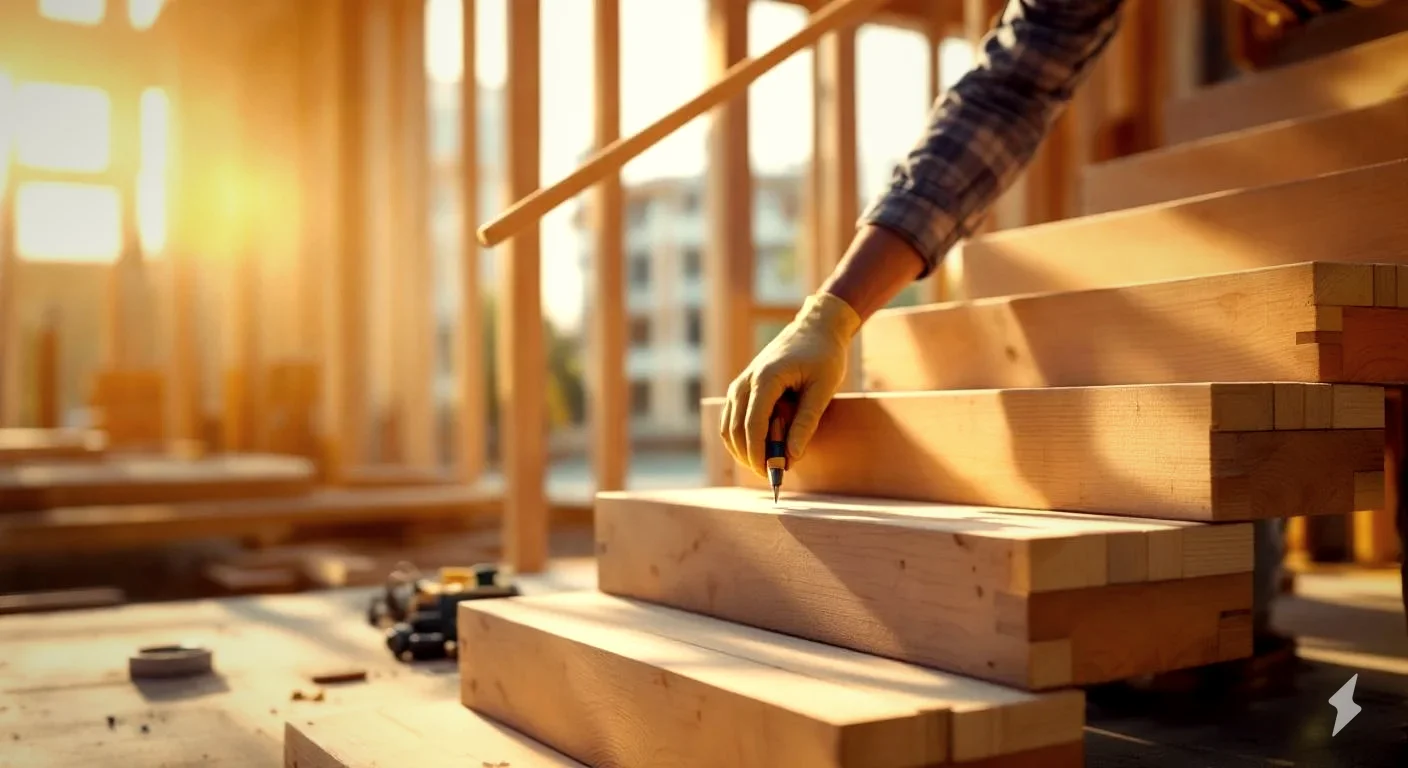
The framing square was hot in my hand. I had marked twelve stringers wrong before lunch because the rise math was off by 3/16 of an inch on a back deck in Tacoma. That tiny error compounds. By the seventh tread you are riding a wave instead of climbing a stair.
Stair stringers are not hard. The math is fifth-grade arithmetic. What kills most guys is sloppy measuring, code blind spots, and forgetting the tread thickness adjustment at the bottom. Walk through this guide once with a calculator, and you will lay out a clean stringer on the first try.
Try EstimationPro free for the whole bid. Use our Stair Stringer Calculator to nail the cut layout in under a minute.
Quick Answer
To calculate a stair stringer, divide total rise by 7 inches to get the number of risers, then divide total rise by that number for actual riser height. Multiply tread run (10-11 inches) by the number of treads (one less than risers) to get total run. Stringer length equals the hypotenuse of rise and run. Always trim one tread thickness off the bottom riser cut.
What You Need Before You Cut
- Total rise (finished floor to finished floor, vertical)
- Available run (horizontal space at the bottom of the stair)
- Tread material thickness (most decks use 5/4 or 2x, 1 inch or 1.5 inch)
- 2x12 stringer stock (pressure-treated for exterior, SPF for interior framing)
- Framing square with stair gauges
- Sharp pencil and a calculator
Code minimums vary by jurisdiction. The 2021 International Residential Code (IRC R311.7.5) caps riser height at 7-3/4 inches and sets minimum tread depth at 10 inches for residential stairs. Decks under the IRC follow the same rules. Always pull the local amendment before you cut. Some PNW cities run tighter on riser variation tolerance.
Step 1: Measure Total Rise From Finish to Finish
Pull a tape from the finished surface of the upper landing to the finished surface of the lower landing. If your bottom landing is concrete that has not been poured yet, set a string line where the slab top will be and measure to that. Get this wrong by half an inch and your top or bottom riser will be off code.
On a deck I framed in Gig Harbor, the homeowner had not poured the patio yet. I measured to dirt grade, the patio came in 2 inches high, and I had to scab a tread on the bottom to fix it. Lesson learned. Measure to where the finished surface will be, not where the dirt is today.
Step 2: Find Riser Count and Actual Riser Height
Take your total rise in inches and divide by 7. This gives you a target riser count. Round to the nearest whole number.
Then divide the total rise by that whole number. That is your actual riser height.
Example: Total rise = 56 inches.
- 56 / 7 = 8 risers
- 56 / 8 = 7.00 inches per riser
Clean. Every riser is identical. Code requires that the largest and smallest riser within a flight cannot vary by more than 3/8 inch. Most inspectors I have worked with want them dead even.
Step 3: Set Tread Run and Total Run
For most decks and interior stairs, use a 10-1/4 inch or 11 inch tread run. The tread overhangs the riser by 1 inch (the nosing) on most jobs, but the actual horizontal cut on the stringer is the run number, not the tread board width.
Number of treads is always one less than the number of risers because the top landing serves as the final “tread.”
Example continued: 8 risers means 7 treads.
- 7 treads x 10.5 inch run = 73.5 inches total run
You need 73.5 inches of horizontal space at the bottom of the stair plus the landing pad. If the homeowner only has 60 inches before the property line, you have a problem. Catch it at the design phase, not after the deck is framed.
Step 4: Calculate Stringer Length
Stringer length is the hypotenuse of a right triangle where the legs are total rise and total run.
Formula: Stringer length = sqrt(rise squared + run squared)
For our example:
- sqrt(56 squared + 73.5 squared) = sqrt(3136 + 5402) = sqrt(8538) = 92.4 inches
Add 12 inches for the top mounting tab and the bottom kicker cut. Buy 2x12 stock at 10 feet minimum, ideally 12 feet so you have room to lay out without scrap pressure. PT 2x12 in 10-foot lengths runs $35-$55 per board in 2026, depending on grade and region.
Step 5: Lay Out the Cuts With a Framing Square
Set your stair gauges on the framing square. One at the rise height on the tongue (the short leg), one at the run on the body (the long leg).
- Lay the 2x12 flat on horses with the crown up.
- Position the framing square with both gauges riding the top edge of the board.
- Trace the rise and run for the first step.
- Slide the square so the run line meets the next rise line. Trace.
- Repeat for every tread.
- The last cut is the kicker (bottom plate) cut, which is horizontal.
I check my layout by measuring the diagonal across all the rise marks. It should equal the stringer length you calculated in Step 4 within 1/16 inch.
Step 6: The Bottom Riser Adjustment Everyone Forgets
Here is where 80% of first-time stringers go sideways.
When you cut the stringer and stand it up on the bottom landing, the first tread sits on top of the stringer. That means the bottom riser ends up taller by the thickness of the tread stock.
Fix: Before you cut the bottom of the stringer, subtract the tread thickness from the bottom kicker cut.
If your tread is 5/4 PT (1 inch actual), trim 1 inch off the bottom. If your tread is 2x (1.5 inches actual), trim 1.5 inches off the bottom. This makes the top riser and bottom riser match all the others.
Miss this and the inspector will fail you on the 3/8 inch variation rule, every time.
Worked Example 1: 36-Inch Deck Stair (Backyard Deck)
A standard residential deck about 36 inches above grade.
- Total rise (deck top to patio): 36 inches
- 36 / 7 = 5.14, round to 5 risers
- 36 / 5 = 7.2 inches per riser
- 5 risers means 4 treads
- 4 x 10.5 inch run = 42 inches total run
- Stringer length = sqrt(36 squared + 42 squared) = sqrt(1296 + 1764) = sqrt(3060) = 55.3 inches
- Plus 12 inches buffer = buy 6-foot or 8-foot PT 2x12
- Bottom kicker cut: subtract 1.5 inches if using 2x6 PT treads
Material list:
- 3 stringers (one in the middle for 5/4 PT decking, two outside)
- 12 lineal feet of 2x6 PT for treads
- 1 box of structural screws or hot-dipped galvanized nails
- Joist hangers or a ledger to attach the stringer top
Pulling the framing budget together? Run the lumber list through our Board Foot Calculator so your takeoff and your bid line up.
Worked Example 2: 8-Foot Basement Stair (Interior)
Basement headroom usually drives this one. Total rise from basement slab to first-floor sheathing is often around 96-108 inches.
- Total rise: 104 inches
- 104 / 7 = 14.86, round to 15 risers
- 104 / 15 = 6.93 inches per riser
- 15 risers means 14 treads
- 14 x 10.5 inch run = 147 inches total run (12 feet 3 inches)
- Stringer length = sqrt(104 squared + 147 squared) = sqrt(10816 + 21609) = sqrt(32425) = 180.1 inches (15 feet)
- 2x12 SPF #2 in 16-foot lengths: about $40-$60 each. Need 3 stringers minimum, 4 if the run is over 36 inches wide.
Headroom check: IRC requires 6 feet 8 inches minimum headroom from the tread nosing line. If joists drop below the stair line, plan a landing or a winder.
Stringer Material Comparison
| Material | Use Case | Cost per LF (2026) | Span Limit |
|---|---|---|---|
| 2x12 SPF #2 | Interior dry framing | $2.50 - $4.00 | 13’-3” max stringer |
| 2x12 PT southern pine | Exterior decks | $3.50 - $5.50 | 13’-3” max stringer |
| 2x12 Cedar | Exposed exterior | $6.00 - $11.00 | 11’-0” max stringer |
| LVL stringer | Long span, commercial | $12.00 - $22.00 | 18’+ |
Source: HomeGuide 2026 lumber pricing, RSMeans 2026 residential framing. PT southern pine pricing tracks the BLS Producer Price Index for Softwood Lumber (WPU081) which rose roughly 8% year over year through Q1 2026.
Regional Pricing on a Set of Deck Stairs (Labor + Materials)
A typical 5-step deck stringer set, fabricated and installed, runs $300-$700 in materials and $200-$500 in labor at carpenter rates of $20-$45/hour (BLS 47-2031, May 2024 wage data). Regional swing is real:
| Metro | Adjustment vs National Average |
|---|---|
| New York City | +35% |
| San Francisco | +30% |
| Seattle / Pacific Northwest | +15% |
| Atlanta | -5% |
| Phoenix | -10% |
| Dallas | -8% |
Source: BLS regional construction wage data, RSMeans City Cost Index 2026. Pacific Northwest carpenters command a premium for wet-weather framing experience. Adjust your bid to your market.
Common Mistakes Even Experienced Carpenters Make
- Measuring to the wrong surface. Always measure finished floor to finished floor, not subfloor to subfloor.
- Forgetting the bottom riser adjustment. The single most common code fail on stairs.
- Crowding the layout. Mark from the top of the stringer down. Do not start from the middle and work both directions.
- Skimping on stringer count. Two stringers spans 36 inches max for 5/4 decking. Wider stairs need a center stringer. Composite decking with thin profiles often needs stringers 12 inches on center.
- Ignoring the headroom rule. A basement stair without 6 feet 8 inches of headroom will not pass. Catch it before you frame.
- Buying short stock. Run out of stringer length and you are scarfing a joint that the inspector will not like.
What Stringers Cost Per Step
Here is what to plug into your bid for materials and labor combined, based on residential remodel and deck jobs in 2026:
| Stair Type | Cost per Step (Materials + Labor) |
|---|---|
| Standard deck stringer (5 steps) | $80 - $140 |
| Interior basement framing stringer (no finish) | $100 - $170 |
| Pre-cut lumberyard stringer | $35 - $75 per stringer |
| Cedar or hardwood custom stringer | $200 - $400 per stringer |
| Steel stringer (commercial) | $300 - $800 per stringer |
Numbers include carpenter labor at $20-$45/hr, 2x12 stock, fasteners, and 1.5-2 hours layout time per stringer. Softwood prices move every quarter, so verify lumberyard quotes the week of your bid.
FAQ
How do you calculate the rise and run for stair stringers? Measure total vertical rise from finish surface to finish surface. Divide by 7 inches to find the riser count, then divide rise by that count for actual riser height. Multiply tread run (10-11 inches) by treads (one less than risers) for total run.
What is the formula for stair stringer length? Stringer length equals the square root of (total rise squared plus total run squared). For a 36 inch rise and 42 inch run, that is sqrt(1296 + 1764) = sqrt(3060) = about 55.3 inches.
How many stringers do I need for a stair? Standard residential stairs use stringers spaced at 16 to 18 inches on center. A 36 inch wide deck stair needs 3 stringers. A 48 inch wide stair needs 3-4. Composite decking with thin profiles often needs them 12 inches on center.
How do I price stair stringer fabrication for a customer? Most contractors charge $100-$250 per stringer fabricated and installed, depending on rise, length, and whether it is interior or exterior pressure-treated lumber. Add for steel hardware, kickers, and inspection rework if the design changes. Try EstimationPro free to build a full stair bid in minutes with line-item labor and material breakdown.
Do I need a permit to build stairs? Permits depend on the project. New deck stairs over 30 inches above grade in most jurisdictions trigger a permit. Interior remodels that change the stair layout almost always need one. Residential building permits run $500-$3,000, typically 0.5-2% of project value per the IRC. Pull the local code before you cut.
Can I use a stair calculator instead of doing the math manually? Yes, and most contractors do for everything except quick field checks. Punch your rise and run into our Stair Stringer Calculator and you get cut marks, stringer length, and a material list in under a minute.
Pricing Disclaimer
All prices in this guide are 2026 ranges based on national averages from HomeGuide, Angi, RSMeans 2026, and BLS wage data. Lumber pricing tracks the BLS Producer Price Index and can swing 10-20% in a quarter. Regional labor rates vary widely. Always verify local material costs and labor rates before locking in your bid.
How EstimationPro Helps Carpenters Bid Stair Work Faster
Most of my bids used to run an hour or longer. Stair math, deck framing, and fastener counts came from different reference books and spreadsheets. The accuracy was fine. The time was killing me.
Now I shoot a photo of the deck site, type “build a 5-step deck stringer set with PT 2x6 treads,” and the estimate comes back with line-item materials, labor hours, and a regional pricing adjustment for the Pacific Northwest in about 90 seconds. EstimationPro doesn’t just build the stair stringer estimate, it generates a clean proposal you can send to the homeowner the same day, kicks off an automated follow-up sequence so the bid does not sit cold in their inbox, and invoices and accepts payment when the job is done. Contractors using EstimationPro save 2+ hours per bid on average, based on my own field-tested workflow running Pacific Remodeling for 20+ years. Try EstimationPro free and see how much time you get back.
Pricing a job like this?
Get every line item priced for your area in a full estimate
Describe the job or snap a few photos. Send it from EstimationPro and it follows up with your client for you.
3 free estimates in the first 7 days. No credit card.
Get Free Estimating Tips
Enter your email and we'll send you pro tips, cost data, and useful resources for contractors.
We'll send helpful resources and occasional tips. Unsubscribe anytime.
 EstimationPro AI For Contractors, By Contractors
 Save 2+ Hours on Every Estimate
Upload photos, record voice notes, and get AI-powered estimates with line items, material lists, and regional pricing.