
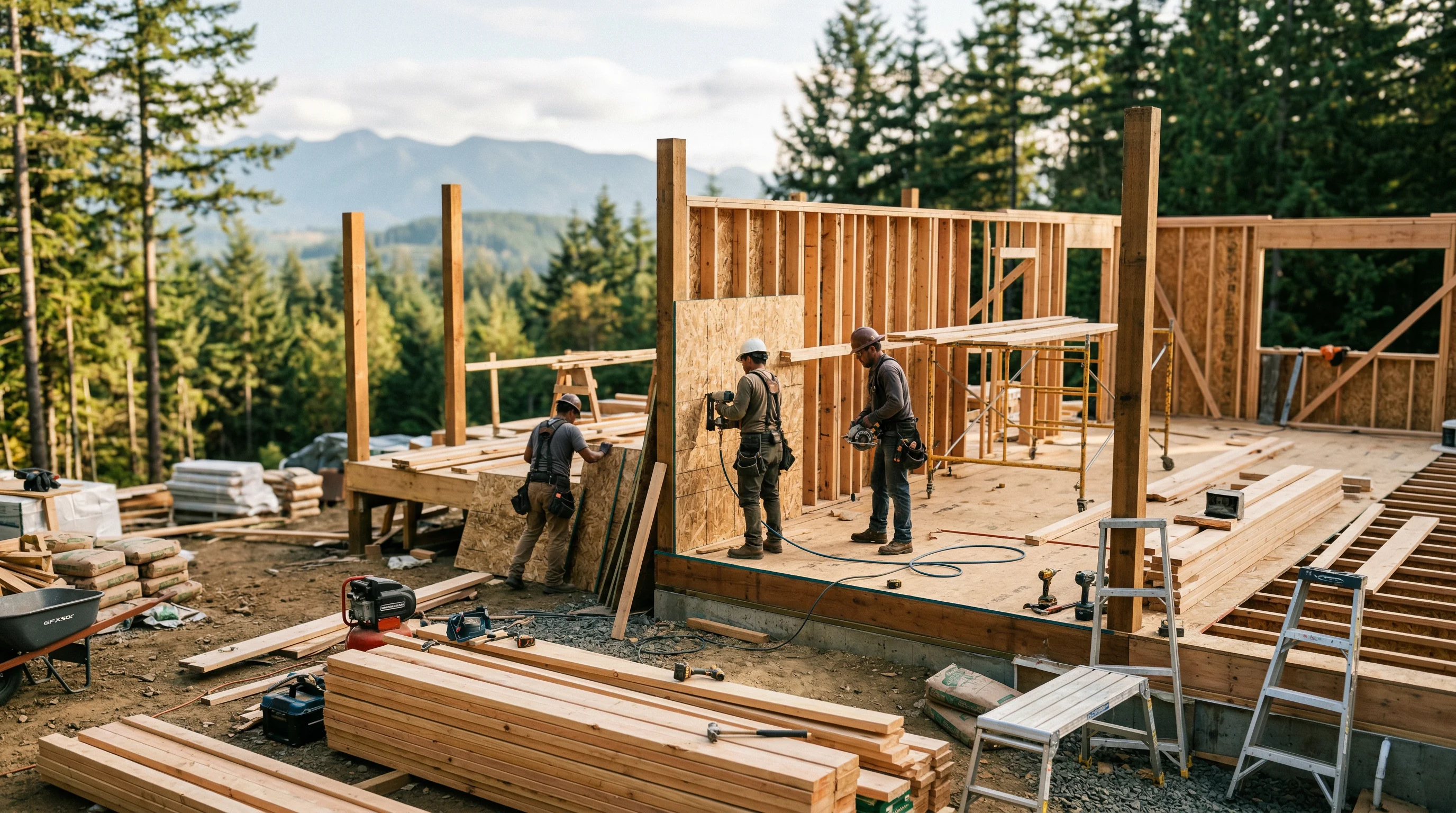
$163,000. That’s what a 1,500 sq ft home addition came in at last year after we ran a full detailed estimate. The homeowner expected $80,000. The gap between what people think construction costs and what it actually costs comes down to one thing: how the estimate was built.
Bad estimates lose money. Good estimates win profitable work. The difference is your method.
In this guide, I’ll break down the four cost estimation methods used in building construction, show you when each one works best, and walk through real numbers so you can apply them on your next project. Try EstimationPro free to build detailed construction estimates with line-item accuracy in minutes.
Quick Answer: How Do You Estimate Building Construction Costs?
Construction cost estimation uses four primary methods: per-square-foot ($150-$400/sf for residential), unit cost (pricing each component individually), assemblies (grouping related items like “framing package”), and detailed estimation (full line-item takeoff with labor, materials, and subs). The right method depends on the project stage. Early planning uses square-foot estimates. Bidding requires detailed takeoffs. Most contractors use a combination of all four.
The Four Construction Cost Estimation Methods
Every construction estimate falls into one of four categories. Each has a place, and each has a margin of error you need to understand before you hand a number to a client.
Method 1: Per-Square-Foot Estimation
Best for: Early-stage budgeting, feasibility checks, ballpark conversations with clients.
Accuracy: +/- 25-40%
This is the roughest method, but it’s the one homeowners ask about first. “How much per square foot?” The answer depends on the building type, finish level, and your market.
| Building Type | Low ($/sf) | High ($/sf) | Typical ($/sf) |
|---|---|---|---|
| Basic residential (spec home) | $150 | $250 | $200 |
| Mid-range residential (custom) | $200 | $350 | $275 |
| High-end residential | $300 | $500+ | $400 |
| Light commercial (office/retail) | $175 | $400 | $250 |
| Garage/shop (detached) | $50 | $150 | $90 |
Source: RSMeans 2026 square foot cost data, adjusted for national averages. Regional variation can swing these numbers 15-30% in either direction.
The problem with square-foot pricing: it hides everything. A $200/sf house and a $200/sf house can look completely different depending on what’s included. Foundation type, roof complexity, fixture allowances, site work - none of that shows up in a single number.
Use this method to set expectations early. Never use it as your bid.
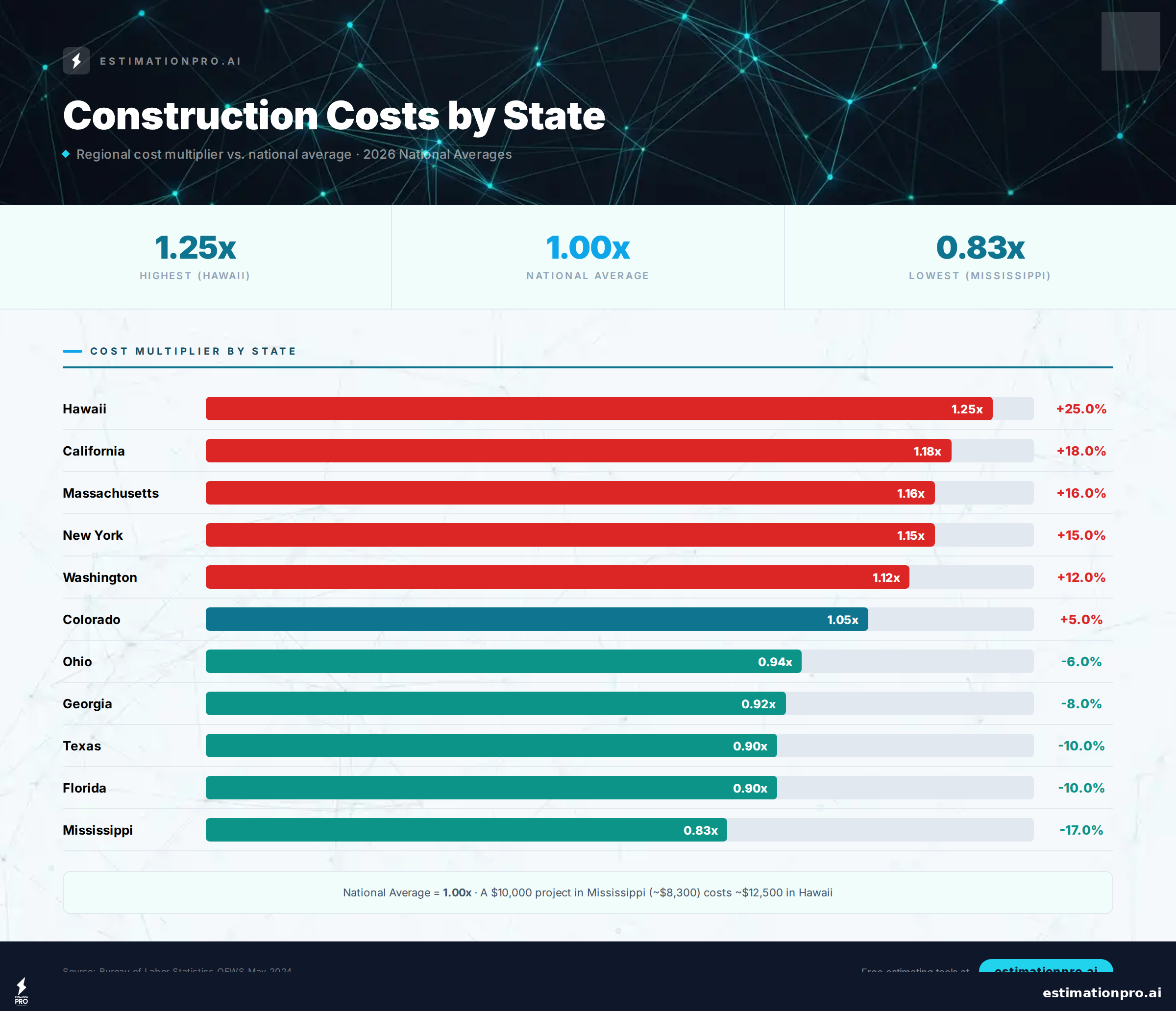
Share This Infographic
Feel free to share this infographic on your website. Just copy the embed code below:
Copy this embed code:
<a href="https://estimationpro.ai/tools/blog/cost-estimation-building-construction" target="_blank" rel="noopener">
  <img src="https://estimationpro.ai/tools/blog/infographics/cost-estimation-building-construction-infographic.png" alt="cost estimation building construction infographic by EstimationPro.AI" style="max-width:100%;height:auto" loading="lazy" />
</a>
<p style="font-size:12px;color:#64748B;margin-top:8px">Source: <a href="https://estimationpro.ai/tools/blog/cost-estimation-building-construction">EstimationPro.AI</a></p>
Method 2: Unit Cost Estimation
Best for: Comparing material options, pricing individual line items, quick cost checks.
Accuracy: +/- 10-20%
Unit cost estimation prices each component separately. You know you need 47 sheets of drywall at $16 each. You need 2,400 sq ft of framing labor at $4-$8 per square foot. Each item gets its own line.
This is where a pricing database pays for itself. When you know your unit costs are current, your estimates tighten up fast. Here are some common unit costs for 2026:
| Item | Unit | Low | High | Typical |
|---|---|---|---|---|
| General laborer | hour | $15 | $35 | $22 |
| Carpenter | hour | $20 | $45 | $30 |
| GC billing rate | hour | $50 | $150 | $90 |
| Building permit (residential) | project | $500 | $3,000 | $1,200 |
| Dumpster rental | week | $300 | $700 | $475 |
Sources: BLS Occupational Employment Statistics (47-2061, 47-2031) May 2024, HomeGuide 2026 contractor rate surveys, Angi 2026 cost guides.
The strength of unit cost estimation is transparency. Your client can see exactly what they’re paying for. The weakness is that it takes longer to build and requires accurate production rates.
Method 3: Assemblies Estimation
Best for: Repetitive construction, tract housing, projects with standardized components.
Accuracy: +/- 10-15%
Assemblies group related items into packages. Instead of pricing studs, plates, nails, headers, sheathing, and labor separately, you price “exterior wall framing” as a single assembly per linear foot or per square foot of wall area.
Common assemblies in residential construction:
- Exterior wall (framed, sheathed, insulated): $12-$25 per sq ft of wall area
- Interior partition (framed, drywalled both sides): $8-$18 per sq ft
- Roof system (trusses, sheathing, underlayment): $6-$14 per sq ft of roof area
- Foundation (slab on grade, 4”): $6-$12 per sq ft of floor area
The advantage: speed. Once you’ve built your assembly library, estimating becomes a matter of measuring quantities and plugging in packages. RSMeans publishes assembly costs annually, and experienced contractors build their own from completed project data.
The risk: assemblies assume standard conditions. When you hit an oddball situation - an unusual roof pitch, a custom foundation, a wall with 15 penetrations - the assembly breaks down and you need to go line-by-line.
Method 4: Detailed Estimation (Full Takeoff)
Best for: Final bids, negotiated contracts, any project where accuracy matters more than speed.
Accuracy: +/- 3-10%
This is the gold standard. Every material, every labor hour, every sub bid, every permit fee gets its own line item. A detailed estimate for a $150,000 residential project might have 200-400 line items.
Here’s what a detailed takeoff includes:
- Material quantities from plan takeoff (measured, not guessed)
- Labor hours calculated from production rates (e.g., a carpenter hangs 25 sheets of drywall per day)
- Subcontractor quotes (minimum 2-3 bids per trade)
- Equipment costs (rental, fuel, delivery fees)
- Permits and inspections ($500-$3,000 for residential, based on project value)
- Overhead (insurance, office, truck, tools, warranty - typically 10-15% of direct costs)
- Profit margin (10-20% depending on market and risk)
This method catches things that square-foot and assembly methods miss: the extra blocking for a heavy mirror, the upgraded electrical panel, the 3 trips to the dump for demo debris. It’s the method that separates contractors who make money from contractors who wonder where it went.
Use our construction cost estimator to build a detailed estimate with accurate line-item pricing.
Worked Example 1: Bathroom Remodel ($28,500)
Let’s walk through a real estimate using a combination of unit cost and detailed methods for a mid-range bathroom remodel (5’ x 8’ hall bath, gut and rebuild):
| Line Item | Quantity | Unit Cost | Total |
|---|---|---|---|
| Demo (gut existing bath) | 40 sf | $4.00/sf | $160 |
| Dumpster (1 week) | 1 | $475 | $475 |
| Rough plumbing (sub) | 1 lot | $3,200 | $3,200 |
| Electrical (sub) | 1 lot | $1,800 | $1,800 |
| Framing/blocking | 8 hrs | $30/hr | $240 |
| Cement board + waterproofing | 40 sf | $4.50/sf | $180 |
| Tile (floor + shower walls) | 120 sf | $14/sf installed | $1,680 |
| Vanity + top (installed) | 1 | $1,200 | $1,200 |
| Toilet (installed) | 1 | $450 | $450 |
| Shower valve + trim (installed) | 1 | $650 | $650 |
| Paint | 1 lot | $400 | $400 |
| Trim + accessories | 1 lot | $350 | $350 |
| Permit | 1 | $500 | $500 |
| Direct costs | $11,285 | ||
| Overhead (15%) | $1,693 | ||
| Profit (15%) | $1,947 | ||
| Total to client | $14,925 |
Wait - I said $28,500. That’s because the homeowner also wanted the floor plan reconfigured, a custom shower niche, heated floors, and a frameless glass enclosure. Each of those “while we’re at it” items nearly doubled the price. This is why detailed estimates matter. You catch the scope before the scope catches you.
Worked Example 2: Detached Garage Build ($47,000)
A 24’ x 24’ detached garage (576 sf), slab on grade, standard 8’ walls, one overhead door, one man door, basic electrical:
| Category | Method | Cost |
|---|---|---|
| Site prep + excavation | Sub bid | $2,800 |
| Concrete slab (576 sf x $8/sf) | Unit cost | $4,600 |
| Framing package (walls + trusses) | Assembly | $8,500 |
| Roofing (asphalt shingles) | Assembly | $3,800 |
| Siding (vinyl, basic) | Assembly | $3,200 |
| Overhead door (16’ insulated) | Unit | $2,400 |
| Man door (steel, installed) | Unit | $650 |
| Electrical (sub) | Sub bid | $3,500 |
| Drywall (optional, walls only) | Unit cost | $2,100 |
| Concrete apron + driveway tie-in | Unit cost | $1,800 |
| Permit | Flat fee | $1,200 |
| Direct costs | $34,550 | |
| O&P (25%) | $8,638 | |
| Contingency (10%) | $3,455 | |
| Total estimate | $46,643 |
Notice the contingency line. On new construction, 10% contingency is standard practice. On remodeling, I bump it to 15-20% because you never know what’s hiding behind existing walls.
Sources: Pricing based on BLS labor rates, RSMeans 2026 assembly costs, and field experience in the Pacific Northwest. Your region may vary 15-30%.
Common Cost Estimation Mistakes
These are the ones that cost real money. I’ve made every one of them, and I’ve learned the hard way.
1. Skipping the Site Visit
Plans don’t tell you everything. The grade, access for deliveries, proximity to the neighbor’s fence, overhead power lines - all of these affect cost and none of them show up on the blueprint. Walk the site before you estimate. Every time.
2. Using Last Year’s Prices
Material prices shift. Lumber alone has swung 40% in a single year. Your pricing database needs to be current, not “close enough.” Check supplier quotes on any material that makes up more than 10% of the job cost.
3. Forgetting Labor Burden
A carpenter making $30/hr doesn’t cost you $30/hr. Add FICA (7.65%), workers comp (8-15% depending on trade and state), unemployment insurance, PTO, and benefits. The real cost is 30-40% higher than the base wage. That’s $39-$42/hr for your $30 carpenter. Miss this, and your profit disappears.
Source: NAHB builder cost survey 2024, BLS employer cost data.
4. Underpricing Overhead
Your truck, insurance, tools, phone, office, accounting, marketing - that all has to come from somewhere. The industry standard for overhead is 10-15% of direct project costs. Some contractors bake it into their labor rate. Others add it as a separate line. Either way, if you’re not accounting for it, you’re subsidizing your clients.
5. Bid Shopping Your Own Subs
Getting competitive sub quotes is smart. Beating up your best subs on price until they cut corners is not. A reliable plumber at $3,200 is worth more than an unknown at $2,600 who might not show up. Your estimate is only as good as the people executing it.
Pro Tips for Better Construction Estimates
- Build a pricing library. Every completed job is data. Track what you estimated vs. what you actually spent. Over time, your estimates get tighter because you’re working from real numbers, not guesses.
- Get three sub bids minimum. One bid tells you nothing. Two bids tell you there’s a range. Three bids tell you the market rate.
- Add contingency based on project type. New construction: 5-10%. Remodeling: 15-20%. Historic renovation: 20-25%. The older and more unknown the building, the higher the contingency.
- Review the scope with the client before pricing. Misunderstandings about scope are the #1 cause of change orders. A 30-minute scope review saves thousands in disputes.
- Use software that tracks it. Spreadsheets work until they don’t. When you’re juggling 5 jobs and 20 sub bids, you need a system that keeps everything organized and catches missed line items.
Check out our construction estimate template for a ready-to-use format that covers all the categories above.
Which Estimation Method Should You Use?
| Project Stage | Recommended Method | Why |
|---|---|---|
| Initial client conversation | Per-square-foot | Sets rough expectations fast |
| Design development | Assemblies | Quick enough for revisions |
| Final bid / contract | Detailed takeoff | Catches everything, protects profit |
| Change orders | Unit cost | Prices individual items clearly |
| Budget tracking | Detailed + actuals | Compares estimate to real spend |
Most experienced contractors use all four methods throughout a single project. The early conversation is square-foot. The preliminary budget uses assemblies. The final bid is detailed. And change orders get unit-priced on the spot.
Frequently Asked Questions
What is the most accurate construction estimating method?
Detailed estimation (full takeoff) is the most accurate method, typically within 3-10% of actual costs. It requires measuring every material quantity from plans, calculating labor hours from production rates, and collecting sub bids for each trade. It takes the most time but catches scope items that other methods miss.
How much does it cost to build per square foot in 2026?
Residential construction in 2026 runs $150-$400+ per square foot depending on finish level, building type, and location. A basic spec home averages around $200/sf nationally. Custom homes with upgraded finishes run $275-$350/sf. High-end custom work exceeds $400/sf. These figures include labor, materials, permits, and contractor overhead and profit.
What percentage should I add for overhead and profit?
The industry standard for overhead and profit (O&P) is 15-35%, with 25% being typical for residential contractors. Overhead covers your fixed business costs (insurance, truck, tools, office, accounting), while profit is your actual take-home. NAHB data shows the average builder net profit margin is 8-12% after overhead, so the total O&P markup needs to cover both.
How do I estimate labor costs for construction?
Start with the base hourly wage, then add 30-40% for labor burden (FICA, workers comp, unemployment, benefits). A carpenter at $30/hr really costs $39-$42/hr fully burdened. Multiply the burdened rate by estimated hours based on production rates. For example, a carpenter installs roughly 25 sheets of drywall per 8-hour day. Use our burdened labor rate calculator to get precise labor costs.
Should I include contingency in my estimate?
Yes. Always include contingency. The amount depends on project type and risk level. New construction: 5-10%. Standard remodeling: 15-20%. Gut renovation of older buildings: 20-25%. Contingency isn’t padding your estimate. It’s accounting for the unknowns that always show up once work begins, like rot behind walls, outdated wiring, or soil conditions that require deeper footings.
Build Better Estimates, Win More Work
The contractors who stay profitable aren’t necessarily the best builders. They’re the best estimators. They know their costs, they account for the hidden stuff, and they price jobs so there’s room to do quality work without losing money.
EstimationPro doesn’t just help you build the estimate. It sends the proposal automatically, then follows up with the homeowner on a schedule so you win more of the bids you already send. The full workflow - estimate, proposal, follow-up, invoice, paid - runs from one platform. No more spreadsheets, no more forgotten follow-ups, no more leaving money on the table.
Try EstimationPro free and see how fast you can go from takeoff to signed contract.
Pricing a job like this?
Get every line item priced for your area in a full estimate
Describe the job or snap a few photos. Send it from EstimationPro and it follows up with your client for you.
3 free estimates in the first 7 days. No credit card.
Typical Residential Construction Cost Breakdown
Get Free Estimating Tips
Enter your email and we'll send you pro tips, cost data, and useful resources for contractors.
We'll send helpful resources and occasional tips. Unsubscribe anytime.
 EstimationPro AI For Contractors, By Contractors
 Save 2+ Hours on Every Estimate
Upload photos, record voice notes, and get AI-powered estimates with line items, material lists, and regional pricing.