
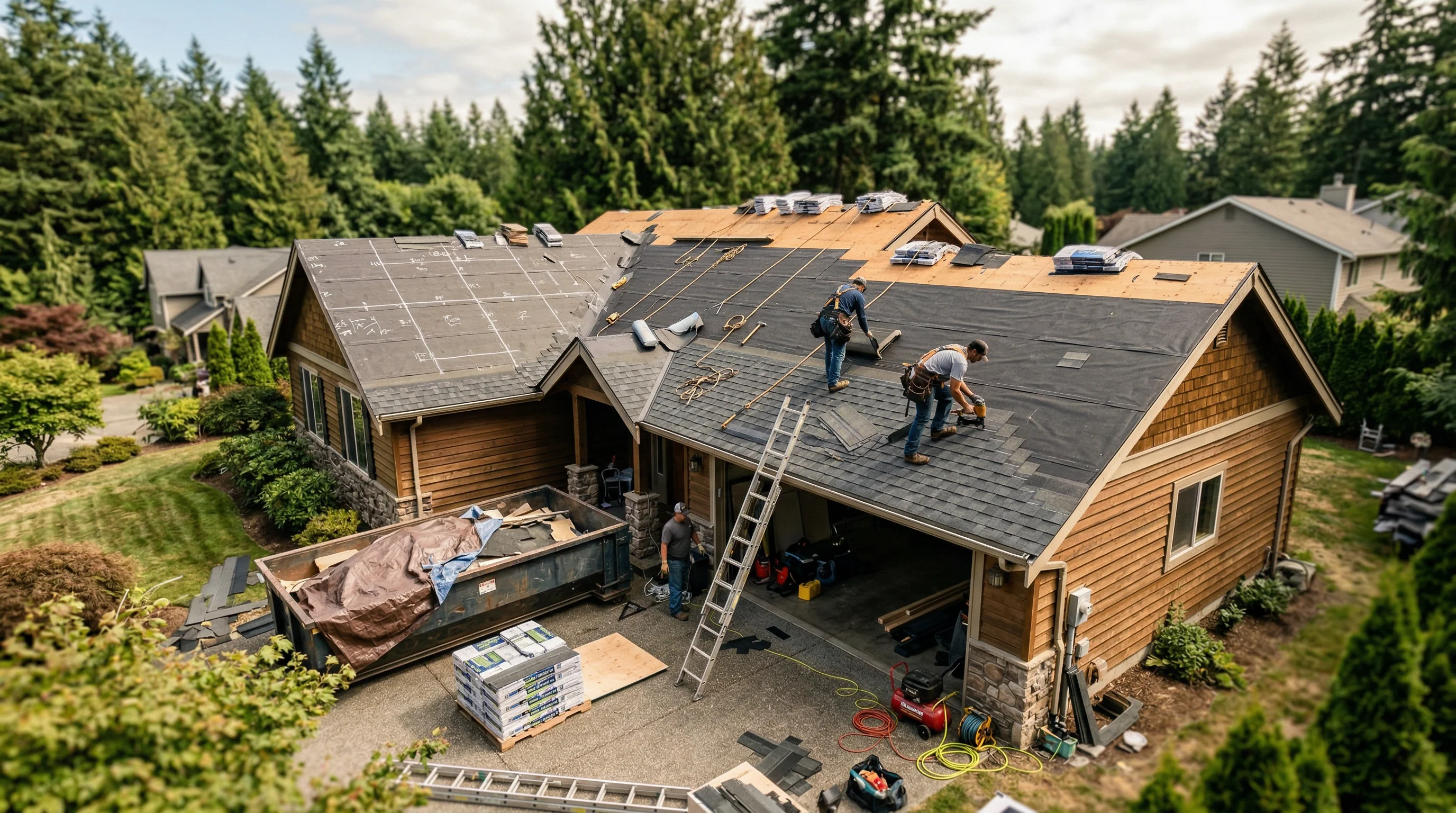
17 squares. That’s the average residential roof in the U.S., and if that number means nothing to you, you’re about to order the wrong amount of shingles.
A roofing “square” is one of those trade terms that trips up homeowners and new contractors alike. Get it wrong and you’re either making a second trip to the supply house or sending back pallets you didn’t need. Either way, it costs you time and money.
Here’s how to calculate roof squares accurately so your material order is right the first time.
Quick Answer: What Is a Roofing Square?
One roofing square equals 100 square feet of roof area. To estimate your roof in squares, measure the total roof surface area (accounting for pitch), then divide by 100. A typical 1,500 SF home with a 6/12 pitch has roughly 17 squares. Add 10-15% for waste, and that’s your material order.
Try EstimationPro free to build a full roofing estimate with labor, materials, and waste calculated automatically.
Why Roofing Squares Matter
Every roofing material you order is priced and sold by the square. Shingle bundles, underlayment rolls, starter strips, ridge caps - all of it ties back to how many squares your roof is.
Here’s what you’re ordering per square:
- Shingles: 3 bundles per square (for standard 3-tab or architectural)
- Underlayment: 1 roll of synthetic covers about 10 squares
- Ice and water shield: typically 2 squares along eaves
- Ridge cap shingles: sold separately, roughly 33 linear feet per bundle
- Starter strip: 1 bundle covers about 100-120 linear feet of eave
If you underestimate by even 2 squares, that’s 6 bundles of shingles you don’t have on the roof when your crew is ready to nail. If you overestimate by 5 squares, you’re sitting on $500-$1,250 in material you need to return (Angi, 2026 roofing material pricing).
Step-by-Step: How to Estimate Roof Squares
Step 1: Measure the Roof Footprint
Start with the ground-level footprint of your roof. This is the area your roof covers when viewed from directly above, not the actual surface area.
For a simple gable roof, measure the length and width of the building including the overhang (typically 12-18 inches on each side).
Example: A ranch home measures 50 feet long by 30 feet wide with 1-foot overhangs on all sides.
- Adjusted length: 50 + 2 = 52 feet
- Adjusted width: 30 + 2 = 32 feet
- Footprint: 52 x 32 = 1,664 square feet
For complex roofs with multiple sections, break it into rectangles and triangles. Measure each section separately and add them together.
Step 2: Determine the Roof Pitch
Roof pitch is the slope expressed as rise over run. A 6/12 pitch means the roof rises 6 inches for every 12 inches of horizontal run. Steeper roofs have more surface area than the footprint suggests.
You can measure pitch three ways:
- From the attic: Hold a level horizontally against a rafter, measure 12 inches along the level, then measure the vertical distance from that point down to the level. That vertical measurement is your rise.
- From the ground: Use a pitch gauge app on your phone or estimate by eye using a known reference.
- From plans: Check the original building drawings if available.
Common residential pitches range from 4/12 (low slope) to 12/12 (steep, 45-degree angle). Most homes fall between 4/12 and 8/12.
Step 3: Apply the Pitch Multiplier
This is the step most people skip, and it’s where estimates go wrong. The pitch multiplier converts your flat footprint into actual roof surface area.
| Roof Pitch | Multiplier | Extra Area vs. Flat |
|---|---|---|
| 3/12 | 1.031 | +3.1% |
| 4/12 | 1.054 | +5.4% |
| 5/12 | 1.083 | +8.3% |
| 6/12 | 1.118 | +11.8% |
| 7/12 | 1.158 | +15.8% |
| 8/12 | 1.202 | +20.2% |
| 9/12 | 1.250 | +25.0% |
| 10/12 | 1.302 | +30.2% |
| 12/12 | 1.414 | +41.4% |
These multipliers come from the Pythagorean theorem applied to the roof triangle. The formula is: multiplier = √(rise² + 12²) / 12 (National Roofing Contractors Association measurement standards).
To get actual roof area: Footprint × Pitch Multiplier = Roof Surface Area
Step 4: Divide by 100
Take your total roof surface area and divide by 100. That gives you the number of roofing squares.
Roof Surface Area ÷ 100 = Roofing Squares
Step 5: Add Waste Factor
No roof gets covered with zero waste. You’ll have cuts at hips, valleys, rakes, and around penetrations like vents, skylights, and chimneys. The more complex the roof, the more waste.
| Roof Complexity | Waste Factor | When to Use |
|---|---|---|
| Simple gable | 10% | Straight runs, few penetrations |
| Cross gable | 12-13% | Multiple ridgelines |
| Hip roof | 15% | Cuts at every hip line |
| Complex/cut-up | 18-20% | Dormers, valleys, multiple levels |
Final order = Squares × (1 + Waste Factor)
Worked Example 1: Simple Gable Roof
A 1,500 SF ranch home with a simple gable roof and a 6/12 pitch. Two plumbing vents, no skylights.
| Step | Calculation | Result |
|---|---|---|
| Footprint (with 1’ overhangs) | 52’ × 32’ | 1,664 SF |
| Pitch multiplier (6/12) | 1,664 × 1.118 | 1,860 SF |
| Divide by 100 | 1,860 ÷ 100 | 18.6 squares |
| Waste factor (10% simple gable) | 18.6 × 1.10 | 20.5 squares |
| Material order | Round up | 21 squares |
Material order for 21 squares:
- Shingles: 63 bundles (3 per square)
- Underlayment: 3 rolls synthetic
- Starter strip: 3 bundles (168 LF of eave/rake)
- Ridge cap: 2 bundles (52 LF of ridge)
At architectural shingle pricing of $100-$250 per square for materials, you’re looking at $2,100-$5,250 in shingle costs alone (Angi 2026 roofing material pricing).
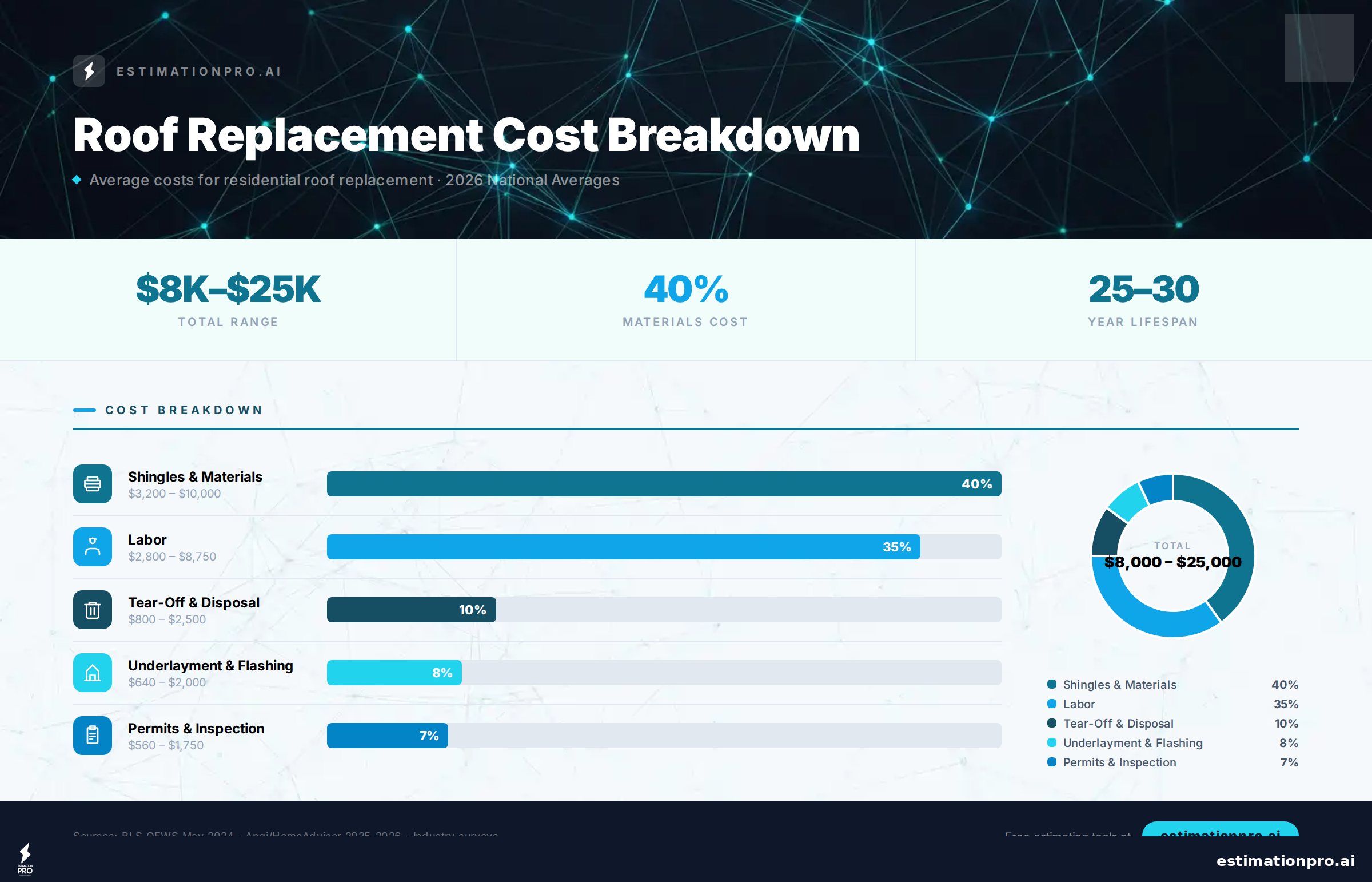
Share This Infographic
Feel free to share this infographic on your website. Just copy the embed code below:
Copy this embed code:
<a href="https://estimationpro.ai/tools/blog/estimate-roof-squares" target="_blank" rel="noopener">
  <img src="https://estimationpro.ai/tools/blog/infographics/estimate-roof-squares-infographic.png" alt="estimate roof squares infographic by EstimationPro.AI" style="max-width:100%;height:auto" loading="lazy" />
</a>
<p style="font-size:12px;color:#64748B;margin-top:8px">Source: <a href="https://estimationpro.ai/tools/blog/estimate-roof-squares">EstimationPro.AI</a></p>
Worked Example 2: Complex Hip Roof
A two-story colonial, 2,400 SF footprint, hip roof with an 8/12 pitch, 2 dormers, and a chimney.
| Step | Calculation | Result |
|---|---|---|
| Footprint (with overhangs) | 54’ × 46’ | 2,484 SF |
| Pitch multiplier (8/12) | 2,484 × 1.202 | 2,986 SF |
| Divide by 100 | 2,986 ÷ 100 | 29.9 squares |
| Dormer additions | +3 squares (estimated) | 32.9 squares |
| Waste factor (18% complex) | 32.9 × 1.18 | 38.8 squares |
| Material order | Round up | 39 squares |
That same roof with architectural shingles at $400-$700 per square installed runs $15,600-$27,300 for the total job (HomeAdvisor 2025 installed pricing).
Use our Roofing Calculator to plug in your measurements and get a detailed material and cost breakdown.
Common Roof Sizes by House Type
Not sure where your home falls? Here are typical square counts based on house style.
| House Type | Typical Footprint | Common Pitch | Estimated Squares |
|---|---|---|---|
| Ranch (1,200 SF) | 1,200 SF | 4/12-6/12 | 14-16 |
| Ranch (1,800 SF) | 1,800 SF | 4/12-6/12 | 21-24 |
| Cape Cod | 900-1,200 SF | 8/12-12/12 | 14-20 |
| Colonial (2-story) | 1,200-1,500 SF | 6/12-8/12 | 16-22 |
| Split-level | 1,000-1,400 SF | 4/12-6/12 | 12-18 |
These are estimates. Always measure your actual roof rather than relying on house square footage alone, because overhangs, additions, and attached garages change the real footprint.
Pro Tips: Avoid These Measurement Mistakes
1. Forgetting the overhangs. The roof extends past the walls by 12-18 inches on most homes. On a 50-foot wall, that’s an extra 8-12 square feet per side. Skip the overhangs and you’re short on material.
2. Using floor square footage instead of footprint. A two-story home with 2,400 SF of living space might only have a 1,200 SF roof footprint. The second floor sits under the same roof. This mistake doubles your material order.
3. Skipping the pitch multiplier. On a 6/12 roof, ignoring pitch costs you nearly 12% of your material order. On a 10/12 roof, you’re 30% short. That’s the difference between finishing the job and sending someone to the supply house mid-project.
4. Using the same waste factor for every roof. A simple gable with straight runs wastes 10%. A cut-up hip roof with dormers and valleys can waste 20%. Using 10% on a complex roof guarantees you run short.
5. Not counting penetrations. Skylights, chimneys, plumbing vents, and HVAC curbs all create waste from cuts and flashing work. Count every penetration before finalizing your order.
How Roof Pitch Affects Your Budget
Pitch doesn’t just change your material quantity. It changes labor cost too. Steeper roofs are harder to work on, require additional safety equipment, and slow down production rates.
According to BLS data (Occupational Employment and Wages, 47-2181 Roofers, May 2024), the median roofer earns roughly $23 per hour. But steep-pitch work commands premium rates because crews move slower and the fall risk increases.
| Pitch Range | Labor Premium | Why |
|---|---|---|
| 4/12-6/12 | Standard rate | Walk-able, standard production |
| 7/12-9/12 | +15-25% | Toe boards or brackets needed |
| 10/12-12/12 | +25-50% | Full harness/rope required, slow going |
A 30-square roof at standard roofing labor rates of $150-$500 per square costs $4,500-$15,000 in labor (HomeAdvisor 2025). Bump that to a steep pitch and you could add $1,000-$7,500 to the labor line.
Check out our Roof Pitch Calculator to find your exact pitch and multiplier.
Quick Reference: The Roof Square Formula
Here’s the complete formula on one line:
Squares = (Footprint SF × Pitch Multiplier ÷ 100) × (1 + Waste %)
Or broken down:
- Measure footprint in square feet (include overhangs)
- Multiply by pitch factor from the table above
- Divide by 100
- Multiply by 1.10 to 1.20 depending on complexity
- Round up to the nearest whole number
That final number is how many squares of material to order.
FAQ
How many bundles of shingles is one square?
Three bundles of standard 3-tab or architectural shingles cover one roofing square (100 SF). Some heavier designer shingles require 4-5 bundles per square. Check the manufacturer’s coverage specs printed on each bundle wrapper.
Can I estimate roof squares from Google Earth?
You can get a rough footprint measurement from satellite imagery, but you still need the pitch to calculate actual surface area. Satellite gives you a bird’s-eye view, which is the flat footprint only. Without applying the pitch multiplier, you’ll underestimate by 5-40% depending on steepness. Tools like our Roofing Calculator let you input both footprint and pitch for an accurate count.
What’s the difference between a roofing square and a square foot?
One roofing square equals 100 square feet. Roofing materials are priced and packaged in squares because it simplifies large-area calculations. Instead of saying “I need 2,100 square feet of shingles,” you say “I need 21 squares.” It also standardizes pricing. When a supplier quotes $100-$250 per square for architectural shingles, that means $1.00-$2.50 per square foot.
Should I round up or down when ordering?
Always round up. If your calculation shows 18.3 squares, order 19. Running short mid-job means your crew sits idle while you wait on delivery, and the replacement bundle might be from a different dye lot, which creates a visible color mismatch on the finished roof.
How do I estimate squares for a roof with dormers?
Measure each dormer face separately. A typical shed dormer adds 1-3 squares depending on size. A gable dormer adds 0.5-2 squares. Add these to your main roof calculation before applying the waste factor. Dormers also increase your waste percentage because of the extra cuts at the dormer-to-main-roof transitions.
Get Accurate Roofing Estimates in Minutes
Calculating squares by hand works, but it’s slow when you’re bidding multiple jobs a week. EstimationPro handles the math automatically. Plug in your measurements, select the roof type, and get detailed, priced line items with labor costs. It builds the proposal too, and follows up with the homeowner so you’re not chasing callbacks. Try EstimationPro free and get your next roofing estimate done in minutes instead of hours.
Pricing varies by region, material availability, and market conditions. The figures in this guide reflect 2026 national averages. Always get local quotes for your area.
Pricing a job like this?
Get every line item priced for your area in a full estimate
Describe the job or snap a few photos. Send it from EstimationPro and it follows up with your client for you.
3 free estimates in the first 7 days. No credit card.
Roofing Material Cost per Square (100 SF Installed)
- Flat appearance
- 15-20 year warranty
- Lightest weight
- Lowest wind rating
- Dimensional look
- 30-50 year warranty
- Better wind resistance
- Most popular choice
- Standing seam or corrugated
- 40-70 year lifespan
- Highest wind/fire rating
- Premium curb appeal
Get Free Estimating Tips
Enter your email and we'll send you pro tips, cost data, and useful resources for contractors.
We'll send helpful resources and occasional tips. Unsubscribe anytime.
 EstimationPro AI For Contractors, By Contractors
 Save 2+ Hours on Every Estimate
Upload photos, record voice notes, and get AI-powered estimates with line items, material lists, and regional pricing.