
$400 per square. That’s what the typical metal roofing material runs before you add labor, and most homeowners hear that number and immediately think it’s too expensive. But here’s the thing they don’t consider: that metal roof will still be keeping water out 50 years from now while your neighbor is on their third set of asphalt shingles.
I’ve installed metal roofs and asphalt roofs. When a homeowner asks me which is better, my answer is always the same - it depends on how long you plan to stay in the house.
Quick Answer: What Do Metal Roof Shingles Cost?
Metal roof shingles cost $120 to $900 per square for materials only, depending on the type, gauge, and finish. Installed costs range from $4 to $30 per square foot, which puts a typical 2,000 sq ft roof between $8,000 and $60,000. Most residential metal shingle projects land in the $15,000 to $25,000 range for a standard home. Corrugated panels are the most affordable option, while standing seam and copper sit at the premium end.
Try EstimationPro free to build a complete metal roofing estimate with materials, labor, and tear-off costs in minutes.
Metal Roofing Material Costs by Type
Not all metal roofing is the same. The price spread is huge because you’re comparing basic farm-panel steel to architectural-grade standing seam. Here’s what each type actually costs in 2026.
| Metal Roofing Type | Material Cost/Square | Installed Cost/Sq Ft | Typical Warranty |
|---|---|---|---|
| Corrugated panels (exposed fastener) | $120 - $250 | $4 - $8 | 25-40 years |
| Stamped metal shingles | $250 - $500 | $8 - $15 | 50 years |
| Standing seam | $400 - $700 | $10 - $22 | 50+ years |
| Copper / zinc panels | $600 - $900 | $18 - $30 | 70+ years |
Sources: HomeAdvisor 2025, Angi 2026 metal roofing pricing data.
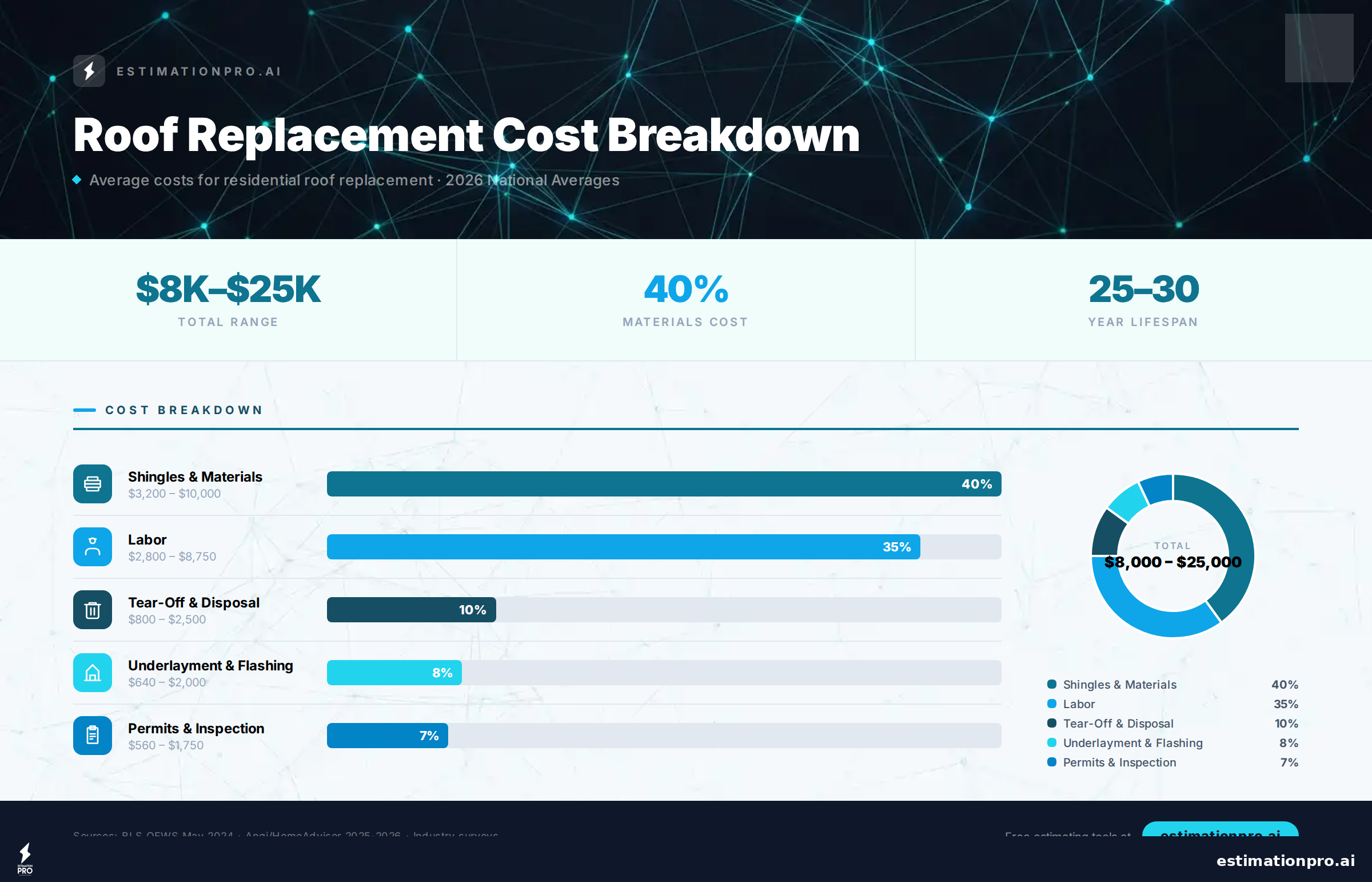
Share This Infographic
Feel free to share this infographic on your website. Just copy the embed code below:
Copy this embed code:
<a href="https://estimationpro.ai/tools/blog/metal-roof-shingles-cost" target="_blank" rel="noopener">
  <img src="https://estimationpro.ai/tools/blog/infographics/metal-roof-shingles-cost-infographic.png" alt="metal roof shingles cost infographic by EstimationPro.AI" style="max-width:100%;height:auto" loading="lazy" />
</a>
<p style="font-size:12px;color:#64748B;margin-top:8px">Source: <a href="https://estimationpro.ai/tools/blog/metal-roof-shingles-cost">EstimationPro.AI</a></p>
One square equals 100 square feet of roof area. A 2,000 sq ft roof footprint is 20 squares, but most roofs are larger than the footprint once you factor in pitch. A 6/12 pitch adds roughly 12% to your square footage. Use our Roofing Calculator to get your exact square count.
Corrugated Metal Panels ($120-$250/square)
These are the panels you see on barns, shops, and pole buildings. Exposed fastener systems using screws with rubber washers. They work fine for residential projects too, especially in rural areas where the look fits. The material is cheap, installation is fast, and they hold up well.
The downside? Exposed fasteners are potential leak points. The rubber washers break down over 15-20 years and need to be resealed or replaced. Still a solid option for budget-minded homeowners.
Stamped Metal Shingles ($250-$500/square)
These look like traditional shingles, slate, or tile from the street, but they’re steel or aluminum underneath. Concealed fastener clips mean no exposed screws. They interlock, which makes them more wind resistant than standard asphalt.
This is where most residential metal roofing projects land. You get the longevity of metal with curb appeal that blends into any neighborhood. The major manufacturers (Decra, Gerard, EDCO) offer stone-coated options that are hard to distinguish from real slate or tile.
Standing Seam ($400-$900/square)
The premium choice for residential metal roofing. Panels run vertically from ridge to eave with raised seams that lock together. Zero penetrations through the panel surface. This is the cleanest install from a waterproofing standpoint.
Standing seam costs more because the panels are typically custom-formed on site using a portable roll-forming machine. Labor is specialized. Not every roofer can install standing seam properly, and the ones who can charge accordingly.
Copper and Zinc ($600-$900/square)
Specialty metals for high-end projects. Copper develops that green patina over time. Zinc self-heals minor scratches. Both last 70-100 years. Unless you’re building a custom home or restoring a historic property, these are overkill for most residential work.
Worked Example #1: Mid-Range Metal Shingle Roof
Project: 1,800 sq ft ranch home, 4/12 pitch, standard metal shingles, tear-off existing asphalt.
| Line Item | Cost |
|---|---|
| Metal shingles (20 squares × $350/sq) | $7,000 |
| Underlayment (synthetic, 20 sq) | $1,200 |
| Labor (20 squares × $250/sq) | $5,000 |
| Tear-off and disposal | $1,400 |
| Flashing, drip edge, trim | $1,100 |
| Ridge cap and ventilation | $700 |
| Total | $16,400 |
Cost per square foot installed: $9.11/sq ft. That’s right in line with the $8-$15 range for stamped metal shingles.
Worked Example #2: Standing Seam on a Two-Story
Project: 2,800 sq ft colonial, 8/12 pitch (pitch multiplier 1.20), standing seam panels, tear-off existing.
Actual roof area: 2,800 × 1.20 = 3,360 sq ft (33.6 squares)
| Line Item | Cost |
|---|---|
| Standing seam panels (34 sq × $550/sq) | $18,700 |
| Underlayment (ice & water shield + synthetic) | $3,200 |
| Labor (34 squares × $400/sq) | $13,600 |
| Tear-off and disposal | $2,800 |
| Flashing, valleys, penetrations | $2,400 |
| Ridge cap and snow guards | $1,600 |
| Total | $42,300 |
Cost per square foot installed: $12.59/sq ft. Steep pitch and standing seam drive this into the upper range, but that roof will outlast the house.
Metal Roof vs. Asphalt Shingles: The Real Math
Everyone wants to compare sticker price. Fair enough. But the better comparison is lifetime cost.
| Factor | Asphalt (Architectural) | Metal Shingles | Standing Seam |
|---|---|---|---|
| Material cost/square | $100 - $250 | $250 - $500 | $400 - $700 |
| Installed cost/sq ft | $4 - $7 | $8 - $15 | $10 - $22 |
| Expected lifespan | 20-30 years | 40-60 years | 50-70 years |
| Replacements in 60 years | 2-3 | 1 | 1 |
| 60-year total cost (2,000 sq ft) | $24,000 - $42,000 | $16,000 - $30,000 | $20,000 - $44,000 |
| Insurance discount | None typical | 10-25% | 10-25% |
| Resale value boost | Standard | 1-6% | 1-6% |
Over a 60-year period, metal often costs LESS than asphalt when you factor in replacements. And that’s before counting the insurance savings. Many insurers offer 10-25% discounts for impact-resistant metal roofing, according to the Insurance Institute for Business & Home Safety (IBHS).
For a full comparison of asphalt pricing, see our asphalt roof shingles cost guide.
What Drives Metal Roof Costs Up (and Down)
Factors That Increase Cost
- Steep pitch. Anything above 6/12 adds safety equipment, slows production, and increases material waste. A 12/12 pitch can add 25-40% to labor.
- Complex roof geometry. Hips, valleys, dormers, skylights. Every intersection needs custom flashing. Simple gable roofs are the cheapest to cover.
- Multiple stories. Higher roofs mean more setup time, scaffolding, and slower material handling.
- Tear-off layers. Some areas allow a second layer of asphalt over existing, but metal always requires a clean deck. Multiple tear-off layers add $1,000-$3,000.
- Material gauge. 24-gauge steel is thicker and more durable than 26-gauge, but costs 15-20% more per panel.
Factors That Decrease Cost
- Simple roof shape. Straight gable with minimal penetrations is the fastest, cheapest install.
- Overlay installation. In some cases, metal can go directly over existing asphalt with furring strips, saving tear-off costs. Check local codes first.
- Off-season scheduling. Winter installs in mild climates can save 5-10% on labor.
- Material bulk pricing. Orders over 30 squares usually qualify for contractor pricing from distributors.
Pro Tips: What Contractors Should Know
-
Always factor in trim and accessories. Drip edge, j-channel, gable trim, ridge cap, valley metal, pipe boots. On a metal roof, trim and accessories can run 15-25% of the panel cost. Miss this in your estimate and you’re eating it.
-
Waste factor is 5-15%. Simple roofs waste less. Complex roofs with lots of cuts waste more. I use 10% as my default and adjust from there based on the roof geometry.
-
Underlayment matters. Synthetic underlayment is the minimum. Ice and water shield in valleys and at eaves is code in most northern climates. Don’t skip it to save $500 on a $20,000 job.
-
Production rates vary by type. A two-person crew can install 3-5 squares of corrugated panels per day, but only 2-3 squares of standing seam. Plan your labor estimates accordingly.
-
Thermal expansion is real. Metal panels expand and contract with temperature changes. Standing seam systems are designed for this with floating clips. If you’re installing corrugated, make sure screw holes are slightly oversized to allow movement. Tight fasteners cause oil-canning and panel buckling.
Common Mistakes When Estimating Metal Roofing
- Using asphalt production rates for metal. Metal takes longer to install. Period. If you bid metal at the same labor rate as asphalt, you’ll lose money on every job.
- Forgetting the pitch multiplier. Roof square footage is not the same as building square footage. A 6/12 pitch multiplies the footprint by 1.12. An 8/12 multiplies by 1.20. Miss this and you’re short on material.
- Ignoring lead times. Custom-color standing seam panels can take 3-6 weeks from the manufacturer. Standard colors in stock at the distributor ship in a few days. Plan accordingly or you’ll have a crew sitting idle.
- Skipping the structural check. Metal roofing is lighter than asphalt (about 1-1.5 lbs per sq ft vs. 2-4 lbs for asphalt), so structural concerns are rare. But if you’re going from asphalt to stone-coated metal shingles on an older home, verify the deck and framing are sound.
Regional Pricing Differences
Metal roofing costs vary by region due to labor rates, material availability, and local demand.
| Region | Installed Cost Range (per sq ft) |
|---|---|
| Southeast | $6 - $18 |
| Midwest | $7 - $20 |
| Pacific Northwest | $8 - $22 |
| Northeast | $9 - $25 |
| Mountain West | $8 - $22 |
Note: Regional pricing reflects 2026 averages. Your actual costs will vary based on local labor markets, material availability, and project complexity. Get 3 bids from local contractors for the most accurate pricing.
Frequently Asked Questions
How long does a metal roof last?
Most metal roofs last 40 to 70 years depending on the material and installation quality. Standing seam and copper can exceed 70 years. Corrugated panels with exposed fasteners typically need fastener maintenance at 15-20 years but the panels themselves last 40+ years. Compare that to 20-30 years for architectural asphalt shingles.
Is a metal roof worth the extra cost over asphalt?
Yes, if you plan to stay in the home 15+ years. The upfront cost is 2-3x higher than asphalt, but you avoid one or two full replacements over the life of the home. Insurance discounts of 10-25% and increased resale value (1-6% according to Remodeling Magazine’s Cost vs. Value report) help offset the difference. For homes you’re flipping or selling within 5 years, asphalt is usually the better financial choice.
Can you install metal roofing over existing shingles?
Sometimes. Many building codes allow metal over one layer of asphalt if the deck is in good condition. You’ll use furring strips or a vented nail base to create an air gap. This saves $1,000-$3,000 in tear-off costs. However, covering up existing shingles means you can’t inspect the deck for rot or damage. Most contractors (myself included) recommend tear-off for the best long-term result.
Are metal roofs noisy in rain?
Not with proper installation. A metal roof installed over solid sheathing with underlayment sounds about the same as asphalt from inside the house. The “tin roof” noise comes from panels installed on open purlins with no insulation, like you’d see on a barn or shop. Residential installs over plywood or OSB with synthetic underlayment are quiet. Adding attic insulation reduces sound even further.
What gauge metal is best for residential roofing?
26-gauge is the industry standard for residential metal roofing. It balances cost and durability well. 24-gauge is thicker and more dent-resistant, which matters in hail-prone areas, but adds 15-20% to material cost. Avoid anything thinner than 29-gauge for residential applications, as it dents easily and feels flimsy underfoot during installation.
Build Your Metal Roofing Estimate
Getting the right numbers on a metal roof bid takes more than just multiplying squares by a material price. You need to account for pitch, waste, tear-off, trim, underlayment, and the specific labor rate for the system you’re installing.
Use our Roofing Calculator to dial in your square footage and material quantities. Then check the Roof Pitch Calculator to get your exact pitch multiplier.
EstimationPro doesn’t just help you calculate the numbers. It builds the full proposal, sends it to the homeowner, and follows up automatically so that bid doesn’t die in their inbox. Contractors lose 40-60% of bids because nobody followed up. Try EstimationPro free and stop leaving money on the table.
Pricing a job like this?
Get every line item priced for your area in a full estimate
Describe the job or snap a few photos. Send it from EstimationPro and it follows up with your client for you.
3 free estimates in the first 7 days. No credit card.
Average Metal Roof Installation Cost (2,000 sq ft)
Metal Roofing Cost by Type
- Exposed fastener system
- 26-gauge galvalume steel
- 25-40 year warranty
- Best for: shops, barns, budget-conscious
- Stamped steel or aluminum
- Concealed fastener clips
- 50-year warranty typical
- Best for: residential homes
- Concealed fastener system
- Custom-formed panels
- 50+ year warranty
- Best for: high-end residential
Get Free Estimating Tips
Enter your email and we'll send you pro tips, cost data, and useful resources for contractors.
We'll send helpful resources and occasional tips. Unsubscribe anytime.
 EstimationPro AI For Contractors, By Contractors
 Price Every Job With Confidence
Stop second-guessing your numbers. EstimationPro prices every line with labor and material rates adjusted for your region.