
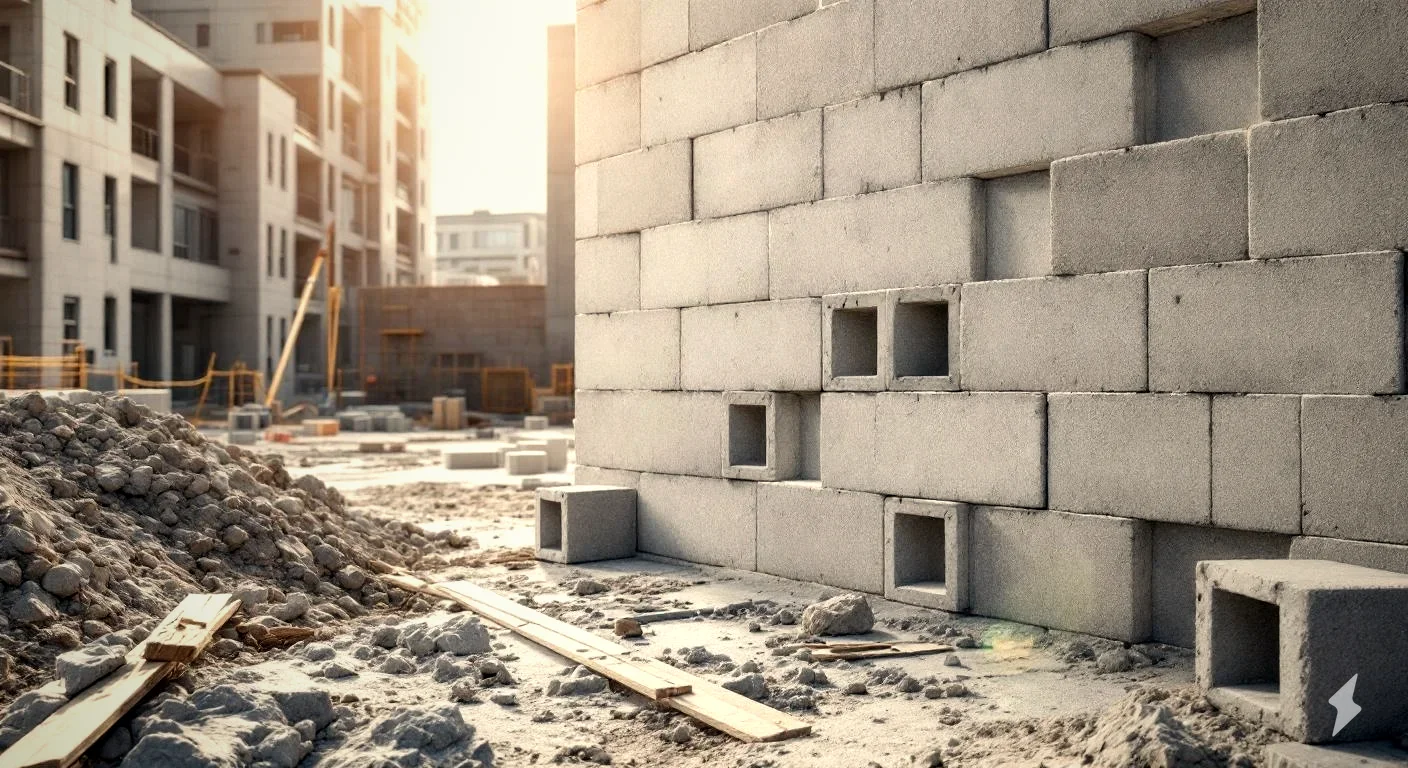
$4,400. That’s what a homeowner in Tacoma paid me last year for a 40-foot cinder block retaining wall. His jaw dropped. He expected half that. But once I walked him through the footing, the rebar, the grout, and the labor to stack 200+ blocks by hand, he got it. Masonry is not cheap, but it lasts 50-plus years.
If you’re pricing a cinder block wall for a bid or a personal project, here’s what the real numbers look like in 2026.
Quick Answer: What Does a Cinder Block Wall Cost?
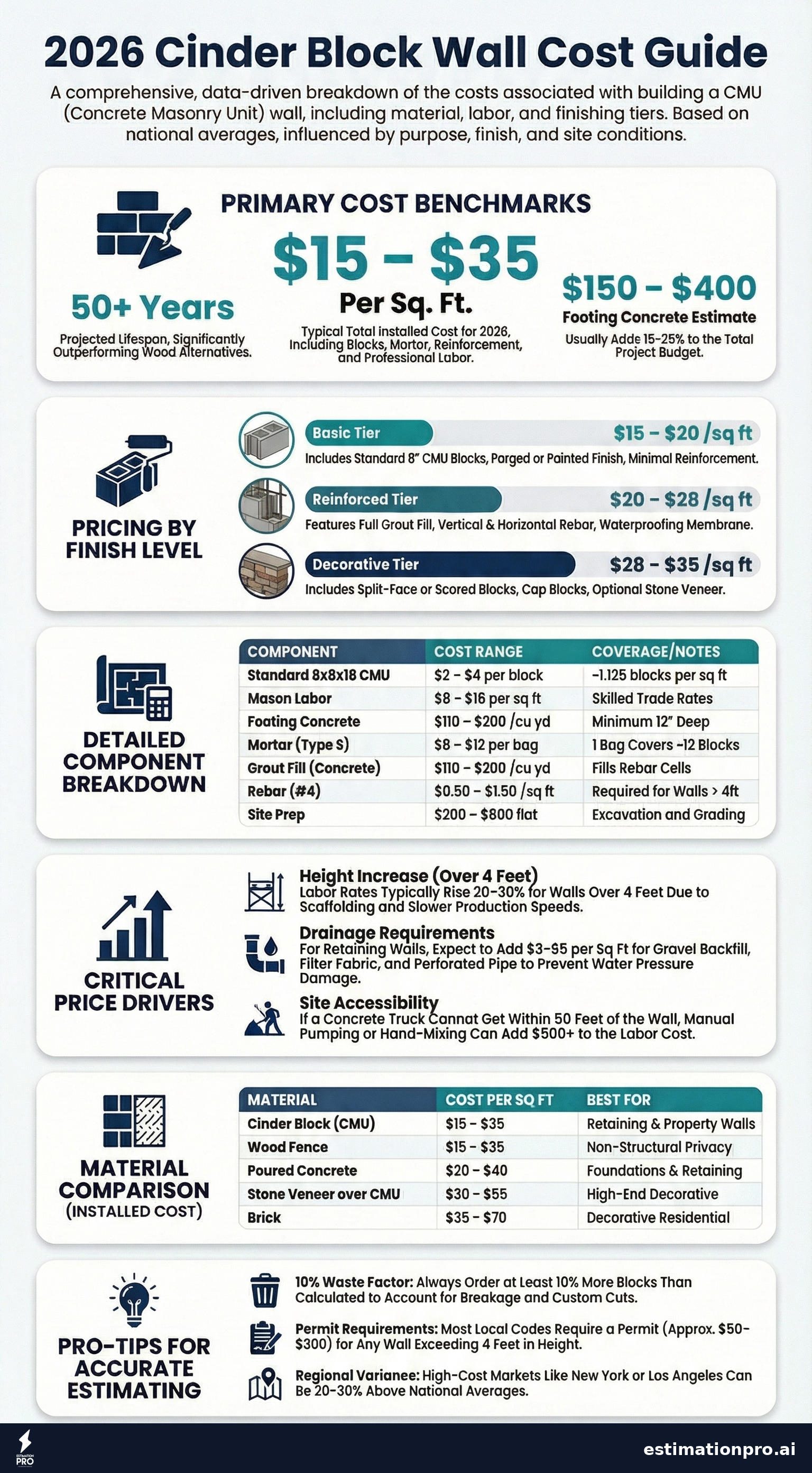
A cinder block (CMU) wall costs $15 to $35 per square foot installed, including blocks, mortar, reinforcement, and labor. A basic 100 sq ft garden wall runs about $1,500 to $2,200. A fully reinforced 6-foot privacy wall at 240 sq ft can reach $5,300 to $8,400. The footing alone adds $150 to $400 depending on length and local concrete prices.
Use our Cinder Block Wall Calculator to get your block count, mortar bags, and material costs in about 30 seconds. Try EstimationPro free to build a full line-item estimate you can hand to the client.
Cost Breakdown by Component
Here’s where the money goes on a typical cinder block wall project. I’ve broken this out the way I’d line-item it on an actual estimate.
| Component | Cost Range | Notes |
|---|---|---|
| Standard 8x8x16 CMU blocks | $2 - $4 each | About 1.125 blocks per sq ft of wall face |
| Mortar | $8 - $12 per bag | One bag covers ~12 blocks |
| Rebar (#4 vertical + horizontal) | $0.50 - $1.50/sq ft | Required for walls over 4 ft or any retaining wall |
| Grout fill (concrete) | $110 - $200/cu yd | Fills rebar cells; about 0.5 cu yd per 80 sq ft |
| Footing concrete | $110 - $200/cu yd | Minimum 12” deep x 2x wall width |
| Mason labor | $8 - $16/sq ft | Skilled trade, not general labor |
| Site prep & excavation | $200 - $600 flat | Footing trench, grading, compaction |
Sources: HomeGuide 2026, Angi 2026, RSMeans residential cost data.
The labor line is where most homeowners get sticker shock. Masons are a skilled trade. A good block layer stacks 30 to 50 blocks per hour on a clean run, but add corners, rebar placement, and level checks and that production rate drops fast.
Worked Example #1: Small Retaining Wall
Project: 20 linear feet, 4 feet high. Standard 8-inch CMU. Reinforced with vertical rebar every 4 feet, horizontal every other course. Poured concrete footing.
| Line Item | Quantity | Unit Cost | Total |
|---|---|---|---|
| 8x8x16 CMU blocks | 90 blocks | $3.00 | $270 |
| Type S mortar | 8 bags | $12.00 | $96 |
| Grout fill concrete | 0.5 cu yd | $150.00 | $75 |
| #4 rebar | 80 lin ft | $0.80 | $64 |
| Footing concrete | 1.5 cu yd | $150.00 | $225 |
| Mason labor (80 sq ft) | 80 sq ft | $12.00 | $960 |
| Footing excavation | 1 | $300.00 | $300 |
| Total | $1,990 |
That works out to about $25 per square foot of wall face, which is right in the middle of the typical range. Add $200 to $400 if the site slopes badly or if you need drainage behind the wall (and you usually do on a retaining wall).
Share This Infographic
Feel free to share this infographic on your website. Just copy the embed code below:
Copy this embed code:
<a href="https://estimationpro.ai/tools/blog/cinder-block-wall-cost" target="_blank" rel="noopener">
  <img src="https://estimationpro.ai/tools/blog/infographics/cinder-block-wall-cost-infographic.png" alt="cinder block wall cost infographic by EstimationPro.AI" style="max-width:100%;height:auto" loading="lazy" />
</a>
<p style="font-size:12px;color:#64748B;margin-top:8px">Source: <a href="https://estimationpro.ai/tools/blog/cinder-block-wall-cost">EstimationPro.AI</a></p>
What Drives the Price Up
Not all block walls are the same job. These factors move the needle.
Height matters more than length. A 6-foot wall needs a bigger footing, more rebar, and scaffold or staging to work from. My labor rate goes up 20-30% on anything over 4 feet because the mason is working slower and needs help lifting blocks to the top courses.
Retaining walls cost more than freestanding walls. You need waterproofing on the back side, drainage gravel and a perforated pipe, and heavier reinforcement because the wall is holding back soil pressure. Budget an extra $3 to $5 per square foot for the drainage package alone.
Finish type changes the final bill. A raw block wall with a coat of paint is the cheapest option. Split-face blocks, stucco coating, or stone veneer on top of the CMU can double the per-square-foot cost. I’ve seen decorative retaining walls hit $50/sqft when the homeowner wanted a stacked stone veneer look.
Access and site conditions. If a concrete truck can’t get within 50 feet of the wall, you’re pumping concrete or mixing by hand. That adds $500 or more. Tight backyards, slopes, and tree roots all slow production.
Worked Example #2: Privacy Wall Along a Property Line
Project: 40 linear feet, 6 feet high. Fully grouted and reinforced. Split-face block with cap blocks on top. Concrete footing.
| Line Item | Quantity | Unit Cost | Total |
|---|---|---|---|
| Split-face 8x8x16 CMU blocks | 270 blocks | $4.50 | $1,215 |
| Type S mortar | 23 bags | $12.00 | $276 |
| Grout fill concrete | 1.5 cu yd | $150.00 | $225 |
| #4 rebar (vert + horiz) | 200 lin ft | $0.80 | $160 |
| Cap blocks | 30 blocks | $6.00 | $180 |
| Footing concrete | 3 cu yd | $150.00 | $450 |
| Mason labor (240 sq ft) | 240 sq ft | $14.00 | $3,360 |
| Footing excavation | 1 | $500.00 | $500 |
| Scaffold rental | 1 week | $150.00 | $150 |
| Total | $6,516 |
That’s about $27 per square foot. The split-face blocks and cap blocks add roughly $3/sqft compared to standard gray CMU, but the finished look is substantially better for a wall that faces the street or neighbors.
Cinder Block vs. Other Wall Materials
If you’re still deciding on material, here’s how block stacks up against the alternatives.
| Material | Cost/Sq Ft Installed | Lifespan | Best For |
|---|---|---|---|
| Cinder block (CMU) | $15 - $35 | 50+ years | Retaining walls, property walls, foundations |
| Brick | $35 - $70 | 100+ years | Decorative walls, high-end residential |
| Poured concrete | $20 - $40 | 50+ years | Retaining walls, foundations |
| Wood fence | $15 - $35 | 15 - 25 years | Privacy fencing (non-structural) |
| Stone veneer over CMU | $30 - $55 | 50+ years | Decorative with structural backing |
Sources: HomeGuide 2026, Angi 2026, NAHB cost data.
Block is hard to beat for the combination of strength and cost. Brick looks better, sure, but at twice the price per square foot it’s a tough sell for a retaining wall nobody will see. Poured concrete walls are competitive on price, but they need forms, and the forming/stripping labor can push costs higher on smaller jobs.
Cost Mistakes I See Contractors Make
I’ve reviewed hundreds of estimates through EstimationPro, and these are the block wall mistakes that burn people.
Forgetting the footing. The footing is 15-25% of the total project cost. I’ve seen bids that priced the block and labor but didn’t include excavation, forming, rebar, or concrete for the footing. That’s a $300 to $600 miss on a small wall.
Underestimating waste. Blocks break. Cuts don’t always go clean. Order 10% overage minimum, 15% if you have a lot of corners or pilasters. At $3 a block, a short order means a second delivery trip and a short-load fee from the supplier.
Skipping drainage on retaining walls. Water pressure behind an un-drained retaining wall will crack it eventually. Gravel backfill, filter fabric, and a perforated drain pipe cost $3 to $5 per square foot. Skipping it saves money now and costs you the whole wall later.
Pricing labor too low. General laborers are not masons. A skilled block layer commands $25 to $45 per hour (BLS data for masonry workers, May 2024). If you’re bidding mason work at general labor rates, you’ll either lose money or attract workers who don’t know how to stack a plumb wall.
Regional Pricing Differences
These prices reflect national averages. Your actual costs depend on where you build.
Block walls in the Southeast and Midwest tend to run 10-20% below these numbers because masonry is more common and labor supply is better. The Pacific Northwest and Northeast typically run 10-15% higher due to shorter building seasons, higher labor costs, and concrete delivery fees. In markets like San Francisco, Los Angeles, or New York, add 20-30% above national averages.
Always get local quotes. A $22/sqft wall in Alabama might be a $30/sqft wall in Portland.
Frequently Asked Questions
How many cinder blocks do I need per square foot of wall?
You need about 1.125 standard 8x8x16 blocks per square foot of wall face. For a quick count, multiply the wall’s height in feet by its length in feet, then multiply by 1.125. Add 10-15% for cuts and waste. Our CMU Block Calculator does this math for you instantly.
Is a cinder block wall cheaper than a poured concrete wall?
For walls under 100 sq ft, cinder block is typically cheaper because there’s no forming cost. For larger walls (200+ sq ft), poured concrete becomes competitive because the labor per square foot is lower once the forms are set. The break-even point is usually around 120-150 sq ft.
Do I need a permit for a cinder block wall?
Most jurisdictions require a permit for any wall over 4 feet tall or any retaining wall that holds back more than 3 feet of soil. Permit costs vary from $50 to $300. Check with your local building department before starting. Walls under 4 feet on flat ground are often exempt, but code requirements vary by municipality.
How long does it take to build a cinder block wall?
A skilled mason lays 30-50 blocks per hour on straight runs. A typical 100 sq ft wall (about 110 blocks) takes 1-2 days including footing work, block laying, grouting, and cleanup. Larger walls at 200+ sq ft typically take 3-5 days. These timelines assume the footing concrete has already cured (24-48 hours minimum).
Can I build a cinder block wall myself?
You can, but it’s harder than it looks. Stacking blocks level and plumb for an entire wall requires practice. A crooked wall is obvious and difficult to fix after the mortar sets. If you’re building a small garden wall under 3 feet tall on a flat site, DIY is reasonable. Anything taller, structural, or retaining should be done by a licensed mason.
Get Your Cinder Block Wall Estimate Right
Getting block wall pricing wrong means either losing the job to someone who bid lower (because you padded too much) or eating the difference out of your own pocket (because you missed the footing or underpriced labor). Neither option is good for your business.
Contractors on Capterra rate EstimationPro 4.8/5 for speed and accuracy on masonry and concrete projects. Try EstimationPro free to build a line-item estimate with materials, labor, and overhead calculated automatically. It sends the proposal to the homeowner and follows up for you, so you’re not chasing leads while you’re stacking blocks on the next job.
Pricing a job like this?
Get every line item priced for your area in a full estimate
Describe the job or snap a few photos. Send it from EstimationPro and it follows up with your client for you.
3 free estimates in the first 7 days. No credit card.
80 Sq Ft Cinder Block Retaining Wall Cost
Cinder Block Wall Cost by Finish Level
- Standard 8" CMU blocks
- Parged or painted finish
- Minimal reinforcement
- Standard footing
- Full grout fill in all cells
- Vertical and horizontal rebar
- Waterproofing membrane
- Stucco or split-face finish
- Split-face or scored block
- Cap blocks on top course
- Full reinforcement package
- Stone veneer or decorative coating
Get Free Estimating Tips
Enter your email and we'll send you pro tips, cost data, and useful resources for contractors.
We'll send helpful resources and occasional tips. Unsubscribe anytime.
 EstimationPro AI For Contractors, By Contractors
 Price Every Job With Confidence
Stop second-guessing your numbers. EstimationPro prices every line with labor and material rates adjusted for your region.