
$2 per square foot or $25 per square foot. Both are tile. Both go on the same floor. But one is basic ceramic from a big box store and the other is hand-cut Italian marble. The gap between cheap tile and premium tile is wider than most people expect, and that gap gets even bigger once you factor in labor, prep, and materials.
I’ve seen homeowners walk into a tile showroom, fall in love with a $18/sf natural stone, and have no idea that the installation will cost almost as much as the tile itself. Understanding what drives tiling price before you buy saves you from ugly surprises at the checkout counter or on the final invoice.
Quick Answer: What Does Tile Cost?
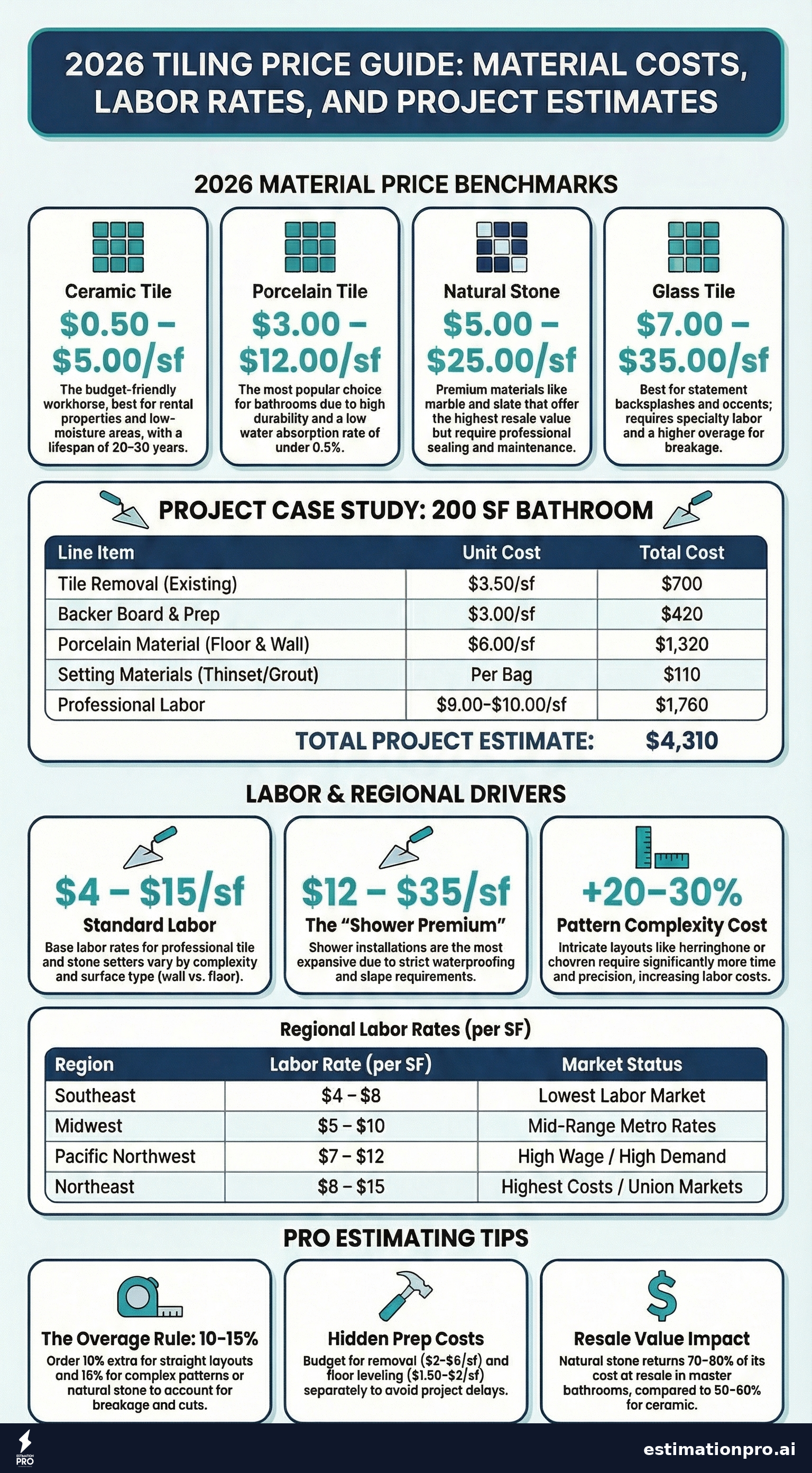
Tile material prices range from $0.50 to $35 per square foot depending on the type. Ceramic runs $0.50-$5/sf, porcelain $3-$12/sf, natural stone $5-$25/sf, and glass tile $7-$35/sf. Add $4-$15/sf for professional installation labor. A typical 200 SF bathroom tile job runs $4,000-$8,000 total including materials, labor, prep, and supplies. Prices vary by region and project complexity.
Use our Tile Installation Cost Calculator to get a detailed estimate for your specific project in minutes.
Try EstimationPro free to build complete tile estimates with line-item detail and send professional proposals from the field.
Tile Material Prices by Type
Not all tile is created equal. Here’s what you’ll actually pay at the material level in 2026, based on current supplier and retailer pricing.
| Tile Type | Price Per SF | Best For | Lifespan |
|---|---|---|---|
| Ceramic | $0.50 - $5.00 | Budget floors, rental properties, backsplashes | 20-30 years |
| Porcelain | $3.00 - $12.00 | Bathrooms, kitchens, high-traffic floors | 30-50 years |
| Natural Stone | $5.00 - $25.00 | Master baths, entryways, premium remodels | 50+ years |
| Glass | $7.00 - $35.00 | Backsplashes, shower accents, feature walls | 30+ years |
| Subway (ceramic) | $1.00 - $5.00 | Kitchen backsplashes, bathroom walls | 20-30 years |
| Large Format (24x24+) | $4.00 - $15.00 | Modern floors, fewer grout lines | 30+ years |
Prices reflect 2026 material costs from HomeAdvisor and Angi. Regional variation of 10-25% is common.
Ceramic: The Budget Workhorse
Ceramic tile starts at $0.50 per square foot for basic field tile. You can tile an entire bathroom floor for under $200 in materials. The trade-off is durability. Ceramic is softer than porcelain, absorbs more water, and chips easier under impact. For rental properties, laundry rooms, or budget-conscious remodels, ceramic gets the job done.
Where ceramic falls short: high-traffic entryways, outdoor applications, and anywhere moisture sits (shower floors without proper slope). I’ve replaced cracked ceramic in bathrooms where the grout failed and water got underneath. Porcelain would have held up twice as long.
Porcelain: The Contractor’s Go-To
Porcelain is what I recommend for most residential projects. At $3-$12 per square foot, it hits the sweet spot between cost and performance. Water absorption under 0.5% (per ASTM C373 testing) means it handles wet environments without breaking down. The wood-look and stone-look options have gotten so realistic that homeowners often can’t tell the difference from the real thing at half the price.
The catch with porcelain: it’s harder to cut. You need a wet saw with a diamond blade, not a basic snap cutter. That adds time on the job. For contractors, factor in 10-15% more labor time versus ceramic.
Natural Stone: Where Budgets Get Real
Natural stone starts at $5/sf for basic travertine and climbs to $25+ for premium marble. But the material cost is only half the story. Stone requires sealing before and after installation, more careful handling (breakage rates are higher), and experienced installers who know how to work with natural variation in thickness. Add $2-$4/sf to your labor estimate for stone compared to ceramic or porcelain.
That said, nothing matches the look. Marble in a master bathroom or slate in an entryway adds a level of quality that manufactured tile can’t replicate. For higher-end remodels where the budget supports it, natural stone delivers real value at resale.
Glass: Specialty Applications Only
Glass tile at $7-$35/sf is priced for accent work, not full floors. A 30 SF kitchen backsplash in glass mosaic might cost $300-$600 in materials. Beautiful, but fragile. Breakage during installation runs 5-10% for glass versus 2-3% for ceramic, so buy extra. And finding an installer experienced with glass isn’t always easy, especially outside metro areas.
Share This Infographic
Feel free to share this infographic on your website. Just copy the embed code below:
Copy this embed code:
<a href="https://estimationpro.ai/tools/blog/tiling-price" target="_blank" rel="noopener">
  <img src="https://estimationpro.ai/tools/blog/infographics/tiling-price-infographic.png" alt="tiling price infographic by EstimationPro.AI" style="max-width:100%;height:auto" loading="lazy" />
</a>
<p style="font-size:12px;color:#64748B;margin-top:8px">Source: <a href="https://estimationpro.ai/tools/blog/tiling-price">EstimationPro.AI</a></p>
What Drives the Labor Cost
Materials are only part of your tiling price. Labor runs $4-$15 per square foot for professional installation (BLS 47-2044, tile and stone setter wages). Several factors push labor higher:
- Surface prep - Old tile removal adds $2-$6/sf. Backer board installation adds $1.50-$3/sf. A floor that needs leveling compound can add another $2-$4/sf.
- Wall vs. floor - Wall tile costs $1-$4/sf more in labor than floor tile. Working against gravity, cutting around outlets, and maintaining level lines all take more time.
- Tile size - Large format tiles (24x24 and bigger) require a $2-$6/sf premium because they need a perfectly level substrate and are harder to handle without cracking.
- Pattern complexity - Herringbone, chevron, and diagonal layouts take 20-30% more time than a straight set. That’s 20-30% more labor cost.
- Shower work - Shower tile installation runs $12-$35/sf installed because of waterproofing, slope requirements, and wall prep. It’s the most labor-intensive tile work in residential remodeling.
Worked Example: 200 SF Bathroom Tile Job
Here’s what a real bathroom tile project looks like with line items. This assumes removing existing tile, standard porcelain on floors and walls, and a tiled shower.
Project: Full bathroom tile replacement, 200 SF total
| Line Item | Quantity | Unit Cost | Total |
|---|---|---|---|
| Existing tile removal | 200 SF | $3.50/sf | $700 |
| Backer board (shower walls) | 80 SF | $3.00/sf | $240 |
| Floor leveling compound | 120 SF | $1.50/sf | $180 |
| Porcelain floor tile (material) | 132 SF (10% overage) | $6.00/sf | $792 |
| Porcelain wall tile (material) | 88 SF (10% overage) | $6.00/sf | $528 |
| Thinset mortar (50 lb bags) | 4 bags | $20/bag | $80 |
| Grout (25 lb bags) | 2 bags | $15/bag | $30 |
| Floor tile labor | 120 SF | $8.00/sf | $960 |
| Wall tile labor | 80 SF | $10.00/sf | $800 |
| Total | $4,310 |
That $4,310 doesn’t include fixtures, vanity, paint, or any plumbing changes. Tile is just one piece of a bathroom remodel. For the full picture, use our Bathroom Tile Calculator to spec your project.
Worked Example: Kitchen Backsplash
Smaller project, different numbers.
Project: Subway tile backsplash, 30 SF
| Line Item | Quantity | Unit Cost | Total |
|---|---|---|---|
| Subway tile (ceramic) | 34 SF (13% overage) | $3.00/sf | $102 |
| Thinset (50 lb bag) | 1 bag | $20 | $20 |
| Grout (25 lb bag) | 1 bag | $15 | $15 |
| Installation labor | 30 SF | $10.00/sf | $300 |
| Total | $437 |
Backsplashes are quick jobs. Most installers can knock out 30 SF in half a day. The material cost is almost nothing. You’re mostly paying for the skill and the tools. This is one area where the labor-to-material ratio skews heavily toward labor.
Where Homeowners Overspend on Tile
After 20 years in remodeling, I’ve watched the same mistakes repeat across hundreds of projects:
-
Buying premium tile for low-visibility areas. Natural stone in a guest bathroom that nobody uses? Porcelain does the same job at half the price. Save the stone for spaces where people actually see it and appreciate it.
-
Ignoring the cost of prep. The tile itself might be $3/sf, but if your subfloor needs leveling, your old tile needs removal, and your shower walls need backer board, the prep work can cost more than the tile. Always get prep costs itemized separately so there are no surprises.
-
Skipping the overage. Budget tile buyers order exactly what they need, then come up short when they break a piece or miscut a corner. Order 10% extra for standard layouts and 15% for diagonal or herringbone patterns. The $50-$100 in extra material saves a $200+ second delivery or a discontinued tile disaster.
-
Choosing complex patterns without pricing the labor. Herringbone looks incredible. It also takes 25-30% more labor time than a straight lay. On a $5,000 tile job, that’s an extra $1,000+ just for the pattern. Make sure the homeowner knows that before they commit.
-
Forgetting transition strips and edge pieces. Bullnose, schluter strips, and threshold pieces add $2-$8 per linear foot. A bathroom with three doorways and a shower curb has 15+ linear feet of edge work. Budget $50-$150 for these details.
Regional Pricing Differences
Tile material prices are fairly consistent nationwide since most tile is manufactured overseas and distributed through the same supply chains. Labor is where the regional gap shows up.
| Region | Labor Rate (per SF) | Notes |
|---|---|---|
| Southeast | $4 - $8 | Lowest labor market |
| Midwest | $5 - $10 | Mid-range, varies by metro |
| Pacific Northwest | $7 - $12 | Higher wages, strong demand |
| Northeast | $8 - $15 | Highest labor costs, union markets |
| Mountain West | $6 - $11 | Growing markets, price climbing |
Regional labor rates based on BLS Occupational Employment Statistics for tile setters (47-2044) and HomeAdvisor 2026 data. Your actual costs depend on local supply, demand, and project complexity.
How to Get an Accurate Tile Estimate
A good tile estimate should include all of these line items, not just materials:
- Tile material - type, grade, quantity with overage
- Setting materials - thinset, grout, backer board, waterproofing membrane
- Prep work - demo, leveling, substrate repair
- Labor - separated by floor vs. wall vs. shower
- Trim and transitions - bullnose, schluter, thresholds
- Waste factor - 10-15% depending on layout pattern
If a quote gives you one lump number for “tile work,” ask for a breakdown. Good contractors itemize because it protects both parties. You know exactly what you’re paying for, and the contractor has documented scope in case something changes. Our Tile Calculator helps you spec quantities and materials before you even call for quotes.
FAQ
How much does it cost to tile a 100 square foot bathroom floor?
Material and labor for a 100 SF bathroom floor typically runs $1,200-$2,200. Ceramic at the low end ($0.50-$5/sf material + $4-$8/sf labor) and porcelain at the mid range ($3-$12/sf material + $6-$12/sf labor). Add $200-$600 for tile removal if replacing existing flooring, plus $80-$150 for thinset and grout.
Is porcelain tile worth the extra cost over ceramic?
For bathrooms, kitchens, and entryways, yes. Porcelain’s lower water absorption rate (under 0.5% vs. 3-5% for ceramic per ASTM C373) means it handles moisture better and lasts 30-50 years versus 20-30 for ceramic. The $2-$7/sf premium pays for itself in longevity, especially in wet areas where ceramic breaks down faster.
Why is tile installation labor so expensive?
Tile setting requires specialized tools (wet saws, leveling systems), physical skill, and precision. A bad tile job with lippage or uneven grout lines is obvious and expensive to fix. Experienced setters command $4-$15/sf because the work demands accuracy, proper substrate prep, and knowledge of waterproofing systems. Shower tile work runs even higher at $12-$35/sf installed because of the waterproofing and slope requirements (per IRC Section R307.2).
How much extra tile should I order?
Order 10% extra for straight layouts and 15% for diagonal, herringbone, or chevron patterns. For natural stone, bump to 15-20% because of higher breakage rates and natural variation that may require sorting out unusable pieces. The extra cost is small insurance against delays and discontinued product.
Does tile type affect resale value?
Yes. According to the NAHB 2026 remodeling impact report, natural stone tile in master bathrooms returns 70-80% of its cost at resale, compared to 50-60% for ceramic. Porcelain falls in between. In higher-end neighborhoods, stone is expected. In starter homes, quality porcelain performs just as well financially.
Build Better Tile Estimates
Getting tile pricing right means itemizing every component, not just the tile itself. Prep, labor, setting materials, and trim pieces all add up fast, and the gap between a rough guess and a real estimate can be thousands of dollars on a single bathroom.
Contractors on Capterra rate EstimationPro 4.8/5 for time savings on exactly this kind of detail work. Try EstimationPro free - it builds the full estimate with line items, sends a polished proposal to your client, and automatically follows up so you don’t lose the job while you’re on another site. Estimate, proposal, follow-up, invoice, paid. One workflow, no spreadsheets.
Pricing a job like this?
Get every line item priced for your area in a full estimate
Describe the job or snap a few photos. Send it from EstimationPro and it follows up with your client for you.
3 free estimates in the first 7 days. No credit card.
Average 200 SF Bathroom Tile Project Cost
Tile Material Cost by Type (Per Square Foot)
- Best budget option
- Works for floors, walls, backsplashes
- Wide color and pattern selection
- Easier to cut and install
- Most popular for bathrooms and kitchens
- Lower water absorption than ceramic
- Better durability and stain resistance
- Available in wood-look and stone-look
- Premium look: marble, travertine, slate
- Each piece is unique
- Requires sealing and more maintenance
- Highest resale value impact
- Statement backsplashes and accents
- Reflective finish brightens rooms
- Fragile - higher breakage during install
- Specialty labor often required
Get Free Estimating Tips
Enter your email and we'll send you pro tips, cost data, and useful resources for contractors.
We'll send helpful resources and occasional tips. Unsubscribe anytime.
 EstimationPro AI For Contractors, By Contractors
 Price Every Job With Confidence
Stop second-guessing your numbers. EstimationPro prices every line with labor and material rates adjusted for your region.