

I lost a $38,000 kitchen remodel once. Not because my price was too high. Not because the homeowner didn’t like me. I lost it because my “proposal” was a handwritten number on a piece of scratch paper, and the other guy showed up with a clean, professional document that made the homeowner feel confident.
That was the last time I ever submitted a bid without a real proposal.
Quick Answer
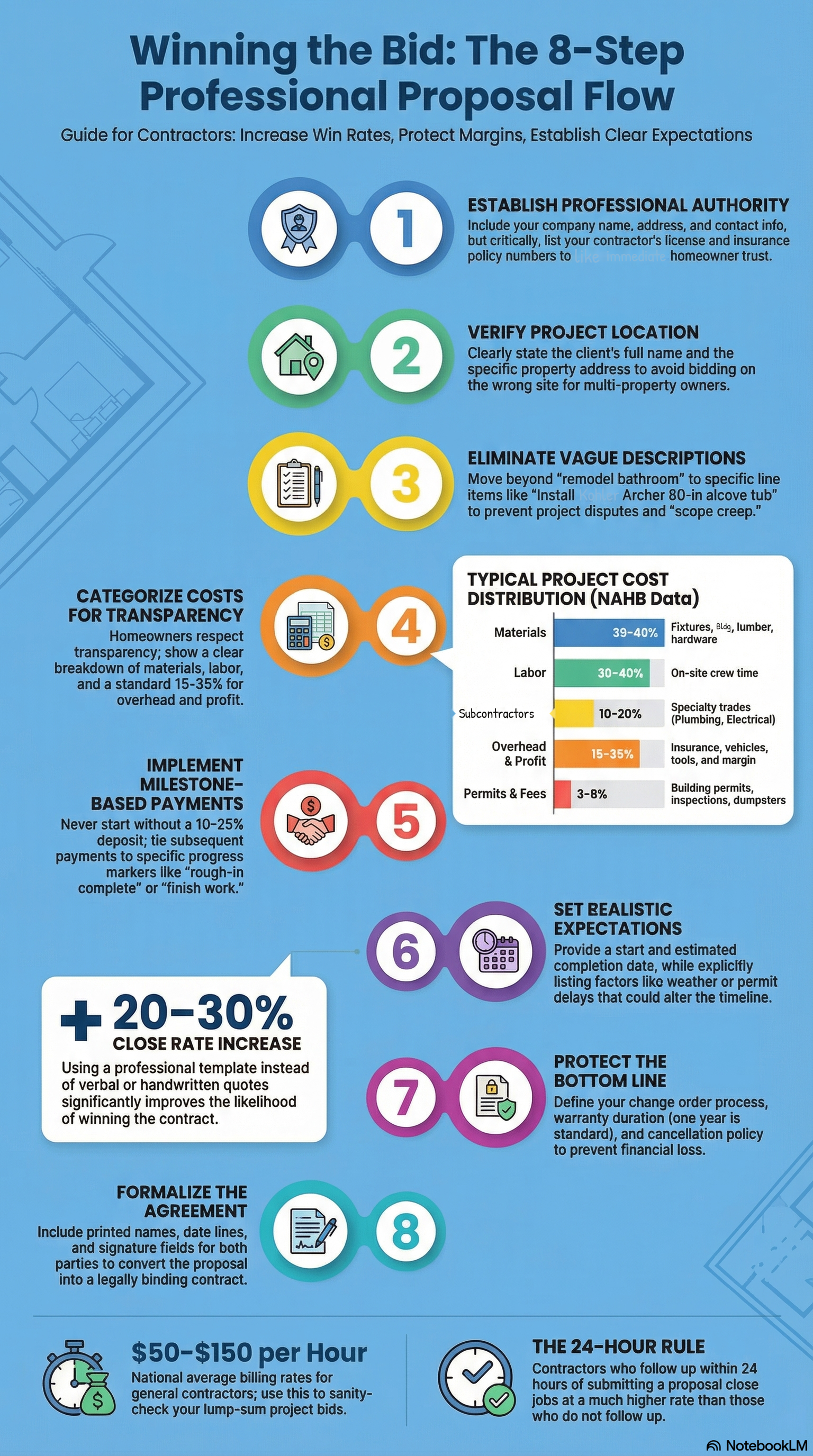
A bid proposal template is a pre-formatted document that outlines your scope of work, pricing breakdown, payment schedule, and terms and conditions for a construction project. A professional proposal takes 15-20 minutes to fill out and can increase your close rate by 20-30% compared to verbal quotes or handwritten estimates, according to NAHB contractor survey data.
Try EstimationPro free to generate detailed estimates that plug directly into your proposal workflow.
What Goes in a Contractor Bid Proposal
Every bid proposal needs these sections. Miss one and you’re either leaving money on the table or opening yourself up to disputes.
1. Company Header and Contact Info
Your company name, license number, phone, email, and address. Include your contractor’s license and insurance policy numbers. Homeowners check this. More importantly, some states require it on written estimates.
2. Client Information
Full name, property address, phone, and email. Get the property address right - you’d be surprised how often contractors bid the wrong house when a client owns multiple properties.
3. Project Description and Scope of Work
This is where most proposals fail. Vague scope kills profitability.
Bad scope line: “Remodel master bathroom”
Good scope line: “Demo existing tub/shower to studs. Install new Kohler Archer 60-in alcove tub with Moen Align fixtures in brushed nickel. Tile surround with 12x24 ceramic tile to 72-in height. Replace existing vanity with 48-in single-sink vanity, quartz top. All plumbing connections to existing rough-in locations.”
The difference? The first version invites arguments. The second version defines exactly what you’re doing and what you’re not doing.
4. Pricing Breakdown
Break costs into categories the homeowner can understand:
| Category | What It Covers | Typical % of Total |
|---|---|---|
| Materials | Fixtures, tile, lumber, hardware | 35-45% |
| Labor | Your crew’s time on site | 30-40% |
| Subcontractors | Plumbing, electrical, HVAC subs | 10-20% |
| Permits and fees | Building permits, inspections, dumpster | 3-8% |
| Overhead and profit | Insurance, truck, tools, your margin | 15-35% |
According to NAHB cost-of-doing-business data, contractor overhead and profit typically runs 15-35% of the project total. That’s not padding - that’s what it costs to run a legitimate business with insurance, vehicles, tools, and warranties.
5. Payment Schedule
Never collect 100% upfront. Never start work without a deposit. Here’s what works:
- Deposit: 10-25% to secure the project and order materials
- Progress payments: Tied to milestones (demo complete, rough-in complete, finish work)
- Final payment: 10-15% due at project completion and client walkthrough
I’ve been doing this for 20 years, and the milestone-based payment schedule protects both sides. The homeowner knows you’re earning every dollar. You know you’re not floating the entire project out of pocket.
6. Timeline and Schedule
Give a start date, estimated completion date, and note what could change the timeline. Weather, permit delays, material backorders - list them. Setting realistic expectations upfront prevents headaches later.
7. Terms and Conditions
Cover the big three:
- Change order process: How changes are handled (written approval + price adjustment before work begins)
- Warranty: What you cover and for how long
- Cancellation policy: What happens if either party needs to walk away
8. Signature Block
Date lines, printed name, and signature for both you and the client. A signed proposal is a contract. Make sure it reads like one.
Bid Proposal vs. Estimate vs. Quote: Know the Difference
These three documents look similar but serve different purposes. Using the wrong one at the wrong time costs you credibility.
| Document | Purpose | Binding? | Level of Detail |
|---|---|---|---|
| Estimate | Rough cost range for planning | No | Low - ballpark numbers |
| Quote | Fixed price for defined scope | Usually yes | Medium - line items |
| Bid Proposal | Complete project package with terms | Yes, when signed | High - scope, price, schedule, terms |
An estimate says “your bathroom remodel will probably run $15,000-$22,000.” A quote says “$18,400 for the work described.” A bid proposal says “$18,400 for the work described, here’s exactly what’s included, here’s the payment schedule, here’s the timeline, and here’s what happens if anything changes.”
Use our Construction Bid Template to format your numbers before plugging them into your full proposal document.
Worked Example: Bathroom Remodel Proposal
Here’s how a real bid proposal pricing section looks for a mid-range bathroom remodel:
| Line Item | Description | Cost |
|---|---|---|
| Demo | Remove tub, vanity, flooring, tile to studs | $1,800 |
| Plumbing rough-in | Relocate drain, new supply lines | $2,400 |
| Electrical | New GFCI outlets, vanity light, exhaust fan | $1,200 |
| Tub/shower install | Kohler Archer tub + tile surround | $3,800 |
| Vanity and countertop | 48-in single-sink, quartz top, Moen faucet | $2,200 |
| Flooring | Luxury vinyl plank, 65 sq ft | $950 |
| Paint and finish | Walls, ceiling, trim, 2 coats | $800 |
| Permits and dumpster | Building permit + 10-yard dumpster | $650 |
| Overhead and profit | Insurance, warranty, management (22%) | $3,100 |
| Total | $16,900 |
Payment schedule for this project:
- Deposit: $4,225 (25%) at contract signing
- Progress 1: $4,225 at rough-in completion
- Progress 2: $4,225 at finish materials installed
- Final: $4,225 at walkthrough and punch list completion
That overhead and profit line is where a lot of contractors get nervous. Don’t hide it. Homeowners respect transparency. I’d rather show a clear 22% O&P line than bury it in inflated line items. The ones who understand business will appreciate it. The ones who don’t were never going to be good clients anyway.
Worked Example: Exterior Painting Proposal
Different trade, same structure:
| Line Item | Description | Cost |
|---|---|---|
| Pressure wash | Full exterior wash, 2,200 sq ft | $450 |
| Prep work | Scrape, sand, caulk, prime bare spots | $1,600 |
| Paint - body | 2 coats Sherwin-Williams Duration, body color | $2,800 |
| Paint - trim | 2 coats, all trim, fascia, soffits | $1,400 |
| Paint - doors/shutters | Front door, garage door, 6 shutters | $600 |
| Materials | Paint, primer, caulk, tape, drop cloths | $850 |
| Overhead and profit | 20% | $1,540 |
| Total | $9,240 |
General contractor billing rates run $50-$150/hour depending on region and specialization (BLS occupational data, May 2024). For a painting proposal like this, you’re pricing the job, not the hours. But knowing your hourly rate helps you sanity-check whether the bid makes sense.
Mistakes That Cost Contractors Jobs
I’ve reviewed hundreds of proposals over the years, both my own and from subs bidding on my projects. Same mistakes keep showing up.
Missing an exclusions section. Your proposal says what you WILL do. It also needs to say what you WON’T do. “This proposal does not include: structural repairs, mold remediation, appliance installation, or landscaping restoration.” Without this, the homeowner assumes everything is included. Then comes the argument.
Vague timelines. “4-6 weeks” means nothing. “Start date: April 14. Estimated completion: May 23. Timeline assumes no weather delays, permit holds exceeding 5 business days, or material backorders.” That’s a timeline.
No change order language. Change orders are how contractors go from profitable to underwater. Your proposal needs a clear statement: “Any changes to the scope of work will be documented in a written change order, approved by both parties, with adjusted pricing and timeline before work proceeds.” Period.
Skipping the warranty section. If you don’t define your warranty, the homeowner will assume whatever makes them happiest. One year on workmanship is standard. Put it in writing.
Sending it as a text message. This still happens. A PDF attached to a professional email beats a screenshot of a notepad every single time.
What Your Proposal Should Look Like (Format Tips)
Clean, professional, scannable. Not fancy.
- PDF format - always. Never send a Word doc or Google Doc link. PDFs look the same on every device and can’t be accidentally edited.
- Your logo at the top - it doesn’t need to be elaborate. Company name, logo, contact info.
- Numbered pages - for multi-page proposals, always
- Consistent font and spacing - pick one font, stick with it
- Total prominently displayed - don’t make them hunt for the number
- Signature lines on the last page - with printed name, date, and signature for both parties
Use the Contractor Markup Calculator to dial in your overhead and profit percentage before you finalize pricing on any proposal.
How to Present Your Proposal
Writing a solid proposal is half the battle. How you deliver it matters just as much.
Present in person when possible. Walk through each section. Answer questions in real time. The homeowner sees your confidence and expertise. That builds trust faster than any document alone.
Send a follow-up email immediately after. Attach the PDF. Thank them for their time. Let them know you’re available for questions. This follow-up is where most contractors drop the ball. They submit the proposal and wait. Then wonder why the homeowner went with someone else.
I’ve seen the numbers on this. Contractors who follow up within 24 hours close at significantly higher rates than those who don’t follow up at all. It’s not magic - it’s just showing up.
Set an expiration date. 30 days is standard. Material prices change. Your schedule fills up. An open-ended proposal tells the homeowner there’s no urgency.
The Digital Proposal Advantage
Paper proposals work. Digital proposals work better. Here’s why.
With a digital proposal system:
- You know exactly when the homeowner opens your proposal
- You can include photos of similar past work right in the document
- Payment processing is built in - the homeowner can approve and pay the deposit in one click
- Automated reminders follow up for you when you’re busy on a job site
- Everything is stored, organized, and searchable
This is exactly the problem EstimationPro was built to solve. You build the estimate, convert it to a professional proposal, and the system handles the follow-up automatically.
Frequently Asked Questions
How long should a contractor bid proposal be?
Most residential proposals run 2-4 pages. One page for scope and pricing, one for terms and payment schedule, and an optional detail page for specifications. Anything over 5 pages and you’re overcomplicating it for a residential client. Commercial proposals are a different story - those can run 20+ pages with bond requirements and insurance certificates.
Should I itemize labor and materials separately?
It depends on your market. Some homeowners want line-item detail. Others just want the bottom number. I typically show category-level breakdown (materials, labor, subs, O&P) without exposing my exact hourly rates or material markup. That gives enough transparency without inviting the homeowner to price-shop individual items.
What’s a normal contractor markup on a bid proposal?
General contractor markup typically ranges from 10-50%, with 20% being the most common for residential remodeling work, according to NAHB and RSMeans data. This covers your overhead (insurance, vehicles, office, tools) and profit. If your markup is under 15%, you’re probably not covering your real costs. If it’s over 40%, you’d better be delivering a premium experience.
Can I use the same template for every project?
Yes, with customization. Your template should be a framework - company info, terms, payment schedule, and signature blocks stay the same. The scope, pricing, timeline, and specifications change for every project. A good template saves you 30-45 minutes per proposal by eliminating the repetitive parts.
What if the homeowner wants changes after I submit my proposal?
That’s what the change order clause is for. Any scope change gets documented in writing with a new price and timeline before you touch it. Verbal change agreements on a job site are how contractors lose money. Get it in writing. Every time.
Share This Infographic
Feel free to share this infographic on your website. Just copy the embed code below:
Copy this embed code:
<a href="https://estimationpro.ai/tools/blog/bid-proposal-template" target="_blank" rel="noopener">
  <img src="https://estimationpro.ai/tools/blog/infographics/bid-proposal-template-infographic.png" alt="bid proposal template infographic by EstimationPro.AI" style="max-width:100%;height:auto" loading="lazy" />
</a>
<p style="font-size:12px;color:#64748B;margin-top:8px">Source: <a href="https://estimationpro.ai/tools/blog/bid-proposal-template">EstimationPro.AI</a></p>
Stop Losing Jobs to Better-Looking Proposals
Your work is solid. Your pricing is fair. But if your proposal looks like it was typed up in 5 minutes, the homeowner is going to wonder what your actual work looks like.
A professional bid proposal doesn’t need to be complicated. It needs to be clear, complete, and confidence-building. Use the template framework above, customize it for each project, and deliver it like a professional.
Contractors on Capterra rate EstimationPro 4.8/5 for time savings on estimates and proposals. Try EstimationPro free - it builds your estimate, generates a professional proposal, sends it to the homeowner, and follows up automatically so you can stop chasing and start building.
Pricing ranges reflect 2026 national averages. Costs vary by region, materials, and project complexity. Always get multiple bids for your specific project.
Pricing a job like this?
Get every line item priced for your area in a full estimate
Describe the job or snap a few photos. Send it from EstimationPro and it follows up with your client for you.
3 free estimates in the first 7 days. No credit card.
Get Free Estimating Tips
Enter your email and we'll send you pro tips, cost data, and useful resources for contractors.
We'll send helpful resources and occasional tips. Unsubscribe anytime.
 EstimationPro AI For Contractors, By Contractors
 Professional Estimates That Follow Up for You
Priced line items, a clean PDF or client link, and automatic follow-up once you send it.