
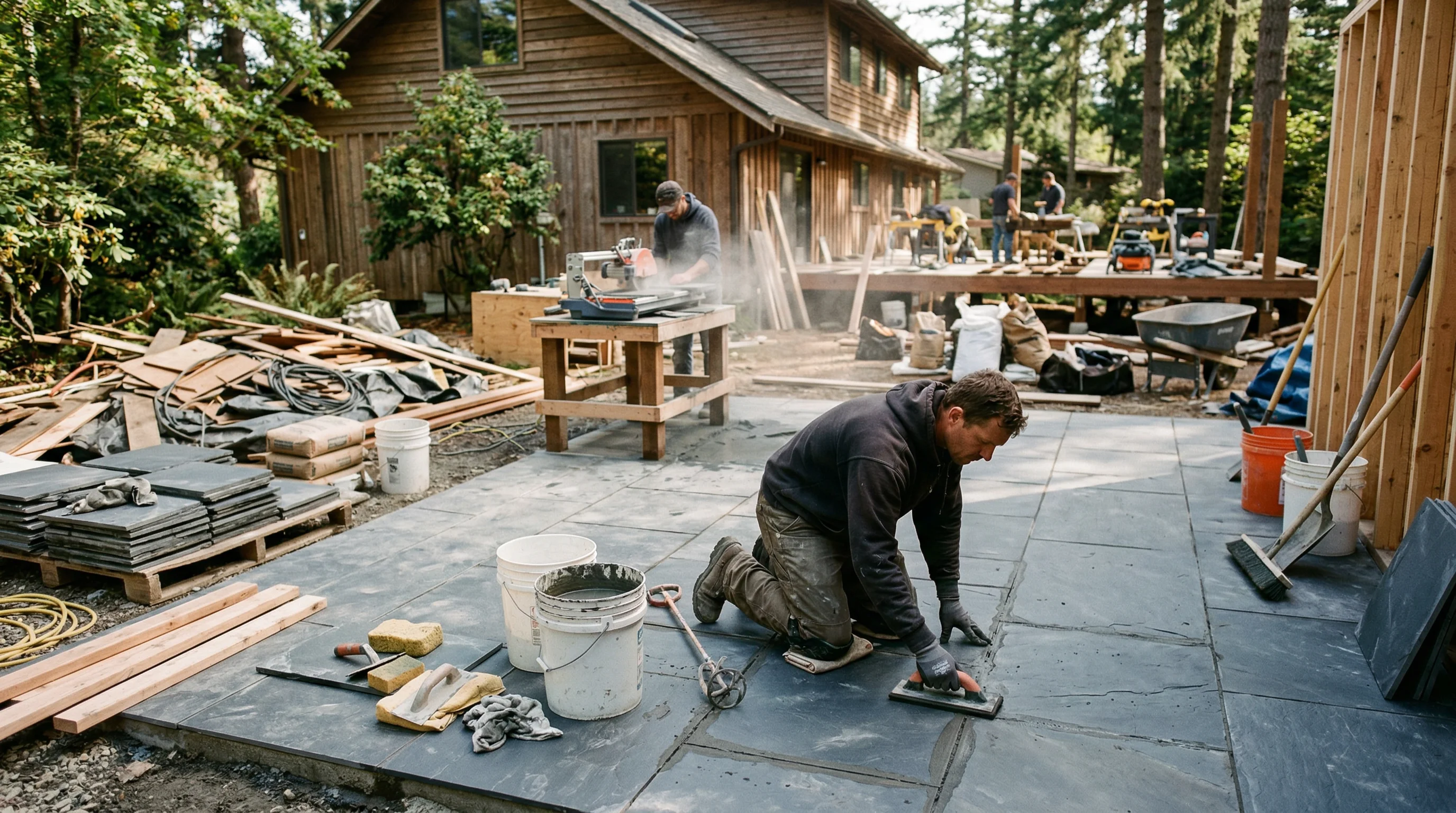
Running out of grout mid-job is amateur hour. You’re on your knees grouting a bathroom floor and the bucket goes empty at 70%. Now you’re driving to the supply house hoping they have the same color in stock. If they don’t? You’re looking at a visible color mismatch that’ll stare at the homeowner every morning for the next 20 years.
Getting your grout estimate right takes five minutes of math. Getting it wrong costs you hours and credibility.
Quick Answer: How Much Grout Do You Need?
A standard 25 lb bag of sanded grout covers 50 to 200 square feet, depending on tile size and joint width. For a typical 12x12 porcelain floor with 1/8-inch joints, one bag covers roughly 95 to 100 square feet. Smaller tiles or wider joints drop coverage fast. Always add 10-15% overage to your grout estimate to avoid mid-job supply runs.
Use our Tile Calculator to get exact material quantities for your project. Try EstimationPro free to build a complete tile estimate with materials, labor, and grout in one place.
How to Calculate Grout Coverage (Step by Step)
Here’s the process I use on every tile job.
Step 1: Measure Your Total Tile Area
Measure length times width for floors. For walls, measure each section separately and add them together. Subtract any openings larger than 2 square feet, like windows and niches.
Step 2: Know Your Tile Size and Joint Width
These two numbers drive everything. Bigger tiles with narrow joints need less grout. Small mosaics with wide joints eat through grout fast.
Common joint widths:
- 1/16 inch - Glass tile, rectified porcelain
- 1/8 inch - Standard floor and wall tile
- 3/16 inch - Natural stone, rustic looks
- 1/4 inch - Saltillo, handmade tile, outdoor
Step 3: Use the Coverage Chart
| Tile Size | 1/8” Joint | 3/16” Joint | 1/4” Joint |
|---|---|---|---|
| 24x24 | 180-200 SF | 120-140 SF | 90-100 SF |
| 12x12 | 90-100 SF | 60-70 SF | 45-50 SF |
| 6x6 | 40-50 SF | 25-35 SF | 18-25 SF |
| 4x4 | 25-35 SF | 18-22 SF | 12-18 SF |
| 3x6 subway | 30-40 SF | 22-28 SF | 15-20 SF |
| 1x1 mosaic | 8-12 SF | 5-8 SF | N/A |
Coverage per 25 lb bag of sanded grout. Unsanded grout covers about 10-20% less per bag. Based on manufacturer coverage charts from Mapei and Custom Building Products (2026).
Step 4: Divide and Round Up
Take your total square footage, divide by the coverage rate from the chart, and round up to the next whole bag. Then add one extra bag for overage.
Formula: (Total SF / Coverage per bag) + 1 bag = bags needed
Grout Types: Which One Goes Where?
Picking the wrong type is worse than running short. Sanded grout in a 1/16-inch joint will crack. Unsanded grout in a 1/4-inch joint will shrink and fall out.
The type you need depends entirely on your joint width and the tile material.
Key rule: Joints 1/8 inch or wider get sanded grout. Joints under 1/8 inch get unsanded. Wet areas with zero maintenance tolerance get epoxy.
Sanded Grout - $10 to $15 per 25 lb Bag
The workhorse. Sand particles fill the joint and resist shrinkage. Use it for most floor tile, wall tile with standard joints, and any joint between 1/8 inch and 1/2 inch. This is what you’ll reach for 80% of the time.
Unsanded Grout - $12 to $20 per 10 lb Bag
Smooth consistency for narrow joints. Essential for glass tile because sand scratches the surface. Also the right choice for polished marble and any joint under 1/8 inch. Comes in smaller bags because you use less per project.
Epoxy Grout - $50 to $80 per Unit
Different animal entirely. Two-part mix that cures rock hard and resists water, stains, and chemicals. Use it in showers, steam rooms, commercial kitchens, and anywhere you need zero-maintenance joints. It’s harder to work with and costs more, but it lasts decades without sealing.
Pricing based on Home Depot and specialty retailer pricing, February 2026.
Worked Example 1: Bathroom Floor (75 SF)
Setup: 12x12 porcelain tile, 1/8-inch sanded grout joints, standard bathroom floor.
| Item | Calculation | Amount |
|---|---|---|
| Tile area | Measured | 75 SF |
| Coverage per bag | 12x12 at 1/8” joint | 95 SF/bag |
| Bags needed | 75 / 95 = 0.79 | 1 bag |
| Overage (1 extra) | Always round up + 1 | 2 bags |
| Grout cost | 2 x $15 | $30 |
Two bags of sanded grout at $15 each. Total grout cost: $30. The overage bag gives you extra for touchups and repairs down the road. I always leave the leftover bag with the homeowner.
Worked Example 2: Kitchen Backsplash (30 SF)
Setup: 3x6 subway tile, 1/16-inch unsanded grout joints, wall application.
| Item | Calculation | Amount |
|---|---|---|
| Tile area | Measured | 30 SF |
| Coverage per bag (1/8”) | 3x6 subway at 1/8” | 35 SF/bag |
| 1/16” adjustment | Narrower joint = ~40% less grout | ~50 SF effective |
| Bags needed | 30 / 50 = 0.6 | 1 bag |
| Grout cost | 1 x $16 (unsanded, 10 lb) | $16 |
One bag of unsanded grout handles a typical backsplash. For subway tile with narrow joints, grout is the cheapest line item on the entire job.
Where Grout Fits in Total Tile Cost
Grout runs 2-4% of your total tile project cost. It’s cheap compared to tile and labor, but running short creates delays that are definitely not cheap. Here’s how the numbers break down for a 100 square foot bathroom floor with mid-range porcelain tile:
| Line Item | Cost | % of Total |
|---|---|---|
| Porcelain tile ($6/SF) | $600 | 40% |
| Installation labor ($8/SF) | $800 | 53% |
| Thinset mortar (2 bags) | $40 | 3% |
| Grout (2 bags) | $30 | 2% |
| Spacers and supplies | $25 | 2% |
| Total | $1,495 | 100% |
Porcelain tile $3-$12/SF, labor $4-$15/SF, thinset $15-$30/bag, grout $10-$25/bag. Sources: Home Depot/Lowe’s retail 2026, BLS Occupational Employment data for tile setters (47-2044) May 2024.
For a detailed breakdown of what tile installers charge in your area, check our tile installation labor cost guide.
Share This Infographic
Feel free to share this infographic on your website. Just copy the embed code below:
Copy this embed code:
<a href="https://estimationpro.ai/tools/blog/grout-estimate" target="_blank" rel="noopener">
  <img src="https://estimationpro.ai/tools/blog/infographics/grout-estimate-infographic.png" alt="grout estimate infographic by EstimationPro.AI" style="max-width:100%;height:auto" loading="lazy" />
</a>
<p style="font-size:12px;color:#64748B;margin-top:8px">Source: <a href="https://estimationpro.ai/tools/blog/grout-estimate">EstimationPro.AI</a></p>
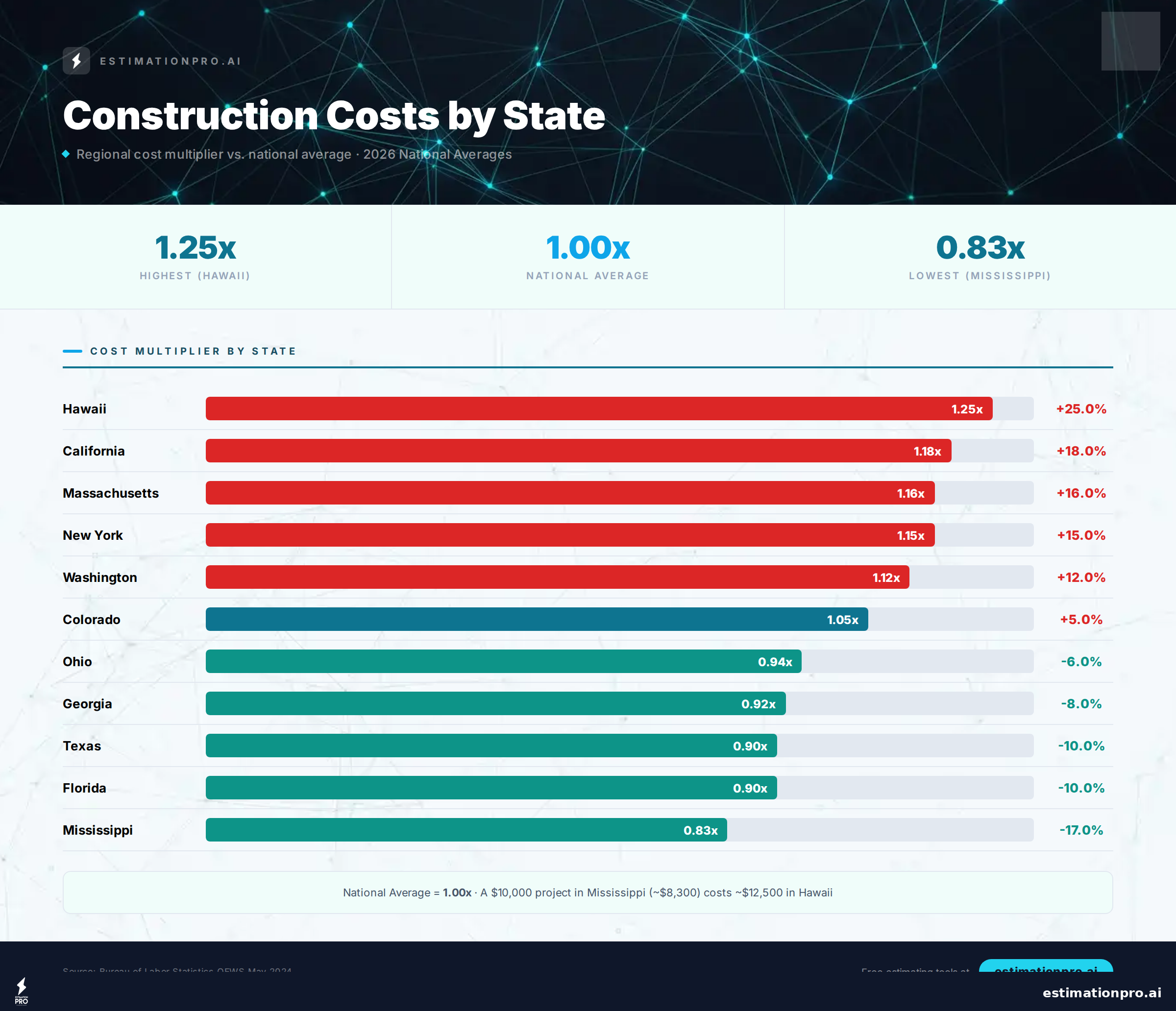
Prices vary by region. Costs shown reflect national averages for 2026.
Common Grout Estimating Mistakes
-
Forgetting the waste factor. Grout gets on your sponge, your bucket, your float. Some goes down the drain during cleanup. Plan for 10-15% waste no matter how careful you are.
-
Not accounting for tile thickness. Thicker tiles mean deeper joints. A 3/8-inch thick tile creates a much deeper grout joint than a 1/4-inch tile. Deeper joints use more grout per square foot.
-
Mixing the wrong type. Sanded grout in narrow joints cracks. Unsanded grout in wide joints shrinks. Match the grout type to your joint width every time.
-
Buying from different lots. Color varies between production batches. Buy all your grout at once from the same lot. Check the lot numbers on the bags before you leave the store.
-
Skipping the sealer. Cement-based grout absorbs water and stains without sealer. Apply a penetrating sealer 48-72 hours after grouting. Skip this step and you’ll be back in six months to fix stained joints.
Pro Tips for Accurate Grout Estimates
-
Measure twice, order once. Walk the job and measure every surface getting tile. Include niches, shower benches, and feature walls that people forget about.
-
Round up, always. Grout is cheap. A return trip to the store is not. One extra bag costs $15. Having your crew wait while you drive to the supply house costs $100+.
-
Keep the leftover bag. Store it sealed in a dry place. Hand it to the homeowner for future repairs. They’ll remember that.
-
Check coverage rates on the bag. Manufacturer specs vary slightly. Mapei and Custom Building Products publish coverage charts right on the packaging. Use those numbers, not a guess.
-
Factor in layout patterns. Herringbone and diagonal patterns create more cuts and more grout joints. Add 5-10% extra grout for pattern layouts versus straight stack.
FAQ
How many square feet does a 25 lb bag of grout cover?
A 25 lb bag of sanded grout covers 50 to 200 square feet, depending on tile size and joint width. Large format tile (24x24) with narrow joints gives you maximum coverage. Small mosaic tile with wide joints drops coverage to under 15 square feet per bag.
What is the difference between sanded and unsanded grout?
Sanded grout contains fine sand and is used for joints 1/8 inch or wider. The sand resists shrinkage in wider joints. Unsanded grout has no sand, produces a smoother finish, and works for joints under 1/8 inch. Use unsanded on glass tile and polished stone to avoid scratching the surface.
How much does grout cost per square foot?
Grout costs roughly $0.15 to $0.60 per square foot for sanded grout, depending on tile size and joint width. For a typical 12x12 tile floor with 1/8-inch joints, grout runs about $0.15 to $0.20 per square foot. Epoxy grout costs 3 to 5 times more but eliminates the need for sealing.
Should I seal grout after installation?
Yes, seal cement-based grout (sanded and unsanded) 48 to 72 hours after installation. Sealer prevents staining and moisture absorption. Reapply every 1 to 2 years in high-traffic areas. Epoxy grout does not need sealing.
How do I estimate grout for mosaic tile?
Mosaic tile uses significantly more grout than standard tile. A 12x12 sheet of 1x1 mosaics has far more joint area than a single 12x12 tile covering the same space. Budget 3 to 5 times more grout per square foot for mosaics compared to large format tile. Check the coverage chart above for specific numbers.
Build Your Complete Tile Estimate
Grout is one line item in a tile project, but getting it right means no mid-job supply runs and no color mismatches. Use the formulas and charts above to nail your quantities before you start mixing.
Ready to estimate your next tile job? EstimationPro handles the full workflow for you: detailed line-item estimates, professional proposals that win trust, and automated follow-up sequences that chase down approvals so you don’t have to. Try EstimationPro free and stop spending your evenings on spreadsheets.
Pricing a job like this?
Get every line item priced for your area in a full estimate
Describe the job or snap a few photos. Send it from EstimationPro and it follows up with your client for you.
3 free estimates in the first 7 days. No credit card.
100 SF Bathroom Floor Tile Cost Breakdown
Grout Types Compared
- Best for joints 1/8 inch to 1/2 inch
- Floors, walls, and countertops
- Most common for tile work
- Textured finish, very durable
- Joints under 1/8 inch only
- Walls, mosaics, and glass tile
- Smooth finish
- Safe for polished stone
- Any joint width
- Waterproof and stain-proof
- Showers, pools, and commercial
- Requires experienced installer
Get Free Estimating Tips
Enter your email and we'll send you pro tips, cost data, and useful resources for contractors.
We'll send helpful resources and occasional tips. Unsubscribe anytime.
 EstimationPro AI For Contractors, By Contractors
 Save 2+ Hours on Every Estimate
Upload photos, record voice notes, and get AI-powered estimates with line items, material lists, and regional pricing.