
I’ve lost money on both fixed-price jobs and T&M jobs. Different reasons each time, but the same root cause: I picked the wrong pricing model for the project in front of me.
That one mistake will cost you more than bad material prices ever will. And most contractors never stop to think about it. They just bid the way they’ve always bid.
Quick Answer
Fixed price means you quote one number and eat any overages. Time and materials (T&M) means you bill actual hours and materials plus markup. Fixed price works when the scope is clear and you can control variables. T&M works when unknowns exist and the scope will shift. Most residential remodelers should use fixed price for 60-70% of their jobs and T&M for the rest. The key is knowing which model protects your profit on each specific project.
Try EstimationPro free to build detailed, line-item estimates for either pricing model in minutes instead of hours.
Fixed Price vs T&M at a Glance
| Factor | Fixed Price | Time & Materials |
|---|---|---|
| Who carries the risk | Contractor | Client |
| Scope clarity needed | High - must define everything upfront | Low - scope can evolve |
| Profit potential | Higher if you estimate well | Capped by your hourly rate + markup |
| Client trust required | Lower - price is locked | Higher - they’re writing blank checks |
| Change order frequency | More formal change orders | Fewer - just adjust the hours |
| Best for | Standard remodels, defined scope | Repairs, older homes, discovery work |
| Typical markup range | 20-50% built into the bid | 10-20% on top of actual costs |
Source: NAHB builder cost data and industry standard practice for residential remodeling.
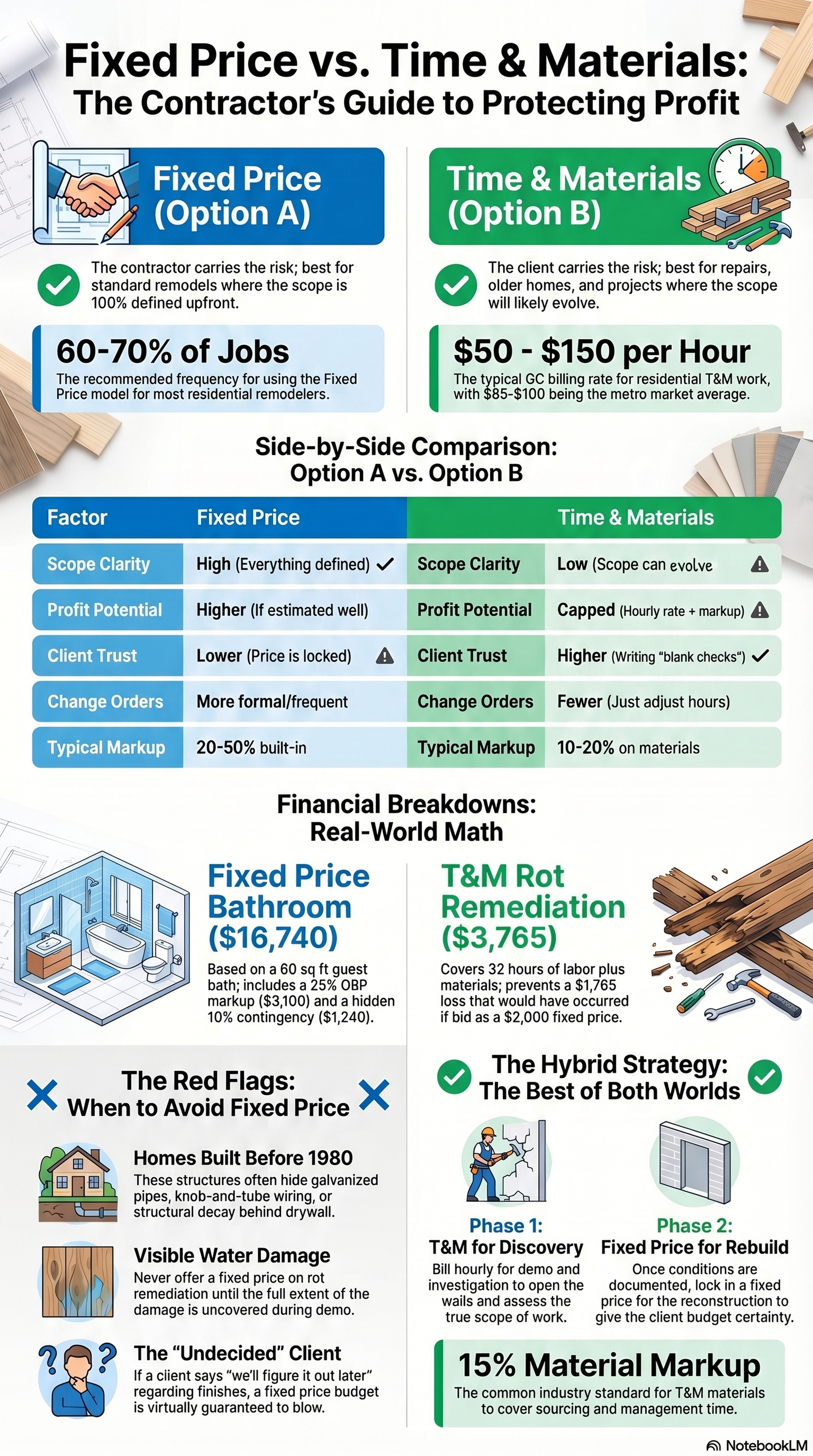
Share This Infographic
Feel free to share this infographic on your website. Just copy the embed code below:
Copy this embed code:
<a href="https://estimationpro.ai/tools/blog/fixed-price-vs-t-and-m" target="_blank" rel="noopener">
  <img src="https://estimationpro.ai/tools/blog/infographics/fixed-price-vs-t-and-m-infographic.png" alt="fixed price vs t&m infographic by EstimationPro.AI" style="max-width:100%;height:auto" loading="lazy" />
</a>
<p style="font-size:12px;color:#64748B;margin-top:8px">Source: <a href="https://estimationpro.ai/tools/blog/fixed-price-vs-t-and-m">EstimationPro.AI</a></p>
When Fixed Price Protects You
Fixed price is the default for a reason. Homeowners want a number. They want to know what they’re signing up for. And honestly, as a contractor, a locked-in price forces you to plan better.
Here’s when it works:
- The scope is fully defined. Custom cabinets selected, tile picked out, fixtures chosen. No open questions left.
- You’ve done this exact type of job before. Your production rates are dialed in.
- The house is newer or recently inspected. Less chance of surprises behind the walls.
- The client is budget-conscious. They need a ceiling. T&M terrifies them.
Worked Example: Fixed Price Bathroom Remodel
Standard guest bathroom gut-and-replace, 60 sq ft, 1985 home (recently inspected, no known issues):
| Line Item | Cost |
|---|---|
| Demo and haul-off | $1,200 |
| Plumbing rough-in | $2,800 |
| Electrical (new GFCI, fan, light) | $1,400 |
| Cement board and waterproofing | $900 |
| Tile - floor and shower surround | $3,200 |
| Vanity, toilet, fixtures | $2,100 |
| Paint and trim | $800 |
| Subtotal | $12,400 |
| Overhead & profit (25%) | $3,100 |
| Contingency (10%) | $1,240 |
| Fixed Price to Client | $16,740 |
That 10% contingency is your buffer. If demo goes clean and plumbing cooperates, you pocket it. According to NAHB survey data, the average O&P markup for residential remodelers runs 15-35%, with 25% being the sweet spot for most small-to-mid contractors.
Notice the contingency is built into your number. The client never sees it as a line item. They see $16,740 and that’s what they pay.
When T&M Saves Your Business
Here’s where fixed price gets dangerous. You open up a wall in a 1970s ranch and find galvanized pipe, knob-and-tube wiring, and a subfloor that crumbles when you step on it.
Now what? Your fixed price just became a losing bet.
T&M is the right call when:
- You can’t see what you’re dealing with. Older homes, water damage, anything behind walls or under floors.
- The client keeps changing their mind. Some people pick tile, then change it, then change it again. T&M absorbs that.
- It’s repair work, not remodel work. Leak chasing, rot remediation, structural fixes. The scope reveals itself as you go.
- Discovery phase. Demo a section to assess conditions before committing to a full bid.
Worked Example: T&M Rot Remediation
Client calls about a soft spot near the tub. You suspect water damage but won’t know the extent until you open it up.
| Item | Hours/Qty | Rate | Total |
|---|---|---|---|
| Demo and investigation | 6 hrs | $90/hr | $540 |
| Subfloor replacement (plywood + labor) | 8 hrs + $180 materials | $90/hr + materials | $900 |
| Sistered floor joists | 4 hrs + $120 materials | $90/hr + materials | $480 |
| Plumbing repair (leaking drain) | 4 hrs | $110/hr (sub) | $440 |
| Cement board + re-tile | 10 hrs + $400 materials | $90/hr + materials | $1,300 |
| Materials markup (15%) | - | - | $105 |
| T&M Total | 32 hrs | - | $3,765 |
GC billing rates for residential work typically run $50-$150 per hour depending on your market, according to HomeGuide and BLS data for first-line construction supervisors.
If you had quoted this fixed at $2,000 based on what you could see from the surface, you’d have lost $1,765 on a single job. I’ve been there. That was an expensive lesson.
The Mistake That Costs Contractors the Most
It’s not choosing the wrong model. It’s being afraid to use T&M when the job clearly calls for it.
Most contractors default to fixed price because that’s what clients expect. But quoting a fixed number on a job full of unknowns is gambling. You’re betting your profit that nothing bad is hiding behind that drywall.
I’ve talked to contractors who lost $5,000-$10,000 on a single bathroom because they were too nervous to propose T&M. They figured the client would walk. Sometimes they do. But the ones who walk were going to be a headache anyway.
The contractors who do well with T&M explain it clearly. They say something like: “I can give you a fixed price, but I’d have to pad it by 30% to cover what I can’t see. Or we can do time and materials, you’ll see every receipt, and you’ll probably pay less because we only fix what’s actually broken.”
That framing works.
A Hybrid Approach That Works in the Field
You don’t have to pick one or the other for every phase of a project. Smart contractors mix them.
Phase 1 - T&M for demo and discovery. Open the walls, document conditions, assess the real scope. Bill hourly for this phase.
Phase 2 - Fixed price for the rebuild. Now that you can see everything, you can estimate accurately. Lock in a fixed price for the reconstruction.
This protects you during the risky phase and gives the client the certainty they want for the expensive phase. Pair this approach with a solid construction estimate template so both phases are documented professionally. I use this approach on about 20% of my jobs, especially older homes in the Pacific Northwest where moisture damage is practically guaranteed once you start peeling back layers.
How Your Markup Changes by Model
The markup conversation is different for each model.
Fixed price markup: Your profit lives inside the bid. Typical GC markup runs 20-50% on subcontractor and material costs, with the overhead and profit (O&P) component landing at 15-35% for most residential contractors. If the difference between markup and margin still confuses you, sort that out first. You build it in, the client doesn’t see it broken out, and your accuracy determines whether you actually make that money.
T&M markup: Your profit comes from the hourly billing rate spread plus a materials markup, usually 10-20% on materials. The client sees everything, so your margin is transparent. The upside is lower risk. The downside is capped profit. You won’t hit a home run on a T&M job, but you won’t strike out either.
Use the Contractor Markup Calculator to dial in your numbers for either model.
Red Flags That Say “Don’t Quote Fixed Price”
Stop and switch to T&M if any of these are true:
- The home was built before 1980 and you haven’t opened any walls yet
- There’s visible water damage near the work area
- Previous work was done without permits (you’ll find surprises)
- The client can’t decide on finishes and keeps saying “we’ll figure it out later”
- You’ve never done this exact type of job and your production rate estimates are guesses
Any one of these can blow a fixed-price budget. Two or more together? You’re asking to lose money.
What Homeowners Need to Hear
If you’re reading this as a homeowner, here’s the honest version.
Fixed price gives you certainty. You know what you’re paying. But that certainty has a cost - your contractor has to build a buffer into the price for things that might go wrong. You’re paying for the insurance whether you need it or not.
T&M can save you money when the scope is uncertain, because you only pay for actual work performed. But it requires trust. You need a contractor who documents everything, shows you receipts, and communicates daily.
Either way, the cheapest bid is usually the worst value. A contractor who underbids on fixed price will either cut corners or hit you with change orders once they’re halfway through your kitchen and you can’t easily switch. I’ve seen it happen dozens of times.
Frequently Asked Questions
Is T&M always more expensive than fixed price?
No. T&M often comes in lower on projects with significant unknowns because the contractor doesn’t have to pad the bid with a large contingency. On a bathroom with water damage, a fixed-price bid might include $3,000-$5,000 in padding that T&M would only charge if the damage actually exists.
What markup is fair on T&M materials?
Industry standard runs 10-20% on materials for T&M work. This covers your time sourcing, picking up, transporting, and managing materials. A 15% markup on materials is common and reasonable for residential remodeling.
Can I switch from fixed price to T&M mid-project?
Yes, but document it with a change order. This happens regularly when demo reveals unexpected conditions. The original fixed-price scope stays intact, and the new discovery work shifts to T&M with a separate agreement. Put it in writing before the extra work starts.
How do I explain T&M to a homeowner who wants a fixed price?
Lead with transparency. Explain that a fixed price on an uncertain job means you’d have to add 20-30% padding to cover unknowns, and they’d pay that whether the problems exist or not. Offer to show them every receipt and time log. Most reasonable homeowners prefer honest T&M over an inflated fixed bid once they understand the math.
What’s a typical GC hourly rate for T&M work?
GC billing rates for residential work typically range from $50 to $150 per hour, with $85-$100 being common in most metro markets according to HomeGuide 2026 data. This rate covers the contractor’s time, overhead, insurance, and profit, not just labor wages.
Contractors using EstimationPro report cutting their estimate time by over 2 hours per bid. Whether you’re pricing fixed or T&M, EstimationPro builds the estimate, generates a professional proposal, and follows up with the homeowner automatically so you win more of the bids you already send. Try EstimationPro free
Pricing a job like this?
Get every line item priced for your area in a full estimate
Describe the job or snap a few photos. Send it from EstimationPro and it follows up with your client for you.
3 free estimates. No credit card.
Get Free Estimating Tips
Enter your email and we'll send you pro tips, cost data, and useful resources for contractors.
We'll send helpful resources and occasional tips. Unsubscribe anytime.
 EstimationPro AI For Contractors, By Contractors
 Price Every Job With Confidence
Stop second-guessing your numbers. EstimationPro prices every line with labor and material rates adjusted for your region.