

Last spring I bid a kitchen remodel on a Tuesday morning. The homeowner wanted a number by Friday. I knew two other contractors were quoting it. So I pulled out my phone, walked the kitchen, snapped 14 photos, and dictated a two-minute voice note about scope. The estimate was in her inbox before I left the driveway. I won the job.
That used to take me three hours at a desk. AI takeoff software is the reason it doesn’t anymore.
There’s a lot of confusion about what AI takeoff software actually is, what it costs, and whether it works for residential remodelers vs. commercial GCs. So let me break down the real options. Try EstimationPro free if you want to skip ahead and just see what photo-and-notes estimating looks like.
Quick Answer: What Is AI Takeoff Software?
AI takeoff software uses computer vision and machine learning to count quantities, measure areas, and generate cost estimates from either jobsite photos, voice notes, or 2D blueprints. Two flavors exist. Photo-and-notes tools (best for remodelers) read site conditions and produce a line-item bid in minutes. Plan-reader tools (best for new construction) ingest PDF plans and output material quantities for spreadsheet export.
How AI Takeoff Software Compares to Manual Takeoff
| Method | Time per Bid | Accuracy vs. Field | Cost | Best For |
|---|---|---|---|---|
| Pencil and scale ruler | 4 to 8 hours | Depends on estimator skill | Free | Solo contractors who like paper |
| Excel + measured plans | 2 to 5 hours | Good if formulas are dialed in | Free to $30/mo | Backbone of most GC offices |
| Photo and notes AI | 5 to 15 min | Strong on remodels, weak on plan reading | $0 to $79/mo | Residential remodelers |
| 2D plan reader AI | 30 to 90 min | Strong on plan reading, needs review | $99 to $399/mo | New construction, commercial |
| Enterprise BIM suite | 2 to 8 hours after setup | Highest, but garbage in = garbage out | $500 to $2,000/mo | Large GCs |
The cost of an estimator’s time is the hidden number nobody talks about. A general contractor’s billing rate runs $50 to $150 per hour according to BLS data on first-line construction supervisors. If you bill yourself at $90 per hour and you spend three hours on a takeoff, that’s $270 of your time on a bid you might not even win.
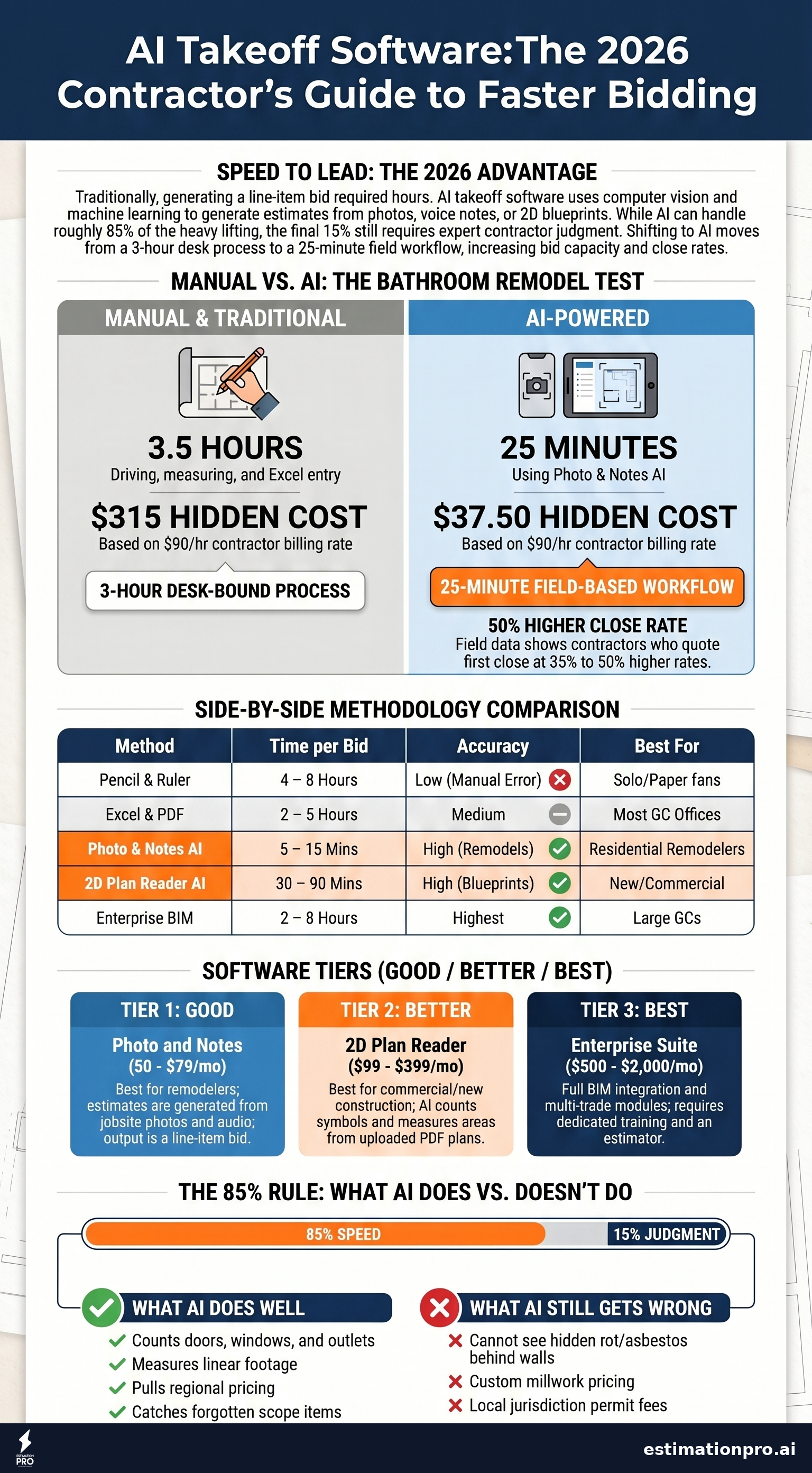
Share This Infographic
Feel free to share this infographic on your website. Just copy the embed code below:
Copy this embed code:
<a href="https://estimationpro.ai/tools/blog/ai-takeoff-software-construction" target="_blank" rel="noopener">
  <img src="https://estimationpro.ai/tools/blog/infographics/ai-takeoff-software-construction-infographic.png" alt="ai takeoff software construction infographic by EstimationPro.AI" style="max-width:100%;height:auto" loading="lazy" />
</a>
<p style="font-size:12px;color:#64748B;margin-top:8px">Source: <a href="https://estimationpro.ai/tools/blog/ai-takeoff-software-construction">EstimationPro.AI</a></p>
What AI Takeoff Actually Does (and Doesn’t Do)
I’ve used three of the tools below on real bids. Here’s what’s true and what’s marketing fluff.
What it does well
- Counts repetitive items (doors, windows, outlets, fixtures)
- Measures rectangular areas and linear footage
- Generates a structured line-item bid in seconds
- Pulls regional pricing from databases
- Catches scope items you forgot to mention
What it still gets wrong
- Hidden conditions behind walls (rot, knob-and-tube wiring, asbestos)
- Slope adjustments on irregular roofs without proper photos
- Custom millwork pricing (you still need a real fabricator quote)
- Permit fees specific to your jurisdiction
- Demo and disposal costs in tight urban lots
The honest answer: AI takeoff gets you to 85 percent in 5 percent of the time. The last 15 percent is judgment. That’s still your job.
Real Pricing for the Top AI Takeoff Tools
I dug through pricing pages, sales calls, and contractor forums in March 2026. Here’s what the popular tools actually cost.
| Tool | Type | Starting Price | Free Trial | Strength |
|---|---|---|---|---|
| EstimationPro | Photo + notes + audio | $0 free tier, $49/mo Pro | 7 days Pro | Residential remodel speed |
| Togal.AI | 2D plan reader | $99/mo | 14 days | Commercial drywall and paint |
| Kreo | 2D + BIM | $179/mo | Demo only | Steel and concrete takeoffs |
| Beam AI | 2D plan reader | $129/mo | 14 days | Multifamily and light commercial |
| STACK | 2D plan reader | $199/mo | 14 days | Roofing and exterior trades |
| PlanSwift Pro | 2D plan reader | $1,795/yr | 14 days | Large GC offices |
| Trimble Autobid | Enterprise BIM | Quote only | Sales-led | Mechanical and electrical |
A note on the “free roof estimate” crowd. Some “AI takeoff” services that promise free estimates from satellite imagery (EagleView, Hover) are not really estimating tools. They sell you measurements, then you do the pricing yourself. Useful, but a different product. We have a separate piece on free roofing estimates if that’s what you came for.
Worked Example 1: Manual Takeoff for a Bathroom Remodel
Job: 60 square foot master bath, full gut, mid-range finishes. Pacific Northwest.
Manual process:
- Drive to site, measure room (30 min)
- Photograph existing conditions (15 min)
- Pull pricing from suppliers (45 min)
- Build line items in Excel (60 min)
- Calculate labor at carpenter rate of $30/hr typical with 35 percent burden (20 min)
- Add 25 percent overhead and profit (10 min)
- Format proposal and send (30 min)
Total: 3 hours and 30 minutes of admin time.
Final bid: $24,800.
If I bill my time at the typical contractor rate of $90 per hour, that’s $315 of my time on one bid. Win rate on cold bids in remodel is around 1 in 4 in my experience. So the real cost per won job is closer to $1,260 in admin time alone.
Worked Example 2: AI Takeoff for the Same Bathroom
Same job, same scope. Photo-and-notes AI workflow:
- Drive to site, take 12 photos and a 90-second voice note (15 min on site)
- Upload to EstimationPro on phone (1 min)
- AI generates line-item estimate (45 seconds)
- Review, edit two line items, confirm regional pricing (8 min)
- Send proposal directly from app (1 min)
Total: 25 minutes. Bid in the homeowner’s inbox before I leave the driveway.
Final bid: $24,400.
The numbers come out within $400 of each other because the AI is pulling from the same pricing database I’d use manually. The difference isn’t accuracy. It’s speed. Speed wins more bids because contractors who quote first close at 35 to 50 percent higher rates than those who quote third or fourth, based on field data from sales coaches like Mark Jewett.
What Homeowners Don’t See
Most homeowners have no clue how much a remodel actually costs to bid out. They think we run some numbers and email them a quote. They don’t see the three hours of measuring, pricing, and re-pricing. They don’t see us re-doing the bid because the supplier raised prices on Tuesday. They don’t see the $300 in admin cost that goes into every losing quote.
That’s the real problem AI takeoff solves. Not “fancy automation.” Not “the future of construction.” It’s getting your evening back. Getting home to your kids instead of hunched over a spreadsheet at 9 PM.
Common Mistakes Switching to AI Takeoff
I see contractors blow this in the same three ways every time.
- They trust the first output. AI gets you to 85 percent. You still have to know what 100 percent looks like. If you don’t know your trade, AI won’t save you. It’ll just produce wrong bids faster.
- They skip the photo discipline. Bad photos = bad bids. Take wide shots, then close-ups of every condition. Show the floor, the ceiling, and any electrical or plumbing visible.
- They use plan-reader tools for remodels. A plan reader needs plans. Most remodels don’t have plans. Use a photo-and-notes tool for remodels and a plan reader for new construction or commercial. Wrong tool = wrong results.
When AI Takeoff Is Not the Answer
Be honest about scope. AI takeoff is not for:
- Custom architectural millwork (still need a fabricator quote)
- Historic restoration (every condition is unique)
- Insurance claims requiring Xactimate format (use Xactimate)
- Bid-build commercial with full contract documents (enterprise BIM is better)
If you’re a remodeler doing kitchens, baths, additions, decks, and basements, photo-and-notes AI is the single best tool you can pick up this year. If you’re a commercial GC bidding off plans, a 2D plan reader pays for itself in two weeks.
How to Pick the Right Tool
I’d ask these four questions before paying for anything.
- What do my bids actually look like? Plans? Photos? Walk-throughs?
- How fast do I need to respond? Same day? 48 hours? A week?
- Who else uses my output? Just me? A PM? A subcontractor crew?
- What’s my real billing rate? Multiply hours saved by your hourly rate to get the real ROI.
Most residential contractors I talk to need same-day turnaround on a walk-through. Photo-and-notes AI is built for that. Most commercial GCs need detailed quantity reports off plans. 2D plan readers are built for that.
Build the Whole Workflow, Not Just the Estimate
Here’s where most contractors stop short. They get faster at estimating, then lose bids because they don’t follow up. I’ve watched contractors send a perfect $40K kitchen quote, hear nothing for two weeks, and assume the homeowner went with someone else. Half the time the homeowner just got busy. A single follow-up email would have closed the deal.
That’s why we built EstimationPro to handle the full workflow. Estimate from photos. Send the proposal. Automatically follow up with the homeowner on day 3, day 7, and day 14. Convert to invoice when accepted. Get paid. The estimate is just the start.
FAQ
Is AI takeoff software accurate enough for real bids?
Yes for quantities, with review. AI takeoff handles 85 percent of standard scope accurately when fed good inputs (clear photos or full plans). The remaining 15 percent is judgment, hidden conditions, and local pricing nuance that a contractor still has to apply. Treat the output as a draft you finalize, not a final bid.
What’s the cheapest AI takeoff tool that actually works?
EstimationPro has a free tier that handles photo-and-notes estimating with no credit card. For 2D plan reading, Togal.AI at $99 per month is the entry point. Anything under $50 per month for plan reading is usually a wrapper on a free OCR API and produces unreliable counts.
Can AI takeoff replace my estimator?
No. It can let one estimator do the work of three. The bottleneck isn’t quantities. It’s pricing judgment, scope clarification, and client communication. Tools that promise to “replace” your estimator are selling fantasy. Tools that promise to give your estimator three hours back per bid are selling reality.
How long does it take to learn AI takeoff software?
Photo-and-notes tools take about 30 minutes to learn. You snap photos, you talk into the app, you get an estimate. Plan-reader tools take 4 to 12 hours of training plus a project or two of practice. Enterprise BIM suites take weeks and usually require a dedicated implementer.
Does AI takeoff work without internet at the jobsite?
Most tools require internet to process. EstimationPro lets you record photos and notes offline, then syncs and processes when you have signal. For rural sites with no signal, capture everything offline and process at the truck or office.
What about pricing data accuracy?
The best tools pull from regional databases (RSMeans, BLS labor wage data, NAHB cost surveys) and update monthly. Cheap tools use static national averages from 2022 and produce stale bids. Always check that pricing reflects your zip code and current material costs. Regional pricing varies by 30 percent or more between markets.
Pricing Reference and Disclaimer
All prices in this article reflect Pacific Northwest markets in April 2026. Software pricing is current as of March 2026 from vendor sites. Labor rates use BLS construction wage data (occupation codes 47-2031 carpenter, 47-1011 first-line supervisor) and HomeGuide 2026 contractor rate surveys. Your market may vary by 20 to 30 percent in either direction.
For more on pricing your work correctly, see our guide on contractor markup vs margin and our burdened labor rate calculator.
Stop Losing Bids to Slow Quotes
Every estimate you take three days to send is a bid the next contractor wins. Speed isn’t optional anymore. Photo-and-notes AI cuts your estimating time from hours to minutes, which means you respond first, look more professional, and quote more jobs per week.
But the estimate is just the front door. The real money lives in follow-up. Contractors using EstimationPro report 2 hours saved per bid and a measurable lift in close rate, mostly from the automated follow-up sequences that nudge homeowners on day 3, day 7, and day 14 without you lifting a finger. Estimate, propose, follow up, invoice, get paid. All in one place.
Try EstimationPro free and see what photo-and-notes estimating looks like on your next walk-through. No credit card. No commitment. Just a faster way to bid the work you’re already doing.
AI Takeoff Software Tiers
- Estimate from jobsite photos and audio notes
- Best for remodelers and small contractors
- Output is a line-item bid, not a 2D takeoff
- 5 to 15 minutes per estimate
- Example: EstimationPro free tier
- Upload PDF plans, AI counts symbols and measures areas
- Best for new construction and commercial bids
- Outputs material quantities for export
- 30 to 90 minutes per project after setup
- Examples: Togal.AI, Beam AI, Kreo
- Full BIM integration, multi-trade modules
- Best for large GCs and design-build firms
- Requires training and dedicated estimator
- Weeks to onboard
- Examples: Trimble Autobid, STACK, PlanSwift Pro
Get Free Estimating Tips
Enter your email and we'll send you pro tips, cost data, and useful resources for contractors.
We'll send helpful resources and occasional tips. Unsubscribe anytime.
 EstimationPro AI For Contractors, By Contractors
 Create Detailed Estimates in Minutes, Not Hours
Upload photos, record voice notes, and get AI-powered estimates with line items, material lists, and regional pricing.