
$10,000 in costs plus 20% markup. That’s a $12,000 bid. What’s your margin?
If you said 20%, you just lost money on paper. The real margin is 16.7%. And if you’ve been bidding this way for years, that 3.3% gap on every single job is the difference between a good year and a great one.
Markup and margin are not the same thing. Most contractors I talk to use the words like they are. They’re not, and the math will burn you if you don’t know the difference. This guide breaks down the formulas, shows you worked examples from actual bids, and gives you the numbers you need to stop leaving money on the table. Try EstimationPro free if you want a tool that does this math for you automatically.
Quick Answer
Markup is the percentage you add on top of your costs. Margin is the percentage of the final price that is profit. Same dollars, different math. A 20% markup on $10,000 in costs gives you a $12,000 price and a $2,000 profit, which is 16.7% margin. To hit a true 20% margin, you need a 25% markup. Every contractor needs to know both numbers cold because margin is what pays your bills, not markup.
The Two Formulas You Need
Here’s the math, stripped down.
Markup formula:
Price = Cost × (1 + Markup %)
Markup % = (Price - Cost) / Cost
Margin formula:
Margin % = (Price - Cost) / Price
Price = Cost / (1 - Margin %)
Same two numbers. Different denominator. Markup divides by cost. Margin divides by price. That one change is why a 20% markup never gives you a 20% margin. The price is always bigger than the cost, so the margin number is always smaller than the markup number.
I use our free contractor markup calculator when I want to go from cost to price, and the profit margin calculator when I want to check what a bid is actually earning me. Two tools, two questions.
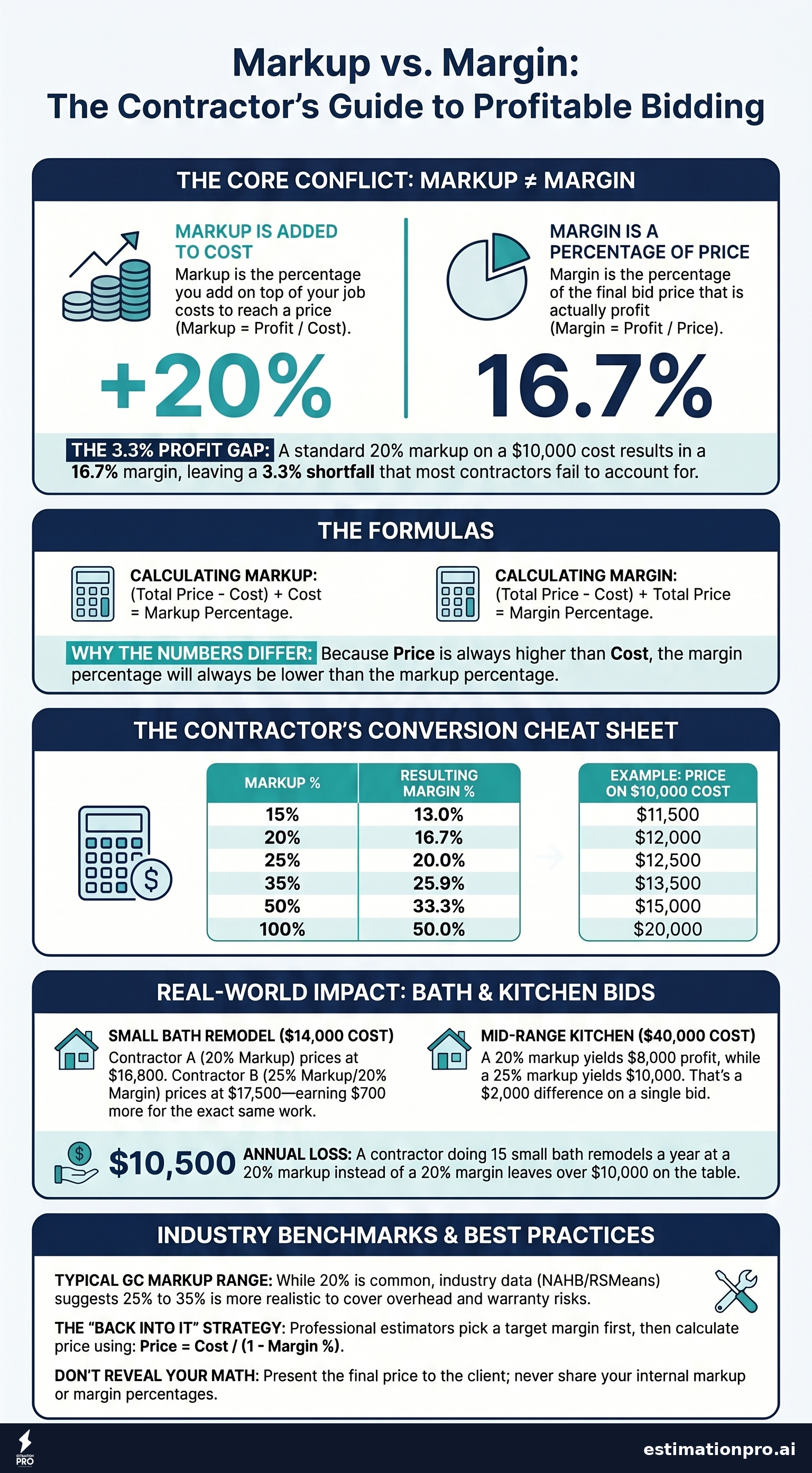
Share This Infographic
Feel free to share this infographic on your website. Just copy the embed code below:
Copy this embed code:
<a href="https://estimationpro.ai/tools/blog/markup-vs-margin-calculator" target="_blank" rel="noopener">
  <img src="https://estimationpro.ai/tools/blog/infographics/markup-vs-margin-calculator-infographic.png" alt="markup vs margin calculator infographic by EstimationPro.AI" style="max-width:100%;height:auto" loading="lazy" />
</a>
<p style="font-size:12px;color:#64748B;margin-top:8px">Source: <a href="https://estimationpro.ai/tools/blog/markup-vs-margin-calculator">EstimationPro.AI</a></p>
Markup to Margin Conversion Table
This is the cheat sheet I wish someone had handed me 15 years ago. Print it and tape it inside your estimating binder.
| Markup | Margin | On $10,000 Cost |
|---|---|---|
| 10% | 9.1% | Price $11,000, profit $1,000 |
| 15% | 13.0% | Price $11,500, profit $1,500 |
| 20% | 16.7% | Price $12,000, profit $2,000 |
| 25% | 20.0% | Price $12,500, profit $2,500 |
| 30% | 23.1% | Price $13,000, profit $3,000 |
| 35% | 25.9% | Price $13,500, profit $3,500 |
| 40% | 28.6% | Price $14,000, profit $4,000 |
| 50% | 33.3% | Price $15,000, profit $5,000 |
| 67% | 40.1% | Price $16,700, profit $6,700 |
| 100% | 50.0% | Price $20,000, profit $10,000 |
Look at the 20% row. Most contractors I meet mark up 20% on subs and materials. They think they’re making 20%. They’re making 16.7%. On a $100,000 job, that’s $3,300 they didn’t price in.
Why Contractors Confuse Them (and Pay for It)
I was one of those contractors for longer than I want to admit. Third-generation carpenter, learned the trade from my dad, learned bidding from him too. He ran markup numbers. I ran markup numbers. Never really thought about margin until I started actually looking at year-end books and wondering where the money went.
Here’s the trap. Your mind reads “20% markup” and stores “20% profit.” But the customer isn’t paying your cost, they’re paying your price. Profit as a percentage of the price is always less than profit as a percentage of the cost. Always.
The bigger the job, the more it matters. A 3.3% gap on a $5,000 bid is $165. A 3.3% gap on a $80,000 kitchen remodel is $2,640. Do that ten times a year and you just funded a new truck payment.
Stop using one number to mean two things. Know your markup for estimating and your margin for profitability. They answer different questions.
Worked Example 1: Small Bath Remodel
Let’s run a real job. Mid-range bathroom, PNW pricing, using our internal cost database and 2026 labor rates.
Job costs:
| Line Item | Cost |
|---|---|
| Demo and disposal | $1,400 |
| Plumbing rough and fixtures | $4,800 |
| Tile material | $2,200 |
| Vanity and top | $1,600 |
| Electrical | $1,100 |
| Labor (80 hours at $30/hr avg per BLS 47-2031 carpenter data) | $2,400 |
| Permits and misc | $500 |
| Total cost | $14,000 |
Contractor A bids 20% markup. Price: $16,800. Profit: $2,800. Margin: 16.7%. Contractor B bids 25% markup (targeting 20% margin). Price: $17,500. Profit: $3,500. Margin: 20%.
Same job. Same quality. Contractor B walks away with $700 more because he knew the math. Over a year of 15 bathrooms like this, that’s $10,500 of real profit left on the table by Contractor A.
Worked Example 2: Kitchen Remodel with Subs
Now a mid-range kitchen. This is where markup really swings the number.
Job costs:
| Line Item | Cost |
|---|---|
| Cabinets | $12,000 |
| Countertops (sub) | $5,500 |
| Appliances | $6,000 |
| Flooring | $3,800 |
| Electrical sub | $2,400 |
| Plumbing sub | $2,100 |
| My labor (120 hrs at $45/hr loaded) | $5,400 |
| Permits, waste factor (15%), misc | $2,800 |
| Total cost | $40,000 |
At a 20% markup: price $48,000, profit $8,000, margin 16.7%. At 25% markup: price $50,000, profit $10,000, margin 20%. At 33% markup: price $53,200, profit $13,200, margin 24.8%.
That’s a $5,200 swing on a single kitchen bid, just from knowing which number to target. If you’re running three kitchens a month, you are either building a real business or grinding yourself into the ground.
What Markup Should Contractors Charge?
Honest answer. It depends on your overhead, your risk, and your market. But here’s the range from real industry data.
Per our pricing reference, which pulls from BLS, NAHB, and RSMeans benchmarks, general contractor markup on subs and materials runs 10% to 50%, with 20% being the most common figure. Overhead and profit combined (the O&P number estimators use) typically lands between 15% and 35%, with 25% as the industry middle. That aligns with NAHB builder cost data and RSMeans O&P benchmarks.
For my Pacific Remodeling work in the PNW, I target a 30 to 40% markup on most remodeling jobs (roughly a 23 to 29% gross margin). That covers:
- Insurance, truck, tools, license, bonding
- Office and admin time I don’t bill directly
- Warranty and callback work
- The hidden-scope hits I take when walls come open and show rot
- Actual take-home profit
A 20% markup sounds reasonable until you price out what your business actually costs to run. Most guys running 15 to 20% markup are losing money and don’t know it yet.
Regional pricing varies. These ranges reflect national benchmarks. Your local market, trade availability, and overhead structure will shift what you actually need to charge. Adjust accordingly.
Common Mistakes That Cost Real Money
Five mistakes I’ve either made or watched other contractors make:
- Using markup to mean margin. Covered above. Fix it today.
- Marking up only materials, not labor. Your labor has overhead too. If you’re paying a carpenter $30/hr loaded but billing only $30/hr, you’re charging for payroll and nothing else. No profit, no overhead coverage.
- Flat markup across everything. A 20% markup on a $12,000 cabinet order and a 20% markup on a $200 box of screws both feel fine, but the cabinet markup covers real risk (delivery, install coordination, warranty) while the screws barely matter. Some contractors use tiered markups for big-ticket subs versus small-dollar items.
- Forgetting waste factor in cost. If your material cost is $8,000 and you haven’t padded 10 to 15% for waste and cuts, your real cost is higher and your margin is lower than you think.
- Ignoring the time value of your bids. A job that ties up your crew for 6 weeks should earn a better margin than a one-day repair. Risk and commitment deserve a bigger piece.
How to Use Markup and Margin in Your Estimating Workflow
Here’s how I run the numbers on a real bid.
- Build out true costs first. Materials with waste factor, loaded labor (wage plus taxes, workers comp, insurance, PTO), subs, permits, dump fees, short-load fees if concrete is coming, consumables.
- Pick a target margin, not a markup. Decide what the job needs to earn. For me, most remodels need 22 to 28% gross margin to cover overhead and leave real profit.
- Back into the price using the margin formula.
Price = Cost / (1 - Margin %). So if I need 25% margin on $40,000 of cost, price is $40,000 / 0.75 = $53,333. - Convert that back to a markup for sanity check. On $40,000 cost, $53,333 price means a $13,333 markup, which is 33.3%.
- Present the price to the client as the price. Never share your markup number. Never share your margin. That’s your business, not theirs.
If you want this automated, the contractor markup calculator does steps 1 through 4 in about 30 seconds. Try EstimationPro free if you want the whole estimating flow (costs, markup, proposal, follow-up) handled in one place.
FAQs
What’s the difference between markup and margin in one sentence? Markup is profit as a percentage of cost. Margin is profit as a percentage of price.
If I want 30% profit on every job, should I charge 30% markup?
No. A 30% markup gives you 23.1% margin. To get a true 30% margin, you need a 42.9% markup. Use Price = Cost / (1 - 0.30) to back into it.
What markup do most contractors charge? Industry data puts the typical general contractor markup at around 20% on subs and materials, with a full range of 10 to 50% depending on the trade, job size, and overhead structure. Based on BLS, NAHB, and RSMeans benchmarks plus field experience, 25 to 35% is more realistic for small residential remodelers who want to actually cover overhead and earn real profit.
How do I calculate margin from a finished bid? Take the final price, subtract all your costs, divide by the price. Example: $50,000 price, $38,000 cost, profit is $12,000. Margin is $12,000 / $50,000 = 24%.
Is a 50% markup too high for a remodeling job? Not automatically. A 50% markup gives you 33.3% margin, which is aggressive but defensible on jobs with high risk, tight timelines, or significant unknown scope. Older homes in the PNW where you expect rot or code upgrades often justify that margin.
Should my markup be the same on labor and materials? You can run it that way for simplicity, but a lot of contractors apply a higher markup to self-performed labor (it carries the most risk and warranty exposure) and a lower markup to pass-through materials and subs. Either approach is fine as long as you actually cover overhead and make real profit.
The Bid Is the Business
Getting markup and margin right is the difference between a carpenter who makes money and one who works for free with extra steps. I’ve watched good craftsmen go out of business because they could build anything but couldn’t price it. And I’ve watched average builders get rich because they understood the math behind the bid.
Learn the formulas. Target margin, not markup. Build your real cost first. Then put a price on it that keeps your lights on and your crew paid.
Contractors using EstimationPro report building bids 2+ hours faster than spreadsheets while hitting target margins automatically. EstimationPro doesn’t just calculate your markup and margin, it builds the full proposal from your notes or photos, sends it to the client, and runs automated follow-up sequences so you win more of the bids you already put out. The whole workflow (estimate, proposal, follow-up, invoice) runs in one place. Try EstimationPro free and stop leaving 3.3% on every job.
Pricing a job like this?
Get every line item priced for your area in a full estimate
Describe the job or snap a few photos. Send it from EstimationPro and it follows up with your client for you.
3 free estimates. No credit card.
Get Free Estimating Tips
Enter your email and we'll send you pro tips, cost data, and useful resources for contractors.
We'll send helpful resources and occasional tips. Unsubscribe anytime.
 EstimationPro AI For Contractors, By Contractors
 Professional Estimates That Follow Up for You
Priced line items, a clean PDF or client link, and automatic follow-up once you send it.