

I’ve climbed roofs in Alaska snow and PNW rain for 20 years, and the number one place contractors bleed money isn’t labor. It’s the tape measure. Miss the square footage by 10% on a steep cut-up roof and you either eat the shortfall or hand the homeowner a change order they’ll never forget.
Here’s how I estimate roof square footage on every job. No guessing. No “close enough.” Just the method that keeps my bids tight and my margin honest. If you’d rather skip the math, Try EstimationPro free and let the tool handle the pitch, waste, and line items for you.
Quick Answer
To estimate roof square footage, measure the building’s footprint (length times width), then multiply by a pitch factor to account for slope. Add 10% to 15% for waste on a simple gable, 15% to 20% on a cut-up roof with hips and valleys. Divide the total by 100 to get roofing squares. A 2,000 sqft footprint on a 6/12 pitch with 15% waste comes out to about 26 squares.
The Three Ways to Measure a Roof
Not every job needs the same method. I use all three depending on access, safety, and how detailed the bid needs to be.
1. Measure From the Ground
Good for a quick walk-up estimate on a single-story home. Run a tape along the foundation or measure the wall plates if you have a ladder. Get length and width of each roof plane’s footprint. Multiply the two and you’ve got your horizontal area.
The catch: you still need the pitch to convert footprint to actual roof area. Pitch changes everything.
2. Measure From the Roof
On a safe, walkable roof I’ll run a 100-foot tape across each plane and measure the actual slope length. That gives you true roof area without needing a pitch multiplier. Just remember to add ridge caps, eave overhang, and hip cuts to the totals.
Never measure from a roof in wet weather. I’ve seen more guys slide on wet algae than fall from ladders.
3. Aerial or Satellite Report
Services like EagleView, RoofScope, or even free tools using satellite imagery can give you a pre-measured report for $15 to $40. Worth every penny on complex roofs with multiple hips, dormers, and valleys. I still verify with a tape on site before ordering material.
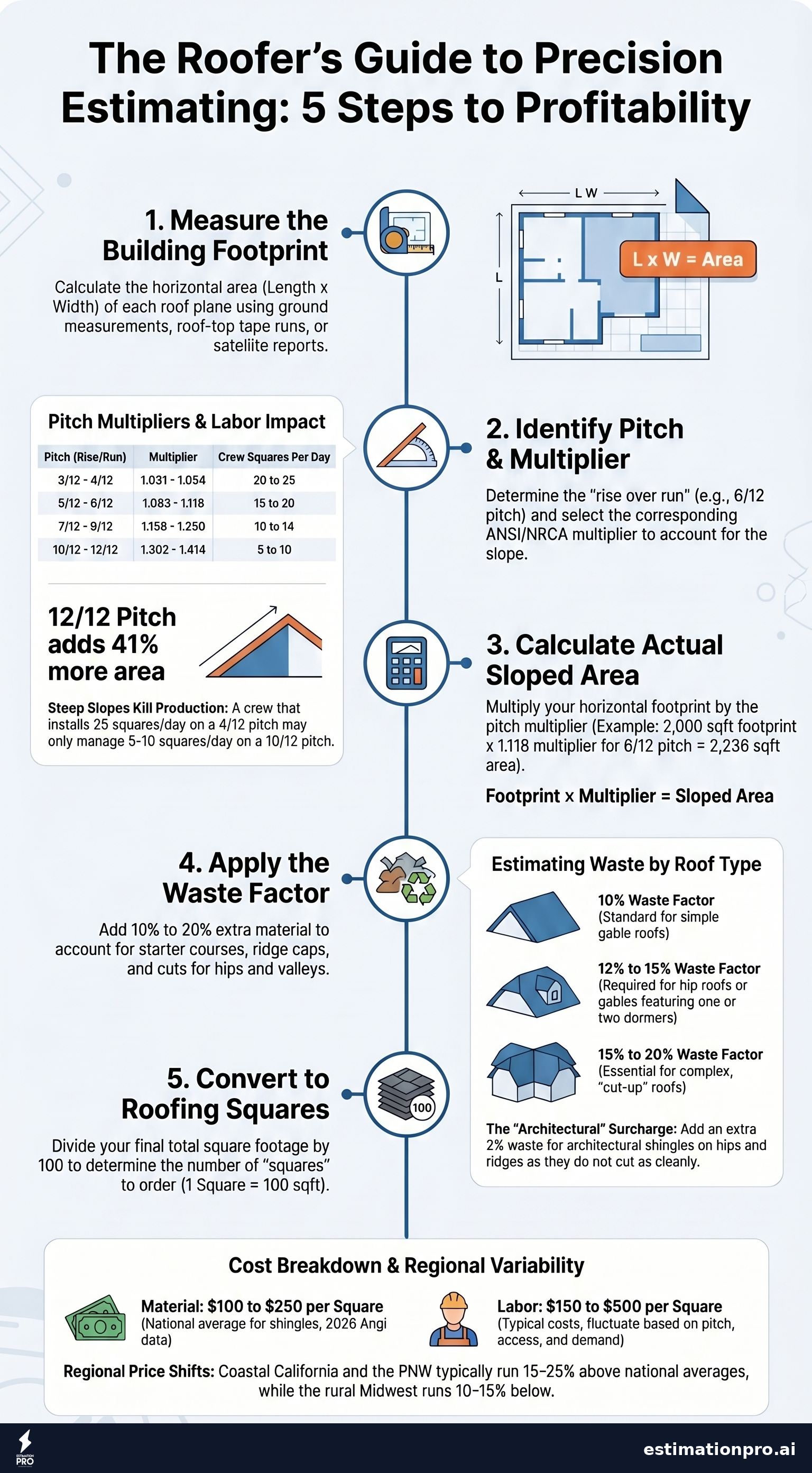
Share This Infographic
Feel free to share this infographic on your website. Just copy the embed code below:
Copy this embed code:
<a href="https://estimationpro.ai/tools/blog/estimate-roof-square-footage" target="_blank" rel="noopener">
  <img src="https://estimationpro.ai/tools/blog/infographics/estimate-roof-square-footage-infographic.png" alt="estimate roof square footage infographic by EstimationPro.AI" style="max-width:100%;height:auto" loading="lazy" />
</a>
<p style="font-size:12px;color:#64748B;margin-top:8px">Source: <a href="https://estimationpro.ai/tools/blog/estimate-roof-square-footage">EstimationPro.AI</a></p>
Pitch Multipliers: The Number Most Estimators Botch
Roof pitch is rise over run. A 6/12 pitch rises 6 inches for every 12 inches horizontal. You take the footprint area and multiply by the pitch factor below to get the actual sloped roof area.
| Pitch (rise/run) | Multiplier | What it feels like |
|---|---|---|
| 3/12 | 1.031 | Low slope, walkable |
| 4/12 | 1.054 | Standard walkable |
| 5/12 | 1.083 | Still walkable with caution |
| 6/12 | 1.118 | Most common pitch I see in the PNW |
| 7/12 | 1.158 | Harness territory |
| 8/12 | 1.202 | Steep, plan for roof jacks |
| 9/12 | 1.250 | Steep, slow production |
| 10/12 | 1.302 | Very steep |
| 12/12 | 1.414 | 45 degrees, crew adds surcharge |
Source: ANSI/NRCA roof slope conversion tables, used industry-wide by BLS 47-2181 classified roofing contractors.
Quick shortcut: a 6/12 pitch adds roughly 12% to the footprint area. A 12/12 pitch adds 41%. Miss that multiplier and a 2,000 sqft footprint job gets shorted by 200 to 400 square feet of shingles.
Waste Factor: Don’t Skip This
Shingle waste comes from starter courses, ridge caps, hip cuts, valley cuts, and mistakes. Every job has waste. The question is how much.
- Simple gable roof: 10% waste
- Gable with one or two dormers: 12% to 13% waste
- Hip roof: 12% to 15% waste
- Complex cut-up with multiple valleys: 15% to 20% waste
- Architectural shingles on hips/ridges: bump waste by 2% (they don’t cut as cleanly)
I’ve made the mistake of ordering 10% waste on a complex hip roof and had to run back to the supplier mid-install. Lost half a day’s production and ate the restocking fee. Never again.
Worked Example #1: Simple Gable, 6/12 Pitch
Small rambler in Gig Harbor. Two rectangles, no dormers, straight gable.
- Footprint: 40 feet by 28 feet = 1,120 sqft
- Pitch: 6/12, multiplier 1.118
- Actual roof area: 1,120 times 1.118 = 1,252 sqft
- Waste at 10%: 1,252 times 1.10 = 1,377 sqft
- Roofing squares: 1,377 divided by 100 = 13.77 squares
- Order: 14 squares of architectural shingles
At $150/square for material (within the $100 to $250/sq Angi 2026 range), that’s $2,100 in shingles. Labor at $250/square typical (BLS and HomeAdvisor 2025 data) adds $3,500. Underlayment, starter, ridge cap, and flashing add another $800 to $1,200 on a job this size.
Worked Example #2: Cut-Up Hip Roof, 8/12 Pitch
Older 1978 two-story in Tacoma. Three hip planes, one valley, a chimney, and a dormer.
- Footprint: 45 feet by 32 feet = 1,440 sqft
- Pitch: 8/12, multiplier 1.202
- Actual roof area: 1,440 times 1.202 = 1,731 sqft
- Waste at 17% (complex cut-up): 1,731 times 1.17 = 2,025 sqft
- Roofing squares: 2,025 divided by 100 = 20.25 squares
- Order: 21 squares plus extra ridge cap bundles
The 17% waste sounds high until you see the cuts on a hip roof with a valley and a dormer. I once ordered 12% on a roof like this and finished a square and a half short. Home Depot was out of the color. Had to drive 40 minutes to another branch. Lost production time that day killed any profit on the material markup.
Common Mistakes I See on Bids
- Forgetting the eave overhang. Most roofs extend 12 to 18 inches past the wall. That’s extra square footage you paid for but didn’t count.
- Using the interior square footage of the house. The roof is bigger than the living space. Always measure the exterior footprint or the roof itself, never the floor plan.
- Ignoring dormers and bump-outs. Each dormer adds 30 to 80 sqft of roof area plus cuts and flashing. Measure them individually.
- Rounding pitch down. “It looks like a 6/12” isn’t good enough. Use a pitch gauge or a level and a ruler on a rafter. A 7/12 rounded to 6/12 shorts you 4%.
- Forgetting the ridge cap. Hip and ridge shingles are sold separately from field shingles. A typical 20-square roof needs 2 to 3 bundles of ridge cap on top of the field material.
- Not adding a contingency for tear-off surprises. I’ve pulled up shingles and found rotted decking on 30% of older PNW homes. Build a line item for potential sheathing replacement at $3 to $5 per sqft.
What Pitch Does to Labor
Pitch doesn’t just add square footage. It slows down the crew. A 12/12 pitch cuts production in half compared to a 4/12. Most roofing crews track production rates by pitch:
| Pitch | Squares per crew per day |
|---|---|
| 3/12 to 4/12 | 20 to 25 |
| 5/12 to 6/12 | 15 to 20 |
| 7/12 to 9/12 | 10 to 14 |
| 10/12 and up | 5 to 10 |
If your crew does 20 squares per day at 4/12 and you bid the same rate on a 10/12, you just lost half your labor margin. Roofing labor runs $150 to $500 per square depending on pitch, region, and access (HomeAdvisor 2025 and BLS 47-2181 wage data).
FAQs
Q: Do I use the footprint or the actual roof area for shingles? A: Actual roof area. Multiply the footprint by the pitch factor first. That’s the number the shingles have to cover.
Q: How do I measure pitch if I can’t get on the roof? A: Use a 24-inch level and a tape measure on a visible rafter from inside the attic. Hold the level horizontal against the rafter, measure vertical drop at the 12-inch mark. That’s your rise over 12.
Q: What’s the difference between a square and square footage? A: One roofing square equals 100 square feet of roof area. Shingles, underlayment, and labor are all priced per square. Divide your total square footage by 100 to get squares.
Q: Should I include the garage or detached structures? A: Yes, if they’re part of the bid. Measure them separately, apply their own pitch multiplier, and add to the total.
Q: How much extra should I order for a tear-off? A: Material stays the same. But budget 10% to 30% extra labor hours for tear-off plus disposal costs of $60 to $120 per square for dumpster fees and dump tickets.
Q: Can I estimate roof square footage from Google Earth? A: For a rough ballpark, yes. Measure the building outline in Google Earth’s ruler tool, then apply a pitch multiplier. It’s useful for a phone quote but you still need to verify on site before you sign a contract.
Related Tools and Reading
- Roofing Estimate Per Square for how pricing breaks down by material
- How to Measure a Roof From the Ground for safer measurement methods
- Estimate Roof Squares for converting square footage to squares
- Shingle Roof Replacement Cost for tear-off and disposal pricing
Regional Pricing Note
All dollar figures reflect national averages from Angi, HomeAdvisor, and BLS data for 2025-2026. PNW and coastal California run 15% to 25% above national. Rural Midwest and South typically run 10% to 15% below. Adjust your bid with a regional multiplier before quoting.
Measure Once, Bid With Confidence
Getting the square footage right is the foundation of every roofing bid. Get it wrong and you’re either undercutting yourself or losing jobs to contractors with better math. Get it right and the rest of the estimate lines up cleanly.
Contractors using EstimationPro report cutting their roofing estimate time from 2 hours down to 20 minutes per bid, with the pitch multipliers and waste factors already dialed in. Try EstimationPro free and you’ll get the full workflow: AI-assisted estimating, professional proposals sent to the homeowner, automated follow-up sequences that nudge them back to you when they go silent, and invoicing when the job closes. You win more of the bids you already send, without chasing anyone.
Pricing a job like this?
Get every line item priced for your area in a full estimate
Describe the job or snap a few photos. Send it from EstimationPro and it follows up with your client for you.
3 free estimates. No credit card.
Get Free Estimating Tips
Enter your email and we'll send you pro tips, cost data, and useful resources for contractors.
We'll send helpful resources and occasional tips. Unsubscribe anytime.
 EstimationPro AI For Contractors, By Contractors
 Save 2+ Hours on Every Estimate
Upload photos, record voice notes, and get AI-powered estimates with line items, material lists, and regional pricing.