
Last fall I helped a buddy put in a small pea gravel patio behind his shop. He had already ordered two yards from the landscape supply, no prep, no math, just eyeballed it. We ended up with gravel piled up in his driveway for three weeks because he overshot by almost a full yard. That pile cost him around $40 he didn’t need to spend, plus the dirty look from his wife every time she pulled in.
Most people miss their pea gravel order by 20 to 40 percent. Too much, and you’re stuck with a pile. Too little, and you’re making a second trip to the supplier before your patio is even done. The math isn’t hard, but you have to do it.
Quick Answer
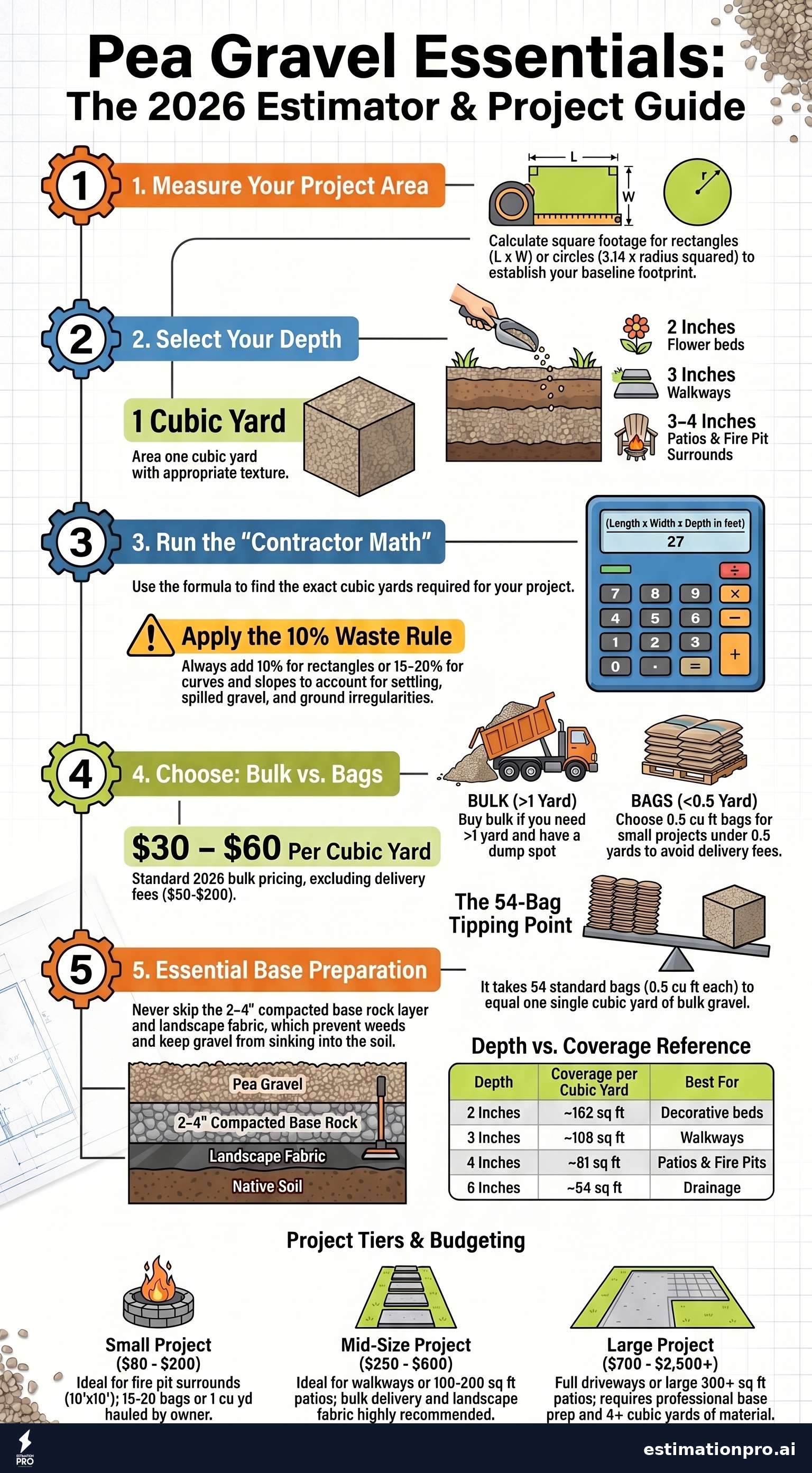
For any pea gravel project, use this formula: length (ft) x width (ft) x depth (ft) / 27 = cubic yards. One cubic yard covers about 100 square feet at 3 inches deep. Budget $30 to $60 per yard bulk, plus $50 to $200 for delivery. For small jobs under 1 yard, bagged pea gravel at Home Depot or Lowe’s is usually cheaper once you factor in delivery fees.
Need the math done for you? Use our Pea Gravel Calculator to get an exact volume and cost estimate in under a minute. Try EstimationPro free if you’re bidding pea gravel work for customers and need to generate full estimates with labor, delivery, and markup baked in.
The Formula (Do This Every Time)
Pea gravel is sold by the cubic yard (bulk) or by the bag (small projects). Everything comes back to cubic yards. Here’s the three-step math I run on every job.
Step 1. Measure length and width in feet.
If your project is a rectangle, easy. If it’s a circle (like around a fire pit), the formula is different: pi x radius squared. A 10-foot-diameter fire pit area means radius of 5, so 3.14 x 5 x 5 = 78.5 sq ft.
Step 2. Pick your depth.
This is where most folks get it wrong. Depth depends on the use case:
- Decorative ground cover or bed: 2 inches (0.17 ft)
- Walkway or foot traffic area: 3 inches (0.25 ft)
- Patio, fire pit surround: 3 to 4 inches (0.25 to 0.33 ft)
- Dog run: 3 to 4 inches (0.25 to 0.33 ft)
- Drainage under a deck: 4 to 6 inches (0.33 to 0.5 ft)
Shallower than 2 inches and the fabric or soil shows through. Deeper than 4 on a walkway and you’ll sink with every step. Pea gravel doesn’t lock together like crushed stone, so it moves under your feet.
Step 3. Multiply and divide.
(Length x Width x Depth) / 27 = cubic yards needed
The 27 comes from cubic feet per cubic yard (3 ft x 3 ft x 3 ft = 27).
Then add a waste factor. Always. I add 10 percent for simple rectangular projects and 15 percent for anything with curves, edges, or tricky geometry. Gravel settles, some falls on the grass during spread, some ends up stuck to your boots.
What a Cubic Yard of Pea Gravel Actually Covers
This is the table I wish I had taped to my truck door when I started. Memorize the 3-inch row.
| Depth | Square Feet per Cubic Yard | Best For |
|---|---|---|
| 2 inches | ~162 sf | Ground cover, flower beds |
| 3 inches | ~108 sf | Walkways, light traffic paths |
| 4 inches | ~81 sf | Patios, fire pit areas |
| 6 inches | ~54 sf | Drainage beds, deep drains |
| 12 inches | ~27 sf | Trench backfill |
One ton of pea gravel (if you’re buying by weight) covers roughly the same as 0.7 to 0.8 cubic yards. One cubic yard weighs about 2,600 to 2,800 pounds depending on moisture content.
Worked Example 1: A 12x10 Patio
Here’s a real one I priced last spring. Customer wanted a pea gravel patio next to her garden shed. Dimensions: 12 feet long, 10 feet wide, 3 inches deep.
Math:
- Square footage: 12 x 10 = 120 sq ft
- Volume: 120 x 0.25 / 27 = 1.11 cubic yards
- Add 10 percent waste: 1.11 x 1.10 = 1.22 cubic yards
Round up. Order 1.25 to 1.5 yards bulk, or 1.5 if your supplier won’t split half-yards.
Cost breakdown at PNW 2026 pricing:
| Line Item | Cost |
|---|---|
| 1.25 yd pea gravel bulk @ $40/yd | $50 |
| Delivery | $100 |
| Landscape fabric (120 sf) | $40 |
| Plastic or steel edging (40 lf) | $60 |
| Compacted base rock (0.6 ton) | $18 |
| Total materials | $268 |
If you’re a contractor bidding this, add labor (prep, install, cleanup) and markup. 4 to 6 hours of labor for a two-person crew, roughly $300 to $500 depending on your rate. Full bid to homeowner usually lands $700 to $1,100 for this size patio done right.
Worked Example 2: Fire Pit Surround
Customer wants a pea gravel ring around a 5-foot diameter fire pit, out to a 10-foot diameter total.
Math:
- Outer circle area: 3.14 x 5 x 5 = 78.5 sq ft
- Inner circle area (pit itself, subtract): 3.14 x 2.5 x 2.5 = 19.6 sq ft
- Gravel area: 78.5 - 19.6 = 58.9 sq ft
- At 4-inch depth (fire pit zones need more): 58.9 x 0.33 / 27 = 0.72 cu yd
- Add 15 percent waste (curves): 0.72 x 1.15 = 0.83 cu yd
That’s under a yard. You have two options: order bulk minimum (most suppliers require 1 yard minimum, so you overbuy) or pick up bagged gravel.
A 0.5 cu ft bag from Home Depot runs about $5 to $7. You need roughly 45 bags to equal 0.83 cu yd. That’s $225 to $315 in bags, versus about $140 bulk (1 yd at $40 plus $100 delivery). Bulk wins here even with leftover gravel.
But if you only needed 0.3 yards? Bags win. Always do the math both ways before ordering.
Bulk vs Bags: When Each Wins
The tipping point is usually around 0.5 to 0.75 cubic yards.
Go bulk when:
- You need more than 1 cubic yard
- You have somewhere to dump the pile (driveway, tarp)
- You can wheelbarrow it to the spot
- Delivery is under $150
Go bags when:
- Project is under 0.5 cubic yards
- You don’t want a pile in the driveway for days
- You can’t get a delivery truck close to the spot
- Bags fit in your own truck bed or trailer
A 0.5 cu ft bag weighs about 50 pounds. Factor in the hauling if you’re buying 30 bags. Your back will remember that choice.
Delivery, Short Loads, and Hidden Fees
Short-load fees are the thing nobody warns you about. Most landscape suppliers have a minimum delivery quantity, usually 1 or 2 cubic yards. Order less and they tack on a $50 to $100 short-load fee on top of the regular delivery charge.
Delivery itself runs $50 to $200 depending on distance. In the PNW it’s usually $75 to $125 within 20 miles of the yard. Past 30 miles it climbs fast.
I’ve seen customers order “just enough” to save money and end up paying more because of the short-load surcharge. If you’re already paying delivery, round up to hit the minimum. You can use leftover pea gravel in a planter bed or save it for next year’s project.
Waste Factor: The 10 Percent Rule
Never order exactly what the math says. I add waste every time:
- 10 percent: Simple rectangle, flat ground, one contiguous area
- 15 percent: Curves, odd shapes, fire pit rings, slopes
- 20 percent: Multiple small areas, heavy settling expected, tight access
The pile you unload will also have some small stones and dust that disappear into the base. Fabric takes a bite. Some gravel rolls off edges. It all adds up.
Where I See Contractors Mess This Up
Four mistakes I’ve watched play out more than once:
-
Skipping the landscape fabric under the gravel. Weeds grow up, dirt migrates up from below, and the gravel looks muddy within a season. Budget for fabric at $0.20 to $0.50 per sq ft. It’s not optional.
-
Not compacting the base. Pea gravel needs 2 to 4 inches of compacted crushed stone or base rock underneath to stay level. Just dumping pea gravel on bare dirt means it will settle unevenly and hold water.
-
Installing edging as an afterthought. Without steel, plastic, or stone edging, pea gravel migrates into the grass within weeks. Every lawn mow spits stones. Budget edging in from day one, not as a “maybe we’ll add it later.”
-
Ordering too shallow. A 1.5-inch layer looks great on day one and fails by week four. Minimum 2 inches anywhere, 3 inches on anything with foot traffic.
Related Tools and Guides
- Gravel: How Much Do I Need? (General Guide) covers driveways, drains, and base rock calculations
- How to Estimate Gravel for a Driveway walks through driveway depth and base prep
- Landscaping Cost Calculator for mixed scope landscape bids
- Mulch Calculator if you’re doing beds alongside the gravel work
FAQ
How many bags of pea gravel equal a cubic yard?
A 0.5 cubic foot bag needs 54 bags to equal 1 cubic yard. Most bags at Home Depot or Lowe’s are 0.5 cu ft and weigh about 50 pounds. Always check the cubic foot rating on the bag, not just the weight.
How deep should pea gravel be for a patio?
Three to four inches minimum. Two inches looks sparse and will show the fabric or soil underneath within a season. For patios that will hold a fire pit or furniture, go 4 inches.
Can I use pea gravel without landscape fabric?
You can, but you shouldn’t. Weeds come up through the gravel within months, and soil migrates upward through the gravel from below every time it rains hard. Fabric runs $0.20 to $0.50 per sq ft. It’s the cheapest insurance on the whole project.
How much does pea gravel cost delivered in 2026?
Bulk pea gravel runs $30 to $60 per cubic yard in most US markets. Delivery adds $50 to $200 depending on distance and supplier. In the Pacific Northwest, figure $40 per yard plus $100 delivery as a solid average.
Will pea gravel wash away in heavy rain?
On a flat surface with proper edging, no. On a slope over 5 percent, yes. For sloped areas use crushed stone instead, since the angular edges lock together. Pea gravel is round and will roll and wash with enough water.
Does pea gravel need a permit to install?
Almost never for residential projects. Permits come into play when you’re doing drainage work tied to a French drain connected to a stormwater system, or when the project triggers impervious surface rules. Check your local building department if you’re doing more than 400 sq ft, but most pea gravel jobs are exempt.
Pricing Disclaimer
All prices reflect 2026 Pacific Northwest pricing based on field experience at Pacific Remodeling and local supplier quotes. Expect +15 to +30 percent in high-cost metros (Bay Area, NYC, Boston, LA) and -10 to -20 percent in low-cost rural markets. Fuel surcharges are pushing delivery costs up faster than gravel itself. Sources: HomeGuide 2026 gravel guide, Angi 2026 landscape pricing, Home Depot/Lowe’s bulk retail pricing, and local quarry quotes 2025-2026.
Measure twice, order once. Pea gravel math isn’t hard, but skipping it costs you money either way. Run the formula, add your waste factor, and call the supplier with a real number. Contractors using EstimationPro report cutting bid time by more than half on small landscape jobs like this, because the platform handles the math, pricing, and proposal in one pass. Try EstimationPro free and see how it turns a pea gravel estimate into a sent proposal, then sends automated follow-up sequences to the homeowner so you win more of the bids you already send, plus built-in invoicing when the job is done.
Share This Infographic
Feel free to share this infographic on your website. Just copy the embed code below:
Copy this embed code:
<a href="https://estimationpro.ai/tools/blog/pea-gravel-how-much-do-i-need" target="_blank" rel="noopener">
  <img src="https://estimationpro.ai/tools/blog/infographics/pea-gravel-how-much-do-i-need-infographic.png" alt="pea gravel how much do i need infographic by EstimationPro.AI" style="max-width:100%;height:auto" loading="lazy" />
</a>
<p style="font-size:12px;color:#64748B;margin-top:8px">Source: <a href="https://estimationpro.ai/tools/blog/pea-gravel-how-much-do-i-need">EstimationPro.AI</a></p>
Pricing a job like this?
Get every line item priced for your area in a full estimate
Describe the job or snap a few photos. Send it from EstimationPro and it follows up with your client for you.
3 free estimates. No credit card.
Pea Gravel Patio Cost Breakdown (120 sq ft, 3-inch depth)
Pea Gravel Projects by Size and Spend
- Fire pit surround, 10 by 10
- 1 to 1.5 cu yd bulk or 15-20 bags
- DIY weekend project
- Usually skip delivery, haul in truck
- Walkway or small patio, 100-200 sq ft
- 1.5 to 2.5 cu yd bulk
- Bulk delivery makes sense here
- Edging and fabric recommended
- Full patio or driveway, 300+ sq ft
- 4+ cu yd bulk delivered
- Needs proper base prep
- Consider contractor install
Get Free Estimating Tips
Enter your email and we'll send you pro tips, cost data, and useful resources for contractors.
We'll send helpful resources and occasional tips. Unsubscribe anytime.
 EstimationPro AI For Contractors, By Contractors
 Save 2+ Hours on Every Estimate
Upload photos, record voice notes, and get AI-powered estimates with line items, material lists, and regional pricing.