
$35,000. That’s roughly what a standard 2-car detached garage runs in most markets right now. I’ve seen homeowners get quotes ranging from $25,000 to north of $70,000 for what looks like the same building on paper, and the confusion always comes down to the same thing - they don’t know where the money goes.
Quick Answer
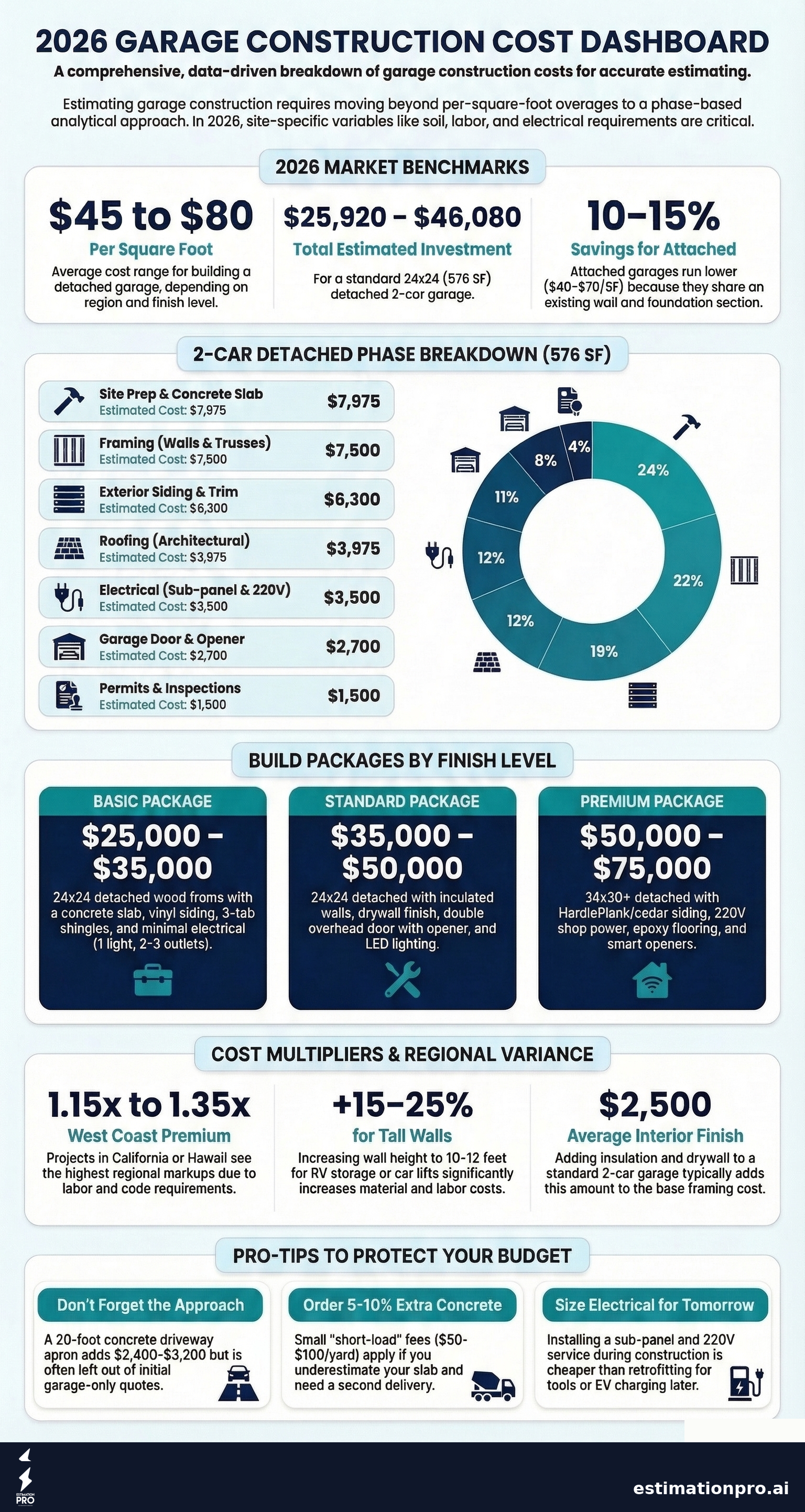
A detached garage costs $45 to $80 per square foot to build in 2026, putting a standard 24x24 (576 SF) build at $25,920 to $46,080 depending on finish level and region. Attached garages run slightly less at $40 to $70 per square foot since they share a wall with the house. The biggest cost variables are foundation conditions, finish level, and whether you need electrical service beyond basic lighting.
Use our Garage Cost Calculator to get a full estimate broken down by materials and labor in minutes. Try EstimationPro free to build a complete, line-item garage estimate you can hand to your client or GC.
Why Total-Project Estimates Miss the Mark
Most garage cost guides give you a single number. That’s not how the job actually gets built or bid.
A garage goes up in phases. Each phase has its own materials, labor rates, and potential surprises. When you estimate phase by phase, you catch the line items that flat per-square-foot numbers hide, things like permit fees, trenching for electrical, or the short-load surcharge on concrete when your slab is under 4 yards.
I’ve bid garages where the slab alone ate 15% of the budget because the site needed 2 feet of fill brought in. A per-square-foot average would never show you that.
Phase 1: Site Prep and Foundation
This is where surprises live. You’re dealing with ground conditions you can’t always see until the excavator shows up.
| Item | Cost Range | Typical |
|---|---|---|
| Site clearing & grading | $1,500 - $4,000 | $2,500 |
| Concrete slab (4” with wire mesh) | $4 - $8/SF | $6/SF |
| Thickened edge or frost footings | $8 - $15/LF | $12/LF |
| Gravel base (4-6”) | $1 - $2/SF | $1.50/SF |
For a 24x24 slab (576 SF):
- Gravel base: ~$865
- Concrete slab at $6/SF: ~$3,460
- Thickened perimeter (96 LF at $12): ~$1,150
- Site prep: ~$2,500
- Phase 1 total: $7,975
The big variable here is your soil. Sandy, well-drained soil? Straightforward pour. Clay soil in a wet climate? You might need a deeper gravel base, French drain, or even piers. I’ve seen foundation costs double on sites with poor drainage. Use our Concrete Calculator to dial in exact yardage for your slab dimensions.
Waste factor: Order 5-10% extra concrete. A short-load fee of $50-$100 per yard kicks in if you’re ordering less than a full truck (usually under 4 yards), so do the math before you split the pour into two small loads.
Sources: Angi 2026 concrete cost guide, HomeAdvisor 2025-2026 installed slab data.
Phase 2: Framing
Framing is where the building takes shape fast. A crew can frame a basic garage in 2-3 days.
| Item | Cost Range | Unit |
|---|---|---|
| Wall framing (2x4 stud, 16” OC) | $20 - $50 | per LF of wall |
| Roof trusses (pre-engineered) | $3 - $8 | per SF of roof area |
| Sheathing (OSB/plywood) | $1.50 - $3 | per SF |
| Hardware & fasteners | $200 - $500 | per project |
For a 24x24 garage:
- Wall framing (96 LF perimeter at $32/LF): ~$3,070
- Roof trusses (576 SF at $5/SF): ~$2,880
- Wall and roof sheathing: ~$1,200
- Hardware: ~$350
- Phase 2 total: $7,500
Pre-engineered trusses save time and money over stick-framing the roof. Unless you need an unusual pitch or clearance for a car lift, go with trusses. Most lumberyards will engineer and deliver them for free when you buy the framing package.
If you’re going taller than 8-foot walls for truck or RV storage, add about 15% to framing costs. The extra material and the scaffold time add up.
Sources: HomeGuide 2026 framing cost data, Angi 2026 framing estimates.
Share This Infographic
Feel free to share this infographic on your website. Just copy the embed code below:
Copy this embed code:
<a href="https://estimationpro.ai/tools/blog/building-cost-estimator-garage" target="_blank" rel="noopener">
  <img src="https://estimationpro.ai/tools/blog/infographics/building-cost-estimator-garage-infographic.png" alt="building cost estimator garage infographic by EstimationPro.AI" style="max-width:100%;height:auto" loading="lazy" />
</a>
<p style="font-size:12px;color:#64748B;margin-top:8px">Source: <a href="https://estimationpro.ai/tools/blog/building-cost-estimator-garage">EstimationPro.AI</a></p>
Phase 3: Roofing
Keep it simple on a garage. Architectural shingles are the sweet spot between cost and longevity.
| Material | Installed Cost/SF | Lifespan |
|---|---|---|
| 3-tab asphalt | $3 - $5 | 15-20 years |
| Architectural shingles | $4 - $7 | 25-30 years |
| Metal standing seam | $8 - $14 | 40-60 years |
For a 24x24 garage (approx. 650 SF roof area with overhang):
- Architectural shingles at $5.50/SF: ~$3,575
- Drip edge, ice/water shield, ridge vent: ~$400
- Phase 3 total: $3,975
The roofing area is larger than the footprint. A standard 6/12 pitch on a 24x24 garage with 12” overhangs gives you roughly 650 SF of roof surface. Don’t estimate roofing off the floor plan or you’ll be short by 10-15%.
Metal roofing makes sense if you’re matching the house or want zero maintenance for decades, but it nearly doubles the cost. For a deeper look at roofing numbers, see our roofing labor cost guide.
Phase 4: Siding and Exterior
Match the house siding if possible. Code may require it in some neighborhoods, and it protects resale value.
| Material | Installed Cost/SF | Notes |
|---|---|---|
| Vinyl siding | $3 - $9 | Lowest cost, low maintenance |
| LP SmartSide | $4 - $10 | Engineered wood, paintable |
| HardiePlank (fiber cement) | $6 - $15 | Premium, very durable |
For a 24x24 garage (~860 SF of wall area minus openings):
- Vinyl siding at $5/SF: ~$4,300
- Soffit, fascia, trim: ~$800
- Man door (steel, prehung): ~$1,200
- Phase 4 total: $6,300
Wall area is calculated from the perimeter times wall height, minus door and window openings. For a 24x24 with 9-foot walls, that’s roughly 96 LF x 9’ = 864 SF, minus about 200 SF for the garage door opening and man door.
Sources: Angi 2026 siding cost guide, HomeGuide 2026 door installation data.
Phase 5: Garage Door and Opener
This is the one line item homeowners actually comparison shop. Fair enough. It’s the most visible part of the build.
| Door Type | Cost Installed |
|---|---|
| Single steel (9x7) | $900 - $2,500 |
| Double steel (16x7) | $1,200 - $3,500 |
| Insulated double (R-16+) | $1,800 - $4,500 |
| Opener (belt or chain drive) | $300 - $700 |
A standard 2-car garage with one 16-foot door and a belt-drive opener runs about $2,200 + $500 = $2,700 installed.
Two single doors instead of one double? Budget an extra $500-$800 total, but you get redundancy. If one opener dies, the other side still works.
My recommendation for most builds: a non-insulated steel double door with a belt-drive opener. Quiet, reliable, and about $2,500 all-in. If you’re insulating the garage for a shop or living space above, spend the extra $600 for an R-16 insulated door. Otherwise you’re insulating three walls and leaving a 128-square-foot hole in the fourth.
Sources: Homewyse Jan 2026 garage door data, Angi 2026 pricing.
Phase 6: Electrical
Even a “basic” garage needs electrical. The question is how much.
| Item | Cost Range |
|---|---|
| 2-3 outlets + 1 overhead light | $500 - $1,200 |
| Full shop setup (sub-panel, 220V, 6+ outlets) | $2,000 - $4,500 |
| New circuit from main panel | $150 - $500 each |
| Outlet installation | $100 - $300 each |
| Exterior light fixture | $150 - $350 each |
Basic electrical (3 outlets, 2 lights, 1 exterior): ~$1,800
Full shop electrical (sub-panel, 220V outlet, 8 circuits): ~$3,500
If you’re running a welder, air compressor, or car lift, you need 220V service. That means a sub-panel in the garage with its own feed from the main panel. Budget accordingly. Adding it later means tearing into finished walls.
Trenching for underground electrical feed (if the main panel is in the house) adds $500-$1,500 depending on distance. Call it out as a separate line item so the client isn’t blindsided.
Sources: BLS 47-2111 electrician wage data May 2024, Angi 2026 electrical cost guide.
Worked Example 1: Basic 1-Car Detached Garage (12x24, 288 SF)
| Phase | Cost |
|---|---|
| Site prep & slab | $4,200 |
| Framing | $4,100 |
| Roofing (3-tab) | $1,600 |
| Vinyl siding + man door | $3,800 |
| Single garage door + opener | $2,000 |
| Basic electrical (2 outlets, 1 light) | $900 |
| Permits & inspections | $800 |
| Total | $17,400 |
Per square foot: $60. That’s right in line with the $45-$80 range. This is a no-frills storage garage. Uninsulated, unfinished interior, gravel approach.
Worked Example 2: Standard 2-Car Detached Garage (24x24, 576 SF)
| Phase | Cost |
|---|---|
| Site prep & slab | $7,975 |
| Framing | $7,500 |
| Roofing (architectural) | $3,975 |
| Vinyl siding + trim + man door | $6,300 |
| Double garage door + opener | $2,700 |
| Electrical (sub-panel, 220V, 6 outlets) | $3,500 |
| Insulation + drywall | $2,500 |
| Permits & inspections | $1,500 |
| Total | $35,950 |
Per square foot: $62. Finished interior, insulated, shop-ready with 220V. This is what most homeowners building a real workshop garage should budget for.
What Drives Costs Up (and Down)
Cost multipliers:
- Tall walls (10-12’) for RV or lift: +15-25%
- Living space above (bonus room): +$80-$150/SF for the upper floor
- Heated/cooled space: +$3,000-$8,000 for HVAC
- Poor soil or high water table: +$2,000-$5,000 for foundation work
- Steep lot requiring retaining walls: +$3,000-$10,000
Cost savers:
- Attached garage (shares a wall): saves 10-15% vs. detached
- Slab-on-grade vs. frost footings: saves $1,000-$3,000 in warm climates
- Owner-supplied garage door: saves markup, but verify warranty
- Permit-exempt sizes (varies by jurisdiction): saves $500-$1,500
Regional Price Variation
Garage construction costs vary by 20-40% depending on where you build. Labor rates, material transport costs, and code requirements all shift by region.
| Region | Cost Multiplier |
|---|---|
| Southeast | 0.80 - 0.90x |
| Midwest | 0.90 - 1.00x |
| Pacific Northwest | 1.00 - 1.10x |
| Northeast | 1.05 - 1.15x |
| West Coast (CA, HI) | 1.15 - 1.35x |
A $35,000 garage in the Midwest might run $42,000-$47,000 in California. Always get local bids. National averages are a starting point, not a final answer.
Mistakes That Kill Your Garage Budget
1. Skipping the site survey. I’ve watched a homeowner commit to a garage location before anyone checked the grade. Turned out the spot needed 18 inches of fill across the entire footprint. That’s $3,000 in dirt and compaction they didn’t see coming.
2. Forgetting the approach. The garage needs a driveway or apron connecting it to the road. A 20-foot concrete apron at $6-$8/SF for a 2-car garage adds $2,400-$3,200. I always include this as a separate line item because clients forget about it until the building is up and they’re driving through mud.
3. Under-sizing electrical. Running 2 outlets to “save money” and then needing to rewire for a 220V compressor a year later costs more than doing it right the first time. Ask the homeowner what tools they plan to use. Size the panel for where they’re going, not where they are today.
4. Ignoring setback requirements. Zoning setbacks dictate where the garage can sit. I’ve seen projects stall for months because the homeowner wanted the garage 5 feet from the property line in a zone that requires 10. Check first. Always.
5. Not matching the house. A garage that clashes with the house hurts curb appeal and resale. Matching siding, trim color, and roof pitch costs maybe $1,000-$2,000 more than going with whatever’s cheapest. Worth every dollar.
FAQ
How long does it take to build a detached garage?
A standard 2-car detached garage takes 4 to 8 weeks from permit to final inspection. The slab needs 3-5 days to cure before framing starts. Framing takes 2-3 days. Roofing, siding, electrical, and finishing fill the rest. Weather delays and inspection scheduling add buffer time.
Do I need a permit to build a garage?
In most jurisdictions, yes. Any structure with a foundation, electrical, or that exceeds a certain square footage (often 120-200 SF) requires a building permit. Permit costs typically run $500 to $2,000 depending on project value and location. Building without a permit creates title and insurance problems down the road.
Is it cheaper to build attached or detached?
Attached garages cost 10-15% less because they share a wall with the house, reducing framing, siding, and foundation work. However, attached garages require firewall separation (5/8” Type X drywall, self-closing door) per IRC R302.6, which adds some cost back. Detached garages offer more flexibility in placement and don’t transmit noise or exhaust fumes into the home.
Can I build a garage myself to save money?
DIY can save 30-40% on labor, but only if you’re qualified. Foundation work and electrical require permits and inspections regardless. Most jurisdictions require licensed electricians for panel work. A realistic DIY scenario: you handle framing and siding, hire out the slab and electrical. That saves $8,000-$12,000 on a typical 2-car build.
What size garage should I build?
A 1-car garage (12x24) fits one vehicle with minimal storage. A 2-car garage (24x24) is the most common and best value per square foot. A 2.5 or 3-car garage (24x30 to 24x36) adds shop or storage space. My advice: build bigger than you think you need. The cost per additional square foot is relatively low during initial construction versus adding on later.
Ready to estimate your next garage project? Try EstimationPro free - it builds your estimate, generates a professional proposal, and follows up with the homeowner automatically so you don’t lose the bid sitting in someone’s inbox.
2-Car Detached Garage Cost Breakdown (576 SF)
Garage Build Packages by Finish Level
- 24x24 detached, wood frame
- Concrete slab, no insulation
- Vinyl siding, 3-tab shingles
- Single overhead door
- 2-3 outlets, 1 overhead light
- 24x24 detached, wood frame
- Insulated walls, drywall finish
- Vinyl or LP SmartSide siding
- Double overhead door with opener
- 4-6 outlets, LED lighting
- Man door with deadbolt
- 24x30+ detached, upgraded frame
- Full insulation, finished interior
- HardiePlank or cedar siding
- Insulated double door with smart opener
- Sub-panel, 220V for tools
- Epoxy floor, workbench area
Get Free Estimating Tips
Enter your email and we'll send you pro tips, cost data, and useful resources for contractors.
We'll send helpful resources and occasional tips. Unsubscribe anytime.
 EstimationPro AI For Contractors, By Contractors
 Price Every Job With Confidence
Stop second-guessing your numbers. EstimationPro AI builds accurate estimates from real cost data.