

$3,200. That’s what I quoted a homeowner last month for a 1,500 square foot interior repaint, and she nearly fell off her chair. “But it’s just paint!” she said. I hear that a lot. What homeowners don’t see is the math behind that number, and the math is the difference between making money and painting for free.
Quick Answer
Calculating painting cost follows a 5-step formula: measure paintable area, calculate material quantities (1 gallon covers 300-400 SF), price labor ($1-$4/SF interior, $1.50-$5/SF exterior), add 15-35% for overhead and profit, then adjust for job-specific variables like prep work and ceiling height. A standard 1,500 SF interior repaint typically runs $3,000-$6,000 all-in. Prices vary by region and reflect 2026 national averages.
If you’re a contractor pricing paint jobs by gut feel, you’re leaving money on the table. Or worse, you’re underbidding and working at a loss without realizing it. I’ve done both, and I can tell you which one hurts more.
This guide walks through the exact calculation method I use to price painting work. Not vague rules of thumb. Actual formulas you can plug your numbers into today.
Try EstimationPro free to build detailed painting estimates with accurate labor and material pricing in minutes.
The 5-Step Painting Cost Formula
Every paint job, whether it’s a single bedroom or a full exterior, follows the same calculation framework:
Total Cost = Materials + Labor + Overhead + Profit
Simple on paper. The challenge is getting each piece right. Here’s how.
Step 1: Measure the Paintable Surface Area
This is where most bad estimates start. Wrong measurements mean wrong material quantities, wrong labor hours, and wrong pricing.
Interior walls:
- Measure each wall: length x height
- Standard rooms: perimeter x ceiling height
- Subtract windows (15 SF each) and doors (21 SF each)
Exterior surfaces:
- Measure each face of the house separately
- Don’t forget soffits, fascia, and trim - these add 10-15% to your wall area
- Gable ends are triangles: base x height / 2
Ceilings:
- Length x width of the room
- Add ceilings separately because they take longer to roll than walls
A 12x14 bedroom with 8-foot ceilings has roughly 400 SF of wall area after subtracting a window and door. That’s your starting number.
Quick Area Reference
| Room Type | Typical Wall Area | With Ceiling |
|---|---|---|
| Bedroom (12x14) | 400 SF | 568 SF |
| Living room (16x20) | 520 SF | 840 SF |
| Bathroom (8x10) | 260 SF | 340 SF |
| Kitchen (12x16) | 380 SF | 572 SF |
| Hallway (4x20) | 368 SF | 448 SF |
These are rough guides. Always measure the actual space.
Step 2: Calculate Material Quantities
Once you have your square footage, you can figure out exactly how much paint and primer you need.
Paint coverage rate: 300-400 SF per gallon on smooth surfaces with standard paint. Use 350 SF as your working number for flat walls. Textured walls, dark-over-light color changes, and porous surfaces drop that to 250-300 SF per gallon.
The formula:
Gallons needed = (Total SF x Number of Coats) / Coverage Rate
For that 1,500 SF interior job with 2 coats:
1,500 x 2 = 3,000 SF / 350 = 8.6 gallons → round up to 9
Always round up. You cannot return a half-used gallon, and running short mid-job means a trip to the store and potential color-match issues between batches.
Material Cost Tiers
| Paint Grade | Price Per Gallon | Best For |
|---|---|---|
| Economy (Glidden, ColorPlace) | $20-$35 | Rentals, utility rooms, flips |
| Standard (Behr, Valspar) | $30-$55 | Most residential work |
| Premium (Benjamin Moore, Sherwin-Williams) | $45-$85 | Client-facing rooms, high-end jobs |
| Primer | $18-$35 | New drywall, stain blocking, color changes |
I price most residential work with standard-grade paint. Premium gets specified when the homeowner requests it or when coverage matters - Benjamin Moore Regal or Sherwin-Williams Emerald cover in one coat on most colors, which actually saves labor time.
Don’t forget supplies:
- Painter’s tape: $5-8 per roll, budget 1 roll per 2 rooms
- Roller covers: $5-15 each, one per color/sheen
- Drop cloths, brushes, caulk, patching compound
I typically budget $50-$100 for supplies on a standard interior job.
Step 3: Estimate Labor Hours and Cost
Labor is the biggest line item on any paint job. Get this wrong and the whole estimate falls apart.
Interior painting production rates:
- Walls (brush and roll): 150-250 SF per hour per painter
- Ceilings: 120-200 SF per hour
- Trim/baseboards: 40-80 linear feet per hour
- Cut-in/edging: 80-120 LF per hour
- Prep work (patch, sand, caulk): adds 20-40% to paint time
Exterior painting production rates:
- Siding (brush/roll): 100-200 SF per hour
- Spray application: 400-800 SF per hour
- Trim/fascia: 30-60 LF per hour
- Scraping/prep: highly variable, 50-150 SF per hour
Labor cost per square foot:
- Interior: $1-$4 per SF (typical $2/SF for standard residential work)
- Exterior: $1.50-$5 per SF (typical $3/SF including prep)
These rates come from BLS painter wage data and field experience. Your actual rate depends on your market, your crew speed, and the condition of the surfaces.
Worked Example: 1,500 SF Interior
| Task | Hours | Rate | Cost |
|---|---|---|---|
| Prep (patch, sand, caulk) | 4 | $35/hr | $140 |
| Prime (1 coat, walls + ceiling) | 6 | $35/hr | $210 |
| Paint walls (2 coats) | 12 | $35/hr | $420 |
| Paint ceiling (1 coat) | 3 | $35/hr | $105 |
| Trim and baseboards | 6 | $35/hr | $210 |
| Cut-in and touch-up | 3 | $35/hr | $105 |
| Total Labor | 34 hrs | $1,190 |
At $2/SF for the 1,500 SF total, you get $3,000 in labor. The hourly breakdown above comes to $1,190, which is the raw crew cost. The difference covers your burden (FICA, workers comp, insurance) plus a margin on labor. More on that in Step 4.
Step 4: Add Overhead and Profit
This is the step most newer contractors skip or underestimate. Your price to the customer is not materials + labor. It’s materials + labor + overhead + profit.
Overhead includes:
- Vehicle costs (gas, insurance, maintenance)
- Tool wear and replacement
- Business insurance and licenses
- Office costs, phone, software
- Unbillable time (estimating, driving, callbacks)
Industry standard overhead and profit markup: 15-35% on top of direct costs. I use 25% as my baseline, which aligns with NAHB and RSMeans benchmarks.
The calculation:
Direct costs = Materials + Labor Selling price = Direct costs x (1 + O&P percentage)
For our 1,500 SF example:
| Line Item | Cost |
|---|---|
| Paint (6 gal standard @ $40) | $240 |
| Primer (3 gal @ $25) | $75 |
| Supplies | $85 |
| Labor (1,500 SF @ $2) | $3,000 |
| Subtotal (Direct Costs) | $3,400 |
| Overhead & Profit (25%) | $850 |
| Total Price to Customer | $4,250 |
That’s $2.83 per square foot all-in. Right in the middle of the $2-$4/SF range you’ll see quoted for standard interior paint work.
Step 5: Adjust for Job-Specific Variables
No two paint jobs are identical. After you run the base calculation, adjust for these factors:
Factors that increase cost:
- High ceilings (over 9 ft) - scaffold or ladder time adds 15-25%
- Heavy prep (wallpaper removal, lead paint, extensive patching) - can double prep hours
- Multiple colors - each color change adds setup and cleanup time
- Dark to light color changes - extra coats needed
- Textured surfaces - lower coverage rate, slower production
- Exterior in poor condition - scraping, priming bare wood
Factors that might decrease cost:
- New construction (no prep, no furniture to move)
- Large open areas (faster production than small rooms)
- Single color throughout
- Spray application on exterior (2-3x faster than brush/roll)
I’ve seen exterior prep on an old Victorian eat up more hours than the actual painting. If the previous paint is peeling, budget accordingly. Don’t assume best-case prep time.
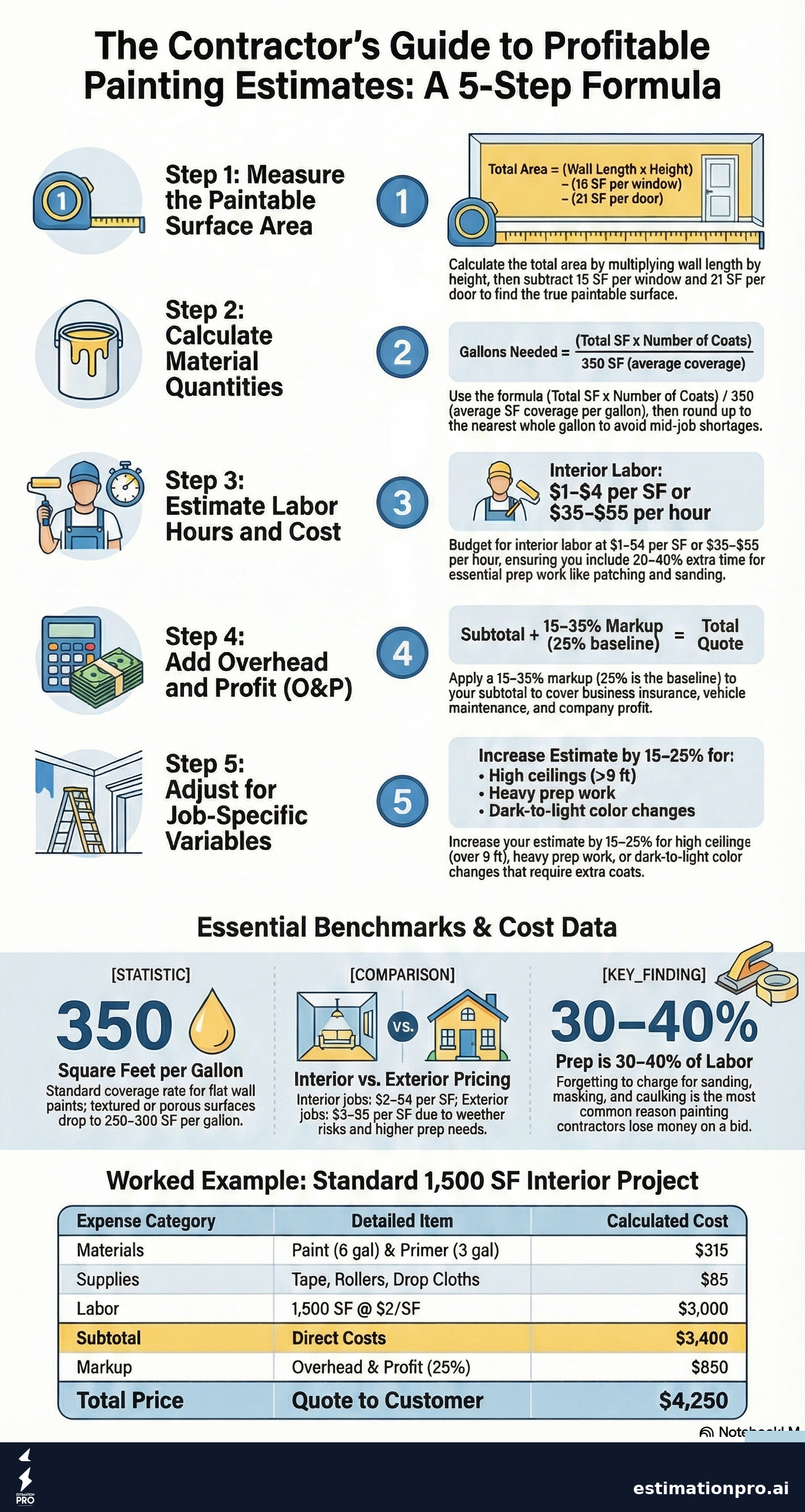
Share This Infographic
Feel free to share this infographic on your website. Just copy the embed code below:
Copy this embed code:
<a href="https://estimationpro.ai/tools/blog/calculating-painting-cost" target="_blank" rel="noopener">
  <img src="https://estimationpro.ai/tools/blog/infographics/calculating-painting-cost-infographic.png" alt="calculating painting cost infographic by EstimationPro.AI" style="max-width:100%;height:auto" loading="lazy" />
</a>
<p style="font-size:12px;color:#64748B;margin-top:8px">Source: <a href="https://estimationpro.ai/tools/blog/calculating-painting-cost">EstimationPro.AI</a></p>
Common Painting Estimate Mistakes
After 20 years of watching contractors bid paint work, these are the mistakes that kill margins:
-
Forgetting prep time. Prep is 30-40% of a paint job’s labor. If you only price the actual painting, you’re working for free during every hour of sanding, patching, and taping.
-
Underestimating coat count. One coat is rarely enough. Dark colors over light, light over dark, new drywall - all need 2 coats minimum. Some colors need 3.
-
Not accounting for waste. Paint left in rollers, trays, and brushes. Overspray. Touch-ups. Budget 10-15% overage on paint quantity.
-
Using the wrong coverage rate. That “400 SF per gallon” on the can is for ideal conditions: smooth wall, light color over light. Real-world coverage on textured walls with color changes is closer to 250-300 SF.
-
Skipping the overhead markup. Selling at cost-plus-nothing means your truck, insurance, and tools are subsidized by your personal income. That’s not a business - that’s a hobby.
Interior vs. Exterior: Quick Comparison
| Factor | Interior | Exterior |
|---|---|---|
| Labor per SF | $1-$4 | $1.50-$5 |
| Paint grade | Standard ($30-$55/gal) | Exterior-rated ($35-$65/gal) |
| Coats needed | 2 (walls), 1-2 (ceiling) | 2 minimum |
| Prep intensity | Low-medium | Medium-high |
| Weather dependency | None | Yes - temperature, humidity, rain |
| Production speed | Faster (controlled environment) | Slower (access, wind, heights) |
| Typical job cost (1,500 SF) | $3,000-$6,000 | $4,500-$9,000 |
Exterior work carries more risk. Wind, rain delays, and access issues (ladders, scaffolding) all slow production. Price accordingly.
Putting It All Together: Exterior Example
A homeowner wants the exterior of their 2,000 SF two-story colonial painted. Here’s the calculation:
Paintable exterior area: approximately 2,800 SF (walls + trim + soffits, minus windows and doors)
| Line Item | Calculation | Cost |
|---|---|---|
| Exterior paint (16 gal premium @ $55) | 2,800 SF x 2 coats / 350 SF/gal | $880 |
| Primer (8 gal @ $25) | Full prime coat on bare/weathered areas | $200 |
| Supplies (caulk, tape, spray tips) | Lump sum | $120 |
| Labor (2,800 SF @ $3/SF) | Includes prep, prime, 2 coats | $8,400 |
| Subtotal | $9,600 | |
| Overhead & Profit (25%) | $2,400 | |
| Total | $12,000 |
That’s $4.29/SF exterior all-in, which falls within the typical range. Adjust up for extensive scraping, lead paint testing, or third-story access.
Regional pricing disclaimer: All costs reflect 2026 national averages based on BLS painter wage data (BLS 47-2141) and manufacturer retail pricing. Your local market may run 10-20% higher or lower depending on labor availability and cost of living.
Use our Paint Calculator to get your material quantities dialed in before you start pricing, and our Painting Estimate Calculator for a faster way to build the full bid.
FAQ
How do I calculate paint cost per square foot?
Divide your total project cost by the paintable square footage. For interior work, the all-in cost typically runs $2-$4 per square foot including materials, labor, and overhead. Exterior runs $3-$5 per square foot. These ranges come from BLS wage data and standard material pricing.
How many gallons of paint do I need for a 1,500 square foot house?
For interior walls with 2 coats, you’ll need approximately 9 gallons of paint plus 3-4 gallons of primer. The calculation: 1,500 SF x 2 coats / 350 SF per gallon = 8.6 gallons, rounded up. Add more if ceilings are included or surfaces are textured.
What is a fair labor rate for painting?
Interior painting labor runs $1-$4 per square foot depending on prep complexity and your market. The national median wage for painters is $23.40/hour according to BLS data, but your billing rate should be higher after factoring in burden, overhead, and profit. Most contractors bill painting crews at $35-$55/hour.
Should I charge by the hour or by the square foot?
Charge by the square foot or by the job, not by the hour. Hourly billing punishes you for being fast and efficient. If your crew can paint a room in 4 hours that a slower crew takes 8, you should earn the same (or more) for the finished result. Square-foot pricing rewards productivity.
How much profit should a painting contractor make?
Aim for 15-35% overhead and profit on top of your direct costs (materials + labor). At 25% O&P, a $3,400 direct-cost job bills at $4,250. That margin covers your truck, insurance, tools, and the time you spend estimating, driving, and managing. Without it, you don’t have a real business.
Stop Guessing, Start Calculating
Every painting estimate should start with measurements, not a gut number. The five-step formula above works whether you’re pricing a bathroom touch-up or a full commercial exterior. Measure the surface, calculate materials, price the labor, add your overhead, and adjust for the specifics of the job.
I’ve watched too many painters underbid work because they eyeballed the square footage or forgot to account for prep. Run the numbers every time. Your bank account will thank you.
Contractors on Capterra rate EstimationPro 4.8/5 for time savings on their bids. Try EstimationPro free - it builds your painting estimate from the square footage up, sends polished proposals to the homeowner, and runs automated follow-up sequences so you win more of the bids you already send.
Pricing a job like this?
Get every line item priced for your area in a full estimate
Describe the job or snap a few photos. Send it from EstimationPro and it follows up with your client for you.
3 free estimates in the first 7 days. No credit card.
1,500 SF Interior Paint Job Cost Breakdown
Get Free Estimating Tips
Enter your email and we'll send you pro tips, cost data, and useful resources for contractors.
We'll send helpful resources and occasional tips. Unsubscribe anytime.
 EstimationPro AI For Contractors, By Contractors
 Save 2+ Hours on Every Estimate
Upload photos, record voice notes, and get AI-powered estimates with line items, material lists, and regional pricing.