

$62,350. That’s the median annual wage for electricians in the United States, according to the Bureau of Labor Statistics. And master electricians billing $75 to $150 per hour in metro areas can push well past six figures. The demand is real - the BLS projects 11% job growth through 2033, much faster than average.
But you can’t just start pulling wire and sending invoices. Every state requires some form of electrical license before you touch a live panel. The path from zero to licensed electrician has specific steps, costs, and timelines that trip people up when they don’t plan ahead.
Quick Answer
To obtain an electrical license, you need 4-5 years of apprenticeship (8,000+ supervised hours), completion of classroom training, and a passing score on your state’s journeyman exam. Total out-of-pocket cost ranges from $1,000 to $5,000 depending on your state. The process takes 4-6 years from start to journeyman, and 6-10 years to reach master electrician. Every state has different requirements, so check your state licensing board first.
Try EstimationPro free - once you’re licensed and ready to bid electrical jobs, you’ll need a way to build accurate estimates fast.
The 7 Steps to Getting Your Electrical License
Step 1: Check Your State’s Specific Requirements
This is where most people waste time. They start an apprenticeship program, put in three years, then discover their state requires a different hour total or a specific classroom ratio they didn’t meet.
Every state sets its own rules. Some require 8,000 hours. Others require 10,000. California needs 8,000 hours with a certified electrician. Texas wants 8,000 hours plus 576 classroom hours. Washington requires 8,000 hours of on-the-job training.
What to look up before you start:
- Total supervised hours required (typically 8,000-10,000)
- Required classroom/technical training hours
- Whether your state accepts out-of-state apprenticeship hours
- Age minimum (usually 18)
- Background check requirements
- Whether a high school diploma or GED is mandatory
Your state’s Department of Labor or Licensing Board website has the exact requirements. Don’t rely on forum posts or word of mouth. I’ve seen guys find out three years in that their hours didn’t count because they didn’t register properly.
Step 2: Complete Your Education Prerequisites
Most states require a high school diploma or GED. Beyond that, you have two main paths for the classroom portion:
Option A: Trade school or community college (6-12 months) Programs like those at community colleges or vocational schools cover electrical theory, NEC code, blueprint reading, and basic math. Tuition runs $1,000 to $10,000 depending on the program.
Option B: Apprenticeship program with built-in classroom training Union programs (IBEW/NECA) and many non-union shops include classroom training alongside on-the-job hours. The IBEW’s Joint Apprenticeship Training Committee (JATC) programs are highly regarded and you earn while you learn.
| Path | Duration | Cost | Earnings During |
|---|---|---|---|
| Trade school then apprenticeship | 5-6 years total | $1,000 - $10,000 tuition | None during school |
| Direct apprenticeship (IBEW/JATC) | 4-5 years | $0 - $500 fees | $15 - $25/hr from day one |
| Non-union apprenticeship | 4-5 years | $0 - $2,000 | $14 - $22/hr |
For most people, the apprenticeship route makes more sense financially. You’re getting paid the entire time.
Step 3: Register as an Apprentice
This step is mandatory in most states. Don’t skip it.
File your apprenticeship registration with your state’s licensing board or Department of Labor. This officially starts your hour clock. Any work you did before registering might not count - and I’ve talked to electricians who lost a full year of credit because they didn’t file paperwork on day one.
You’ll typically need:
- Completed application form
- Proof of education (diploma/GED)
- Government-issued ID
- Application fee ($25-$100)
- Employer/sponsor information
- Background check authorization
Once registered, your employer must document and verify your hours. Keep your own records too. Track every hour in a logbook or spreadsheet. If there’s ever a dispute about your hours, your personal records are your backup.
Step 4: Complete Your Apprenticeship Hours
This is the long part. Plan on 4-5 years of full-time work.
During your apprenticeship, you’ll work under a licensed journeyman or master electrician. The National Electrical Code (NEC) and your state code govern everything you’ll learn. Expect to cover:
- Residential wiring (circuits, panels, outlets, lighting)
- Commercial wiring (three-phase systems, conduit runs)
- Industrial controls and motor circuits
- Fire alarm and low-voltage systems
- Code compliance and inspection prep
What your weekly schedule looks like:
- 32-40 hours on the job (supervised electrical work)
- 4-8 hours of classroom instruction (evenings or weekends)
- Independent study for code knowledge
The apprentice wage starts around $15-$25 per hour depending on your market. That increases as you progress. By year three or four, you’re typically earning 60-80% of a journeyman’s wage.
Step 5: Study for and Pass the Journeyman Exam
After completing your hours, you’re eligible to sit for the journeyman electrician exam. This is where the license actually gets earned.
Exam details:
- Format: Multiple choice, open-book (NEC codebook allowed)
- Questions: 80-100 questions depending on state
- Time: 4-5 hours
- Passing score: 70-75% in most states
- Fee: $50-$400 per attempt
- Provider: Many states use PSI or Prometric testing centers
Don’t let “open book” fool you. The NEC is 1,000+ pages. If you don’t know where to find answers fast, you’ll run out of time. Tab your codebook. Mark the sections you reference most. Practice with timed mock exams.
Study resources:
- Mike Holt’s exam prep materials (industry standard, $150-$300)
- Your state’s published exam content outline
- NEC codebook with your own tabs and highlights
- Practice exams from Electrician Exam Prep or similar providers
- Study groups with other apprentices taking the same exam
I’d budget 3-6 months of serious study alongside your work schedule. Guys who cram for two weeks usually retake the exam at least once. Once you pass, you’ll want a solid electrical estimate template to start bidding work right away.
Step 6: Apply for Your License
Passed the exam? Now file for the actual license.
Typical application requirements:
- Proof of passing exam score
- Completed application form
- Verification of apprenticeship hours (signed by supervising electrician)
- Application fee ($50-$200)
- Proof of insurance (if required in your state)
- Background check results
Processing times vary. Some states issue licenses within 2-4 weeks. Others take 6-8 weeks. Don’t book jobs until you have the license in hand.
Step 7: Maintain Your License with Continuing Education
Your license isn’t permanent. Most states require continuing education (CE) to renew, typically every 1-3 years.
Renewal requirements (common ranges):
- CE hours: 12-24 hours per renewal cycle
- Renewal fee: $50-$200
- NEC code update training: usually required when a new code cycle drops (every 3 years)
CE courses cover code changes, safety updates, and new technologies (solar, EV charging, smart home systems). Budget $100-$500 per renewal cycle for courses and fees.
What It Actually Costs to Get Licensed
Here’s a realistic cost breakdown for the full path from apprentice to journeyman:
| Cost Item | Low End | High End |
|---|---|---|
| Trade school tuition (if applicable) | $0 | $10,000 |
| Apprenticeship registration | $25 | $100 |
| Tools and equipment | $500 | $2,000 |
| NEC codebook | $100 | $150 |
| Exam prep materials | $150 | $400 |
| Exam fee (per attempt) | $50 | $400 |
| License application | $50 | $200 |
| Total (apprenticeship route) | $875 | $3,250 |
| Total (trade school route) | $875 | $13,250 |
The apprenticeship route saves money and pays you while you learn. Most electricians I know went that direction and don’t regret it.
Prices vary by region and reflect 2026 national averages. State licensing board fees, exam costs, and wage rates differ significantly depending on your area. Check your state’s licensing board for exact pricing.
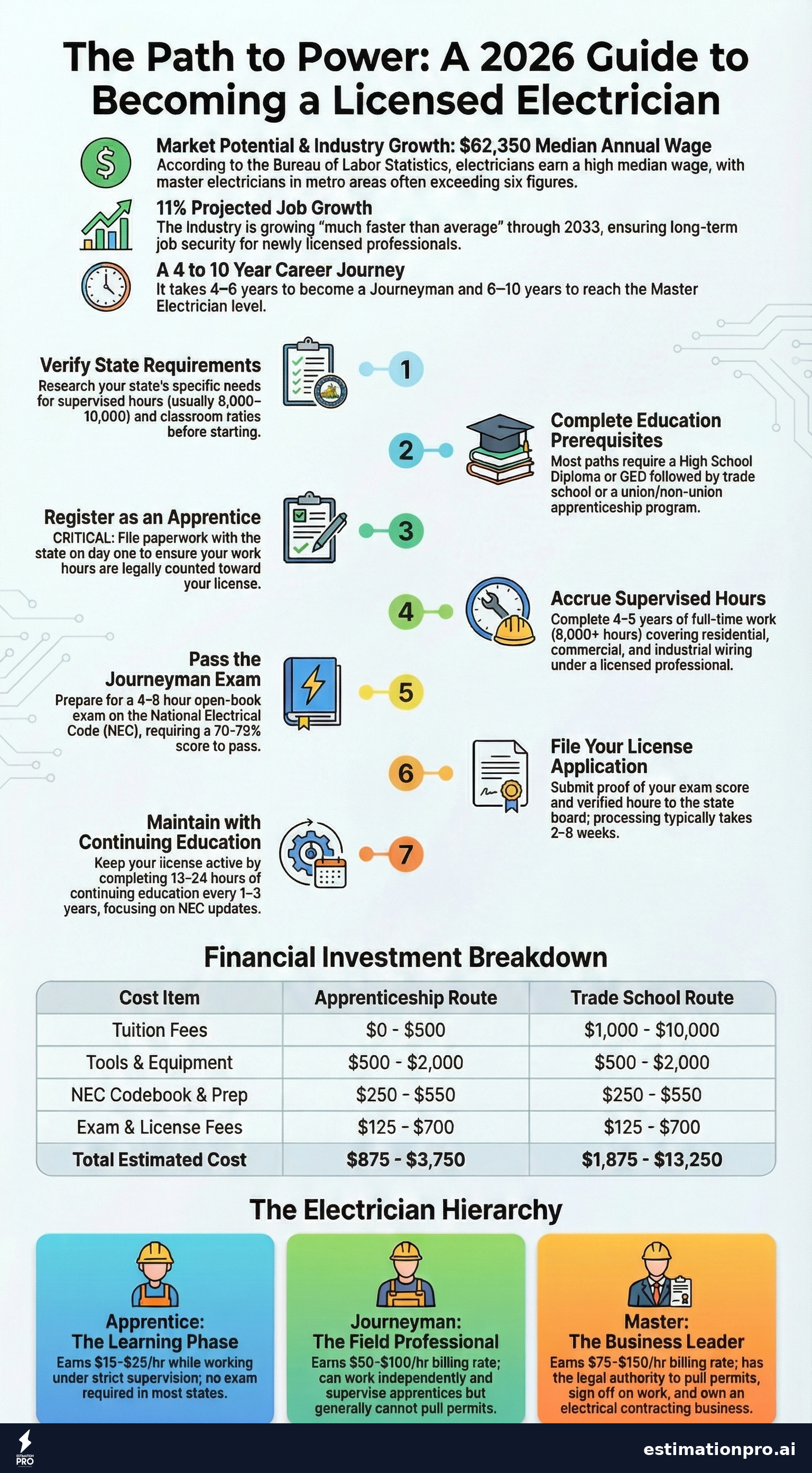
Share This Infographic
Feel free to share this infographic on your website. Just copy the embed code below:
Copy this embed code:
<a href="https://estimationpro.ai/tools/blog/how-to-obtain-an-electrical-license" target="_blank" rel="noopener">
  <img src="https://estimationpro.ai/tools/blog/infographics/how-to-obtain-an-electrical-license-infographic.png" alt="How to obtain an electrical license infographic by EstimationPro.AI" style="max-width:100%;height:auto" loading="lazy" />
</a>
<p style="font-size:12px;color:#64748B;margin-top:8px">Source: <a href="https://estimationpro.ai/tools/blog/how-to-obtain-an-electrical-license">EstimationPro.AI</a></p>
Worked Example: Getting Licensed in Washington State
My home state has a clear process, so here’s what it looks like start to finish:
The path:
- Register as a 01 Electrician Trainee with Washington L&I ($50 fee)
- Complete 8,000 hours under a licensed journeyman
- Complete 96 hours of basic classroom instruction (4 hours per quarter)
- Pass the Washington State Journeyman Electrician Exam (administered by L&I, $83.80 fee)
- Apply for Journeyman license ($83.80 application fee)
The timeline: 4-5 years full-time
The cost:
| Item | Amount |
|---|---|
| Trainee registration | $50 |
| Tools (over 4 years) | $1,200 |
| NEC codebook | $120 |
| Mike Holt’s exam prep | $250 |
| Exam fee | $83.80 |
| License application | $83.80 |
| Total | $1,787.60 |
Meanwhile, you’re earning $18-$28/hr during the apprenticeship - that’s a full-time salary while getting licensed.
Worked Example: Earning Potential After Licensing
Once you have your journeyman license, the math changes fast.
A journeyman electrician in the Pacific Northwest charges between $50 and $100 per hour as a billing rate. Even as an employee, salaries range from $55,000 to $85,000 annually, per BLS data for the region.
But the real jump comes when you get your master’s license and start your own shop. A master electrician running a small crew can bill $75-$150/hr. On a typical residential panel upgrade ($1,500 to $4,000 per project), you’re looking at $800-$2,500 in gross profit after materials.
That’s where having solid estimating tools matters. You’re no longer just doing the work - you’re pricing it, proposing it, and following up. Miss a line item on a panel upgrade bid, and you’re eating the cost out of your own pocket. Good electrical estimating software pays for itself after one or two jobs.
Mistakes That Cost You Time and Money
1. Not registering your apprenticeship hours from day one. Some states won’t count hours retroactively. Register before you pick up a tool.
2. Assuming your hours transfer between states. They might. They might not. Some states have reciprocity agreements. Others make you re-apprentice or take their specific exam. Check before you move.
3. Skipping the study and relying on “open book.” The NEC is dense. Knowing where to find answers is a skill that takes months to build. Plan your study time.
4. Not budgeting for tools. Good hand tools, a quality meter, and proper PPE add up. Budget $500-$2,000 over your apprenticeship.
5. Ignoring the business side. Getting the license is step one. Running a profitable electrical business requires estimating, proposals, follow-up, invoicing, insurance, and marketing. The trade skills alone won’t keep the doors open. Start with an electrical estimate template in Excel if you want something basic, or go straight to dedicated software.
Apprentice vs. Journeyman vs. Master: What’s the Difference?
This matters because each level unlocks different work you can legally perform.
Apprentice/Trainee:
- Must work under direct supervision
- Cannot pull permits
- Cannot sign off on inspections
- Limited scope of independent work
Journeyman Electrician:
- Works independently on most residential and commercial jobs
- Can supervise apprentices
- Cannot pull permits in most states (depends on jurisdiction)
- The workhorse license for field electricians
Master Electrician:
- Can pull permits and sign off on all electrical work
- Required to open your own electrical contracting business in most states
- Requires additional experience (typically 2-4 years as a journeyman) plus another exam
- Can supervise multiple journeymen and apprentices
If you want to run your own business, you need the master’s license. Period. Some states let you operate under a master electrician’s license as a contractor, but long-term, you want your own.
State Licensing Resources
Requirements vary, but these cover the most common questions:
- National: NFPA 70 / NEC - the code everyone tests on
- Exam prep: Mike Holt Enterprises - the industry standard study material
- Apprenticeship programs: IBEW/NECA Electrical Training Alliance - the largest program in the country
- BLS Career Data: Bureau of Labor Statistics Occupational Outlook for Electricians - salary, growth, and regional data
Check your state’s Department of Labor or Contractor Licensing Board website for exact requirements, fees, and exam schedules.
FAQ
How long does it take to get an electrical license?
4-6 years for a journeyman license (4-5 years of apprenticeship plus exam prep and processing). A master electrician license adds another 2-4 years of journeyman experience on top of that. The total path from apprentice to master typically runs 6-10 years.
Can I get an electrical license without an apprenticeship?
In most states, no. The hands-on hours requirement exists for safety reasons - electrical work kills people when done wrong. A few states allow equivalent experience or military electrical training to substitute for some apprenticeship hours, but you’ll still need to pass the exam and meet minimum hour requirements.
How much does the electrical license exam cost?
$50 to $400 per attempt, depending on your state. Washington charges $83.80. California charges $100. Some states contract with PSI or Prometric, which add their own scheduling fees. Budget for at least two attempts - the national first-time pass rate hovers around 65-70%.
Do electrical licenses transfer between states?
Sometimes. Some states have reciprocity agreements that let you transfer your license without retesting. Others require you to take their state-specific exam even if you’re already licensed elsewhere. The National Electrical Licensing Exam (standardized by ICC) is accepted in about 30 states, which makes portability easier if you pass that version.
What’s the difference between a contractor license and an electrical license?
An electrical license proves you can do the work safely and to code. A contractor license (or business license) proves you can legally operate a business. You typically need both to run your own shop. The contractor license involves proof of insurance, bonding, and sometimes a separate business exam. I’ve seen licensed electricians get fined for operating without the business license on top of their trade license.
Ready to Start Bidding Electrical Jobs?
The license gets you in the door. But building a profitable electrical business means getting estimates out fast, looking professional, and following up with every lead. I’ve watched skilled electricians lose jobs to less talented competitors simply because the other guy quoted first and followed up.
Contractors on Capterra rate EstimationPro 4.8/5 for time savings on bids. EstimationPro handles the full workflow - build line-item estimates, send polished proposals, and automated follow-up sequences chase down every lead so your bids don’t die in someone’s inbox. Try EstimationPro free and start quoting electrical work in minutes instead of hours.
Pricing a job like this?
Get every line item priced for your area in a full estimate
Describe the job or snap a few photos. Send it from EstimationPro and it follows up with your client for you.
3 free estimates in the first 7 days. No credit card.
Electrical License Levels at a Glance
- Work under supervision only
- Earn $15 - $25/hr while learning
- 4-5 year commitment
- No exam required in most states
- Work independently on most jobs
- Earn $50 - $100/hr billing rate
- Must pass state exam
- Most common license for field work
- Pull permits and sign off on work
- Earn $75 - $150/hr billing rate
- Additional exam + experience required
- Required to run your own electrical business
Get Free Estimating Tips
Enter your email and we'll send you pro tips, cost data, and useful resources for contractors.
We'll send helpful resources and occasional tips. Unsubscribe anytime.
 EstimationPro AI For Contractors, By Contractors
 Professional Estimates That Follow Up for You
Priced line items, a clean PDF or client link, and automatic follow-up once you send it.