
$4,200. That’s what a typical whole-house carpet job runs for a 1,500 square foot ranch when you go mid-range. Most homeowners guess about half that number and then wonder why the bids look so high.
I’ve walked into plenty of homes where the carpet was original from the ’90s, matted down in the hallways, and the homeowner already picked out what they wanted at the flooring store. They had a material number in mind but no clue about pad, removal, seams, transitions, or stairs. That gap between material price and total installed cost is where carpet estimates go sideways.
This guide breaks down every line item so you can build an accurate carpet estimate. Contractors will get a template for line-item bids. Homeowners will understand exactly what they’re paying for.
Quick Answer: What Does Carpet Cost Installed?
Carpet installation runs $3 to $22 per square foot fully installed, depending on carpet grade, pad thickness, and your local labor market. A typical mid-range job lands between $7 and $14 per square foot including material, pad, labor, and basic removal of old flooring. For a standard 12x15 living room (180 sq ft), expect $1,260 to $2,520 total.
Use our Carpet Installation Cost Calculator to plug in your exact room dimensions and carpet grade for a detailed estimate in minutes. Try EstimationPro free to build a full line-item estimate you can hand to your client.
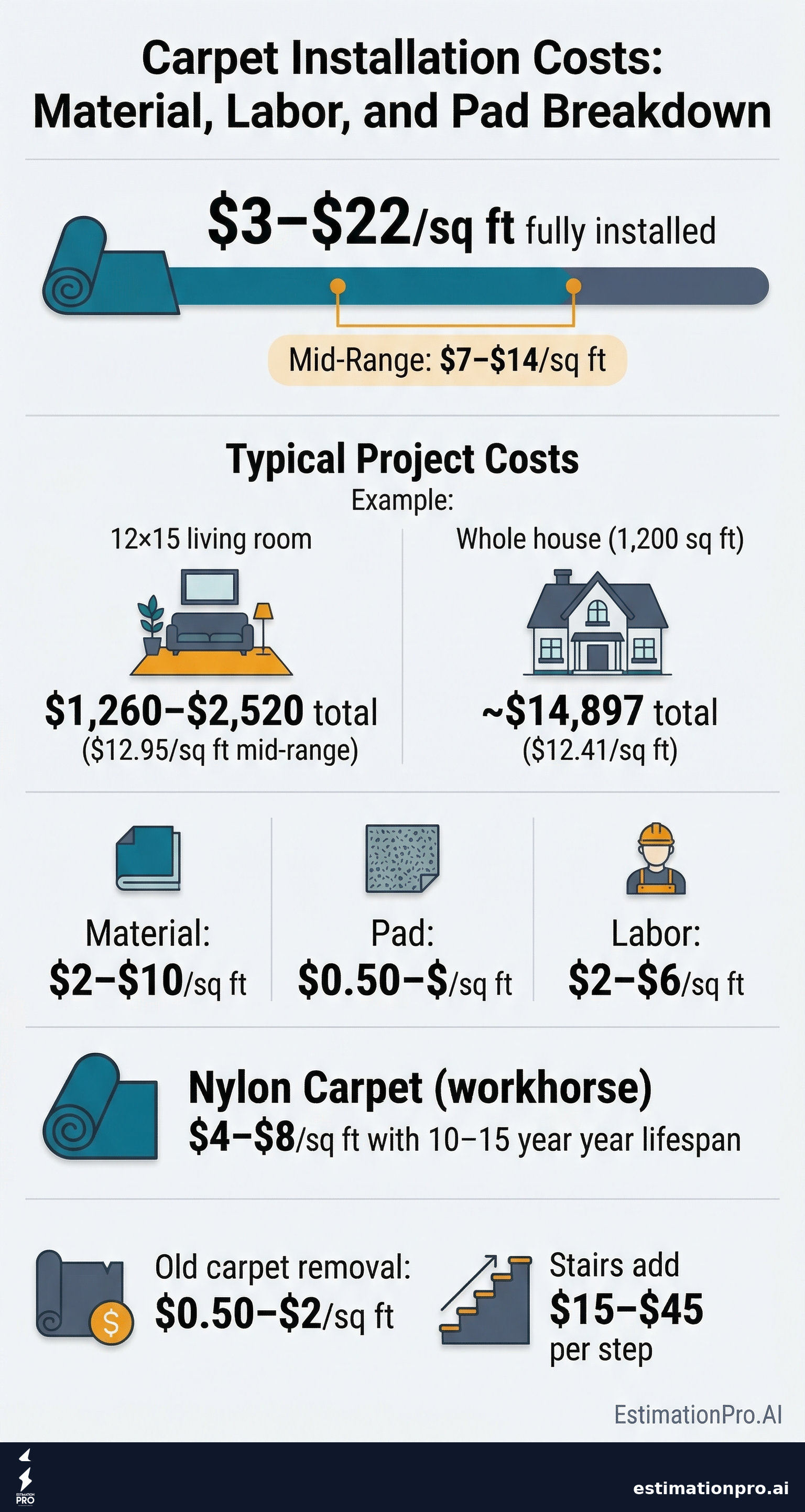
Share This Infographic
Feel free to share this infographic on your website. Just copy the embed code below:
Copy this embed code:
<a href="https://estimationpro.ai/tools/blog/carpet-estimate" target="_blank" rel="noopener">
  <img src="https://estimationpro.ai/tools/blog/infographics/carpet-estimate-infographic.png" alt="Carpet Estimate: What You'll Actually Pay in 2026 infographic by EstimationPro.AI" style="max-width:100%;height:auto" loading="lazy" />
</a>
<p style="font-size:12px;color:#64748B;margin-top:8px">Source: <a href="https://estimationpro.ai/tools/blog/carpet-estimate">EstimationPro.AI</a></p>
What Goes Into a Carpet Estimate
A carpet estimate is more than material times square footage. Here’s every line item that should show up on a proper bid:
- Carpet material - $2 to $10 per square foot depending on fiber type and density
- Carpet pad - $0.50 to $1.50 per square foot (don’t skip this)
- Installation labor - $2 to $6 per square foot in most markets
- Old flooring removal - $0.50 to $2 per square foot for rip-out and haul-off
- Furniture moving - $50 to $200 per room depending on what’s in there
- Tack strips - $0.50 to $1 per linear foot around room perimeter
- Seaming - $1 to $3 per linear foot where carpet rolls meet
- Stairs - $15 to $45 per step (labor-intensive, tight cuts)
- Transitions and thresholds - $5 to $20 each where carpet meets hard floor
Miss any of those and your estimate is low. That’s how contractors lose money on flooring jobs.
Carpet Material Costs by Type
Not all carpet is the same. Fiber type drives durability and price more than anything else.
| Carpet Type | Material Cost (per sq ft) | Best For | Lifespan |
|---|---|---|---|
| Polyester | $2 - $4 | Bedrooms, low-traffic rooms | 5-8 years |
| Olefin (Polypropylene) | $2 - $5 | Basements, rentals | 5-7 years |
| Nylon | $4 - $8 | Living rooms, hallways, stairs | 10-15 years |
| Triexta (SmartStrand) | $3 - $7 | Family rooms, pet owners | 10-15 years |
| Wool | $8 - $10+ | Formal rooms, luxury installs | 15-25 years |
Source: HomeAdvisor 2025 carpet cost data and Home Depot/Lowe’s retail pricing, verified February 2026. According to the Bureau of Labor Statistics, floor covering installers earned a median wage of $46,480 per year in 2024, which directly drives labor rates in carpet estimates.
Nylon is the workhorse. I’d recommend it for any room with regular traffic. Polyester looks great on day one but mats down fast in hallways or family rooms. Wool is beautiful but the price makes it a tough sell for most homeowners.
Why the Pad Matters More Than You Think
Most homeowners don’t even know carpet pad exists until they see it on the estimate. But pad quality directly affects how long the carpet lasts and how it feels underfoot.
- 6 lb density, 7/16” thick - Minimum for residential. Builder grade. $0.50-$0.75/sq ft.
- 8 lb density, 7/16” thick - Good middle ground. Handles moderate traffic. $0.75-$1.00/sq ft.
- 8+ lb density, 1/2” thick - Best residential pad. Extends carpet life significantly. $1.00-$1.50/sq ft.
Cheap pad under expensive carpet is money wasted. The carpet will wear faster, show traffic patterns sooner, and feel thin within a year or two. I always tell homeowners: spend the extra $0.25 per square foot on better pad. Over 1,000 square feet that’s only $250 more, but the carpet will last years longer.
According to Werner Braun, Technical Director at the Carpet and Rug Institute (CRI), residential carpet pad should meet a minimum density of 6 pounds per cubic foot for any living space. CRI’s residential pad specifications define the grades below.
Worked Example 1: Single Living Room (180 sq ft)
Here’s what a 12x15 living room looks like with mid-range nylon carpet:
| Line Item | Calculation | Cost |
|---|---|---|
| Carpet (nylon, mid-grade) | 180 sq ft x $6.00 | $1,080 |
| Carpet pad (8 lb, 7/16”) | 180 sq ft x $1.00 | $180 |
| Installation labor | 180 sq ft x $4.00 | $720 |
| Old carpet removal | 180 sq ft x $1.00 | $180 |
| Tack strips | 54 LF perimeter x $0.75 | $41 |
| Seaming (one seam) | 15 LF x $2.00 | $30 |
| Furniture move (couch, table, bookshelf) | Flat rate | $100 |
| Total | $2,331 |
That works out to about $12.95 per square foot installed - right in the mid-range sweet spot. Add 10% waste factor on material and pad for cuts and scrap, and you’re at roughly $2,460.
Worked Example 2: Whole House (1,200 sq ft)
Three bedrooms, a hallway, a living room, and stairs. This is the kind of job that separates a solid estimate from a rough guess.
| Line Item | Calculation | Cost |
|---|---|---|
| Carpet (nylon, mid-grade) | 1,200 sq ft x $5.50 + 10% waste | $7,260 |
| Carpet pad (8 lb, 7/16”) | 1,200 sq ft x $0.85 + 10% waste | $1,122 |
| Installation labor | 1,200 sq ft x $3.50 | $4,200 |
| Old carpet removal & haul | 1,200 sq ft x $1.00 | $1,200 |
| Stairs (14 steps) | 14 x $25 | $350 |
| Seaming (multiple rooms) | ~60 LF x $2.00 | $120 |
| Tack strips (all rooms) | ~280 LF x $0.75 | $210 |
| Transitions (4 doorways to hard floor) | 4 x $15 | $60 |
| Furniture moving (5 rooms) | 5 x $75 | $375 |
| Total | $14,897 |
Per square foot, that’s about $12.41 installed. Volume pricing typically brings material cost down slightly compared to a single-room job. Notice the stairs add $350 on their own - that’s a line item a lot of inexperienced estimators forget.
Mistakes That Kill Carpet Estimates
I’ve seen these come back to bite contractors and homeowners alike:
-
Forgetting waste factor. Carpet comes in 12-foot-wide rolls. Every room needs cuts, and those cuts create waste. Budget 10% overage minimum. Rooms with odd shapes or angles need 15%.
-
Ignoring stairs. Stairs are priced per step, not per square foot. Each step takes 3-5 times longer to install than flat floor. A 14-step staircase can add $350-$630 to the job.
-
Skipping the subfloor inspection. If the subfloor has squeaks, soft spots, or moisture damage, that needs to be fixed before carpet goes down. Subfloor repair runs $2-$8 per square foot depending on severity. You don’t want to find this after the old carpet is already ripped out and the truck is in the driveway.
-
Using the wrong pad for the traffic. Builder-grade pad in a hallway with three kids and a dog? That carpet will look five years old in eighteen months. Match pad density to traffic level.
-
Not measuring for seams. Carpet rolls are typically 12 or 15 feet wide. If the room is wider than the roll, you need a seam. Where that seam lands affects both appearance and cost. Good installers plan seam placement in low-traffic areas and away from windows where light would highlight it.
What Affects Your Price the Most
Three factors drive the biggest swings in a carpet estimate:
1. Fiber type and density. The difference between builder-grade polyester ($3/sq ft installed) and premium nylon ($14/sq ft installed) is enormous. On a 1,200 sq ft whole-house job, that’s the difference between $3,600 and $16,800 in material alone.
2. Your local labor market. Installation labor varies by region. In the Pacific Northwest where I work, carpet installers typically charge $3-$5 per square foot. In high-cost metros like San Francisco or New York, expect $5-$8. Rural areas might be $2-$3. Always get local bids.
3. Job complexity. A rectangular bedroom with one door is fast. An L-shaped living room with a fireplace bump-out, three closets, and stairs takes twice as long. Complex layouts mean more cuts, more seams, more waste, and more labor hours.
Prices vary by region, season, and market conditions. These figures are based on national averages from HomeAdvisor 2025 and BLS labor data, verified against Pacific Northwest field pricing.
Carpet vs. Other Flooring Options
If you’re debating carpet against other flooring types, here’s how the numbers stack up:
| Flooring Type | Installed Cost (per sq ft) | Lifespan | Best For |
|---|---|---|---|
| Carpet (mid-range) | $7 - $14 | 10-15 years | Bedrooms, family rooms |
| Luxury Vinyl Plank (LVP) | $2 - $14 | 15-25 years | Kitchens, basements, rentals |
| Laminate | $3 - $13 | 15-20 years | Budget-friendly hard floors |
| Hardwood | $6 - $25 | 25-50+ years | Living rooms, dining rooms |
| Tile | $3 - $30 | 30+ years | Bathrooms, kitchens, entryways |
Carpet is still the most comfortable and quietest option for bedrooms and living spaces. It’s also the fastest to install. A skilled crew can carpet a whole house in 1-2 days. Hardwood or tile takes a week or more.
Check our Flooring Calculator to compare material quantities across different flooring types, or use the Square Footage Calculator to get your exact room measurements right.
How to Get an Accurate Carpet Estimate
Whether you’re the contractor writing the bid or the homeowner reviewing one, here’s what a proper carpet estimate should include:
-
Measure every room individually. Don’t estimate total square footage in your head. Measure length and width of each room, every closet, and count every stair.
-
Account for carpet roll width. Standard rolls are 12 feet wide. Map out how the roll fits each room to calculate seams and waste accurately.
-
Specify the carpet and pad. The estimate should name the exact carpet product, fiber type, face weight, and pad density. “Carpet - $5/sf” is not a real estimate.
-
Include all ancillary costs. Removal, furniture moving, transitions, stairs, tack strips, seaming. These add up to 15-25% of the total job cost.
-
Add waste factor. 10% for simple rectangular rooms. 15% for rooms with angles, bump-outs, or closets.
-
Note what’s excluded. Subfloor repair, mold remediation, or asbestos testing on old adhesive should be called out as potential extras.
Frequently Asked Questions
How much does it cost to carpet a 10x12 bedroom?
A 10x12 bedroom (120 sq ft) typically costs $840 to $1,680 installed with mid-range nylon carpet and standard pad. That includes material, pad, labor, and basic old carpet removal. Builder-grade carpet drops the total to $360-$840, while premium options can push it to $1,680-$2,640.
Is it cheaper to buy carpet from the store and hire my own installer?
Sometimes, but not always. Big box stores often bundle installation with purchase at competitive rates because they use subcontract crews at volume pricing. If you buy carpet separately and hire an independent installer, you might pay more for labor but could get better quality installation. Compare total installed prices, not just material cost.
How long does carpet installation take?
A single room takes 2-4 hours. A whole-house job (1,000-1,500 sq ft) typically takes 1-2 days with a two-person crew. Add half a day for old carpet removal if the installer handles it. Stairs add 30-60 minutes per flight.
Should I carpet over existing carpet?
No. It might seem cheaper, but the old carpet traps moisture, dust, and allergens. It also makes the new carpet feel lumpy and wear unevenly. Always remove old carpet and inspect the subfloor before new installation.
What’s the best carpet for homes with pets?
Nylon or Triexta (Mohawk SmartStrand) with a stain-resistant treatment. These fibers resist pet stains and clean up better than polyester. Avoid loop pile - pet claws snag the loops and create pulls. Cut pile or frieze styles work much better with animals.
Build Your Carpet Estimate the Right Way
Carpet might seem like one of the simpler flooring jobs, but the details add up fast. Stairs, seams, waste, pad selection, and furniture logistics can swing a bid by 30% or more if they’re not accounted for properly.
EstimationPro doesn’t just help you calculate material quantities. It builds the full line-item estimate, generates a professional proposal your client can approve on the spot, and automatically follows up if they don’t respond. That follow-up alone wins back jobs that would have ghosted in the inbox. Try EstimationPro free and see how fast you can turn a carpet measurement into a signed contract.
Pricing a job like this?
Get every line item priced for your area in a full estimate
Describe the job or snap a few photos. Send it from EstimationPro and it follows up with your client for you.
3 free estimates in the first 7 days. No credit card.
Average Carpet Estimate - 12x15 Living Room
Carpet Grade Comparison
- Polyester or olefin fiber
- Light residential traffic
- 5-7 year lifespan
- Limited color and texture options
- Nylon or Triexta (SmartStrand)
- Handles moderate foot traffic
- 10-15 year lifespan
- Stain-resistant treatments
- Wide selection of styles
- Wool or high-density nylon
- Heavy traffic areas
- 15-25 year lifespan
- Superior stain and crush resistance
- Custom patterns available
Get Free Estimating Tips
Enter your email and we'll send you pro tips, cost data, and useful resources for contractors.
We'll send helpful resources and occasional tips. Unsubscribe anytime.
 EstimationPro AI For Contractors, By Contractors
 Save 2+ Hours on Every Estimate
Upload photos, record voice notes, and get AI-powered estimates with line items, material lists, and regional pricing.