
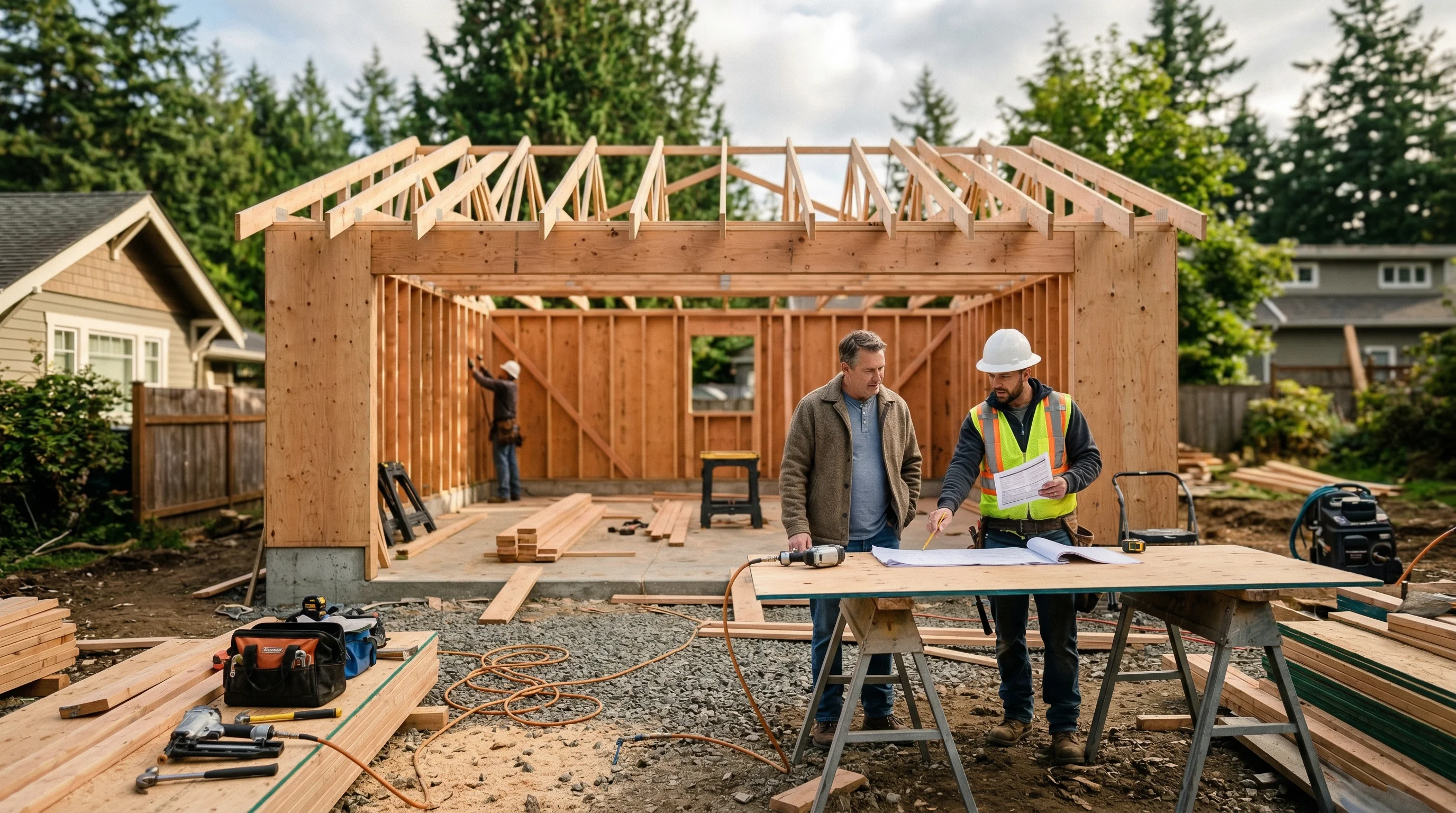
$34,500. That’s what a standard 24x24 detached garage runs in most markets right now. Miss one line item on the estimate and you’re eating the difference.
Quick Answer
A complete garage estimate should include site prep, slab, framing, roofing, siding, garage door, electrical, permits, and overhead. Detached garages run $45-$80 per square foot and attached garages run $40-$70 per square foot for the full build (Angi 2026). The most common estimating mistake is leaving out site work, permit fees, and electrical - which can add $5,000-$12,000 to the real project cost.
I’ve bid dozens of garage projects over the years, and garage estimates are where I see contractors lose money the fastest. Not because the work is hard. Because the estimates are incomplete. They forget the permit fees. They skip the grading. They price the slab but not the compaction. And six weeks later, they’re wondering why the job went sideways.
This guide walks through exactly how to build a garage estimate that covers every line item, protects your margin, and wins the job. Use our Garage Cost Calculator to run your numbers quickly, or follow this step-by-step process to build the bid from scratch.
Try EstimationPro free to generate a complete garage estimate from photos and notes in minutes instead of hours.
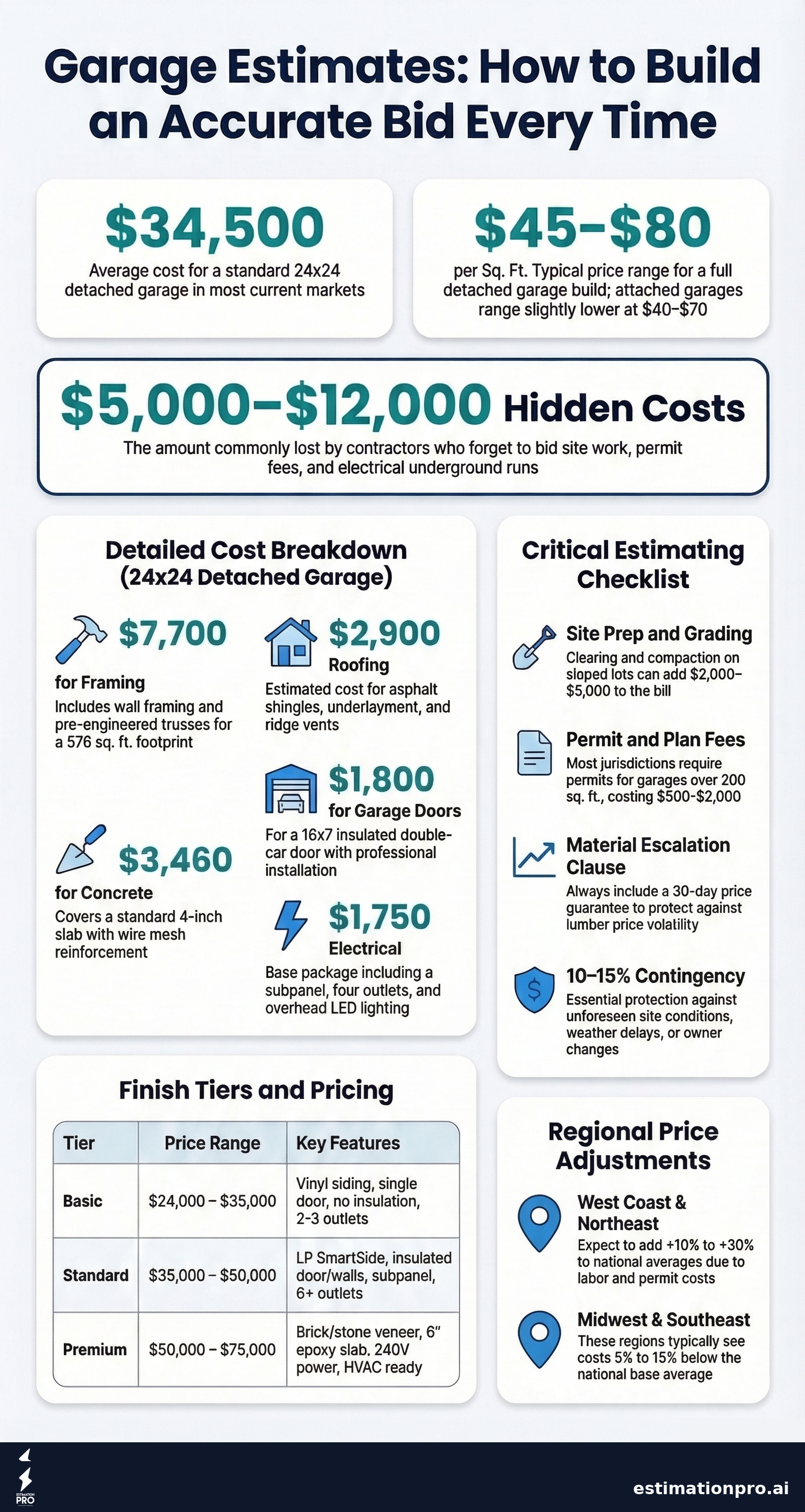
Share This Infographic
Feel free to share this infographic on your website. Just copy the embed code below:
Copy this embed code:
<a href="https://estimationpro.ai/tools/blog/garage-estimates" target="_blank" rel="noopener">
  <img src="https://estimationpro.ai/tools/blog/infographics/garage-estimates-infographic.png" alt="Garage Estimates: How to Build an Accurate Bid Every Time infographic by EstimationPro.AI" style="max-width:100%;height:auto" loading="lazy" />
</a>
<p style="font-size:12px;color:#64748B;margin-top:8px">Source: <a href="https://estimationpro.ai/tools/blog/garage-estimates">EstimationPro.AI</a></p>
What Most Contractors Miss on Garage Estimates
Before I walk through the process, here are the line items that get left off garage bids most often. I’ve made some of these mistakes myself early on.
- Site prep and grading. Clearing, grading, and compaction before the slab pour. On sloped lots, this alone can run $2,000-$5,000.
- Permit fees. Garages over 200 square feet require permits in most jurisdictions. Budget $500-$2,000 depending on your city.
- Utility connections. Running electrical from the house panel to the garage. Underground conduit adds cost that gets overlooked.
- Downspouts and drainage. Gutters on a new garage aren’t optional if you’re near the property line or on clay soil.
- Finish work inside. Drywall, paint, and trim on the interior. Homeowners assume it’s included. If it’s not in the bid, it becomes a change order fight.
These five items can add $5,000-$12,000 to a project. Leave them out of the estimate and your margin disappears.
Step-by-Step: Building a Garage Estimate From the Ground Up
Here’s the process I follow every time. It keeps the bid tight and makes sure nothing falls through the cracks.
1. Site Visit and Measurements
You can’t estimate a garage from a phone call. Walk the site. Measure the footprint. Check the grade. Note the soil conditions. Look at where the electrical panel sits and how far you’ll need to run conduit.
Key measurements to capture:
- Garage footprint (length x width)
- Ceiling height (standard 8’, but many homeowners want 10’ or higher for lifts)
- Distance from house electrical panel to garage location
- Grade change across the footprint
- Setback from property lines (check local code)
2. Foundation and Slab
The slab is your first major line item. Standard garage slabs run $4-$8 per square foot installed, depending on thickness, reinforcement, and site conditions (Angi 2026).
For a 24x24 garage (576 sq ft):
- 4” slab with wire mesh: $2,300-$4,600
- 6” slab with rebar for heavy equipment: $3,500-$5,750
- Thickened edge at perimeter (monolithic pour): add $3-$5 per linear foot
Don’t forget to include:
- Gravel base (4-6” compacted)
- Vapor barrier
- Anchor bolts for wall plates
- Apron in front of the garage door (usually 4’ deep minimum)
3. Framing
Wall framing runs $20-$50 per linear foot depending on stud size and complexity (HomeGuide 2026). Roof trusses add $3-$8 per square foot of roof plan area.
| Framing Component | Unit | Cost Range |
|---|---|---|
| Wall framing (2x4, 8’ walls) | per LF | $20-$35 |
| Wall framing (2x6 or 10’ walls) | per LF | $30-$50 |
| Pre-engineered trusses (set + sheathed) | per SF | $3-$8 |
| Headers over garage door openings | each | $150-$400 |
For a 24x24 garage with 8’ walls:
- Perimeter wall framing: 96 LF x $32/LF = $3,072
- Roof trusses and sheathing: 576 SF x $5/SF = $2,880
- Headers and blocking: $600
- Total framing: ~$6,550
4. Roofing
Price the roof by the square (100 sq ft). A 24x24 garage with standard gable trusses gives you roughly 650-700 square feet of roof area depending on pitch.
Budget $350-$550 per square for asphalt shingles installed, including underlayment, drip edge, and ridge vent. That puts a basic garage roof at $2,300-$3,850.
5. Exterior and Siding
Vinyl siding is cheapest at $3-$7 per square foot installed. LP SmartSide or fiber cement runs $6-$12 per square foot. Don’t forget:
- Soffit and fascia
- Exterior trim around doors and windows
- Caulking and paint (if applicable)
A 24x24 garage has roughly 960 square feet of exterior wall area (less openings). Budget $2,500-$5,000 for mid-range siding.
6. Garage Door
Single car door (8x7 or 9x7): $800-$1,500 installed Double car door (16x7): $1,200-$2,500 installed Insulated double with opener: $1,800-$3,500 installed
The garage door is the most visible part of the build. This is not the place to cut costs if the homeowner cares about curb appeal. My advice: always present at least two options so the homeowner can choose their comfort level.
7. Electrical
At minimum, a garage needs a subpanel, lighting, and outlets. According to Bureau of Labor Statistics occupational data, licensed electricians bill $50-$150 per hour in most markets.
| Electrical Item | Cost Range |
|---|---|
| Subpanel installation (60-100A) | $500-$1,500 |
| Standard outlets (per outlet) | $100-$300 |
| LED overhead lighting (per fixture) | $75-$200 |
| Exterior light fixture | $100-$250 |
| 240V outlet (for welder/compressor) | $250-$500 |
| Underground conduit run (per LF) | $8-$15 |
A basic electrical package (subpanel, 4 outlets, 2 lights) runs $1,200-$2,500. A full workshop setup with 240V service can hit $3,000-$5,000.
8. Permits, Insurance, and Overhead
This is where inexperienced estimators get burned. You need to account for:
- Building permits: $500-$2,000
- Plan review fees: $200-$500
- Builder’s risk insurance: varies by coverage
- Waste removal / dumpster: $300-$600
- Port-a-john rental: $150-$300/month
- Your overhead and profit margin: 15-25% on top of direct costs
I add overhead and profit as a separate line item. It keeps the estimate honest and makes it easier to adjust if you need to sharpen the pencil on a competitive bid.
Worked Example: 24x24 Detached Garage (Standard Finish)
Here’s a real estimate breakdown for a standard 2-car detached garage. Slab on grade, 8’ walls, gable roof with asphalt shingles, vinyl siding.
| Line Item | Quantity | Unit Cost | Total |
|---|---|---|---|
| Site prep and grading | 1 lot | $1,500 | $1,500 |
| Concrete slab (4”, wire mesh) | 576 SF | $6/SF | $3,460 |
| Wall framing (2x4, 8’ walls) | 96 LF | $32/LF | $3,072 |
| Roof trusses + sheathing | 576 SF | $5/SF | $2,880 |
| Roofing (asphalt shingles) | 7 squares | $420/sq | $2,940 |
| Vinyl siding + trim | 800 SF | $5/SF | $4,000 |
| Garage door (16x7, insulated) | 1 | $1,800 | $1,800 |
| Entry door (steel, prehung) | 1 | $1,200 | $1,200 |
| Electrical (subpanel + 4 outlets + lights) | 1 lot | $1,750 | $1,750 |
| Gutters and downspouts | 96 LF | $8/LF | $770 |
| Permits and plan review | 1 | $1,200 | $1,200 |
| Dumpster and cleanup | 1 | $450 | $450 |
| Subtotal | $25,022 | ||
| Overhead + profit (20%) | $5,004 | ||
| Total Estimate | $30,026 |
That’s a solid, defensible number. Every line item is documented. If the homeowner asks “why does it cost this much,” you can point to every dollar.
Worked Example: 20x20 Attached Garage Addition
Attached garages save money on one exterior wall (shared with the house) but add complexity with tie-ins to existing structure, roofing transitions, and matching exterior finishes.
| Line Item | Quantity | Unit Cost | Total |
|---|---|---|---|
| Site prep | 1 lot | $1,200 | $1,200 |
| Concrete slab | 400 SF | $6/SF | $2,400 |
| Wall framing (3 walls + tie-in) | 60 LF | $40/LF | $2,400 |
| Roof framing + tie-in to existing | 400 SF | $7/SF | $2,800 |
| Roofing (match existing) | 5 squares | $450/sq | $2,250 |
| Siding (match existing, fiber cement) | 480 SF | $9/SF | $4,320 |
| Garage door (16x7 insulated) | 1 | $2,000 | $2,000 |
| Electrical (tap existing panel) | 1 lot | $1,200 | $1,200 |
| Permits | 1 | $1,500 | $1,500 |
| Dumpster | 1 | $400 | $400 |
| Subtotal | $20,470 | ||
| Overhead + profit (20%) | $4,094 | ||
| Total Estimate | $24,564 |
Notice the higher per-unit costs on framing and siding. Tie-in work is slower. Matching existing materials takes more labor. Factor that into your rates or the job will eat your margin.
For more detail on garage costs by size and type, check our garage cost estimator guide.
Mistakes That Kill Your Garage Estimate Margins
I’ve learned these the hard way. Every one of these has cost me or another contractor I know real money.
1. Not accounting for soil conditions. Clay soil? You might need deeper footings. Rocky ground? Excavation costs double. Sandy soil near the water table? You’re looking at a different foundation entirely. Always check soil before you price the slab.
2. Pricing lumber at today’s rate without a materials escalation clause. According to Robert Dietz, Chief Economist at the National Association of Home Builders (NAHB), “lumber prices remain volatile and can shift significantly within a single quarter.” If your garage estimate sits for 60 days before the homeowner signs, your material costs might be way off. Include a 30-day price guarantee, not an open-ended one.
3. Forgetting the garage door opener. Sounds small. It’s a $300-$600 add that homeowners expect is included. Spell it out on the estimate either way.
4. Undersizing the electrical. A homeowner who says “just a couple outlets” today will want 240V for a welder or EV charger next year. Price what they ask for, but mention the upgrade path. It’s good customer service and a future upsell.
5. Ignoring setback and HOA requirements. I’ve seen contractors frame a garage only to find out it violates the 5-foot setback. That’s a tear-down at your expense. Check codes before you bid.
How Long Should a Garage Estimate Take?
A complete garage estimate with accurate line items should take 2-4 hours if you’re doing it manually. Site visit, takeoff, material pricing, subcontractor quotes, and writing it up.
That’s time you’re not billing for. And if the homeowner gets three bids, you’ve got a 33% chance of landing the job.
This is exactly why I built EstimationPro. Snap photos on the site visit, add your notes, and the AI generates a full line-item estimate in minutes. Not a ballpark. A real estimate with quantities, unit costs, and a professional PDF you can send on the spot. I’ve used it on my own garage bids and it’s accurate to within 5% of my manual takeoffs.
Regional Pricing Adjustments
Garage construction costs vary significantly by region. These numbers reflect national averages. Adjust based on your local market:
| Region | Cost Adjustment |
|---|---|
| Northeast | +10-20% |
| Southeast | -5-10% |
| Midwest | -5-15% |
| Southwest | Base |
| Pacific Northwest | +5-15% |
| West Coast (CA) | +15-30% |
Labor availability, material delivery costs, permit fees, and local code requirements all drive regional differences. Use local sub quotes whenever possible rather than national averages.
Prices in this article are national averages for 2026 and may vary by region, market conditions, and project specifics. Always verify with local suppliers and subcontractors before finalizing your estimate.
Frequently Asked Questions
How much does it cost to build a 2-car garage?
A standard 2-car detached garage (24x24) costs $24,000-$46,000 depending on finish level and location. Basic builds with vinyl siding and minimal electrical run $24,000-$35,000. Standard builds with insulation, a finished interior, and full electrical run $35,000-$50,000 (Angi 2026, HomeGuide 2026).
What should be included in a garage estimate?
A complete garage estimate should include: site prep, concrete slab, framing (walls and roof), roofing, siding, garage door, entry door, electrical, permits, dumpster/cleanup, and overhead with profit. Missing any of these line items means you’re underpricing the job.
How do I estimate a garage addition to my house?
Attached garage additions cost $40-$70 per square foot for the structure (HomeLight 2026, Angi 2026). They’re less expensive than detached garages per square foot because you share one wall, but tie-in work to existing framing, roofing, and siding adds labor cost. Always account for matching existing exterior finishes.
Should I include a contingency in my garage estimate?
Yes. Budget 10-15% contingency on garage projects. Site conditions, weather delays, and material price changes are the most common overages. A 10% contingency on a $30,000 garage adds $3,000 of protection to your margin.
How long does it take to build a garage?
Most detached garages take 3-6 weeks from slab pour to finished product. Attached garages with tie-in work can take 4-8 weeks. Permit approval typically adds 2-4 weeks before construction starts. Build this timeline into your estimate schedule so the homeowner has realistic expectations.
Your Garage Estimating Checklist
Before you send any garage estimate, make sure you’ve covered every one of these:
- Site visit completed with measurements
- Soil conditions checked
- Setback and HOA requirements verified
- Building permit costs confirmed with local authority
- Slab thickness and reinforcement specified
- Framing materials and wall height confirmed
- Roofing material and pitch documented
- Siding type matches homeowner preference
- Garage door size, style, and opener included
- Electrical scope defined (outlets, lighting, 240V)
- Gutters, downspouts, and grading included
- Dumpster and cleanup budgeted
- Overhead and profit margin applied
- Materials escalation clause in contract
- Contingency line item included
Stop Spending Evenings on Garage Bids
Garage estimates don’t have to take all night. Try EstimationPro free and turn your site visit photos and notes into a complete, line-item garage estimate in minutes. EstimationPro doesn’t just build the estimate - it generates a professional proposal, sends it to the homeowner, and automatically follows up so you win more of the bids you already send. More jobs closed, less time estimating, more evenings with your family.
24x24 Detached Garage Estimate Breakdown
Garage Estimate Tiers by Finish Level
- Concrete slab, no epoxy
- Vinyl siding
- Single garage door
- 2-3 outlets, 1 light
- Uninsulated
- 4" slab with vapor barrier
- LP SmartSide or Hardie
- Insulated garage door
- Subpanel, 6+ outlets
- Insulated walls
- 6" reinforced slab with epoxy
- Brick or stone veneer
- Two insulated doors with openers
- Full electrical with 240V
- Finished interior, HVAC ready
Get Free Estimating Tips
Enter your email and we'll send you pro tips, cost data, and useful resources for contractors.
We'll send helpful resources and occasional tips. Unsubscribe anytime.
 EstimationPro AI For Contractors, By Contractors
 Create Detailed Estimates in Minutes, Not Hours
Upload photos, record voice notes, and get AI-powered estimates with line items, material lists, and regional pricing.