
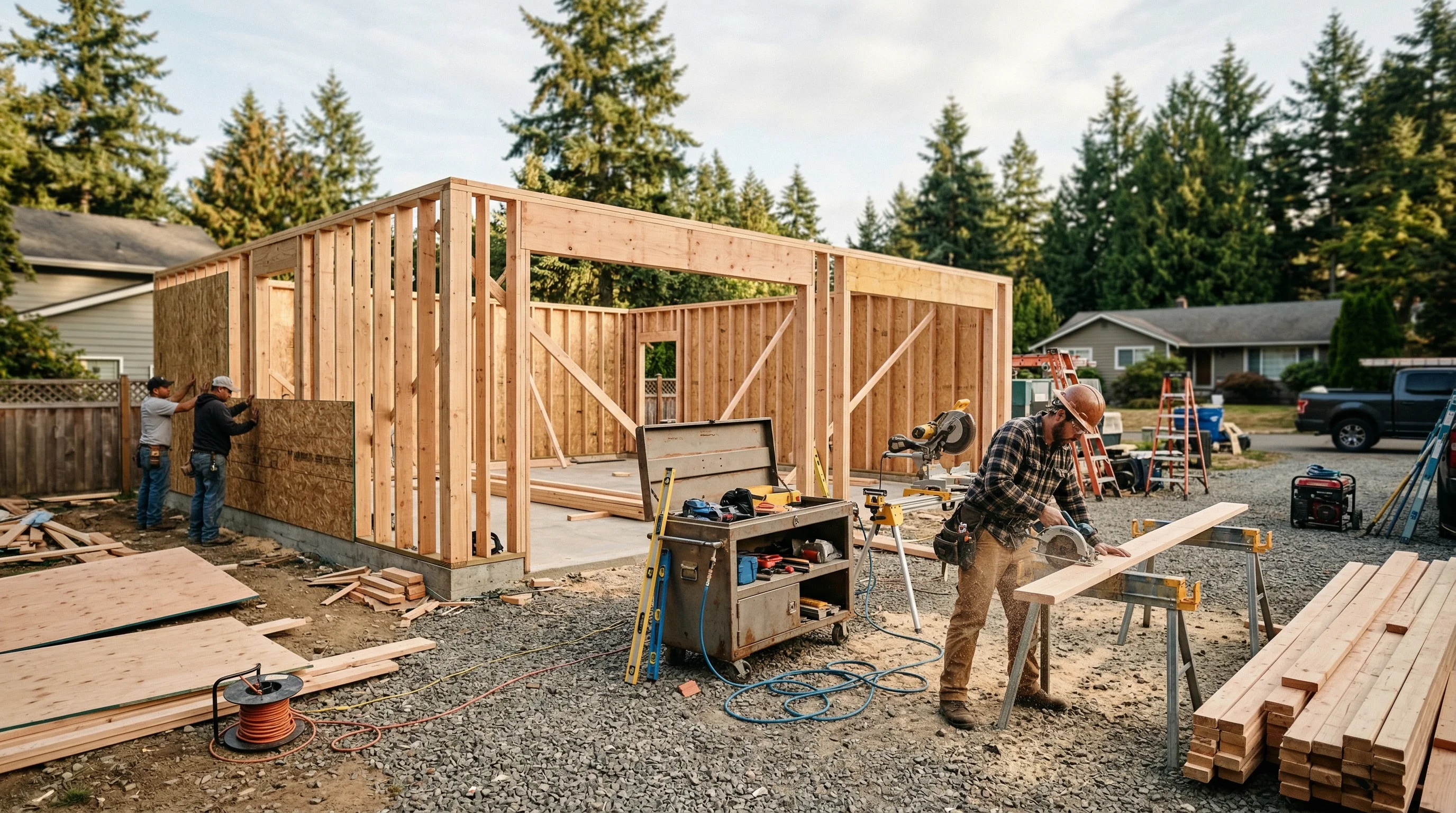
$34,500. That’s the number I handed a homeowner last month for a 24x24 detached two-car garage in the Pacific Northwest. His jaw dropped. He’d been told by a buddy that garages cost “around 20 grand.” That buddy hadn’t priced lumber since 2019.
Quick Answer
A standard detached 2-car garage (24x24) costs $26,000-$46,000 in 2026. Attached garages run 10-15% less. The biggest price drivers are finish level (basic vs. insulated and drywalled), electrical scope, site conditions, and regional labor rates. A bare-bones single-car runs $15,000-$22,000. A finished workshop-quality build can hit $65,000+.
Garage pricing catches people off guard because the range is enormous. A bare-bones single-car detached garage might run $15,000. A finished two-car with electrical, insulation, and a concrete apron can hit $65,000 or more. The difference comes down to six or seven decisions that most homeowners never think about until the estimate lands in their inbox.
I’ve been building and estimating garages for over 20 years, and the same pricing questions come up on every single job. This guide breaks down exactly what a garage price estimator accounts for, what drives the numbers, and how to read an estimate so you know whether it’s fair.
Use our Garage Cost Calculator to run your own numbers in minutes. Try EstimationPro free to generate a full line-item estimate with materials, labor, and overhead built in.
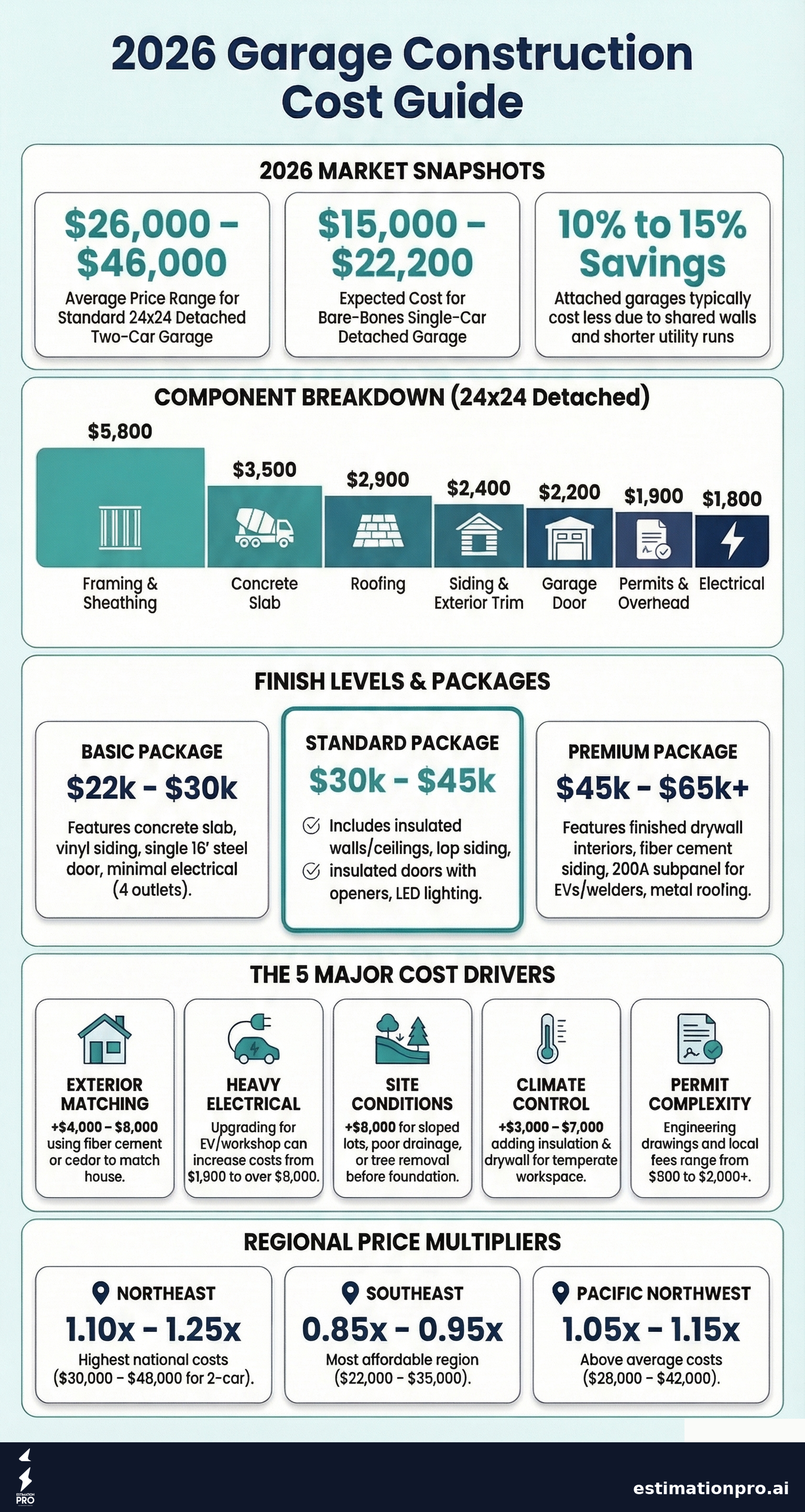
Share This Infographic
Feel free to share this infographic on your website. Just copy the embed code below:
Copy this embed code:
<a href="https://estimationpro.ai/tools/blog/garage-price-estimator" target="_blank" rel="noopener">
  <img src="https://estimationpro.ai/tools/blog/infographics/garage-price-estimator-infographic.png" alt="Garage Price Estimator: 2026 Costs and Pricing infographic by EstimationPro.AI" style="max-width:100%;height:auto" loading="lazy" />
</a>
<p style="font-size:12px;color:#64748B;margin-top:8px">Source: <a href="https://estimationpro.ai/tools/blog/garage-price-estimator">EstimationPro.AI</a></p>
What a Garage Price Estimator Actually Calculates
A real garage estimate isn’t one number. It’s a stack of line items, each with its own material cost, labor rate, and waste factor. Here’s what goes into it:
- Site work and excavation - Grading, compaction, gravel base. Costs spike if the lot slopes or has poor drainage.
- Concrete slab - Typically 4” thick with wire mesh. For a 24x24 garage, that’s 576 sq ft at $4-$8 per sq ft installed, or roughly $2,300-$4,600.
- Framing - Walls, trusses, sheathing. Wall framing runs $20-$50 per linear foot depending on stud size and height.
- Roofing - Sheathing, underlayment, shingles. 3-tab asphalt runs $3-$5 per sq ft installed.
- Siding and exterior trim - Matched to the house or basic vinyl.
- Garage door(s) - Single car (9x7) runs $900-$2,500 installed. Double (16x7) runs $1,200-$3,500.
- Electrical - Outlets run $100-$300 each installed. A subpanel adds $1,200-$2,500.
- Permits and inspections - Usually $500-$2,000 depending on your jurisdiction.
Every one of those line items has a range. That’s why two garage estimates for the “same” project can differ by $15,000.
Detached vs. Attached: The Price Gap Nobody Explains
| Factor | Detached Garage | Attached Garage |
|---|---|---|
| Cost per sq ft | $45-$80 | $40-$70 |
| Foundation | Full perimeter + slab | Shared wall, partial foundation |
| Fire separation | Standard framing | Fire-rated drywall required (5/8” Type X) |
| Roofing | Independent roof structure | Ties into existing roofline |
| Electrical | New run from panel | Shorter run, existing panel access |
| Typical 2-car total | $26,000-$46,000 | $23,000-$40,000 |
Attached garages cost less on paper. But here’s what that table doesn’t show: tying into an existing roofline is fussy work. If the contractor has to match 20-year-old shingles or work around existing gutters, the labor hours climb fast. I’ve seen attached garages end up costing MORE than detached because the tie-in work ate the savings.
Detached garages are cleaner builds. Four walls, independent roof, no surprises behind existing siding. For contractors, they’re more predictable to estimate. For homeowners, that predictability means fewer change orders.
Worked Example: 24x24 Detached Two-Car Garage
Here’s a real-world line-item breakdown for a standard detached two-car garage on a flat lot:
| Line Item | Quantity | Unit Cost | Total |
|---|---|---|---|
| Site prep and grading | 576 sq ft | $2.50/sf | $1,440 |
| Concrete slab (4” w/ mesh) | 576 sq ft | $6.00/sf | $3,456 |
| Wall framing (8’ walls) | 192 LF | $30/LF | $5,760 |
| Roof trusses + sheathing | 576 sq ft | $5.00/sf | $2,880 |
| 3-tab shingles installed | 576 sq ft | $4.00/sf | $2,304 |
| Vinyl siding | 768 sq ft | $3.50/sf | $2,688 |
| Garage door (16’ double) | 1 | $2,200 | $2,200 |
| Garage door opener | 1 | $500 | $500 |
| Electrical (6 outlets + lights) | 1 lot | $1,800 | $1,800 |
| Permits | 1 | $1,200 | $1,200 |
| Overhead and profit (15%) | - | - | $3,634 |
| Total | $27,862 |
That’s a basic build. No insulation, no drywall, no 240V circuit. Add those and you’re looking at $33,000-$38,000 for the same footprint.
Where the overage hits: Concrete is the biggest variable. If the soil needs extra compaction or the lot requires a retaining element, the slab cost can jump 40%. I always pad concrete line items by 10% for waste and short-load fees. Ready-mix concrete runs $110-$200 per cubic yard delivered, and short loads under 5 yards carry a surcharge of $50-$100 per yard. Use our concrete calculator to dial in your slab quantities before you price the pour.
Five Factors That Push Garage Prices Higher Than Expected
1. Matching the house exterior. Your HOA or your spouse wants the garage to look like it belongs. Fiber cement siding instead of vinyl. Architectural shingles instead of 3-tab. Trim details. These upgrades can add $4,000-$8,000 to a basic garage.
2. Insulation and climate control. In the Pacific Northwest, an uninsulated garage is cold and damp six months out of the year. Batt insulation runs $1-$3.50 per sq ft for walls and ceiling. Add drywall and finishing at $2-$5 per sq ft, and you’ve added $3,000-$7,000 to the project.
3. Heavy electrical. A basic garage needs a few outlets and a light. But if you want a workshop with 240V for a welder or table saw, EV charging, or a subpanel for future expansion, electrical can jump from $1,800 to $5,000+.
4. Site conditions. Slope, drainage, tree removal, utility relocation. I’ve quoted garages where the site work alone was $8,000 before we poured a single yard of concrete. A flat, clear lot with good soil is the cheapest scenario. Anything else adds money.
5. Permit complexity. Some jurisdictions want engineered drawings, soil reports, and multiple inspections. Others just want a basic plan set and a permit fee. The range is $500 to $2,000+ just in permit costs, and engineering drawings can add another $1,500-$3,000.
Worked Example: 20x20 Single-Car With Workshop Finish
| Line Item | Quantity | Unit Cost | Total |
|---|---|---|---|
| Site prep | 400 sq ft | $2.50/sf | $1,000 |
| Concrete slab (4” w/ mesh) | 400 sq ft | $6.00/sf | $2,400 |
| Wall framing (10’ walls) | 160 LF | $35/LF | $5,600 |
| Roof trusses + sheathing | 400 sq ft | $5.00/sf | $2,000 |
| Architectural shingles | 400 sq ft | $5.00/sf | $2,000 |
| Lap siding to match house | 640 sq ft | $5.00/sf | $3,200 |
| Insulation (walls + ceiling) | 1,040 sq ft | $2.00/sf | $2,080 |
| Drywall + finish | 1,040 sq ft | $3.25/sf | $3,380 |
| Garage door (9’ single) | 1 | $1,500 | $1,500 |
| Opener + keypad | 1 | $550 | $550 |
| Electrical (subpanel, 240V, 8 outlets) | 1 lot | $3,500 | $3,500 |
| Permits + engineering | 1 | $1,800 | $1,800 |
| Overhead and profit (15%) | - | - | $4,352 |
| Total | $33,362 |
A finished 20x20 workshop garage costs more than a basic 24x24 two-car. Size isn’t the only driver. Finish level is.
How to Read a Garage Estimate (and Spot Red Flags)
Not all estimates are equal. Here’s what to look for:
- Line items, not lump sums. If a contractor gives you one number with no breakdown, you can’t compare it to anything. A professional estimate lists every material, labor category, and allowance separately.
- Waste factors included. Lumber waste is typically 5-10%. Concrete is 5-10% depending on pour complexity. Shingles are usually 10-15% for waste and cuts. If the estimate shows zero waste, the contractor either knows something you don’t or is going to come back with a change order.
- Permit costs called out. Some contractors bury permits in overhead. Others exclude them entirely. Ask directly.
- Contingency or allowance line. A good estimate includes 5-10% contingency for unknowns. Hidden conditions, material price changes, weather delays. An estimate with zero contingency is a contractor who hasn’t been surprised yet. They will be.
- Overhead and profit stated. Industry standard is 10-20% for overhead and 10-15% for profit. If you don’t see it, it’s hidden in inflated line items. I’d rather see it called out honestly.
Mistakes Homeowners Make When Comparing Garage Bids
Comparing lump-sum bids to line-item bids. You can’t. The lump-sum bid might include everything, or it might leave out electrical, permits, and site work. Get both bids in the same format before you compare.
Ignoring the garage door quality. A $900 builder-grade door and a $2,500 insulated steel door with smart opener are wildly different products. The door is the most visible element of the garage. Cheap doors dent, rust, and fail faster.
Skipping the slab thickness question. Check how to estimate construction jobs for more on building accurate bids. Standard is 4” for passenger vehicles. If you’re parking a truck, boat, or heavy equipment, you need 5-6” with rebar. Going thin to save $800 on concrete and then cracking the slab under a loaded trailer is an expensive lesson.
Assuming the cheapest bid is the best value. I’ve said this a hundred times: you get what you pay for. The lowest bid usually means something was left out, the contractor is desperate for work, or they’re cutting corners you won’t see until the first winter. A mid-range bid from a licensed, insured contractor with references is almost always the best value.
Regional Pricing: Why Your Neighbor’s Garage Cost Doesn’t Apply
Garage prices vary significantly by region. According to BLS data and RSMeans 2025, labor rates in major metro areas run 20-40% higher than rural areas. Material delivery costs also vary based on distance from distribution centers.
| Region | Cost Multiplier | 24x24 Detached Range |
|---|---|---|
| Pacific Northwest | 1.05-1.15x | $28,000-$42,000 |
| Southeast | 0.85-0.95x | $22,000-$35,000 |
| Northeast | 1.10-1.25x | $30,000-$48,000 |
| Midwest | 0.90-1.00x | $24,000-$37,000 |
| Southwest | 0.95-1.10x | $25,000-$40,000 |
These are rough ranges. Your actual price depends on local labor supply, material availability, permit requirements, and soil conditions. Always get local estimates - national averages are directional, not actionable.
All prices in this guide reflect 2026 data from Angi, HomeGuide, and RSMeans, supplemented by field experience. Your market may vary. Get at least three local bids before committing.
FAQ
How much does it cost to build a 2-car garage in 2026?
A basic detached 2-car garage (24x24) runs $26,000-$46,000 depending on finish level, site conditions, and region. Attached garages typically cost 10-15% less due to shared wall construction, but tie-in complexity can offset those savings.
What is the cheapest type of garage to build?
A detached, slab-on-grade garage with vinyl siding, 3-tab shingles, and no insulation or drywall. For a 20x20 single-car, expect $15,000-$22,000. Carport structures (no walls) are cheaper still at $5,000-$12,000, but don’t provide the same protection or resale value.
Should I get an attached or detached garage?
Detached garages are simpler to build and estimate. Attached garages save on materials (shared wall) but add complexity with roofline tie-ins, fire-rated assemblies, and matching existing finishes. If your lot layout allows either, I’d recommend detached for a cleaner, more predictable build unless you value the covered walkway connection to the house.
How long does it take to build a garage?
Two to four weeks for a basic detached garage, assuming permits are already in hand. Add 1-2 weeks for insulation, drywall, and finish work. Attached garages often take longer due to tie-in work and existing structure coordination. Permit approval alone can take 2-6 weeks depending on your jurisdiction.
Do I need a permit to build a garage?
Almost always, yes. Most jurisdictions require permits for any structure with a foundation. Expect building permits, and possibly electrical and plumbing permits if you’re adding utilities. Building without a permit creates liability issues and can cause problems when you sell the house.
Get a Complete Garage Estimate in Minutes
Pricing a garage by hand means juggling material takeoffs, labor rates, waste calculations, and regional adjustments. That’s exactly why I built EstimationPro. Feed it the project details - size, finish level, location, special requirements - and it generates a full line-item estimate you can hand to a client or use to evaluate a contractor’s bid.
EstimationPro doesn’t just build the estimate. It sends the proposal automatically, follows up with the homeowner on a schedule you set, and handles invoicing when the job is done. That’s the full cycle from bid to paid, without spending your evenings in a spreadsheet. Try EstimationPro free and see how fast you can price your next garage job.
24x24 Detached Garage Cost Breakdown
Garage Build Packages by Finish Level
- Concrete slab, no insulation
- Vinyl siding
- Single 16' steel door
- 4 outlets, 1 light circuit
- 3-tab shingles
- Insulated walls and ceiling
- Lap siding to match house
- Insulated steel door with opener
- Subpanel, 6+ outlets, LED lighting
- Architectural shingles
- Finished interior with drywall
- Fiber cement or cedar siding
- Two insulated doors with smart openers
- 200A subpanel, 240V for welder/EV
- Standing seam metal roof
Get Free Estimating Tips
Enter your email and we'll send you pro tips, cost data, and useful resources for contractors.
We'll send helpful resources and occasional tips. Unsubscribe anytime.
 EstimationPro AI For Contractors, By Contractors
 Price Every Job With Confidence
Stop second-guessing your numbers. EstimationPro AI builds accurate estimates from real cost data.