
$31,000. That’s the midpoint for a standard 2-car attached garage addition in 2026 - and I’ve seen bids swing $15,000 in either direction depending on site conditions and finish level. A garage addition isn’t just a box with a door. It ties into your existing foundation, roofline, and electrical panel, and every one of those connections adds cost that homeowners don’t expect.
I’ve bid enough garage additions to know that the biggest price surprises come from what’s underground and what’s behind the wall you’re tying into. The slab, the footer depth, the existing framing - those are the variables that make or break your budget.
Quick Answer
A garage addition costs $40 to $70 per square foot for an attached build and $45 to $80 per square foot for detached construction, according to Angi and HomeLight 2026 data. A standard 2-car attached garage (24x24) runs $23,000 to $40,000, with most homeowners paying around $31,000 for a finished build with insulation, drywall, and a concrete approach.
Use our Garage Cost Calculator to get a detailed estimate for your specific project. Or Try EstimationPro free to build a complete, line-item garage addition estimate in minutes.
Garage Addition Cost by Size and Type
Here’s what you’re looking at for the most common garage sizes. These include the slab, framing, roofing, a standard garage door, basic electrical, and exterior finish to match the house.
| Garage Size | Sq Ft | Attached Cost Range | Detached Cost Range |
|---|---|---|---|
| 1-Car (12x24) | 288 | $11,500 - $20,200 | $13,000 - $23,000 |
| 1.5-Car (16x24) | 384 | $15,400 - $26,900 | $17,300 - $30,700 |
| 2-Car (24x24) | 576 | $23,000 - $40,300 | $25,900 - $46,100 |
| 2.5-Car (28x24) | 672 | $26,900 - $47,000 | $30,200 - $53,800 |
| 3-Car (36x24) | 864 | $34,600 - $60,500 | $38,900 - $69,100 |
Prices reflect 2026 national averages. Your actual cost depends on local labor rates, soil conditions, and finish level. Pacific Northwest and Northeast markets typically run 10-20% above these ranges.
Why is detached more expensive? Simple. A detached garage needs four full walls instead of three, its own complete foundation perimeter, a separate electrical run from the main panel, and often a separate concrete approach or driveway extension. An attached addition shares one wall, ties into the existing foundation (sometimes), and can tap into existing electrical more easily.
Where the Money Goes
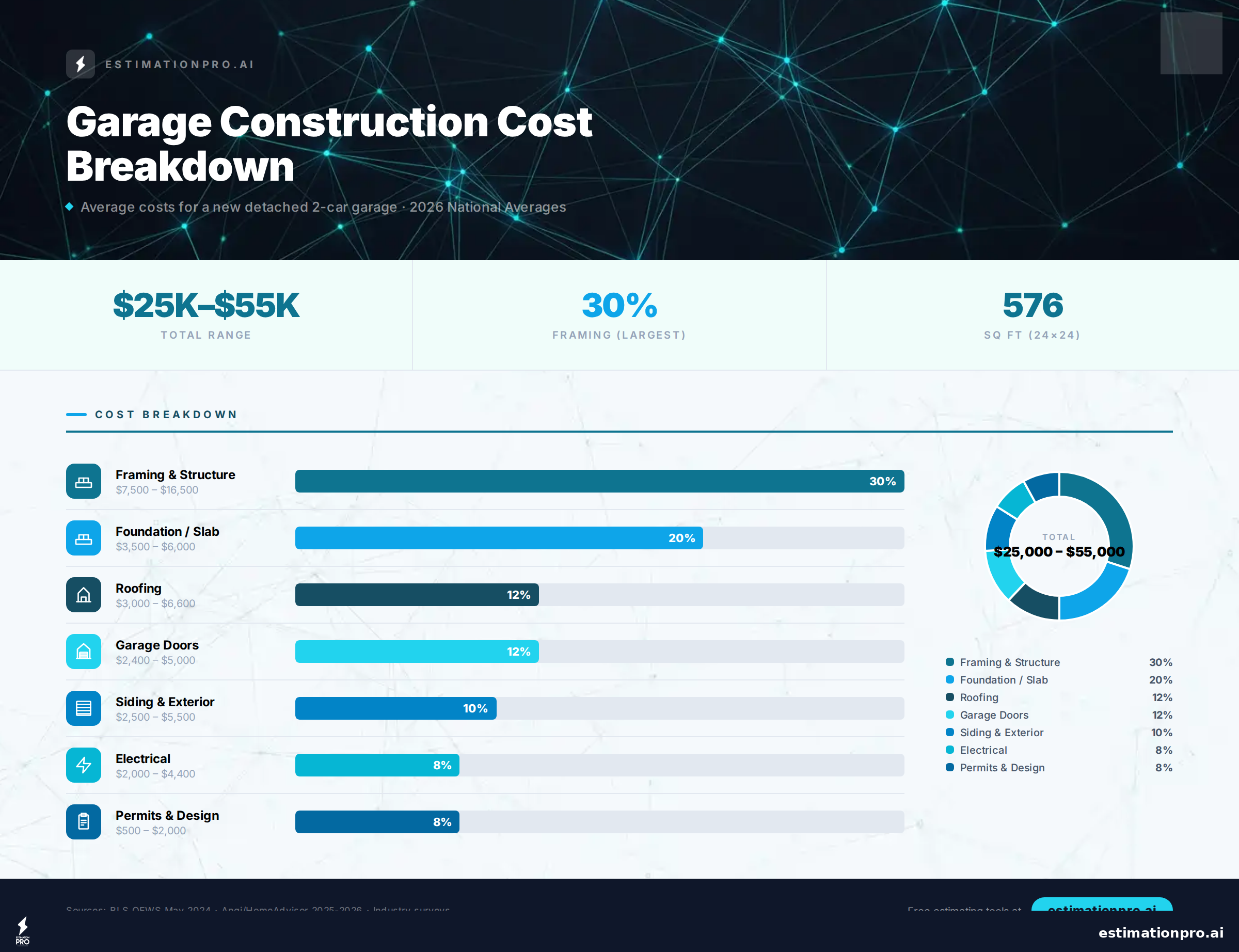
Most homeowners think “garage” and picture walls, a roof, and a door. But the slab alone eats 12-15% of the budget. Here’s the actual breakdown for a typical 2-car attached garage addition:
Foundation and slab: The concrete slab runs $4 to $8 per square foot installed (Angi 2026). For a 576 sq ft garage, that’s roughly $3,500 to $4,600. Footer depth depends on your local frost line - in the PNW, we’re digging 12-18 inches. In Minnesota, you’re going 42 inches or deeper. Deeper footers mean more concrete, more labor, more money.
Framing: Wall and roof framing runs about $7,500 for a 2-car garage. That covers studs, plates, headers, trusses, and sheathing. If you’re tying the new roofline into an existing roof, expect the framing crew to spend extra time on the transition. That tie-in is where leaks happen five years later if it’s not done right.
Roofing: Around $3,000 for asphalt shingles on a standard 2-car. Matching the existing shingles can be tricky if your roof is more than a few years old. Manufacturers change colors and discontinue lines constantly.
Exterior finish: $3,500 covers siding, trim, and paint to match the house. Vinyl is cheapest. Fiber cement (like HardiPlank) costs more but lasts decades. Whatever the house has, the addition needs to match or it looks like an afterthought.
Garage door: A standard 16-foot double door runs $1,500 to $3,000 installed. Insulated steel doors with windows are middle-of-the-road at about $2,200. Skip the cheapest single-layer doors - they dent if you look at them wrong and do nothing for insulation.
Electrical: Budget $2,500 to $3,500 for a subpanel, overhead lighting, outlets, and an opener circuit. Code requires at least one GFCI outlet and adequate lighting. If you want a 220V outlet for a welder or compressor, add $500-$800 for the dedicated circuit.
Insulation and drywall: About $3,200 for the full package. 5/8” fire-rated drywall is required on the wall shared with the house (IRC Section R302.6). That’s not optional. I’ve seen homeowners try to skip it and fail inspection.
Share This Infographic
Feel free to share this infographic on your website. Just copy the embed code below:
Copy this embed code:
<a href="https://estimationpro.ai/tools/blog/garage-addition-cost-estimator" target="_blank" rel="noopener">
  <img src="https://estimationpro.ai/tools/blog/infographics/garage-addition-cost-estimator-infographic.png" alt="garage addition cost estimator infographic by EstimationPro.AI" style="max-width:100%;height:auto" loading="lazy" />
</a>
<p style="font-size:12px;color:#64748B;margin-top:8px">Source: <a href="https://estimationpro.ai/tools/blog/garage-addition-cost-estimator">EstimationPro.AI</a></p>
Worked Example: 2-Car Attached Addition
Let’s run the numbers on the most common scenario - a 24x24 attached garage added to a single-story ranch.
| Line Item | Cost |
|---|---|
| Concrete slab (576 sf x $6.50/sf) | $3,744 |
| Footings (80 LF x $18/LF) | $1,440 |
| Wall framing (72 LF x $32/LF) | $2,304 |
| Roof trusses + sheathing (576 sf x $5/sf) | $2,880 |
| Roofing (shingles, felt, flashing) | $2,900 |
| Siding + trim (match existing) | $3,200 |
| 16’ insulated garage door + opener | $2,800 |
| Electrical (subpanel, lights, outlets) | $2,800 |
| Insulation (walls + ceiling) | $1,150 |
| Drywall (fire-rated shared wall + ceiling) | $2,100 |
| Concrete driveway approach (200 sf) | $1,600 |
| Permits + engineering | $1,800 |
| Total | $28,718 |
Add 10-15% for overhead, profit, and contingency, and you land at $31,600 to $33,000. That tracks with the $55/sq ft typical rate from the pricing data.
The items that vary most? Permits and engineering. Some jurisdictions charge $500. Others charge $3,000 and require stamped structural drawings. Call your local building department before you finalize any budget.
Worked Example: 1-Car Detached Garage
Now a simpler build - a 12x24 detached garage on a flat lot with good soil.
| Line Item | Cost |
|---|---|
| Concrete slab (288 sf x $6.50/sf) | $1,872 |
| Footings (72 LF x $18/LF) | $1,296 |
| Wall framing (72 LF x $35/LF) | $2,520 |
| Roof trusses + sheathing (288 sf x $5.50/sf) | $1,584 |
| Roofing | $1,800 |
| Siding + trim | $2,400 |
| 9’ single garage door + opener | $1,600 |
| Electrical (trench run from house, panel, lights) | $3,200 |
| Concrete approach (120 sf) | $960 |
| Permits | $1,200 |
| Total | $18,432 |
With margin, you’re looking at $20,300 to $21,200. Notice the electrical is actually higher than the attached version. Running power underground from the house to a detached structure requires a trench, conduit, and often a separate panel. That $3,200 line item is realistic - I’ve seen it hit $4,000 when the trench run is long or hits rock.
What Pushes the Price Up
Not every garage addition is straightforward. These factors can add 20-40% to the base cost:
- Sloped lot or poor soil. Grading, retaining walls, or engineered fill can add $3,000 to $8,000 before you pour a single yard of concrete.
- Living space above. A bonus room over the garage roughly doubles the framing and finish cost. You’re adding floor joists, a staircase, HVAC, plumbing if there’s a bathroom, and fire separation. Budget $80 to $120 per square foot for the upper floor.
- Matching a complex roofline. Hips, valleys, dormers - the more angles the existing roof has, the more the tie-in costs. A simple gable-to-gable connection is straightforward. Tying into a hip roof with dormers is a different job entirely.
- Older homes with outdated systems. If your electrical panel is maxed out, you may need a panel upgrade ($1,500 to $3,000) before the garage work even starts. I’ve opened walls on homes built before modern code and found wiring that should have been replaced decades ago.
- HOA or historic district rules. Design review processes add time and sometimes require more expensive materials or specific architectural details.
What Saves Money
- Keep it simple. A basic gable roof on a rectangular footprint is the cheapest build. Every bump-out, angle, or custom feature adds labor.
- Unfinished interior. Skip the drywall and insulation if you just need covered parking. You save roughly $3 to $5 per square foot, which is $1,700 to $2,900 on a 2-car garage.
- Standard sizes. Garage doors come in standard widths (8’, 9’, 16’, 18’). Building to match standard door sizes avoids custom-order pricing.
- Do your own demo. If you’re removing an old carport or shed to make room, doing the teardown yourself saves $1,000 to $2,000 in labor.
- Get the Framing Cost Calculator numbers first. Framing is the single biggest labor line item, and knowing the rate upfront keeps you from getting surprised.
Mistakes I See Homeowners Make on Garage Additions
Ignoring setback requirements. Every city has rules about how close a structure can be to the property line. I’ve had clients design their dream garage only to find out it violates the 5-foot side setback. Now the whole plan has to shrink or shift, and the site work gets more complicated.
Skipping the survey. A $400 property survey saves you from building on the neighbor’s land. That sounds dramatic, but I’ve seen it happen. Fence lines are not property lines.
Choosing the cheapest garage door. The door is the first thing everyone sees. A flimsy single-layer door with no insulation looks bad, sounds like a tin can in the wind, and offers zero R-value. Spend the extra $400-$600 for an insulated door with a decent R-value. You’ll notice the difference every winter morning.
Not planning for future use. If there’s any chance you’ll want a workshop, home gym, or storage loft later, run the extra circuits and beef up the slab now. Adding a 220V outlet during construction costs $300. Adding it after the walls are closed costs $800+. Think ahead.
Forgetting the driveway connection. Your new garage needs a driveway or apron that connects to the existing driveway or street. That concrete work adds $1,000 to $3,000 depending on the distance, and it’s easy to leave out of the initial estimate.
Permits and Code Requirements
A garage addition is not a shed. You’ll need permits in virtually every jurisdiction, and the process typically involves:
- Building permit - covers structural, electrical, and sometimes mechanical
- Site plan review - shows the addition’s footprint relative to property lines, setbacks, and easements
- Foundation inspection - before the slab pour
- Framing inspection - before insulation and drywall
- Electrical inspection - before covering walls
- Final inspection - everything complete, doors operational, occupancy approved
Permit costs range from $500 to $3,000 depending on your municipality and the project value. Some cities base fees on a percentage of construction cost (typically 1-2%). Budget 4-8 weeks for permit approval in most markets.
Per the International Residential Code (IRC Section R309.1), an attached garage requires a self-closing, fire-rated door between the garage and the living space (minimum 20-minute fire rating). The shared wall needs 1/2” drywall minimum (5/8” fire-rated in most jurisdictions). These aren’t suggestions. They’re code.
Frequently Asked Questions
How long does a garage addition take to build?
Most attached garage additions take 6 to 12 weeks from permit approval to final inspection. Detached builds often run slightly faster (4 to 8 weeks) since there’s less tie-in work. Weather delays, material lead times, and inspection scheduling can stretch either timeline. Plan for the longer end if you’re building between November and March.
Does a garage addition increase home value?
Yes. According to the National Association of Home Builders (NAHB), a 2-car garage addition recovers 60 to 80% of its cost at resale, depending on your market. In areas where street parking is the only alternative, the ROI can exceed 80%. A garage that matches the home’s architecture and adds curb appeal recovers the most value.
Should I build attached or detached?
Attached is cheaper because you share a wall and often tie into existing foundation and electrical. Detached makes sense if your lot layout doesn’t allow an attached build, if you want a workshop separated from the house (noise, fumes), or if local code requires fire separation distances you can’t meet with an attached design. Detached also gives you more flexibility on placement.
Can I convert my carport to a garage?
Converting a carport to an enclosed garage typically costs $8,000 to $20,000 - less than a new addition because the roof structure and at least two support columns already exist. You’re adding walls, a garage door, concrete work to close the floor, and electrical. Permits are still required. The savings depend heavily on the carport’s existing structural capacity.
Do I need an architect or just a contractor?
For a standard rectangular garage addition, most contractors can handle the design and permitting with basic structural drawings. If you’re adding living space above, building on a difficult lot, or dealing with historic district requirements, hire an architect or structural engineer. Engineered drawings typically cost $1,500 to $4,000 but prevent expensive mid-build changes.
Ready to price out your garage addition? Use our Garage Cost Calculator to run the numbers for your exact dimensions. Or check out our guides on garage estimates and cost to build a garage for more detail on specific components.
EstimationPro doesn’t just help you build the estimate. It generates a professional proposal, sends it to the homeowner, and automatically follows up on day 1, day 3, and day 7 so the bid doesn’t die in their inbox. Contractors lose 40-60% of bids to ghosting. Automated follow-up wins those conversations back. Try EstimationPro free and stop leaving money on the table.
2-Car Attached Garage Addition Cost Breakdown (576 sq ft)
Garage Addition Finish Levels
- Bare stud walls
- Single overhead light
- Standard single-layer door
- Gravel or dirt approach
- No insulation
- Insulated and drywalled
- Multiple circuits and outlets
- Insulated garage door
- Concrete driveway tie-in
- Exterior matches house
- Epoxy-coated floor
- 220V outlet for tools
- Mini-split HVAC
- Storage system built-ins
- Smart opener with Wi-Fi
Get Free Estimating Tips
Enter your email and we'll send you pro tips, cost data, and useful resources for contractors.
We'll send helpful resources and occasional tips. Unsubscribe anytime.
 EstimationPro AI For Contractors, By Contractors
 Price Every Job With Confidence
Stop second-guessing your numbers. EstimationPro AI builds accurate estimates from real cost data.