

$250. That’s the change order fee I missed on a kitchen remodel in 2019 because I didn’t have it written into the contract. The homeowner wanted to swap subway tile for a herringbone pattern mid-install. Not a big deal, right? Except it added two hours of layout time, a return trip to the supplier, and a delay on the next phase. I ate every dollar of that admin cost because my contract didn’t address it.
That job taught me something I should have learned years earlier. The extra work on a change order has a price. But so does the paperwork, the re-scheduling, the phone calls, and the mental load of recalculating the whole project timeline. That’s what a change order fee covers.
Try EstimationPro free to build estimates with change order fees already baked into your workflow, from first bid to final invoice.
Quick Answer
A change order fee is a separate charge for processing a mid-project scope change, on top of the actual cost of the extra work. Most contractors charge either a flat fee of $75 to $500 or an increased markup of 25% to 40% on change order work (compared to the standard 15% to 25% overhead and profit on original contract work). The fee covers your admin time, schedule disruption, and re-estimation costs. Put it in writing before the project starts so clients aren’t surprised.
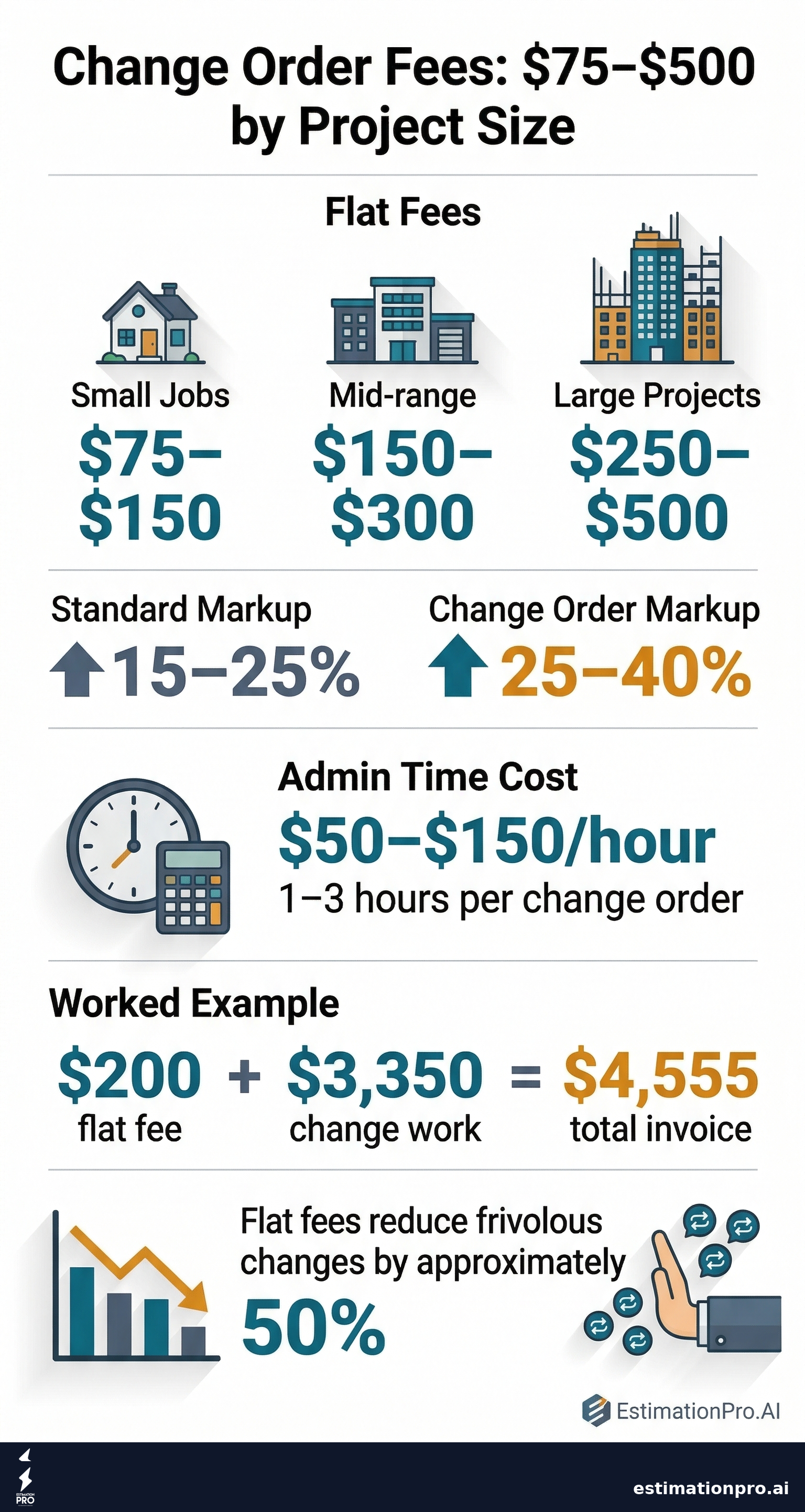
Share This Infographic
Feel free to share this infographic on your website. Just copy the embed code below:
Copy this embed code:
<a href="https://estimationpro.ai/tools/blog/change-order-fee" target="_blank" rel="noopener">
  <img src="https://estimationpro.ai/tools/blog/infographics/change-order-fee-infographic.png" alt="Change Order Fees: What to Charge and How to Structure Them infographic by EstimationPro.AI" style="max-width:100%;height:auto" loading="lazy" />
</a>
<p style="font-size:12px;color:#64748B;margin-top:8px">Source: <a href="https://estimationpro.ai/tools/blog/change-order-fee">EstimationPro.AI</a></p>
Why You Need a Change Order Fee (Not Just a Markup)
I’ve talked to contractors who say, “I just mark up the extra work and call it good.” That works if the change order is straightforward. Add a can light. Swap a faucet. Five minutes of re-estimating, no schedule impact.
But most change orders aren’t that clean.
Here’s what actually happens when a homeowner says “while you’re at it, can we also…”:
- You stop production to discuss the change
- You re-estimate materials, labor, and timeline
- You call suppliers to check availability and pricing
- You update the schedule and notify subs
- You write up the change order document for both parties to sign
- You adjust invoicing and payment milestones
That process takes 1 to 3 hours of your time. At a GC billing rate of $50 to $150 per hour (source: HomeGuide 2026 contractor rate data), you’re looking at $50 to $450 of unbilled admin work if you don’t charge for it separately.
A markup on the extra work covers your profit on that work. A change order fee covers the cost of processing the change itself. They’re two different things.
Three Ways to Structure Your Change Order Fee
There’s no single right answer. The best structure depends on your typical project size, how often changes come up, and what your clients expect.
1. Flat Fee Per Change Order
| Project Size | Typical Flat Fee | Best For |
|---|---|---|
| Small jobs (under $10K) | $75 - $150 | Handyman work, minor repairs |
| Mid-range ($10K - $50K) | $150 - $300 | Bathroom and kitchen remodels |
| Large projects ($50K+) | $250 - $500 | Additions, whole-house remodels |
How it works: Every change order triggers the flat fee regardless of the dollar amount of the change. Client wants to add $200 worth of trim? Fee applies. Client wants to swap $5,000 in countertops? Same fee.
Why it works: Simple to explain. Easy to enforce. Clients understand flat fees better than percentages, and it discourages small, frequent changes that eat your day.
Contract language example:
“Any modification to the contracted scope of work will incur a Change Order Processing Fee of $200 per change order, in addition to the adjusted cost of labor, materials, and applicable markup.”
2. Percentage-Based (Higher Markup on Changes)
Instead of a separate fee, you increase your overhead and profit markup on change order work.
| Markup Type | Typical Range | Source |
|---|---|---|
| Standard O&P (original contract) | 15% - 25% | NAHB builder cost data |
| Change order O&P markup | 25% - 40% | Industry standard practice |
| Difference (your change order premium) | 10% - 15% | The “fee” built into the price |
How it works: Your original contract prices at 20% O&P. Change order work gets priced at 30% to 35% O&P. The difference is effectively your change order fee, just built into the line items rather than broken out separately.
Why it works: Clients see one number per change order instead of “cost + markup + fee.” Some homeowners push back harder on a visible fee than on a slightly higher markup they don’t fully understand.
The downside: You’re hiding the fee. I’d rather be upfront about it. But some markets and some clients respond better to this approach.
3. Time-and-Materials for Admin
You bill your actual admin time at your hourly rate, with a minimum charge.
How it works: You track the time you spend estimating, sourcing, scheduling, and documenting the change. Bill at your standard rate ($50 to $150/hr) with a 1-hour minimum.
Why it works: Fair and transparent. You get paid for exactly the time you put in. Works well for large, complex change orders where a flat fee of $200 wouldn’t cover the 4 hours you spent re-engineering the project.
The downside: Requires time tracking. Some clients don’t like open-ended billing.
Which Fee Structure Should You Use?
Pick based on your project type:
- Flat fee if you do mostly residential remodels under $75K and your changes are usually straightforward
- Percentage markup if you do commercial work or work with builders who expect it
- T&M admin if you do custom homes or additions where changes can be complex and time-intensive
I use a flat fee on most of my remodeling projects. $200 per change order. It’s clean, it’s predictable, and it sets the right expectations from day one. My clients know that changing their mind has a real cost, and that alone cuts down on frivolous changes by about half.
Worked Example 1: Kitchen Remodel Change Order
Original contract: $48,000 kitchen remodel, 20% O&P markup
The change: Homeowner wants to upgrade from laminate to quartz countertops mid-project.
| Line Item | Cost |
|---|---|
| Quartz material (40 SF at $65/SF) | $2,600 |
| Remove laminate template, re-template for quartz | $350 |
| Additional labor (seam work, sink cutout) | $400 |
| Subtotal | $3,350 |
| O&P markup at 30% (change order rate) | $1,005 |
| Change order processing fee (flat) | $200 |
| Total change order | $4,555 |
Without the fee and the elevated markup, you’d charge $3,350 + $670 (20% standard) = $4,020. The difference is $535. That’s what covers your admin time, the schedule disruption, and the re-coordination with the countertop fabricator.
Worked Example 2: Bathroom Remodel - Multiple Small Changes
Original contract: $22,000 bathroom remodel
The changes (over 3 weeks):
| Change Order | Description | Work Cost | Fee |
|---|---|---|---|
| CO #1 | Move shower valve 6 inches (after tile was laid out) | $380 | $200 |
| CO #2 | Swap chrome fixtures for brushed nickel | $220 | $200 |
| CO #3 | Add recessed medicine cabinet (wasn’t in original scope) | $650 | $200 |
Total added cost: $1,250 in work + $600 in fees = $1,850 (before markup)
Without fees, those three changes would have cost you roughly 4 to 5 hours of admin time at zero compensation. That’s half a day you’re not building, not billing, and not on another job.
Here’s the part most contractors miss. Those $200 fees aren’t just revenue. They’re a filter. After CO #1, most homeowners think twice before requesting CO #2. The fee makes them consolidate their changes into fewer, more thoughtful requests. That saves you even more time than the fee brings in.
What Your Contract Needs to Say
Your change order fee only works if it’s in the contract before you start. Springing it on a client mid-project is a recipe for a fight.
Five things to include:
- The fee amount or formula - flat dollar, percentage, or hourly rate with minimum
- What triggers it - any scope change, or only changes above a dollar threshold
- What the fee covers - re-estimation, scheduling, documentation, supplier coordination
- When it’s due - with the change order approval, before work begins
- That it’s separate from the cost of the work - the fee is for processing, not for the labor and materials
Some contractors set a threshold. Changes under $500 in added cost get a lower fee ($100). Changes over $500 get the full fee ($200 to $300). I’ve seen this work well on larger projects where small field adjustments happen constantly.
Mistakes That Cost Contractors Money
Not having a fee at all. This is the most common one. You absorb 2 to 3 hours of admin per change order, multiply that by 4 to 6 changes on a typical remodel, and you’ve donated a full day of work for free. At $90/hour (typical GC billing rate per BLS supervisor data), that’s $720 to $1,620 in unbilled time per project.
Charging the fee but not enforcing it. Your contract says $200 per change order, but when the client pushes back on CO #3, you waive it “just this once.” Now the precedent is set. Every future fee will be a negotiation.
Setting the fee too high. A $500 change order fee on a $15,000 bathroom remodel feels heavy-handed. Scale the fee to the project. You want it to cover your costs and discourage frivolous changes, not make clients afraid to talk to you.
Setting the fee too low. A $50 fee doesn’t cover the time it takes to write the change order, let alone re-estimate and reschedule. It needs to be meaningful enough that clients take it seriously.
Only applying markup, not a fee. Like I said earlier, a markup covers your profit on the extra work. It doesn’t compensate you for the disruption. A $200 change to swap a light fixture might carry $40 in extra markup at 20%. That doesn’t begin to cover the hour you spent sourcing the new fixture and adjusting the electrical rough-in schedule.
What Homeowners Should Know
If you’re a homeowner reading this, a change order fee isn’t your contractor nickel-and-diming you. It’s the cost of changing direction mid-build.
Think about it this way. You wouldn’t walk into a lawyer’s office, change the terms of a deal after the paperwork is drawn up, and expect them to redo everything for free. Construction works the same way. Your contractor has scheduled crews, ordered materials, and planned the build sequence based on what you agreed to. Changing the plan costs real time and money.
The best way to avoid change order fees? Make your decisions before construction starts. Pick your finishes. Finalize your layout. Commit to the plan. I walk every client through this conversation during the design phase, and the ones who take it seriously save thousands over the life of the project.
Check out our guide on change orders in construction for the full breakdown of types, process, and documentation. And if you’re still figuring out your baseline markup, read contractor markup vs margin before you set your change order rates.
How EstimationPro Handles Change Orders
Here’s where I’ll be direct. I built EstimationPro because managing change orders by hand is painful. You’re juggling paper forms, updating spreadsheets, and trying to remember which client approved what.
With EstimationPro, your change order fee is part of your default settings. When a scope change comes up, you generate the change order from the original estimate, the fee gets added automatically, and the client gets a professional document to approve. No scrambling through old emails. No forgotten fees.
For the pricing side, check out how to price a change order for my full 7-step process.
All pricing in this post reflects 2026 national averages. Prices vary by region, market conditions, and project complexity. Get quotes from local contractors to verify costs in your area.
Frequently Asked Questions
What is a typical change order fee for residential construction?
Most residential contractors charge a flat fee of $75 to $300 per change order, or they increase their overhead and profit markup from the standard 15% to 25% up to 25% to 40% on change order work. The fee covers admin time, re-estimation, schedule adjustments, and documentation.
Can I charge a change order fee if it’s not in the contract?
Technically no. If your contract doesn’t mention a change order fee, you can’t add one after the fact. This is why you need the language in your agreement before the project starts. Surprising a client with a fee mid-project creates conflict and can jeopardize the relationship.
Should I waive the change order fee for small changes?
Some contractors set a dollar threshold, like waiving the fee for changes under $200 in added work. I personally don’t waive fees because even small changes require documentation and schedule review. But if a field adjustment takes you 5 minutes and doesn’t affect the schedule, use your judgment. The point is protecting your time, not billing for something that cost you nothing.
How do I explain the change order fee to a client?
Be upfront during the contract review. Say something like: “If you decide to make changes during construction, there’s a $200 processing fee per change order. That covers my time to re-estimate the work, adjust the schedule, coordinate with suppliers and subs, and get you a written change order to approve. It keeps everything documented and professional.” Most reasonable clients understand this immediately.
Is a change order fee the same as a change order markup?
No. The markup is your overhead and profit on the cost of the additional work (labor, materials, subs). The fee is a separate charge for the administrative process of handling the change. You can charge both. Many contractors who use a percentage-based approach roll them together into one higher markup rate, typically 25% to 40% on change order work versus 15% to 25% on original contract work.
Ready to stop losing money on change orders? Try EstimationPro free to manage your estimates, proposals, and change orders in one place. EstimationPro doesn’t just build the estimate. It sends the proposal, follows up with the homeowner automatically, and tracks every change order so nothing falls through the cracks.
Pricing a job like this?
Get every line item priced for your area in a full estimate
Describe the job or snap a few photos. Send it from EstimationPro and it follows up with your client for you.
3 free estimates in the first 7 days. No credit card.
Get Free Estimating Tips
Enter your email and we'll send you pro tips, cost data, and useful resources for contractors.
We'll send helpful resources and occasional tips. Unsubscribe anytime.
 EstimationPro AI For Contractors, By Contractors
 Professional Estimates That Follow Up for You
Priced line items, a clean PDF or client link, and automatic follow-up once you send it.