
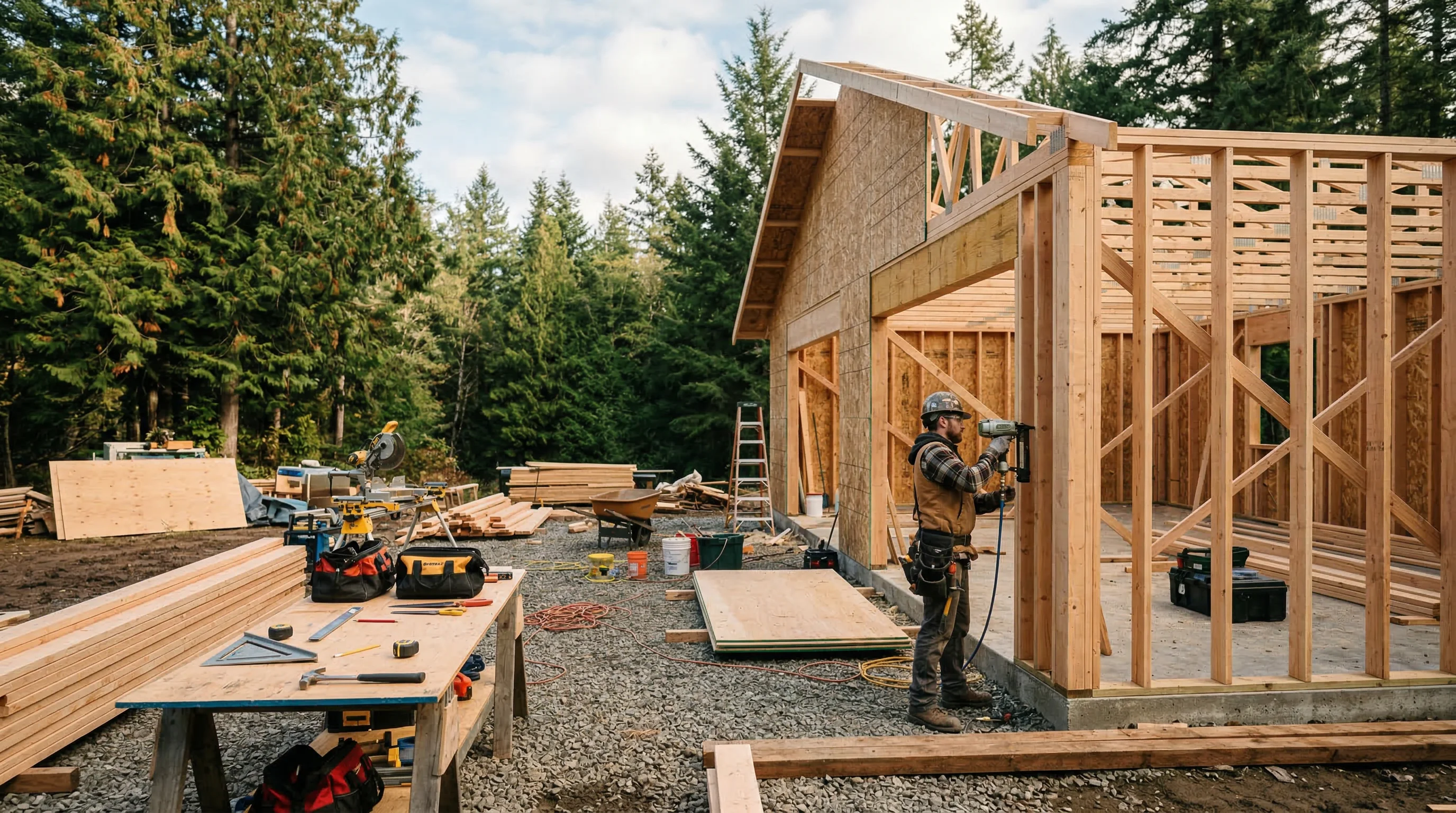
$24,000. That’s roughly what a standard 20x20 detached garage costs to build in 2026. But I’ve seen that number swing anywhere from $18,000 to $32,000 depending on finishes, site conditions, and where you live.
Quick Answer
A detached garage costs $45-$80 per square foot to build in 2026, with the typical build running about $60 per square foot. A 20x20 single-bay garage runs $18,000-$32,000. A 24x24 two-car garage runs $25,900-$46,100. Attached garages cost $40-$70 per square foot since they share one wall with the house. According to the National Association of Home Builders, garage construction has seen a 4-6% annual cost increase since 2022 driven primarily by lumber and labor.
The difference between a profitable garage project and one that bleeds money usually comes down to whether the contractor ran accurate numbers before breaking ground. That’s where a good cost to build a garage calculator saves you.
Use our Garage Cost Calculator to plug in your dimensions, finish level, and extras. You’ll get a line-item breakdown in minutes instead of spending an evening with a spreadsheet.
Try EstimationPro free to build complete garage estimates with materials, labor, and overhead baked in.
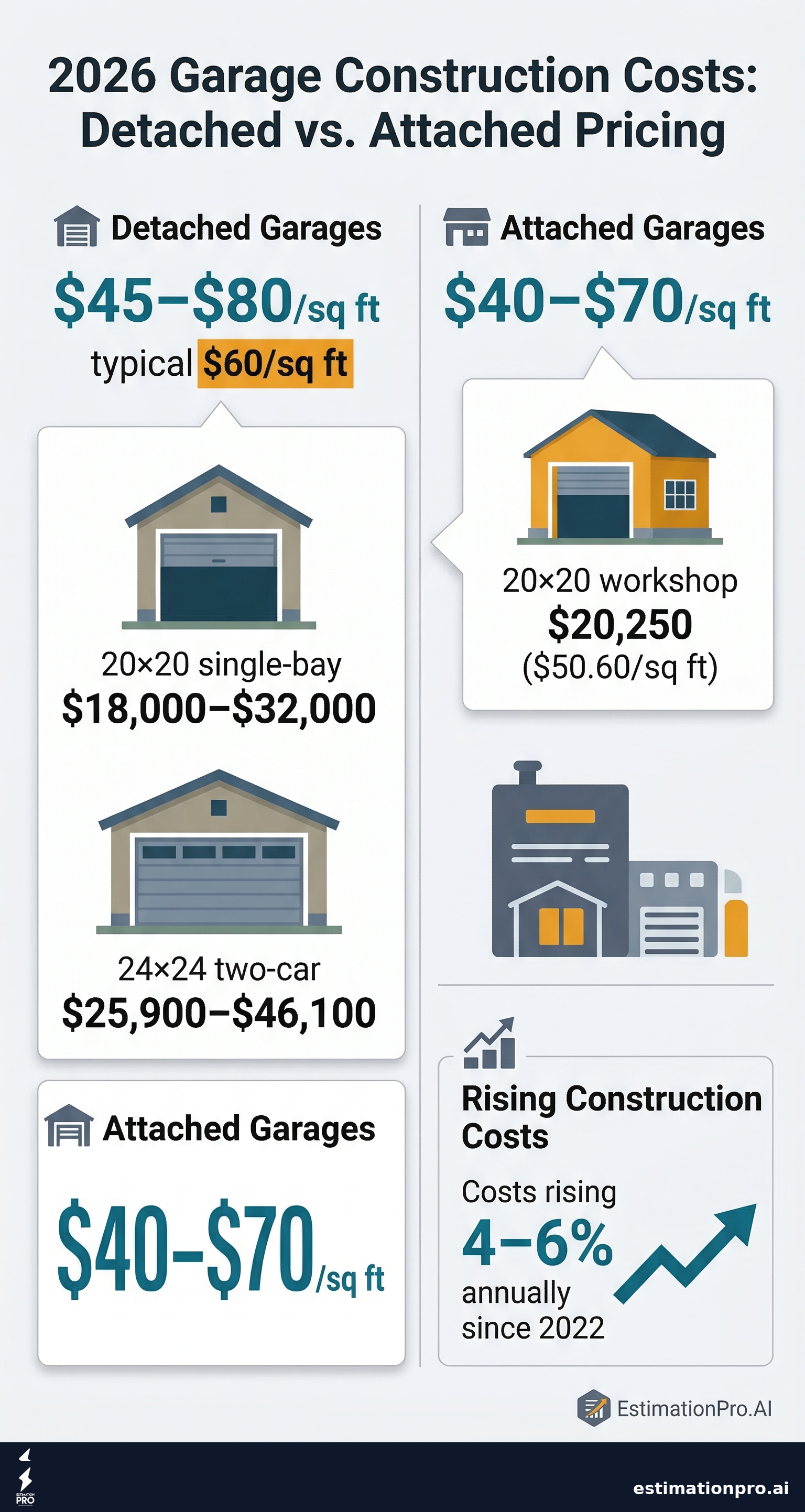
Share This Infographic
Feel free to share this infographic on your website. Just copy the embed code below:
Copy this embed code:
<a href="https://estimationpro.ai/tools/blog/cost-to-build-a-garage-calculator" target="_blank" rel="noopener">
  <img src="https://estimationpro.ai/tools/blog/infographics/cost-to-build-a-garage-calculator-infographic.png" alt="Cost to Build a Garage Calculator: 2026 Pricing infographic by EstimationPro.AI" style="max-width:100%;height:auto" loading="lazy" />
</a>
<p style="font-size:12px;color:#64748B;margin-top:8px">Source: <a href="https://estimationpro.ai/tools/blog/cost-to-build-a-garage-calculator">EstimationPro.AI</a></p>
What a Garage Calculator Actually Needs From You
Not all calculators are created equal. A solid garage cost calculator asks for more than just length and width. Here’s what you need before you start punching numbers:
- Footprint - length, width, and ceiling height (standard is 9-10 ft for a garage)
- Attached or detached - attached shares a wall with the house, which saves framing but adds tie-in complexity
- Foundation type - monolithic slab, stem wall, or frost-protected shallow foundation
- Number of bays - single, double, or triple, which determines door count and header sizing
- Finish level - basic shell, standard build, or finished space with climate control
- Electrical scope - basic lighting only, or a full subpanel with 240V outlets for welders and compressors
- Regional location - labor rates vary 30-40% between markets
I always tell customers to figure out what they’ll actually use the garage for before talking about size. A guy who just wants to park two cars needs a different build than someone running a woodshop out of it.
Detached vs. Attached: How the Numbers Change
The per-square-foot cost difference between attached and detached surprises most people.
| Factor | Detached Garage | Attached Garage |
|---|---|---|
| Cost per sq ft | $45 - $80 | $40 - $70 |
| Typical cost per sq ft | $60 | $55 |
| Foundation | Full slab, independent | Ties into existing foundation |
| Shared walls | None | One wall shared with house |
| Permits | Separate structure permit | Addition/remodel permit |
| Fire code | Standard | Fire-rated drywall on shared wall |
| Utility connections | Trenching required | Shorter runs from house |
| Resale value add | Moderate | High |
Detached costs more per square foot because everything is independent. You’re running a separate electrical feed, pouring a standalone slab, and framing all four walls from scratch. Attached garages save on one wall and shorter utility runs, but the tie-in work where the new structure meets the old house can get complicated fast.
According to Robert Dietz, Chief Economist at the National Association of Home Builders, residential construction input costs remain elevated compared to pre-pandemic levels, with lumber and labor being the primary drivers. Source: pricing based on 2026 data from Angi and HomeLight, verified against field estimates from Pacific Northwest projects. See also the Bureau of Labor Statistics Producer Price Index for residential construction for national cost trend data.
Worked Example 1: 20x20 Single-Bay Workshop Garage
This is the most common request I get from homeowners who want a dedicated workshop with one wide bay and room for a workbench along the back wall. 400 square feet.
| Line Item | Cost |
|---|---|
| Site prep and grading | $1,200 |
| Concrete slab (6”, wire mesh, 400 sq ft) | $3,200 |
| Framing - walls and roof trusses | $5,600 |
| Roofing - asphalt shingles, felt, drip edge | $2,200 |
| Siding - LP SmartSide to match house | $2,000 |
| Garage door - single 16x7, insulated | $1,400 |
| Electrical - 100A subpanel, 6 circuits, LED lighting | $1,800 |
| Insulation - R-15 walls, R-38 ceiling batts | $800 |
| Drywall - 5/8” fire-rated, taped, painted | $1,300 |
| Permits and engineering | $750 |
| Total | $20,250 |
That works out to about $50.60 per square foot for a solid, insulated workshop garage. You could strip the insulation and drywall to drop it closer to $18,000 ($45/sq ft), or add epoxy flooring and a mini-split for another $3,500-$4,000.
Waste factor: I built in 10% overage on framing lumber and 15% on roofing materials. Always do this. Running short mid-project means a trip to the yard and lost production time.
Worked Example 2: 28x32 Two-Bay Garage With Storage Loft
Bigger footprint, two bays, and a storage loft above. 896 square feet of floor space plus approximately 500 square feet of loft.
| Line Item | Cost |
|---|---|
| Site prep, excavation, grading | $2,800 |
| Concrete slab (6”, rebar, 896 sq ft) | $6,700 |
| Framing - walls, loft floor, engineered trusses | $14,200 |
| Roofing - architectural shingles, ice & water shield | $5,400 |
| Siding - HardiePlank, primed and painted | $4,800 |
| Garage doors - two 9x8, insulated, with openers | $4,600 |
| Electrical - 200A subpanel, 8 circuits, 240V outlet | $3,200 |
| Insulation - R-21 walls, R-49 ceiling | $1,800 |
| Drywall - full interior finish | $3,600 |
| Loft flooring - 3/4” T&G plywood | $1,400 |
| Staircase to loft | $1,800 |
| Permits, engineering, survey | $1,200 |
| Total | $51,500 |
That’s about $57.50 per square foot of floor space. The loft adds roughly $8,000-$10,000 over a standard build because you need engineered trusses rated for storage loads, loft framing, and stair access.
I’ve built a few of these over the years, and the one thing that always catches people off guard is the engineered truss cost. Standard trusses assume an unoccupied attic. Storage-rated trusses are heavier, more expensive, and require engineering stamps in most jurisdictions.
The Costs Most Calculators Miss
Here’s where a basic online calculator falls short. These line items show up on every real garage project, but most calculators ignore them:
Site work and prep. Grading, tree removal, soil compaction, possibly a retaining wall if the lot slopes. I’ve seen site prep alone run $1,500-$5,000 depending on conditions. If you need to relocate a utility line, add more.
Permits and inspections. Budget $500-$1,500. Some jurisdictions require engineered plans and soil reports for detached structures over a certain square footage. That engineering fee alone can be $800-$1,200.
Utility trenching. Running electrical and potentially water/sewer to a detached garage means trenching. That’s $15-$25 per linear foot depending on depth and terrain. A garage 50 feet from the house could add $750-$1,250 just for the trench.
Matching existing materials. Homeowners want the garage to look like it belongs. Matching siding, trim color, and roof shingles costs more than going with the cheapest option. Budget a 15-20% premium for material matching.
Concrete short-load fees. A 20x20 slab needs roughly 5 cubic yards. Most concrete companies charge a short-load fee for orders under 8-10 yards. That’s $50-$100 per yard on top of the concrete price. On a small pour, it adds up fast.
Source: short-load fee ranges based on Trusscore 2026 contractor pricing data and field experience in the Pacific Northwest.
What Drives Regional Price Swings
Garage construction costs swing 30-40% depending on where you build. Same plans, same finishes, different zip code, different price.
| Region | Cost per sq ft range | Why |
|---|---|---|
| Pacific Northwest | $55 - $80 | High labor rates, seismic requirements |
| Southeast | $40 - $60 | Lower labor costs, no frost footings |
| Midwest | $45 - $65 | Moderate labor, deep frost footings required |
| Northeast | $55 - $80 | High labor, deep frost footings, strict codes |
| Southwest | $45 - $65 | Lower labor, no frost concerns, but soil issues |
The biggest variable is labor. Framing crews in Seattle charge $8-$12 per square foot. The same work in Alabama runs $5-$8. Frost depth matters too. In the Pacific Northwest, I’m digging 12-18 inches for footings. In Minnesota, that’s 42-48 inches. Deeper footings mean more concrete, more labor, and more money.
All pricing in this guide reflects 2026 national averages. Your actual costs will vary by region, material availability, and local labor markets. Get at least three local bids for accurate numbers.
5 Mistakes That Blow Up Your Garage Budget
I’ve watched homeowners and contractors make these errors. Every single one costs money.
1. Skipping the soil test. A $300 soil report can save you $5,000 in foundation problems. I poured a garage slab once on what looked like solid ground. Three months later, the corner had settled 3/4 inch because nobody tested for fill dirt. Lesson learned.
2. Undersizing electrical. “Just put in a couple outlets” turns into “I need 240V for my welder” six months later. Running a new circuit after the walls are finished costs three times what it would have during construction. Use a wire size calculator to make sure your runs are sized correctly from the start. Plan your electrical for what you’ll need in five years, not just today.
3. Forgetting about drainage. Water flows downhill, and if your garage slab sits lower than the surrounding grade, you’ll have water problems. A proper grading plan and maybe a French drain costs $1,000-$2,000 up front. Fixing water intrusion after the fact costs much more.
4. Using a calculator but ignoring the inputs. Garbage in, garbage out. If you tell the calculator your slab is 4 inches thick but your plans call for 6 inches, the estimate is wrong before you start. Measure twice.
5. Not accounting for overhead and profit. If you’re a contractor using a calculator for bids, remember the calculator gives you direct costs. You still need to add your overhead (typically 10-20%) and profit margin (10-15%) on top. A $20,000 material-and-labor number should bid at $26,000-$28,000 after markup.
How to Use a Garage Calculator for Accurate Bids
If you’re a contractor, here’s my process for turning calculator output into a real bid:
- Measure the site - get exact dimensions, note slope, access, and setback requirements
- Run the calculator with your actual specs, not assumptions
- Add your waste factors - 10% framing, 15% roofing, 5% concrete overage
- Price check materials against your local supplier quotes, not national averages
- Add site-specific costs - trenching, tree removal, access challenges, temporary power
- Apply your overhead rate - insurance, truck, tools, office, license fees
- Add profit margin - if you’re not making money, you’re not staying in business
- Build in contingency - 5-10% for the things you can’t see until you start digging
The calculator gives you the starting point. Your experience and local knowledge turn it into a bid you can stand behind.
Frequently Asked Questions
How much does it cost to build a 2-car detached garage?
A standard 2-car detached garage (24x24, 576 sq ft) costs $25,900 - $46,100 in 2026. The typical build runs about $34,500 at $60 per square foot. This includes slab, framing, roofing, siding, one or two garage doors, and basic electrical. Finished interiors with insulation and drywall add $3-$5 per square foot.
Is it cheaper to build an attached or detached garage?
Attached garages typically cost $5-$10 less per square foot than detached because they share one wall with the house and have shorter utility runs. However, attached garages require fire-rated construction on the shared wall and may trigger additional code requirements for the connection point. Total project cost for a 2-car attached garage runs $23,000-$40,300.
How accurate are online garage cost calculators?
Basic calculators give you a ballpark within 15-25% of actual costs. They’re useful for initial budgeting but usually miss site prep, permits, utility connections, and regional pricing differences. A calculator backed by real contractor pricing data, like ours at EstimationPro, gets closer because it accounts for these variables.
Do I need a permit to build a garage?
In most jurisdictions, yes. Detached garages over 120-200 square feet typically require a building permit. Attached garages always require a permit because they modify the existing structure. Permit costs range from $500 to $1,500 depending on your area. Some municipalities also require engineered plans and soil reports.
How long does it take to build a garage?
A standard detached garage takes 3-6 weeks from slab pour to final inspection. Attached garages take longer, typically 4-8 weeks, because the tie-in to the existing structure adds complexity. Weather, permit processing, and material lead times can extend these timelines. Factor in 2-4 weeks of planning and permitting before construction starts.
Get Your Garage Numbers Dialed In
A calculator gets you 80% of the way to an accurate garage estimate. The other 20% comes from walking the site, checking soil conditions, and knowing your local material prices. No app replaces boots on the ground.
But the math part? That should never take you all evening. Try EstimationPro free to build your next garage estimate from photos, notes, and voice recordings. EstimationPro doesn’t just build the estimate - it generates the proposal, sends it to the customer, and follows up automatically so you’re not chasing leads while you’re trying to frame walls. Estimate, propose, follow up, invoice, get paid. That’s the whole workflow, handled.
20x20 Workshop Garage Build Cost
Garage Build Packages by Finish Level
- Concrete slab, 4 inch
- Standard framing, vinyl siding
- Single garage door
- Minimal electrical (1 circuit)
- No insulation or drywall
- Concrete slab, 6 inch
- Framing with house-matched siding
- Insulated garage door
- Full electrical panel (4+ circuits)
- Batt insulation, finished drywall
- Reinforced slab with epoxy floor
- Premium siding, architectural shingles
- Two insulated doors with openers
- Full electrical + 240V for tools
- Climate control, fire-rated drywall
Get Free Estimating Tips
Enter your email and we'll send you pro tips, cost data, and useful resources for contractors.
We'll send helpful resources and occasional tips. Unsubscribe anytime.
 EstimationPro AI For Contractors, By Contractors
 Price Every Job With Confidence
Stop second-guessing your numbers. EstimationPro AI builds accurate estimates from real cost data.