

$65,000. That’s the midpoint for a mid-range whole-house renovation in 2026, and most homeowners I talk to are off by at least 30% when they guess what their project will cost.
The problem isn’t that renovation is expensive. It’s that most people have never seen an actual renovation estimate before they request one. They don’t know what line items to expect, what’s reasonable, or what a contractor might be leaving out on purpose to win the bid.
I’ve written hundreds of renovation estimates over 20 years of remodeling in the Pacific Northwest. This guide breaks down what a real home renovation estimate looks like, what each room actually costs, and how to spot the ones that’ll get you in trouble.
Use our Home Renovation Cost Estimator to build a room-by-room estimate in minutes. Or Try EstimationPro free to generate a full renovation estimate from photos and notes.
Quick Answer: What Does a Home Renovation Cost?
A home renovation typically costs $15,000 to $250,000+ depending on scope. A cosmetic refresh (paint, flooring, fixtures) runs $15,000 to $40,000. A mid-range renovation with a kitchen and bathroom remodel falls between $40,000 and $100,000. A full gut renovation that touches structure, mechanical systems, and every room starts at $100,000 and can exceed $250,000 for larger homes, according to NAHB cost data and Remodeling Magazine’s Cost vs. Value Report.
What Every Home Renovation Estimate Should Include
A proper estimate isn’t a single number on a napkin. If that’s what you’re getting, walk away. Here’s what should be on the page.
Scope of work. A written description of every task, room by room. Not “renovate kitchen” but “demo existing cabinets, install 24 linear feet of shaker-style cabinets, install quartz countertops, new backsplash, relocate one outlet.” Specifics matter.
Materials list with allowances. Every material should be called out. If the contractor uses “allowances” (a dollar amount budgeted for items you haven’t selected yet, like tile or countertops), those should be clearly labeled so you know what’s a fixed cost and what might change.
Labor breakdown. You should see what the labor costs per trade. Carpentry, plumbing, electrical, tile, painting. If it’s all lumped into one number, you can’t compare estimates or know where the money goes.
Timeline. Start date, milestones, expected completion. Renovation timelines slip, that’s reality. But a contractor who won’t put any dates on paper hasn’t thought through the project.
Payment schedule. When is each payment due? Tied to milestones or just calendar dates? I tie payments to completion milestones. You finish the rough-in, you get paid for the rough-in.
Exclusions. What’s NOT included is just as telling as what is. Permits, dumpster fees, temporary housing, appliance delivery, landscaping repair. If none of these are listed, the contractor either hasn’t thought about them or is planning to charge you later.
Room-by-Room Cost Ranges
Here’s what each major renovation area actually costs in 2026. These ranges come from the pricing reference database we maintain at EstimationPro, cross-checked against BLS wage data and Angi’s annual cost surveys.
| Room / System | Budget | Mid-Range | High-End |
|---|---|---|---|
| Kitchen (per sq ft) | $50 - $150 | $150 - $300 | $250 - $500 |
| Bathroom (full project) | $3,000 - $12,000 | $12,000 - $30,000 | $30,000 - $75,000 |
| Flooring - hardwood (per sq ft) | $6 - $10 | $10 - $18 | $18 - $25 |
| Interior painting (per sq ft) | $1.50 - $2.50 | $2.50 - $4.00 | $4.00 - $6.00 |
| Electrical panel upgrade | $1,500 - $2,500 | $2,500 - $4,000 | $4,000+ |
| Plumbing fixture replacement | $150 - $350 | $350 - $600 | $600+ per fixture |
| Whole-house replumb (PEX, per sf) | $3 - $5 | $5 - $7 | $7 - $8 |
Regional pricing disclaimer: All costs shown are national averages as of 2026. Prices vary by region, local labor rates, home age, and existing conditions. Pacific Northwest and coastal metro areas trend 10-20% above these figures. Get quotes from local contractors for accurate pricing.
Worked Example 1: Cosmetic Refresh on a 1,800 SF Home
The Johnsons want to update their 1994 colonial before listing it. No structural changes, no layout modifications. Just make it look current.
| Line Item | Quantity | Unit Cost | Total |
|---|---|---|---|
| Interior paint (walls + trim) | 1,800 sf | $3.00/sf | $5,400 |
| LVP flooring, installed | 1,200 sf | $7.00/sf | $8,400 |
| New light fixtures | 12 each | $175 avg | $2,100 |
| Kitchen hardware + faucet | 1 lot | $650 | $650 |
| Bathroom faucets + mirrors | 2 baths | $500 each | $1,000 |
| Front door replacement | 1 each | $2,200 installed | $2,200 |
| GC overhead & profit (20%) | - | - | $3,950 |
| Total | $23,700 |
This is a cosmetic-only renovation. No demo, no plumbing moves, no electrical rewiring. It’s new surfaces and fixtures. The GC overhead and profit markup of 20% is within the standard 15-35% range per NAHB builder cost benchmarks.
Worked Example 2: Mid-Range Kitchen + Bathroom Renovation
The Garcias want a full kitchen remodel and one master bathroom renovation in their 2,100 SF home built in 2001.
| Line Item | Quantity | Unit Cost | Total |
|---|---|---|---|
| Kitchen demo | 150 sf | $4.50/sf | $675 |
| Cabinets (semi-custom, installed) | 24 LF | $350/LF | $8,400 |
| Quartz countertops | 45 sf | $85/sf | $3,825 |
| Kitchen flooring (tile) | 150 sf | $12/sf installed | $1,800 |
| Kitchen plumbing (sink + disposal) | 1 lot | $1,200 | $1,200 |
| Kitchen electrical (outlets + lighting) | 1 lot | $2,800 | $2,800 |
| Bathroom demo | 80 sf | $5.00/sf | $400 |
| Bathroom tile (floor + shower) | 200 sf | $14/sf installed | $2,800 |
| Vanity + countertop | 1 each | $1,800 | $1,800 |
| Toilet + plumbing fixtures | 1 lot | $1,300 | $1,300 |
| Bathroom plumbing rough-in updates | 1 project | $2,500 | $2,500 |
| Painting (both rooms) | 1 lot | $2,200 | $2,200 |
| Permits and inspections | 1 lot | $1,500 | $1,500 |
| Dumpster (2 hauls) | 2 each | $450 | $900 |
| GC overhead & profit (22%) | - | - | $7,500 |
| Total | $41,600 |
That’s a real estimate with real line items. Notice how every trade is broken out. You can see exactly where the money goes, and you can compare this against another contractor’s bid to see if they’re missing anything.
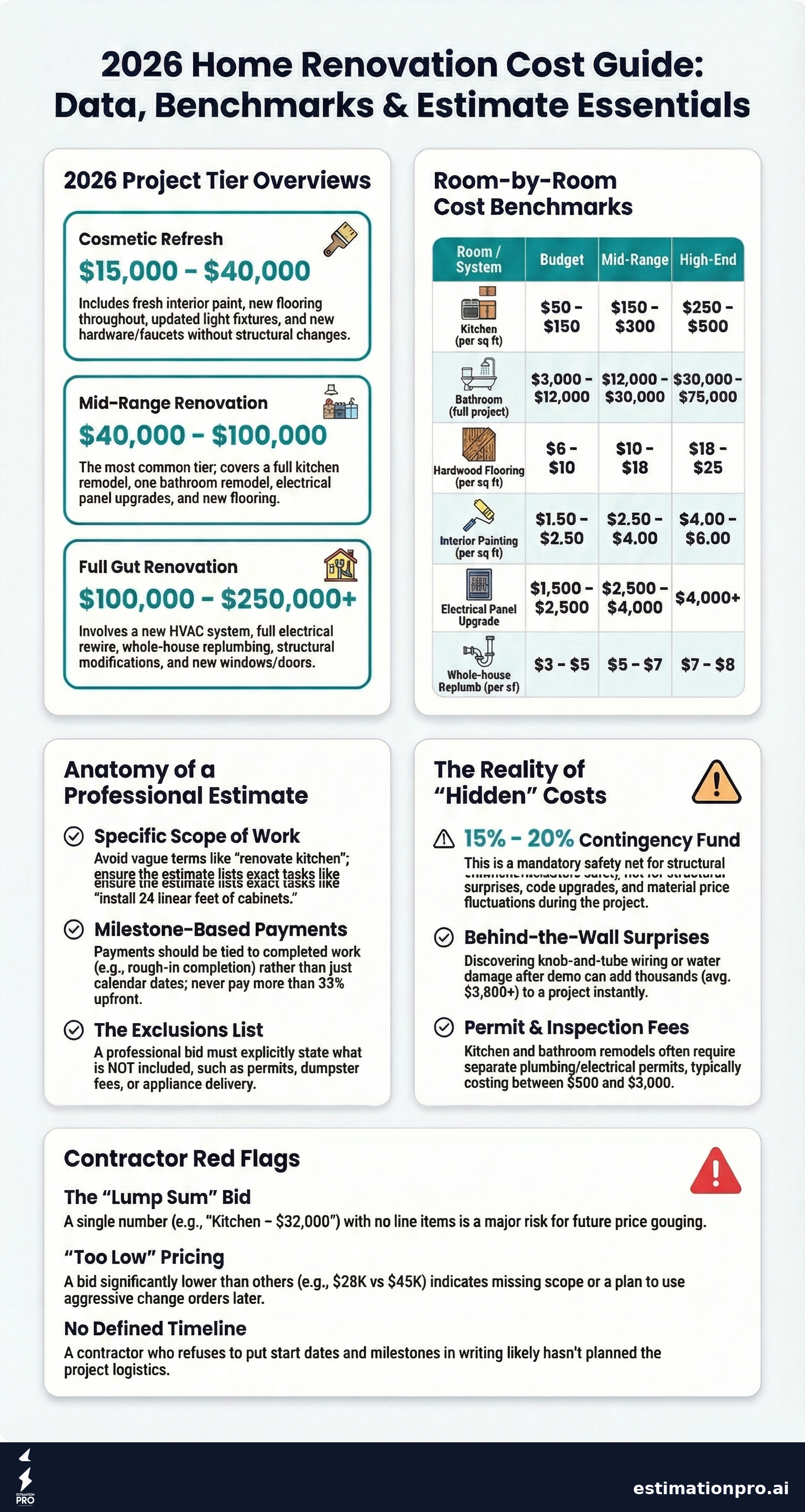
Share This Infographic
Feel free to share this infographic on your website. Just copy the embed code below:
Copy this embed code:
<a href="https://estimationpro.ai/tools/blog/home-renovation-estimate" target="_blank" rel="noopener">
  <img src="https://estimationpro.ai/tools/blog/infographics/home-renovation-estimate-infographic.png" alt="home renovation estimate infographic by EstimationPro.AI" style="max-width:100%;height:auto" loading="lazy" />
</a>
<p style="font-size:12px;color:#64748B;margin-top:8px">Source: <a href="https://estimationpro.ai/tools/blog/home-renovation-estimate">EstimationPro.AI</a></p>
Hidden Costs That Blow Renovation Budgets
I’ve seen it happen dozens of times. The estimate looks solid, the homeowner signs the contract, and then reality shows up on demo day.
Behind the walls. In older homes, you open up a wall for a kitchen remodel and find knob-and-tube wiring, galvanized pipes, or water damage. I pulled drywall in a 1987 ranch last year and found a joist sister that was barely holding. That single discovery added $3,800 to the project. The homeowners had no idea.
Permit and inspection costs. Many estimates don’t include permits. In most jurisdictions, a full kitchen remodel needs a building permit, and if you’re moving plumbing or electrical, those need separate permits too. Budget $500 to $3,000 depending on your city.
Temporary living. If you’re gutting a kitchen and both bathrooms, you might need somewhere else to stay for 2-4 weeks. Hotels or short-term rentals add $2,000-$5,000 to the real cost of the project.
Material lead times and price holds. An estimate is a snapshot. Cabinets quoted today might cost 8-12% more if you don’t order for three months. Ask your contractor how long the price is good for. Thirty days is standard.
Waste and overage. A good contractor builds in 10-15% waste factor on materials like tile, flooring, and drywall. If the estimate has zero waste factor, either they’re padding the quantity silently or you’re going to get a change order when they run short.
Red Flags in Renovation Estimates
Not all estimates are created equal. Here’s what should make you pause.
No line items. “Kitchen renovation - $32,000.” That tells you nothing. What’s included? What grade of materials? How many hours of labor? A single lump sum with no detail is either lazy or intentionally vague.
No exclusions list. If the estimate doesn’t tell you what’s NOT included, assume everything inconvenient got left out. Appliances, permits, dumpster, paint touch-ups after the plumber patches drywall.
Way below other bids. If three contractors bid $42K, $45K, and $47K, and the fourth comes in at $28K, that fourth bid is missing scope. Period. They’ll make it up in change orders once your kitchen is torn apart and you can’t walk away.
“We’ll figure it out as we go.” No. The scope should be defined before a single nail gets pulled. Flexibility is fine for minor decisions (paint sheen, hardware finish). But the bones of the estimate need to be locked down.
No payment schedule. A contractor asking for 50% upfront before any work starts is a massive red flag. Standard practice: 10-15% deposit, then payments tied to completion milestones. Never pay for work that hasn’t been done.
How to Compare Multiple Renovation Estimates
Getting three bids is standard advice. Comparing them is where most homeowners struggle.
Step 1: Normalize the scope. Make sure every bid covers the same work. If Contractor A includes permits and Contractor B doesn’t, add $1,500 to Contractor B’s number before comparing.
Step 2: Check the allowances. One contractor might include a $3,000 countertop allowance while another uses $6,000. That’s a $3,000 difference that has nothing to do with their labor or markup.
Step 3: Look at the labor rates. General contractors typically bill $50 to $150 per hour depending on region and experience, per BLS data and HomeGuide’s 2026 rate survey. Licensed plumbers and electricians run $50 to $150 per hour. If the labor numbers seem impossibly low, the contractor is either underpaying workers (quality risk) or plans to cut corners.
Step 4: Ask about change order policy. How are additions or surprises handled? Is there a markup on change orders? Some contractors charge a 15-25% markup on changes. That’s not unreasonable for small additions, but it adds up fast if the original scope was vague.
Use the Bathroom Remodel Cost Calculator or Kitchen Remodel Cost Calculator to benchmark specific rooms before comparing bids.
What 15-20% Contingency Actually Means
Every renovation guide tells you to set aside 15-20% contingency. But what does that number really cover?
For a $65,000 mid-range renovation, 15% contingency is $9,750. That’s your safety net for:
- Structural surprises behind walls or under floors
- Code upgrades required once you open up systems
- Material price changes between estimate and order date
- Scope creep from “while we’re at it” decisions
- Inspection failures that require rework
On homes built before 1990, I’d push that to 20%. Older homes hide more problems. A 2015 build with standard systems? You can probably get away with 10-12%. But never zero. Something always comes up.
When to Get a Professional Estimate vs. DIY
Some homeowners try to estimate renovation costs themselves using online calculators and averages. That works for cosmetic updates where the scope is predictable. New paint, new flooring, swap some fixtures. You can get close enough.
For anything that involves trades (plumbing, electrical, structural), you need a professional estimate. The variables multiply fast. Is the electrical panel big enough? Are the supply lines copper or galvanized? Is the subfloor plywood or OSB? What’s behind the tile? Each answer changes the number.
My rule: if you need a permit, you need a professional estimate.
FAQ
How long does a home renovation take?
A cosmetic refresh (paint, flooring, fixtures) takes 2-4 weeks. A mid-range kitchen and bathroom renovation runs 8-16 weeks. A full gut renovation on a 2,000+ SF home takes 4-8 months depending on permit timelines and material lead times.
Should I renovate all at once or in phases?
Doing it all at once is cheaper per dollar spent because the contractor mobilizes once, the dumpster is already there, and trades can overlap. But it means a bigger upfront cost and possibly moving out. Phasing spreads the expense but typically costs 15-25% more total due to repeated setup and mobilization.
How much should I put down on a renovation contract?
Standard deposit is 10-15% of the total project cost, with remaining payments tied to completion milestones. Never pay more than 33% before work begins, regardless of what the contractor asks for. Most states have laws limiting contractor deposits, often to 10% or $1,000, whichever is less.
Do I need permits for a home renovation?
Any work that changes structure, plumbing, electrical, or HVAC requires permits in most jurisdictions. Cosmetic work (paint, flooring, fixtures that don’t move) typically does not. Your contractor should pull permits, and you should confirm they did. Unpermitted work can kill a home sale later.
What’s the ROI on a home renovation?
According to Remodeling Magazine’s 2025 Cost vs. Value Report, mid-range kitchen remodels recoup about 75% of cost at resale. Bathroom remodels return 60-70%. Cosmetic refreshes (curb appeal, paint, flooring) often return 80-100% because the cost is lower and the visual impact is high.
Ready to build your own renovation estimate? Try EstimationPro free. Upload photos and notes, and EstimationPro generates a professional estimate with line items, sends the proposal to your client, and follows up automatically so you win more of the bids you already send.
Pricing a job like this?
Get every line item priced for your area in a full estimate
Describe the job or snap a few photos. Send it from EstimationPro and it follows up with your client for you.
3 free estimates in the first 7 days. No credit card.
Average Whole-House Renovation Cost Breakdown
Home Renovation Packages by Scope
- Fresh interior paint
- New flooring throughout
- Updated light fixtures
- New hardware and faucets
- Full kitchen remodel
- One bathroom remodel
- New flooring throughout
- Interior painting
- Electrical panel upgrade
- Kitchen and all bathrooms
- New HVAC system
- Full electrical rewire
- Whole-house replumb
- Structural modifications
- New windows and doors
Get Free Estimating Tips
Enter your email and we'll send you pro tips, cost data, and useful resources for contractors.
We'll send helpful resources and occasional tips. Unsubscribe anytime.
 EstimationPro AI For Contractors, By Contractors
 Save 2+ Hours on Every Estimate
Upload photos, record voice notes, and get AI-powered estimates with line items, material lists, and regional pricing.