
$18,400. That’s what a standing seam metal roof runs on a typical 2,000 sq ft home in the Pacific Northwest, fully installed. I’ve seen contractors lose money on metal jobs because they estimated them the same way they’d estimate a shingle tear-and-replace. Metal is a different animal.
The production rates are slower. The material waste is different. The trim package alone can eat your profit if you don’t account for it. This guide walks through how I estimate metal roof installations, step by step, so you don’t leave money on the table.
Use our Metal Roof Calculator to run your numbers fast, or Try EstimationPro free to build a complete roofing proposal in minutes.
Quick Answer
Estimating a metal roof installation requires measuring roof squares, selecting a panel type, pricing materials at $120-$900 per square, adding labor at $150-$500 per square, and factoring in trim, underlayment, and tear-off costs. A typical residential metal roof runs $4-$30 per square foot installed depending on the panel type and roof complexity. Always add 10-15% waste factor for cuts, and budget extra for valleys, hips, and penetrations.
Step 1: Measure the Roof
Everything starts here. Get this wrong and the whole estimate falls apart.
You need the total roof area in squares (1 square = 100 sq ft). Three ways to get it:
- On-roof measurement with a tape and chalk line (most accurate, weather permitting)
- Ground measurement with a pitch multiplier - measure the footprint, determine pitch, multiply by the roof pitch factor
- Satellite measurement using tools like EagleView or Google Earth Pro
For a simple gable roof, measure the building footprint (length x width), then multiply by the pitch factor:
| Roof Pitch | Multiplier |
|---|---|
| 4/12 | 1.054 |
| 5/12 | 1.083 |
| 6/12 | 1.118 |
| 7/12 | 1.158 |
| 8/12 | 1.202 |
| 10/12 | 1.302 |
| 12/12 | 1.414 |
Example: A 30 ft x 40 ft home with a 6/12 pitch gable roof:
- Footprint: 1,200 sq ft
- With pitch multiplier: 1,200 x 1.118 = 1,342 sq ft
- Overhangs (1 ft on each side): add ~140 sq ft
- Total roof area: ~1,482 sq ft = 14.82 squares
Our Roof Square Footage Calculator handles the math for complex shapes including hips, valleys, and dormers.
Step 2: Pick the Right Panel Type
This is the single biggest variable in a metal roof estimate. The price difference between corrugated and copper is 5x or more.
Here’s what I tell contractors new to metal roofing: start with standing seam. It’s the bread and butter of residential metal work. Hidden fasteners mean fewer callbacks from leaks, and homeowners love the clean lines.
Material cost per square (materials only):
| Panel Type | Low | High | Typical |
|---|---|---|---|
| Corrugated/R-panel | $120 | $250 | $180 |
| Standing seam | $250 | $600 | $400 |
| Metal shingles (stamped) | $300 | $700 | $450 |
| Copper or zinc | $600 | $900+ | $750 |
These are material-only prices per square (per HomeAdvisor 2025 and Angi 2026 data). Installed costs add labor, underlayment, trim, and disposal on top.
Prices vary by region. Metro areas and coastal zones typically run 10-20% higher. Rural areas may see lower material costs but higher delivery fees.
Step 3: Build the Materials List
Metal roofing isn’t just panels. The trim and accessories package is where new estimators get burned. Here’s what most residential metal jobs need:
Panels:
- Total squares x panel cost
- Add 10-15% waste for cuts and valleys (more for hip roofs, less for simple gables)
Underlayment:
- Synthetic underlayment: $0.15-$0.40/sq ft
- Ice and water shield at eaves and valleys: $0.75-$1.50/sq ft (code-required in cold climates)
Trim and flashing:
- Ridge cap: $3-$8/linear foot
- Drip edge: $1-$3/linear foot
- Valley flashing: $4-$10/linear foot
- Pipe boots and penetration flashings: $15-$50 each
- Gable trim/rake edge: $2-$5/linear foot
- Transition flashing (where metal meets a wall): $3-$8/linear foot
Fasteners:
- Standing seam clips: $1-$3 each (one per 12-24 inches along each panel)
- Exposed fastener screws (corrugated): $50-$80 per square
- Butyl tape sealant: $5-$15 per roll
I’ve seen trim and accessories add 15-25% on top of panel costs. Don’t skip this line item. It’s where margin disappears.
Step 4: Estimate Labor
Metal roofing labor is slower than asphalt shingle work. Period. A crew that lays 15 squares of shingles in a day might only install 6-8 squares of standing seam.
Labor rates per square (based on BLS roofer wage data and field experience):
| Task | Per Square |
|---|---|
| Tear-off (existing roof) | $50 - $120 |
| Deck inspection and repair | Time and materials |
| Underlayment install | $30 - $60 |
| Standing seam panel install | $150 - $350 |
| Corrugated panel install | $100 - $200 |
| Metal shingle install | $200 - $400 |
| Trim and flashing | 15-25% of panel labor |
Total installation labor runs $150-$500 per square, with standing seam averaging around $250 per square. That tracks with BLS data showing roofer median wages around $23/hour (BLS Occupational Employment, 47-2181) plus the burdened rate, supervision, and crew size.
Roof complexity multipliers:
Simple gable with no penetrations? Straight math. But most roofs aren’t simple.
- Hip roof: add 15-20% to labor and waste
- Multiple valleys: add 10-15%
- Steep pitch (8/12+): add 15-25% for safety equipment and slower production
- Multiple stories: add 10-15% for scaffolding and material handling
- Lots of penetrations (vents, pipes, skylights): add 5-10%
Worked Example: 2,000 sq ft Standing Seam Roof
Here’s a real-world estimate for a 2,000 sq ft standing seam installation on a moderate-complexity hip roof (7/12 pitch) with an existing asphalt shingle tear-off.
Roof area: 2,000 sq ft = 20 squares
Materials:
| Item | Calculation | Cost |
|---|---|---|
| Standing seam panels | 20 sq x $400/sq + 15% waste | $9,200 |
| Synthetic underlayment | 2,000 sf x $0.25/sf | $500 |
| Ice & water shield (eaves + valleys) | 400 sf x $1.00/sf | $400 |
| Ridge cap | 40 lf x $5/lf | $200 |
| Drip edge | 180 lf x $2/lf | $360 |
| Valley flashing | 30 lf x $6/lf | $180 |
| Pipe boots (4) | 4 x $35 | $140 |
| Gable/rake trim | 80 lf x $3.50/lf | $280 |
| Clips and fasteners | 20 sq x $40/sq | $800 |
| Butyl tape | 6 rolls x $10 | $60 |
| Materials total | $12,120 |
Labor:
| Task | Calculation | Cost |
|---|---|---|
| Tear-off and disposal | 20 sq x $75/sq | $1,500 |
| Underlayment | 20 sq x $45/sq | $900 |
| Panel installation | 20 sq x $250/sq | $5,000 |
| Trim and flashing | 25% of panel labor | $1,250 |
| Labor total | $8,650 |
Project total: $20,770
Add your overhead and profit margin. At a 35% markup, the bid price lands around $28,040. That’s roughly $14 per square foot installed, which falls right in the middle of the standing seam range.
Worked Example: 1,500 sq ft Corrugated Roof (Budget Option)
Simpler job. A 1,500 sq ft simple gable (5/12 pitch), exposed fastener corrugated panels, new construction (no tear-off).
Roof area: 1,500 sq ft = 15 squares
| Category | Cost |
|---|---|
| Corrugated panels (15 sq x $180 + 10% waste) | $2,970 |
| Underlayment and ice shield | $500 |
| Trim, flashing, fasteners | $650 |
| Labor (panel + underlayment + trim) | $3,000 |
| Project total | $7,120 |
At 35% markup: $9,612 or about $6.40/sq ft installed. That’s competitive with high-end architectural shingles, and the roof lasts twice as long.
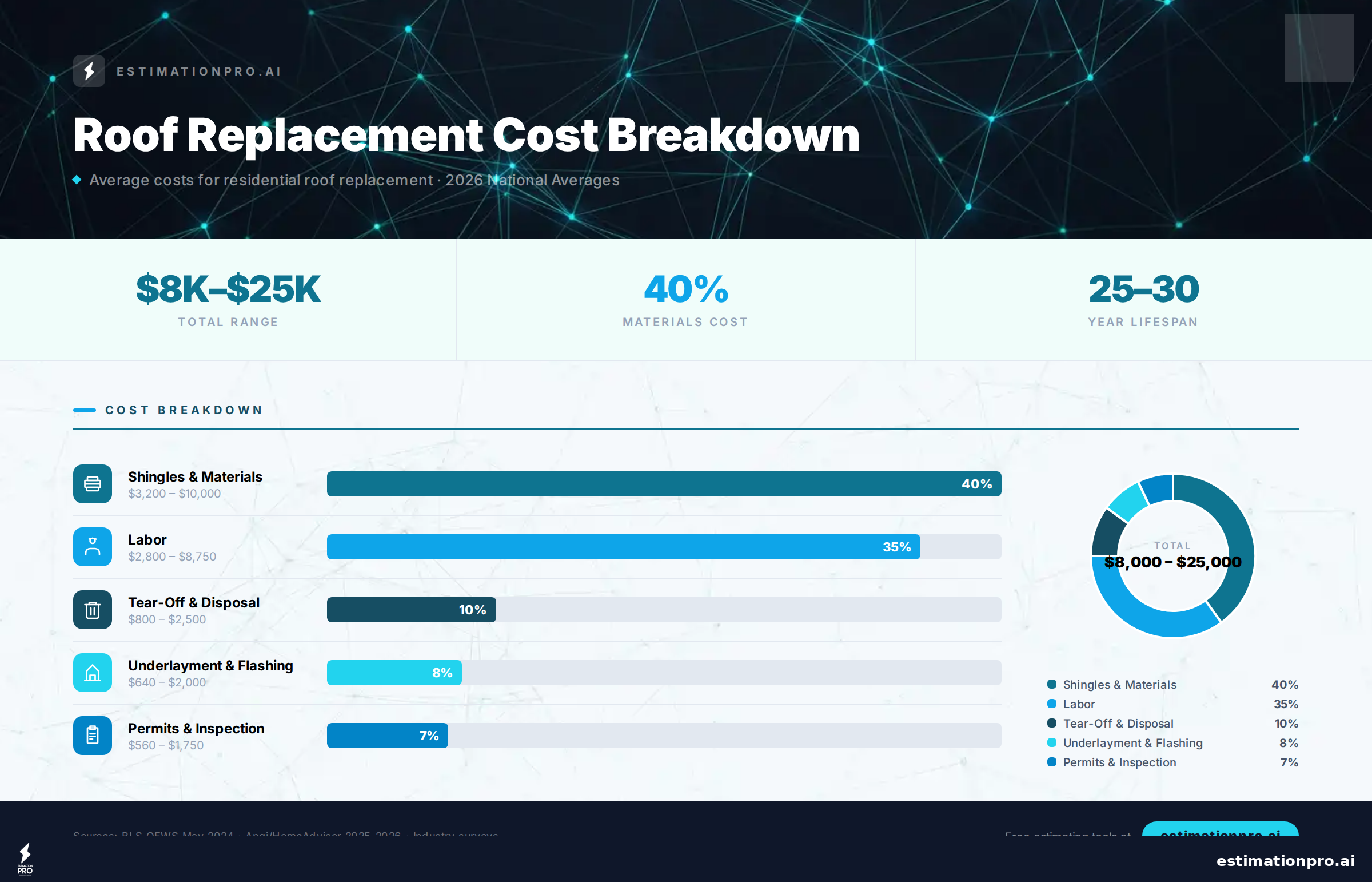
Share This Infographic
Feel free to share this infographic on your website. Just copy the embed code below:
Copy this embed code:
<a href="https://estimationpro.ai/tools/blog/estimate-metal-roof-installation" target="_blank" rel="noopener">
  <img src="https://estimationpro.ai/tools/blog/infographics/estimate-metal-roof-installation-infographic.png" alt="estimate metal roof installation infographic by EstimationPro.AI" style="max-width:100%;height:auto" loading="lazy" />
</a>
<p style="font-size:12px;color:#64748B;margin-top:8px">Source: <a href="https://estimationpro.ai/tools/blog/estimate-metal-roof-installation">EstimationPro.AI</a></p>
Where Contractors Lose Money on Metal Roofs
I’ve watched good roofers underbid metal jobs because they didn’t account for these hidden costs:
1. Panel custom ordering lead times. Standing seam panels are typically cut to length at the supplier. That means a 2-4 week lead time. If your crew sits idle waiting on materials, you’re losing money. Order early.
2. Oil canning on standing seam. Wavy distortions in flat panel areas. It’s mostly cosmetic, but homeowners notice it and complain. Using striations or pencil ribs in the panel profile reduces oil canning - but striated panels cost more. Build it into the bid or explain it upfront.
3. Thermal expansion. Metal moves. A 20-foot standing seam panel can expand nearly half an inch in summer heat. Floating clip systems accommodate this movement, but they add cost and require proper training to install. Fixed clips in the wrong spots cause buckling. I’ve seen callbacks from this exact issue.
4. Trim package underestimation. The panels themselves are easy to price. The 47 different pieces of trim are where the estimate goes sideways. Count every linear foot of ridge, rake, drip edge, valley, and transition. Then add 10% overage.
5. Underlayment requirements. Code in most northern states requires ice and water shield at eaves for at least the first 24 inches past the interior wall line (IRC R905.1.2). Some metal roof manufacturers void the warranty without synthetic underlayment over the entire deck. Check the specs before you bid.
Scrap and Waste Factors
Metal roofing waste is different from shingle waste. You can’t just add 10% across the board.
| Roof Shape | Waste Factor |
|---|---|
| Simple gable | 5-8% |
| Gable with dormers | 10-12% |
| Hip roof | 12-18% |
| Complex multi-hip | 15-22% |
| Mansard or gambrel | 18-25% |
Standing seam panels cut to length generate less field waste than corrugated sheets that need trimming. But the minimum order quantities and panel length increments can force you to buy more than you need. Factor that in.
Frequently Asked Questions
How long does it take to install a metal roof?
A 2,000 sq ft standing seam roof typically takes a 3-4 person crew 5-7 working days. Corrugated is faster - the same crew might finish in 3-4 days. Weather delays, steep pitches, and complex roof shapes extend the timeline. Shingle tear-off adds 1-2 days depending on layers.
Is a metal roof worth the extra cost over shingles?
Metal roofs cost 2-3x more than asphalt shingles upfront, but they last 40-60+ years versus 20-30 for architectural shingles. Over a 50-year span, you’d replace shingles at least once. When you factor in the second shingle replacement plus tear-off costs, metal often comes out cheaper long-term. Metal also reflects heat (lowering cooling costs by 10-25% according to the Metal Roofing Alliance) and handles wind and hail better.
Do I need to remove old shingles before installing a metal roof?
Not always. Some building codes allow metal roof installation over one layer of existing asphalt shingles. You’ll need battens or furring strips to create an air gap and a flat nailing surface. This saves $50-$120 per square on tear-off costs. But check local code requirements and the metal panel manufacturer’s warranty terms first - some void coverage if installed over old roofing.
What permits are needed for a metal roof installation?
Most jurisdictions require a building permit for a full roof replacement, regardless of material. The permit process typically involves submitting plans showing the roof system (panels, underlayment, flashing details, structural adequacy) and passing at least one inspection after installation. Permit fees range from $150-$500 depending on your area. Budget for it.
How do I account for regional pricing differences?
Metal roofing costs vary 10-30% by region. Coastal areas pay more due to corrosion-resistant coating requirements (Galvalume minimum, sometimes stainless steel fasteners). Northern states have higher underlayment requirements. Urban labor markets run higher than rural. The Roofing Calculator on our site adjusts for regional cost differences automatically.
Turn Your Metal Roof Estimate Into a Winning Proposal
Estimating is only half the battle. The other half is getting the homeowner to sign.
EstimationPro doesn’t just build the estimate - it generates a professional proposal, sends it to the homeowner, and follows up automatically so you win more of the bids you already send. No more chasing callbacks or wondering if they got your quote. Try EstimationPro free and turn your next metal roof estimate into a signed contract.
Pricing a job like this?
Get every line item priced for your area in a full estimate
Describe the job or snap a few photos. Send it from EstimationPro and it follows up with your client for you.
3 free estimates in the first 7 days. No credit card.
Metal Roof Installation Estimate (2,000 sq ft)
Metal Roofing by Type
- Exposed fastener system
- Easiest DIY option
- 25-40 year warranty
- Best for sheds, barns, and budget projects
- Hidden fastener system
- Superior weather resistance
- 40-60 year warranty
- Most popular for residential homes
- Mimics slate, shake, or tile look
- Interlocking panel design
- 50+ year warranty
- Premium curb appeal
- Natural patina over time
- 100+ year lifespan
- Zero maintenance
- Architect-specified, high-end projects
Get Free Estimating Tips
Enter your email and we'll send you pro tips, cost data, and useful resources for contractors.
We'll send helpful resources and occasional tips. Unsubscribe anytime.
 EstimationPro AI For Contractors, By Contractors
 Save 2+ Hours on Every Estimate
Upload photos, record voice notes, and get AI-powered estimates with line items, material lists, and regional pricing.