

I’ve watched good contractors go broke staying busy. Full schedules, nice trucks, jobs lined up for months. And they were losing money on every single one because their pricing was wrong.
The problem isn’t that these guys can’t build. They can. The problem is nobody taught them how to price a job. They guess. They match whatever the last guy charged. They look at materials, add some labor hours, tack on a number that “feels right,” and send the bid. That’s not pricing. That’s gambling.
Quick Answer
To price a construction job correctly, you need to calculate five things: direct material costs, direct labor costs (including burden), job-specific overhead, company overhead allocation, and your profit margin. Most contractors only account for the first two, which is why the industry average net profit margin sits around 6% according to NAHB builder surveys. A proper pricing system should target 10-20% net profit after all real costs are covered.
Try EstimationPro free to build accurate, line-item estimates that account for labor burden, overhead, and profit automatically.
The Mistake That Costs You the Most Money
Before I walk through the pricing steps, let me show you the single biggest pricing error I see.
A contractor pays his carpenter $30/hour. He bills the client $30/hour for that carpenter’s time. He thinks he’s breaking even on labor and making his money on markup elsewhere.
He’s actually losing $10-$12 per hour on that carpenter.
Why? Labor burden. Here’s what $30/hour really costs you:
| Labor Burden Item | Rate | Cost per Hour |
|---|---|---|
| Base wage | - | $30.00 |
| FICA (employer share) | 7.65% | $2.30 |
| Workers’ comp (carpentry) | ~15% | $4.50 |
| General liability insurance | ~5% | $1.50 |
| PTO / holidays / sick time | ~4% | $1.20 |
| Unemployment insurance (FUTA/SUTA) | ~3% | $0.90 |
| True cost per hour | ~35% | $40.40 |
That $30/hour carpenter actually costs you $40/hour before he picks up a single tool. BLS Occupational Employment data (May 2024) reports median carpenter wages at $28.80/hour nationally, and total employer compensation costs run 30-40% above base wages according to BLS Employer Costs for Employee Compensation surveys.
If you’re not pricing labor burden into every estimate, you’re paying your employees out of what you think is profit.
Step-by-Step: How to Price Any Construction Job
Step 1 - Measure and Define the Scope
You can’t price what you haven’t measured. Walk the job. Take photos. Note existing conditions. Write down every single thing the client wants done, and everything you can see that might need doing once the walls are open.
For remodels especially, I always add a line item for “unforeseen conditions” at 10-15% of the total job cost. Twenty years of opening up walls has taught me that what you can’t see will get you every time.
Step 2 - Calculate Direct Material Costs
Price every material at current supplier rates, not what you paid six months ago. Lumber, concrete, and copper pricing can swing 10-20% in a single quarter.
Add your waste factor:
- Framing lumber: 10-15% waste
- Drywall: 10-12% waste
- Tile and flooring: 10-15% waste (more for diagonal patterns)
- Paint: 5-10% overage
- Concrete: order 5-10% over calculated volume (short-load fees cost more than extra yardage)
Step 3 - Calculate Direct Labor Costs
Estimate hours per task based on production rates, not wishful thinking. Here are realistic rates from field experience:
| Task | Production Rate | Unit |
|---|---|---|
| Wall framing (8’ stud wall) | 15-25 LF/day per carpenter | linear foot |
| Drywall hang | 30-40 sheets/day (2-person crew) | 4x8 sheet |
| Interior painting (walls) | 300-400 SF/day per painter | square foot |
| Tile installation (floor) | 50-80 SF/day per setter | square foot |
| Rough plumbing | 1-2 fixtures/day | fixture |
Multiply task hours by the burdened labor rate from Step 1. Not the base wage. The burdened rate.
General construction laborers cost $15-$35/hour in base wages depending on experience and region (BLS 47-2061). Carpenters run $20-$45/hour (BLS 47-2031). Your burdened cost is 30-40% higher than those base numbers.
Step 4 - Add Job-Specific Overhead
These are costs tied directly to this particular job:
- Permits: $500-$3,000 for residential projects, varies by municipality
- Dumpster rental: $300-$700/week for a 10-20 yard roll-off
- Equipment rental: scaffolding, lifts, compactors
- Delivery fees: material delivery, crane time if needed
- Travel: fuel and vehicle wear for jobs outside your normal radius
- Subcontractors: electrical, plumbing, HVAC at their quoted rates
Don’t bury these in your markup. List them as line items. Clients respect transparency, and it protects you from eating costs on jobs with unusual site conditions.
Step 5 - Allocate Company Overhead
This is the one most contractors skip entirely. Your company has fixed costs whether you’re working or not:
- Shop or office rent
- Truck payments, fuel, maintenance
- Insurance (business, vehicle, umbrella)
- Licensing and bonding
- Software, phones, accounting
- Your own salary (yes, this is overhead)
- Marketing and advertising
Add up your annual overhead and divide by the number of billable hours you work per year. Most contractors realistically bill 1,200-1,600 hours per year. That’s 30-40 productive weeks after you subtract estimating time, callbacks, weather days, and admin.
If your annual overhead is $80,000 and you bill 1,400 hours, your overhead cost is $57/hour. Every hour on the job needs to recover that $57 or you’re slowly going underwater.
NAHB builder cost data shows typical overhead and profit (O&P) for residential contractors falls between 15-35%, with 25% being the industry benchmark.
Step 6 - Set Your Profit Margin
Profit is what’s left after every legitimate cost is covered. It’s the reward for risk, for carrying receivables, for guaranteeing the work, and for the years of experience you bring.
Do not confuse markup with margin. They’re different numbers.
- 20% markup on a $10,000 cost base = $12,000 price (your profit is $2,000, which is 16.7% margin)
- 20% margin on a $10,000 cost base = $12,500 price (your profit is $2,500)
Use the Contractor Markup Calculator to convert between markup and margin so you’re quoting the right number.
Most residential remodeling contractors should target 15-25% markup on total costs at minimum. High-complexity work, tight timelines, or difficult access warrant higher margins.
Worked Example: Pricing a Bathroom Remodel
Here’s what pricing looks like when you do it right. Mid-range bathroom, gut-to-studs, 60 SF.
| Line Item | Cost |
|---|---|
| Demolition and haul-off | $1,200 |
| Rough plumbing | $2,800 |
| Electrical (GFCI, vent fan, lighting) | $1,500 |
| Framing repairs / blocking | $600 |
| Waterproofing (Kerdi or equivalent) | $800 |
| Tile (floor + shower walls, materials + labor) | $4,200 |
| Vanity, toilet, fixtures | $2,400 |
| Drywall, prime, paint | $1,100 |
| Trim and accessories | $600 |
| Direct costs subtotal | $15,200 |
| Permit | $800 |
| Dumpster (1 week) | $475 |
| Job overhead subtotal | $1,275 |
| Company overhead (15%) | $2,471 |
| Total costs | $18,946 |
| Profit (20% markup) | $3,789 |
| Bid price | $22,735 |
That $22,735 bid on a mid-range bathroom remodel falls right in line with the $12,000-$30,000 range that Remodeling Magazine’s Cost vs Value report and Angi’s 2026 data show for mid-range bathroom projects nationally.
The contractor who prices this at $15,200 (materials and labor only) is working for free. The contractor who prices it at $22,735 is running a real business.
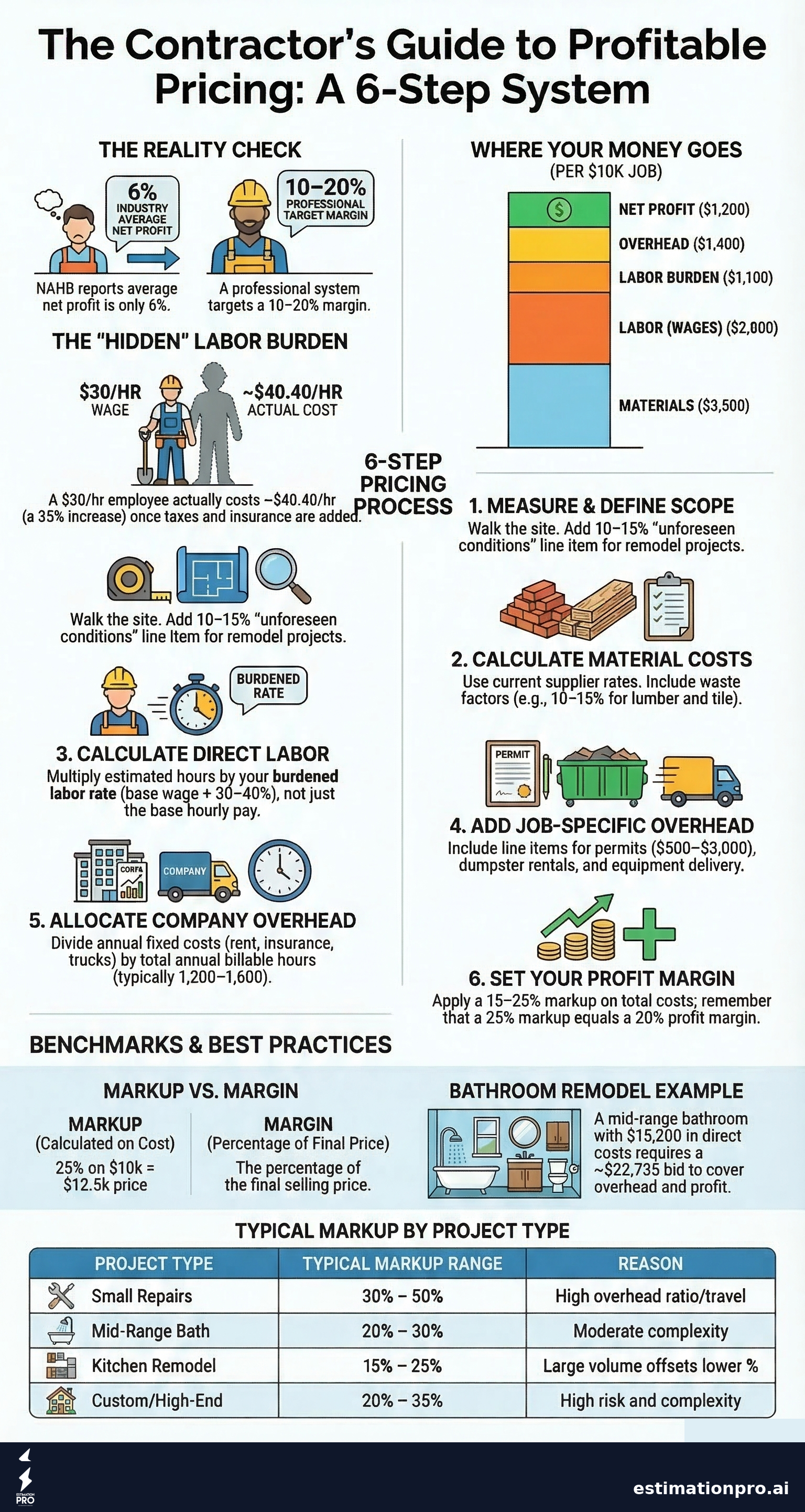
Share This Infographic
Feel free to share this infographic on your website. Just copy the embed code below:
Copy this embed code:
<a href="https://estimationpro.ai/tools/blog/how-to-price-construction-jobs" target="_blank" rel="noopener">
  <img src="https://estimationpro.ai/tools/blog/infographics/how-to-price-construction-jobs-infographic.png" alt="how to price construction jobs infographic by EstimationPro.AI" style="max-width:100%;height:auto" loading="lazy" />
</a>
<p style="font-size:12px;color:#64748B;margin-top:8px">Source: <a href="https://estimationpro.ai/tools/blog/how-to-price-construction-jobs">EstimationPro.AI</a></p>
What to Do When You’re “Too Expensive”
You’re going to lose bids. Accept that now. Not every job is a good fit.
When a homeowner says your price is too high, one of three things is happening:
- They got a lowball bid from someone who doesn’t know their costs. That contractor will either lose money, cut corners, or hit them with change orders. Let them.
- Their budget doesn’t match the scope. Help them reduce scope to hit their number. Remove the heated floors. Go with stock tile instead of handmade. Adjust, don’t discount.
- They’re shopping on price alone. These aren’t your clients. Refer them elsewhere and move on. You’ll save yourself headaches and lost profit.
I’d rather do three jobs at the right price than five jobs at the wrong one. Volume without profit is just expensive exercise.
Read more pricing strategies in our Contractor Markup vs. Margin guide, and use the Contractor Overhead Calculator to dial in your company overhead percentage.
Pricing Across Different Project Types
Not every job prices the same way. Here’s how pricing shifts by project type:
| Project Type | Typical Markup Range | Why |
|---|---|---|
| Small repairs / handyman | 30-50% | Higher overhead ratio on small-dollar jobs, travel eats margin |
| Mid-range bathroom remodel | 20-30% | Predictable scope, moderate complexity |
| Kitchen remodel | 15-25% | Larger dollar amount offsets lower percentage, longer timeline |
| Insurance restoration | 10-20% | Volume-based, carrier pricing schedules |
| Custom / high-end | 20-35% | Design complexity, premium client expectations, change order risk |
General contractor billing rates typically run $50-$150/hour depending on market and project type (HomeGuide 2026, Angi 2026). Your rate should recover overhead and produce profit, not just cover labor.
Five Pricing Mistakes That Drain Profit
- Forgetting labor burden. Your employees cost 30-40% more than their hourly wage. Price the real number.
- Using last year’s material prices. Lumber and copper move fast. Get fresh quotes every time.
- No contingency on remodels. Hidden conditions blow up 3 out of every 5 gut remodels. Build in 10-15%.
- Competing on price. The cheapest bid usually wins the worst clients. Price for profit and let quality sell.
- Not tracking actual costs. If you don’t compare estimates to actuals after each job, you’re guessing forever. Track it. Every job.
Frequently Asked Questions
What percentage should a contractor mark up materials?
Most contractors mark up materials 10-50%, with 20% being the industry standard for residential work. The markup covers procurement time, delivery coordination, material storage, warranty handling, and the risk of price fluctuations between estimate and purchase. Higher markups are common on specialty or hard-to-source items.
How do I know if my pricing is too low?
If your net profit margin is below 8-10% after paying yourself a fair salary, your pricing is too low. Other warning signs: you can’t afford to turn down any job, you’re not setting aside money for equipment replacement, and callbacks eat into next month’s income. NAHB data shows the average small contractor nets 6% - that’s survival, not success.
Should I charge by the hour or by the job?
Price by the job (fixed price) whenever possible. Hourly pricing caps your earnings - the faster you get, the less you make. Fixed-price bids reward efficiency and experience. The exception is time-and-materials work for truly unpredictable scope, like insurance restoration or concealed damage repair where you can’t define the full scope upfront.
How do I handle material price increases after I’ve quoted?
Include a clause in your proposal that material prices are valid for 30 days from the estimate date. For projects with long lead times, specify that material costs will be adjusted to current pricing at time of purchase. This protects you from eating cost increases on a job you quoted three months ago.
What’s the difference between markup and margin?
Markup is calculated on cost. Margin is calculated on the selling price. A 25% markup on $10,000 cost gives you a $12,500 price and a $2,500 profit (which is a 20% margin). They’re related but not the same number, and confusing them can cost you thousands per year. Use our Contractor Markup Calculator to convert between the two.
Note: All pricing figures reflect 2026 national averages. Costs vary significantly by region, labor market, and material availability. Always verify with local suppliers and adjust for your market conditions.
Build Estimates That Actually Make Money
Pricing right takes discipline. It means knowing your real costs, tracking your numbers, and having the confidence to bid what the job is actually worth instead of what you hope will win it.
Try EstimationPro free to build detailed, line-item estimates that capture every cost. EstimationPro doesn’t just help you price the job - it generates professional proposals, sends them to the client, and runs automated follow-up sequences so your bid doesn’t die in someone’s inbox. From estimate to proposal to follow-up to invoice, the whole workflow is handled so you can get back to building.
Pricing a job like this?
Get every line item priced for your area in a full estimate
Describe the job or snap a few photos. Send it from EstimationPro and it follows up with your client for you.
3 free estimates in the first 7 days. No credit card.
Where Your Pricing Actually Goes (per $10,000 job)
Get Free Estimating Tips
Enter your email and we'll send you pro tips, cost data, and useful resources for contractors.
We'll send helpful resources and occasional tips. Unsubscribe anytime.
 EstimationPro AI For Contractors, By Contractors
 Price Every Job With Confidence
Stop second-guessing your numbers. EstimationPro prices every line with labor and material rates adjusted for your region.