

Ran out of paint one coat into a primary bedroom in Tacoma. Two gallons short. My crew stood around for 90 minutes while I drove back to Sherwin-Williams and hoped the tint batch matched. It didn’t. We had to tint an extra gallon to splice the two batches together and pray the finish coat hid the transition. It did, barely.
That job taught me something simple. Measure once, add a waste factor, then buy 10% more than you think. Running short costs more than the extra gallon. Use our Paint Calculator to run the numbers for any room in under a minute, or Try EstimationPro free to build a full painting estimate with labor and materials in one shot.
Quick Answer: How Much Paint Do I Need?
One gallon of interior paint covers about 350 square feet on a smooth, previously painted wall. For most rooms you will need two coats. Measure the wall area in square feet, divide by 350, then multiply by two for coats. Add 10% for waste, touch-ups, and cut-in. A 12 by 12 bedroom with 8-foot ceilings needs roughly 2 to 2.5 gallons for walls. Fresh drywall, rough stucco, or dark-to-light color changes can double that.
The Coverage Number Nobody Tells You About
Paint cans say 350 to 400 square feet per gallon. That number assumes a smooth, primed surface and one coat by a pro. Real world is different.
Here’s what actually drives coverage:
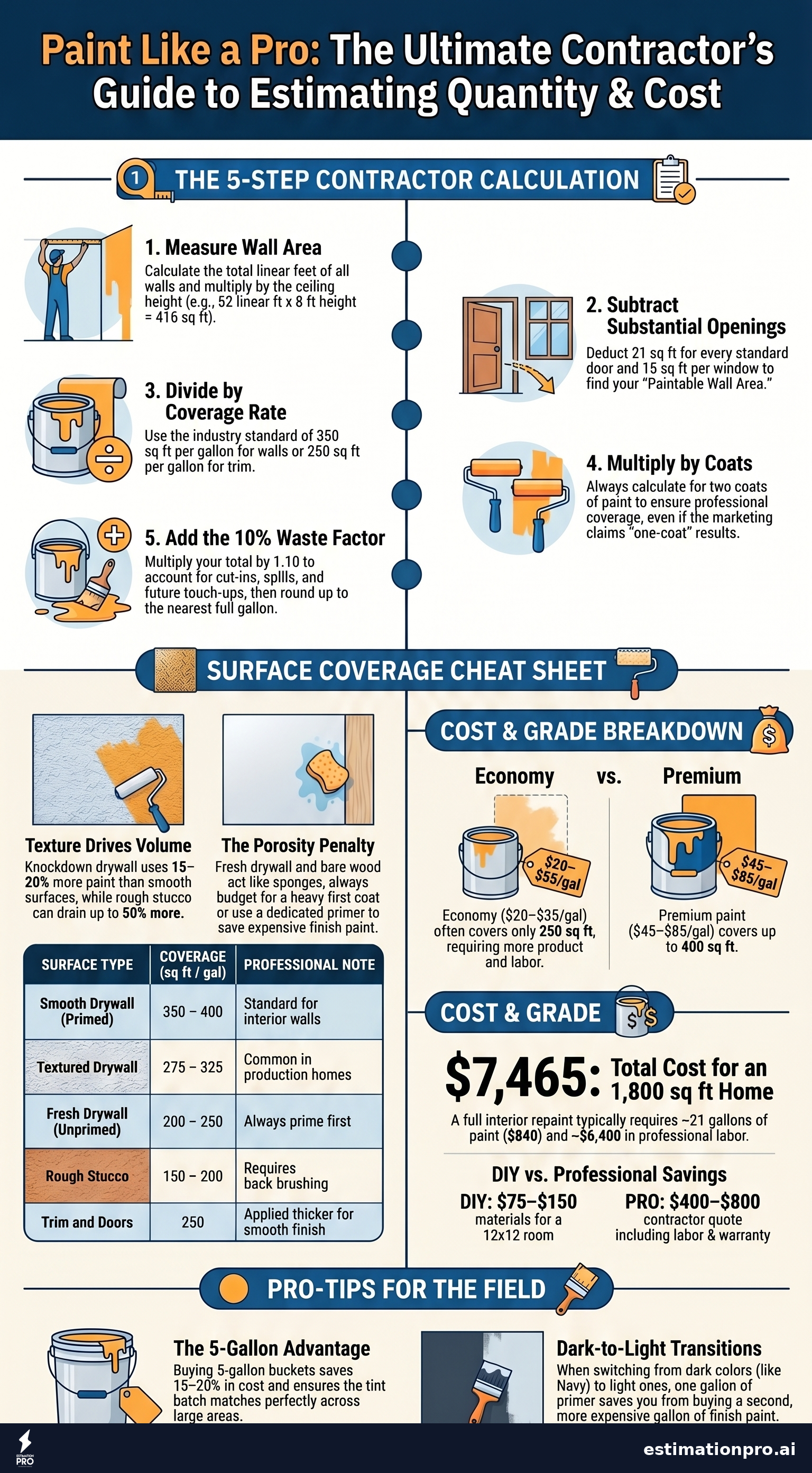
- Surface texture. Knockdown drywall eats 15 to 20% more paint than smooth. Stucco can drain 50% more.
- Porosity. Fresh drywall and bare wood suck paint in like a sponge. Always prime first or budget a heavy first coat.
- Color shift. Going from deep red to white? Plan on three coats. Going white on white? Two is usually enough.
- Application method. Rolling is efficient. Brushing cuts coverage by 20%. Spray with backrolling lands in between.
- Trim vs walls. Trim paint covers less because you apply it thicker for a smooth finish.
I run 350 sq ft per gallon on walls and 250 sq ft per gallon on trim. Those numbers have held up across 20 years of kitchens, baths, and full-interior repaints.
How To Calculate Paint Needed (The Contractor Way)
This is the exact method I use on every estimate.
Step 1: Measure wall area
Add up the length of all walls in the room, then multiply by ceiling height.
Example: 12 ft + 12 ft + 14 ft + 14 ft = 52 linear feet. Times 8 ft ceilings = 416 sq ft.
Step 2: Subtract doors and windows
A standard door is 21 sq ft. A standard window is 15 sq ft. Only subtract if the openings are substantial, otherwise the waste factor covers it.
Example: one door (21) and two windows (30) = 51 sq ft. Paintable wall area = 365 sq ft.
Step 3: Divide by coverage rate
365 sq ft divided by 350 sq ft per gallon = 1.04 gallons per coat.
Step 4: Multiply by coats
Two coats standard for most jobs. 1.04 x 2 = 2.08 gallons.
Step 5: Add waste factor
I add 10% for cut-in, touch-ups, and spilled trays. 2.08 x 1.10 = 2.29 gallons.
Round up to the next full gallon. Buy 3 gallons for this bedroom. You will have some left over for touch-ups two years from now when the homeowner’s dog scratches the baseboard.
Paint Coverage By Surface Type
Not every surface drinks paint the same way. Plan accordingly.
| Surface | Coverage per Gallon | Notes |
|---|---|---|
| Smooth drywall (primed) | 350-400 sq ft | Standard bedroom walls |
| Textured drywall (knockdown) | 275-325 sq ft | Most production homes |
| Fresh drywall (unprimed) | 200-250 sq ft | Always prime first |
| Bare wood | 200-300 sq ft | Two coats plus primer |
| Smooth stucco | 200-250 sq ft | Exterior, roll and brush |
| Rough stucco | 150-200 sq ft | Exterior, needs back-brushing |
| Siding (primed) | 250-350 sq ft | Hardie, cedar, or fiber cement |
| Concrete/CMU | 150-250 sq ft | Block filler first |
| Trim and doors | 250 sq ft | Thicker film build |
Pricing reference: coverage rates from manufacturer specs (Sherwin-Williams, Benjamin Moore). Labor and material ranges from BLS 47-2141 painter wage data and field experience.
Two Worked Examples
Example 1: Full interior repaint, 1,800 sq ft home
Living room, kitchen, 3 bedrooms, 2 bathrooms, hallway. Walls only, no ceilings, no trim.
- Total paintable wall area: 3,200 sq ft (industry rule: wall area = ~1.8x floor area)
- Coats: 2
- Total coverage needed: 6,400 sq ft
- Gallons at 350 sq ft/gal: 18.3
- Waste factor 10%: 20.1 gallons
- Round up: 21 gallons
Cost breakdown using standard-grade paint at $40/gal:
| Line item | Qty | Unit | Total |
|---|---|---|---|
| Standard interior paint | 21 gal | $40 | $840 |
| Primer | 3 gal | $25 | $75 |
| Supplies (rollers, tape, drop cloths) | 1 lot | $150 | $150 |
| Material subtotal | $1,065 | ||
| Interior painting labor | 3,200 sq ft | $2/sf | $6,400 |
| Total | $7,465 |
Example 2: Single bathroom, dark navy to white
Small bath, 5 ft x 8 ft, 8-foot ceilings. Walls are currently navy blue.
- Wall area: 208 sq ft, minus door (21) and window (15) = 172 sq ft
- Primer: 1 gallon (full coverage to kill the dark color)
- Finish paint: 172 sq ft x 2 coats = 344 sq ft
- Gallons: 344/350 = 0.98, plus 10% = 1.08 gallons
- Buy 1 gallon primer and 2 gallons white paint (one for backup, plus touch-ups)
Going dark-to-light without primer usually means 3 coats of finish paint. The gallon of primer saves you a gallon of expensive finish paint. Do the math every time.
Share This Infographic
Feel free to share this infographic on your website. Just copy the embed code below:
Copy this embed code:
<a href="https://estimationpro.ai/tools/blog/paint-how-much-do-i-need" target="_blank" rel="noopener">
  <img src="https://estimationpro.ai/tools/blog/infographics/paint-how-much-do-i-need-infographic.png" alt="paint how much do i need infographic by EstimationPro.AI" style="max-width:100%;height:auto" loading="lazy" />
</a>
<p style="font-size:12px;color:#64748B;margin-top:8px">Source: <a href="https://estimationpro.ai/tools/blog/paint-how-much-do-i-need">EstimationPro.AI</a></p>
Paint Grades and What They Actually Cover
Paint is one of those places where cheaping out costs more in the end.
- Economy ($20-35/gal): Covers 250 to 300 sq ft per gallon. You end up using more paint. Rarely worth it on a customer job.
- Standard ($30-55/gal): Behr, Valspar, mid-tier Sherwin-Williams. Covers 325 to 375 sq ft. Good for rentals and budget remodels.
- Premium ($45-85/gal): Benjamin Moore Aura, Sherwin-Williams Emerald. Covers 350 to 400 sq ft. One-coat coverage is realistic on light colors over primed surfaces.
On my own jobs I use premium on anything the homeowner will see up close. The extra $25 a gallon usually saves me half a gallon in coverage plus one less coat. That math almost always works.
Primer: When You Actually Need It
New construction painters skip primer and catch hell when the walls flash-dry at different rates. Don’t skip it in these situations:
- Fresh drywall. Always. The paper face sucks paint inconsistently.
- Stain-blocked areas. Water stains, smoke damage, pet mess. Use a stain-blocking primer like Zinsser BIN.
- Bare wood. Unfinished trim, new doors, raw siding.
- Dark to light. Anything going more than 2 shades lighter needs primer to keep the finish coat count down.
- Glossy surfaces. You cannot paint over semi-gloss or gloss without bonding primer. Finish will peel.
Primer covers at 200 to 300 sq ft per gallon. Plan accordingly.
Common Painting Estimate Mistakes
These are the ones I see on every bad bid.
- Forgetting ceiling paint. Ceilings are separate paint, separate labor. A 12x12 room has 144 sq ft of ceiling, which eats another half gallon.
- Missing the prep work. Patching, sanding, caulking. On older PNW homes I budget 1 to 2 hours of prep for every hour of painting.
- Underbidding cut-in. Cut-in by brush is slow. It can take as long as rolling the whole wall. Don’t estimate it as 10% of the job.
- Ignoring the waste factor. A 10% waste factor is not optional. It covers cut-in, touch-ups, tray waste, and the can you kick over at 4pm on Friday.
- Quoting one coat to win the bid. One-coat coverage is a marketing claim. Budget two coats unless you want to eat the labor on the third.
- Forgetting caulk, spackle, and sandpaper. Material supplies run $100-$200 on most interior jobs.
Exterior Paint Is a Different Beast
Exterior paint is more expensive, spreads thinner, and has to deal with weather. Budget differently.
- Coverage: 250 to 350 sq ft per gallon, 50 to 100 sq ft less than interior
- Coats: Always 2, sometimes 3 on bare or weathered siding
- Labor: $1.50 to $5 per sq ft, higher than interior because of prep, ladders, and drying windows
- Primer: Mandatory on bare wood, Hardie, and any spot repairs
A 2,000 sq ft single-story house with typical PNW siding runs about 20 to 25 gallons of exterior paint plus 5 gallons of primer. If you want the full cost breakdown, use our Exterior Paint Calculator to run your specific house through.
Regional Note
These numbers reflect Pacific Northwest pricing as of 2026. Paint material costs are fairly flat nationally because the big brands set pricing at corporate. Labor varies by 30 to 40% between markets. Texas and Florida run cheaper, Northeast and California run more expensive. Adjust the labor line accordingly.
FAQ
How many square feet does a 5-gallon bucket of paint cover?
A 5-gallon bucket covers 1,500 to 2,000 sq ft at one coat. At two coats, plan on 750 to 1,000 sq ft of wall area. That is enough for most 1,500 sq ft homes’ interior walls, not ceilings.
How much paint do I need for a 12x12 room?
A 12x12 room with 8-foot ceilings has roughly 384 sq ft of paintable wall area after subtracting a door and window. At two coats and 350 sq ft per gallon, you need about 2.2 gallons. Buy 3 gallons to cover waste and have touch-up paint left over.
Do I need to prime before painting?
Prime if the surface is fresh drywall, bare wood, stained, glossy, or dramatically darker than your finish color. Skip primer on previously painted walls where you are staying in the same color family. Priming saves a coat of expensive finish paint in most problem cases.
Is it cheaper to buy a 5-gallon bucket or single gallons?
Five-gallon buckets save 15 to 20% per gallon on most brands. If you need 4 or more gallons of the same color, always buy the bucket. Plus the tint batch matches across the whole job, which single-gallon purchases do not guarantee.
How much paint for exterior of a house?
A 2,000 sq ft single-story home with typical siding needs 18 to 25 gallons of exterior paint plus 5 gallons of primer for a full repaint. Two-story homes run 30 to 40% more material because of the higher surface area.
How much does it cost to paint a room yourself vs hire?
DIY paint for a 12x12 room runs $75-$150 in paint and supplies. A contractor quote for the same room lands at $400-$800 including labor. The gap is labor, prep, and the warranty on the finish holding up for 5+ years.
Pulling It All Together
Paint estimating is measurement plus coverage rate plus coats plus waste factor. Every contractor I know who runs short on paint skipped the waste factor. Don’t be that guy.
If you’re bidding paint jobs regularly, stop calculating this by hand on every quote. Contractors using EstimationPro build full painting estimates in 10 minutes instead of an hour, with labor, material, and markup automated. The platform handles the math, sends the proposal, and follows up with the homeowner on autopilot so you win more of the bids you already send. Try EstimationPro free and see how fast your next paint bid comes together.
Pricing a job like this?
Get every line item priced for your area in a full estimate
Describe the job or snap a few photos. Send it from EstimationPro and it follows up with your client for you.
3 free estimates. No credit card.
Get Free Estimating Tips
Enter your email and we'll send you pro tips, cost data, and useful resources for contractors.
We'll send helpful resources and occasional tips. Unsubscribe anytime.
 EstimationPro AI For Contractors, By Contractors
 Save 2+ Hours on Every Estimate
Upload photos, record voice notes, and get AI-powered estimates with line items, material lists, and regional pricing.