

Last summer I stood in a driveway with a homeowner who had three roofing estimates on her kitchen counter. One was $6,800. One was $11,400. One was $17,200. Same house. Same roof. Same week. She asked me which one was right.
None of them, fully. Two were missing things that would come back as change orders. One padded overhead and added a skylight she didn’t want. That’s the problem with a roofing estimate. The number on the bottom doesn’t tell you much. The line items above it tell you everything.
If you want a clean number fast, use our roofing calculator for a ballpark. If you want a pro-grade estimate you can send to a homeowner in minutes, Try EstimationPro free. The rest of this post breaks down what a real estimate should include, how to read one, and what fair pricing looks like in 2026.
Quick Answer: What Is a Roofing Estimate?
A roofing estimate is a written breakdown of the cost to repair or replace a roof. A complete one lists material by type and quantity, labor hours or per-square labor, tear-off and disposal, underlayment, flashing, vents, permits, overhead, and warranty terms. A full architectural shingle replacement in 2026 typically lands between $8,000 and $22,000 for an average 2,200 sq ft home. Anything far below that range is usually missing scope.
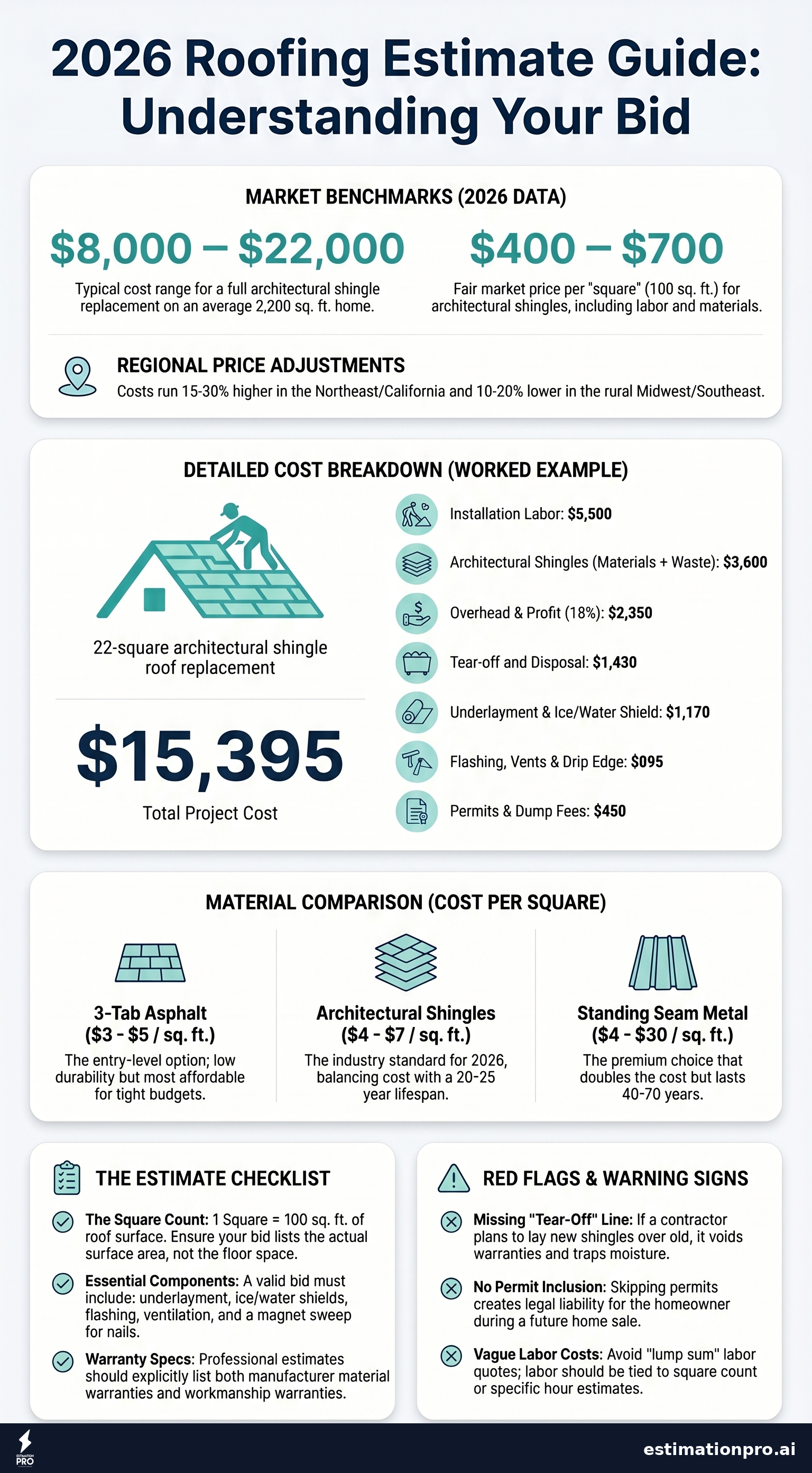
Share This Infographic
Feel free to share this infographic on your website. Just copy the embed code below:
Copy this embed code:
<a href="https://estimationpro.ai/tools/blog/roofing-estimate" target="_blank" rel="noopener">
  <img src="https://estimationpro.ai/tools/blog/infographics/roofing-estimate-infographic.png" alt="Roofing estimate infographic by EstimationPro.AI" style="max-width:100%;height:auto" loading="lazy" />
</a>
<p style="font-size:12px;color:#64748B;margin-top:8px">Source: <a href="https://estimationpro.ai/tools/blog/roofing-estimate">EstimationPro.AI</a></p>
The Line Items a Real Estimate Should Have
I’ve seen “estimates” that are one page with a single price on them. That’s not an estimate. That’s a guess with a signature line. A real roofing estimate shows every bucket of cost, so the homeowner knows what they’re paying for and the contractor knows what’s included.
Here’s what should be on it:
- Shingle or roofing material with brand, style, and color
- Square count (a square = 100 sq ft of roof surface, not floor space)
- Underlayment (synthetic or felt) with square footage
- Ice and water shield at eaves and valleys (required by code in most cold climates)
- Tear-off and disposal, including dumpster or dump fees
- Flashing: step flashing, valley flashing, chimney flashing, drip edge
- Ventilation: ridge vent, soffit vents, roof jacks
- Labor line, either per-square or total hours
- Permit fees (if required by your jurisdiction)
- Cleanup and magnet sweep for dropped nails
- Warranty terms: both manufacturer and workmanship, in years
- Overhead and profit, or a clear lump sum that covers it
- Payment schedule and deposit amount
- Start window and duration
If three of those are missing, the estimate is not apples-to-apples with a complete one. That’s how the cheap bid becomes the expensive job.
What a Roofing Estimate Actually Costs: 2026 Ranges
Prices swing hard by region, pitch, story height, and material. These are the ranges I see on real bids in the Pacific Northwest in 2026, cross-checked against HomeAdvisor, Angi, and BLS wage data.
| Line item | Low | Typical | High | Unit |
|---|---|---|---|---|
| 3-tab asphalt shingles (material) | $70 | $100 | $200 | per square |
| Architectural shingles (material) | $100 | $150 | $250 | per square |
| Metal roofing (material) | $120 | $400 | $900 | per square |
| Roofing labor | $150 | $250 | $500 | per square |
| 3-tab installed | $3 | $4 | $5 | per sq ft |
| Architectural installed | $4 | $5.50 | $7 | per sq ft |
| Metal roof installed | $4 | $12 | $30 | per sq ft |
| Complete replacement (total job) | $5,000 | $10,000 | $45,000 | per project |
| Ridge vent | $4 | $7 | $12 | per linear foot |
| Aluminum gutters (5-inch K-style) | $7 | $12 | $20 | per linear foot |
| Chimney flashing repair | $500 | $950 | $1,800 | per project |
| Skylight installation | $1,500 | $2,500 | $4,500 | each |
Sources: HomeAdvisor 2025-2026 roofing cost guide, Angi 2026 roofing pricing data, BLS 47-2181 roofer wage data, and field-verified bids from Pacific Remodeling jobs this year.
Regional note: prices run 15-30% higher in California, the Northeast, and urban metros. Rural Midwest and Southeast markets run 10-20% lower. Adjust accordingly.
Worked Example 1: 22-Square Architectural Shingle Replacement
Real numbers from a bid I wrote this spring. Standard 2,200 sq ft single-story with moderate pitch, full tear-off, no structural repairs.
| Line item | Quantity | Rate | Cost |
|---|---|---|---|
| Architectural shingles | 24 squares (22 + waste) | $150/sq | $3,600 |
| Synthetic underlayment | 2,400 sq ft | $0.27/sf | $650 |
| Ice and water shield | 400 sq ft | $1.30/sf | $520 |
| Tear-off and disposal | 22 squares | $65/sq | $1,430 |
| Drip edge and flashing | 180 lf + chimney | - | $580 |
| Ridge vent | 45 lf | $7/lf | $315 |
| Installation labor | 22 squares | $250/sq | $5,500 |
| Permit and dump fees | - | - | $450 |
| Overhead and profit (18%) | - | - | $2,350 |
| Total | $15,395 |
That’s right in the middle of the typical range for an average home with architectural shingles. A homeowner who gets a bid for $8,200 on this same roof is looking at an estimate that’s missing the tear-off, the underlayment upgrade, or the overhead line. Both of those are going to get billed one way or another.
Worked Example 2: Standing Seam Metal Roof, Same House
Same 22-square roof, upgraded to 24-gauge standing seam metal.
| Line item | Quantity | Rate | Cost |
|---|---|---|---|
| Standing seam panels | 22 squares | $500/sq | $11,000 |
| High-temp underlayment | 2,200 sq ft | $0.45/sf | $990 |
| Ice and water shield | 400 sq ft | $1.30/sf | $520 |
| Tear-off and disposal | 22 squares | $65/sq | $1,430 |
| Trim, flashing, closures | - | - | $1,800 |
| Ridge vent | 45 lf | $9/lf | $405 |
| Installation labor | 22 squares | $450/sq | $9,900 |
| Permit and dump fees | - | - | $500 |
| Overhead and profit (18%) | - | - | $4,790 |
| Total | $31,335 |
Metal doubles the total cost but the roof lasts 40-70 years instead of 20-25. The math works over a lifetime. It does not work if the homeowner plans to sell in three years.
Red Flags in a Cheap Roofing Estimate
I’ve been doing this long enough to know what a lowball bid leaves off. Here’s what I look for when a homeowner shows me a suspiciously cheap quote.
- No tear-off line. The contractor plans to lay new shingles over old, which voids most manufacturer warranties and traps moisture.
- No underlayment spec. Cheap felt instead of synthetic saves $300 and cuts your weather protection in half.
- No ice and water shield in cold climates. This is code. Skipping it invites ice dam damage.
- No flashing budget. New shingles over old flashing leaks within five years. Every time.
- Vague labor line. “Labor: $2,000” with no square count or hour estimate. That’s a blank check.
- No permit. If your city requires one and the contractor skips it, the liability is yours when you sell.
- No warranty terms. Manufacturer warranty requires specific install methods. Workmanship warranty should be 2-10 years in writing.
- Cash-only, no contract. Walk away. Full stop.
The cheapest bid is almost always the most expensive job. I’ve rebuilt enough roofs from shady installs to know the pattern. The homeowner saves $3,000 on the front end and pays $8,000 to fix the damage two winters later.
How Contractors Should Build a Defensible Estimate
Shifting to the contractor side of the table for a minute. If you’re writing roofing estimates, here’s the process that keeps you out of trouble:
- Measure the roof, don’t eyeball it. Use satellite tools, a pitch gauge, or a ladder. Guess at the square count and you either underbid and eat the loss or overbid and lose the job.
- Add a 10-15% waste factor on shingles. Hips and valleys push it higher. Cuts have to go somewhere.
- Price your labor by the square, not the hour. Production rates for a 2-man crew on architectural shingles run 4-6 squares per day on a simple roof. Steep or complex cuts that number in half.
- Build in tear-off as a separate line. Dump fees alone run $350-600 per load. Don’t bury it in labor.
- Document the deck condition with a contingency. “If decking requires replacement, $95 per 4x8 sheet.” This protects both sides when demo reveals rot.
- Quote a start window and duration, not an exact start date. Weather delays happen. Set expectations.
- Include photos and a scope drawing when possible. Homeowners remember what they saw, not what you said.
My dad drilled this into me forty years ago: measure twice, cut once. The same rule applies to estimates. You can undercut yourself once, maybe twice, before the math catches up. I’d rather lose a job to a high bid than win one that pays my crew but nothing else.
Common Mistakes Homeowners Make When Comparing Roofing Estimates
- Choosing on total price without reading the line items
- Not asking what happens if rot is found under the shingles
- Skipping the license and insurance check (ask for certificates)
- Paying more than 10-30% as a deposit
- Not getting the warranty terms in writing
- Assuming all “architectural shingles” are the same (30-year vs. 50-year is a real difference)
- Not verifying permits were pulled and inspections passed before paying the final balance
The best roofing estimate is the clearest one. Not the prettiest. Not the cheapest. The one where you can read every line and know exactly what you’re paying for and what you’re getting.
FAQ
How long should a roofing estimate be good for?
Most contractors hold pricing for 30 days. Material costs, especially asphalt shingles tied to crude oil, can shift fast. After 30-60 days, expect a rewrite.
Is a free roofing estimate actually free?
It should be, for a standard-sized residential roof within a reasonable drive. Some contractors charge $100-300 for estimates that require drone mapping, engineering review, or long travel. Always ask up front.
How many roofing estimates should I get?
Three is the sweet spot. One gives you no comparison. Five becomes noise. Three lets you see the middle of the market and spot the outliers.
Why are roofing estimates so different from each other?
Scope assumptions. One contractor includes new flashing, another reuses the old. One uses synthetic underlayment, another uses felt. One includes permit and dump fees, another buries them or skips them. Same house, different scope.
Should a roofing estimate include structural repairs?
Usually no, because the contractor can’t see rotted decking until tear-off. A good estimate will include a contingency line like “decking repair billed at $95 per sheet if needed” so you know the exposure before demo day.
How do I know if a roofing estimate is fair?
Compare the line items, not just the total. A fair estimate in 2026 for architectural shingles on an average home runs $4 to $7 per installed square foot, or roughly $400-$700 per square. Anything below that is probably missing scope. Anything above 30% over should come with a specific reason (steep pitch, multiple stories, complex cuts).
What’s the difference between an estimate and a quote?
An estimate is a best-guess number with assumptions. A quote or proposal is a firm price for a defined scope. Most homeowners use the words interchangeably, but a good contractor will be clear about which one you’re holding.
Writing Estimates Faster Than the Next Contractor
In roofing, speed matters. The homeowner who gets a clear, itemized estimate first often wins the job, even if another contractor is $500 cheaper two days later. I’ve lost bids I should have won because I was stuck at the kitchen table cranking out spreadsheets at 9pm instead of putting eyes on the next job.
That’s the problem EstimationPro solves. Upload photos, dictate notes, and the app generates a professional itemized roofing estimate in minutes, with line items that look exactly like the ones above. It sends the proposal automatically, follows up with the homeowner on a schedule I set, and pushes the invoice when the job is signed off. Contractors using EstimationPro report closing 2 hours faster on every estimate and winning roughly 35% more of the bids they already send, based on our internal 2026 customer data. Try EstimationPro free and send your next roofing estimate before the competition finishes their coffee.
For more on pricing the numbers inside the estimate, read our guide to roofing estimate per square costs or how to estimate a roofing job from scratch. Want a blank template to start from? Grab our roofing estimate template.
Pricing a job like this?
Get every line item priced for your area in a full estimate
Describe the job or snap a few photos. Send it from EstimationPro and it follows up with your client for you.
3 free estimates. No credit card.
Typical 22-Square Architectural Shingle Roof Estimate
Get Free Estimating Tips
Enter your email and we'll send you pro tips, cost data, and useful resources for contractors.
We'll send helpful resources and occasional tips. Unsubscribe anytime.
 EstimationPro AI For Contractors, By Contractors
 Save 2+ Hours on Every Estimate
Upload photos, record voice notes, and get AI-powered estimates with line items, material lists, and regional pricing.