

I once watched a contractor lose $14,000 on a single bathroom remodel. Not because the work was bad. His estimate missed three line items that added up fast once the walls came open - outdated plumbing, rotted subfloor, and an electrical panel that needed upgrading to pass inspection.
That job turned profitable work into a lesson he’ll never forget. And it all started with a sloppy estimate.
Construction estimating is the skill that separates contractors who make money from contractors who just stay busy. Get it right, and every job runs on solid numbers. Get it wrong, and you’re eating costs while the homeowner thinks you overcharged.
Quick Answer: What Is Construction Estimating?
Construction estimating is calculating the total cost of a project before the first hammer swings. A complete estimate covers material quantities, labor hours, equipment, subcontractor bids, permits, waste, overhead, and profit. For residential remodeling, expect to spend 2-6 hours building an estimate depending on scope. According to the NAHB, material and labor costs account for roughly 60-65% of total project cost, with the rest going to overhead, profit, permits, and contingency.
Try EstimationPro free to build detailed estimates in minutes instead of hours, with automated follow-up that keeps your bids from dying in a homeowner’s inbox.
What Every Construction Estimate Must Include
Skip any of these and you’re leaving money on the table or, worse, losing it.
Materials - Every board, sheet, fastener, adhesive, and finish product. Quantities come from your takeoff. Always add waste factor (typically 5-15% depending on the material and cut complexity).
Labor - Hours per task multiplied by your crew’s hourly rates. Carpenter wages run $20-$45/hour depending on experience and region (BLS Occupational Employment data, May 2024). Don’t forget labor burden - FICA, workers comp, insurance, and PTO add 30-40% on top of base wages. Use a burdened labor rate calculator to get the real number.
Subcontractors - Plumbing, electrical, HVAC. Get actual bids, not guesses. I’ve seen guys estimate “about $3,000 for plumbing” and get a bid back at $5,200. That $2,200 gap comes straight out of your pocket.
Equipment & Rentals - Dumpster, scaffolding, specialty tools. A residential dumpster runs $300-$700 per week depending on size and market (HomeGuide 2026).
Permits & Inspections - Residential building permits cost $500-$3,000 depending on project value and jurisdiction (Angi 2026). Budget for these before you price the job.
Overhead - Truck, insurance, office, phone, accounting, marketing. Everything it costs to keep the lights on whether you’re working or not. Industry benchmarks from NAHB and RSMeans put contractor overhead at 15-35% of direct costs.
Profit - This is not overhead. This is your paycheck for running the business, taking the risk, and standing behind the work. Typical contractor markup runs 10-50%, with 20% being the most common for residential remodeling (RSMeans data).
The 7-Step Estimating Process
1. Review the Full Scope of Work
Read every word of the plans, specs, and notes. Walk the site. Look at what’s behind the walls if you can. I’ve learned the hard way that skipping the site walk costs more than the hour it takes.
Ask the homeowner questions now, not later. What finishes do they want? What’s their budget range? Are there decisions they haven’t made yet? Unmade decisions become change orders.
2. Do Your Material Takeoff
Measure everything. Count everything. A takeoff is the foundation of your estimate. If you’re measuring a space, a square footage calculator saves time on odd-shaped rooms.
| Material | How to Measure | Typical Waste Factor |
|---|---|---|
| Lumber/Framing | Linear feet + board count | 5-10% |
| Drywall | Wall/ceiling area in sq ft | 10-15% |
| Tile | Floor + wall area in sq ft | 10-15% (more for diagonal) |
| Paint | Surface area / coverage rate | 10% |
| Concrete | Volume in cubic yards | 5-10% |
| Roofing | Roof area in squares (100 sq ft) | 10-15% |
3. Calculate Labor Hours
This is where experience matters most. Production rates vary by trade, crew skill, and site conditions.
A few benchmarks from my own projects and industry data:
- Framing: 0.03-0.05 hours per board foot (experienced crew)
- Drywall hang: 30-40 sheets per day (2-person crew)
- Tile installation: 50-80 sq ft per day per installer
- Painting: 200-400 sq ft per hour (rolling, no cut-in)
- Demo: Highly variable. Old homes with plaster take 3x longer than drywall demo.
Multiply hours by your burdened labor rate. If your carpenter costs $30/hour in wages and labor burden adds 35%, your real cost is $40.50/hour. Miss that distinction and you’re underbidding every job.
4. Collect Subcontractor Bids
Get real quotes. Three bids minimum for each sub trade if you have the time. Compare scope, not just price. A $4,000 plumbing bid that includes fixture installation is cheaper than a $3,200 bid that doesn’t.
5. Add Permits, Equipment, and Miscellaneous
These are the line items that new contractors forget. Every single time.
- Building permits
- Dumpster rental and haul-off
- Portable toilet (longer jobs)
- Tool rental or specialty equipment
- Protection materials (floor protection, plastic sheeting)
- Cleanup labor
6. Apply Your Overhead and Markup
Your overhead rate should be calculated annually based on your actual business costs. If your annual overhead is $60,000 and you do $300,000 in direct project costs, your overhead rate is 20%.
Then add profit on top. A 20% markup on a $25,000 direct cost project means $5,000 in gross profit. That’s before taxes. If you want to understand how markup and margin differ (they’re not the same number), check the contractor markup calculator.
7. Review, Sanity-Check, and Finalize
Before you hand over that estimate, ask yourself three questions:
- Does this number feel right based on similar jobs I’ve done?
- Did I account for the age and condition of the structure?
- Would I accept this price if I were the homeowner?
If something feels off, find it. Trust your gut. I’ve caught missed line items on the final review more times than I can count.
Worked Example: Kitchen Remodel Estimate
Here’s what a midrange kitchen remodel estimate looks like for a 150 sq ft kitchen in the Pacific Northwest. Midrange kitchen remodels typically run $150-$300 per square foot installed (industry average for semi-custom finishes).
| Line Item | Quantity | Unit Cost | Total |
|---|---|---|---|
| Demo & haul-off | 1 lot | $1,800 | $1,800 |
| Cabinets (semi-custom) | 20 LF | $400/LF | $8,000 |
| Countertops (quartz) | 35 SF | $130/SF | $4,550 |
| Flooring (LVP) | 150 SF | $7.50/SF | $1,125 |
| Backsplash tile | 30 SF | $18/SF | $540 |
| Plumbing rough-in + fixtures | 1 lot | $3,000 | $3,000 |
| Electrical (new circuits, lighting) | 1 lot | $2,000 | $2,000 |
| Painting | 1 lot | $1,200 | $1,200 |
| Permits | 1 | $1,200 | $1,200 |
| Dumpster (2 weeks) | 2 weeks | $475/wk | $950 |
| Subtotal (Direct Costs) | $24,365 | ||
| Overhead (20%) | $4,873 | ||
| Profit (15%) | $3,655 | ||
| Total Estimate | $32,893 |
That lands at roughly $219 per square foot, right in the midrange window. Notice how overhead and profit add nearly $8,500 to the job. New contractors often skip these lines and wonder why they’re not making money.
Worked Example: Roof Replacement Estimate
Different trade, same process. Here’s a 20-square (2,000 sq ft) architectural shingle roof replacement.
| Line Item | Quantity | Unit Cost | Total |
|---|---|---|---|
| Tear-off & disposal | 20 squares | $75/sq | $1,500 |
| Underlayment (synthetic) | 20 squares | $15/sq | $300 |
| Architectural shingles | 20 squares | $150/sq | $3,000 |
| Ridge cap & starter strip | 1 lot | $350 | $350 |
| Flashing & drip edge | 1 lot | $400 | $400 |
| Labor (tear-off + install) | 20 squares | $150/sq | $3,000 |
| Dumpster | 1 | $475 | $475 |
| Permit | 1 | $500 | $500 |
| Subtotal | $9,525 | ||
| Overhead (20%) | $1,905 | ||
| Profit (15%) | $1,429 | ||
| Total Estimate | $12,859 |
That’s about $6.43 per square foot installed, which lines up with the $3-$5/SF range for basic architectural shingle installs plus overhead and profit.
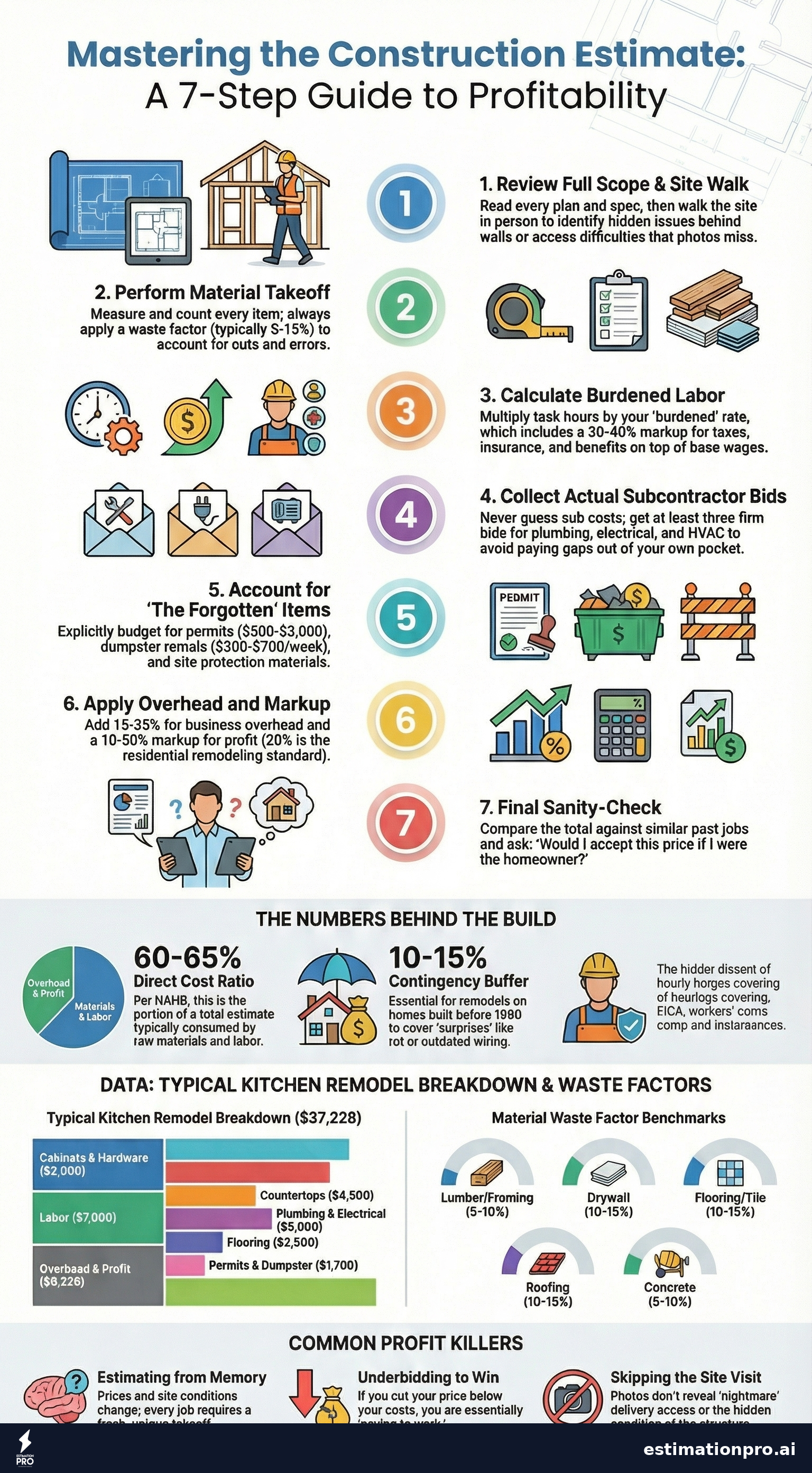
Share This Infographic
Feel free to share this infographic on your website. Just copy the embed code below:
Copy this embed code:
<a href="https://estimationpro.ai/tools/blog/construction-estimating" target="_blank" rel="noopener">
  <img src="https://estimationpro.ai/tools/blog/infographics/construction-estimating-infographic.png" alt="construction estimating infographic by EstimationPro.AI" style="max-width:100%;height:auto" loading="lazy" />
</a>
<p style="font-size:12px;color:#64748B;margin-top:8px">Source: <a href="https://estimationpro.ai/tools/blog/construction-estimating">EstimationPro.AI</a></p>
Where New Contractors Get Estimates Wrong
After 20+ years in the trades, I’ve seen the same mistakes kill profits over and over.
Estimating from memory. You did a similar bathroom last year, so you quote the same number. But material prices changed. This house is older. The scope is slightly different. Every job deserves its own takeoff.
Forgetting labor burden. You pay your guys $30/hour. But FICA (7.65%), workers comp (8-15% depending on trade), state unemployment, and benefits push that real cost to $40-$45/hour. That gap eats your profit on every job.
No contingency for surprises. Older homes hide problems. Rot behind tile. Aluminum wiring behind drywall. Galvanized plumbing that crumbles when you touch it. I always build 10-15% contingency into remodel estimates for homes built before 1990. Newer homes get 5%.
Underbidding to win the job. Dropping your price to beat a competitor only works if you can still make money. If you can’t, you’re paying to work. Good, fast, or cheap - the homeowner picks two, not three.
Skipping the site visit. Photos and FaceTime calls don’t show you what’s behind the walls. They don’t show you the tight driveway that makes material delivery a nightmare. They don’t show you the dog. Walk the job.
Frequently Asked Questions
How long does it take to estimate a construction job?
For residential remodeling, expect 2-6 hours per estimate. A simple bathroom refresh might take 2 hours. A full kitchen gut-and-remodel with custom finishes can take 4-6 hours when you factor in the site visit, material research, sub quotes, and pricing. Using estimating software like EstimationPro can cut this to under an hour for most residential jobs.
What percentage should I add for overhead and profit?
Industry standard is 15-35% for overhead and 10-20% for profit (NAHB builder cost benchmarks). Your actual overhead rate depends on your business expenses. Calculate it from your real numbers, not a guess. A solo operator working from a truck has different overhead than a company with an office and three crews.
Should I give free estimates?
That depends on your market and the job size. For large remodels ($20K+), a detailed estimate represents real work and expertise. Many contractors charge $150-$500 for detailed estimates and credit it toward the job if hired. For smaller jobs, free estimates are still the norm. Read more in our guide on how to estimate construction jobs.
What’s the difference between an estimate and a bid?
An estimate is your best projection of what a job will cost. A bid is a firm price you’re committing to. Estimates can change as scope changes. Bids are locked in. Most residential contractors provide estimates first, then convert to a fixed-price proposal once the scope is finalized. See our breakdown of estimate vs bid for more detail.
How much contingency should I include?
For remodeling work, 10-15% contingency is standard. New construction with complete plans typically needs 5-10%. The older the structure and the less you can see before demo, the higher your contingency should be. I’d rather return unused contingency to the homeowner than eat a $5,000 surprise.
Stop Spending Evenings on Estimates
The hardest part of construction estimating isn’t the math. It’s the time. Every hour you spend hunched over a spreadsheet is an hour you’re not on a job site, not with your family, not running your business.
Contractors on Capterra rate EstimationPro 4.8/5 for speed and accuracy. Try EstimationPro free to build professional estimates in minutes. It doesn’t just create the estimate - it sends the proposal automatically and follows up with the homeowner so you win more of the bids you already send. That’s the difference between estimating software and a real contractor workflow.
Pricing in this guide reflects 2026 national averages. Prices vary by region depending on labor availability, material costs, and local demand. Always get quotes from local contractors before budgeting your project.
Pricing a job like this?
Get every line item priced for your area in a full estimate
Describe the job or snap a few photos. Send it from EstimationPro and it follows up with your client for you.
3 free estimates in the first 7 days. No credit card.
Typical Kitchen Remodel Estimate Breakdown
Get Free Estimating Tips
Enter your email and we'll send you pro tips, cost data, and useful resources for contractors.
We'll send helpful resources and occasional tips. Unsubscribe anytime.
 EstimationPro AI For Contractors, By Contractors
 Save 2+ Hours on Every Estimate
Upload photos, record voice notes, and get AI-powered estimates with line items, material lists, and regional pricing.