

$10,000. That’s what the average homeowner spends on a new roof in 2026, and I’ve seen jobs come in at half that or four times that depending on material, pitch, and what surprises show up during tear-off.
If you’re a contractor trying to quote a roof replacement accurately, or a homeowner trying to figure out whether that bid you got is fair, this guide covers the real numbers. No fluff. Just material costs, labor rates, and two worked examples you can reference against your own project.
Quick Answer: What Does a New Roof Cost?
A complete roof replacement on a typical 2,000 square foot home costs between $5,000 and $15,000 for asphalt shingles, or $18,000 to $45,000 for standing seam metal. The national average lands around $10,000 for architectural shingles with tear-off, based on 2026 data from Angi and HomeAdvisor. Your actual number depends on roof size, material choice, pitch, layers to remove, and regional labor rates.
Use our Roofing Calculator to plug in your specific measurements and get a detailed estimate in minutes. Try EstimationPro free to build a complete roofing proposal with line items, labor, and materials included.
Material Cost Comparison (Per Square)
One “square” in roofing equals 100 square feet. A 2,000 SF roof is 20 squares.
| Material | Cost Per Square (Material Only) | Installed Per SF | Typical Warranty |
|---|---|---|---|
| 3-Tab Asphalt | $70 - $200 | $3 - $5 | 20-25 years |
| Architectural Asphalt | $100 - $250 | $4 - $7 | 30-50 years |
| Metal (Standing Seam) | $120 - $900 | $4 - $30 | 40-70 years |
Sources: Angi 2026, HomeAdvisor 2025-2026, BLS Occupational Data for Roofers (47-2181)
Architectural shingles dominate the market right now. They cost a bit more than 3-tab, but the dimensional look, longer warranty, and higher wind rating make them the default recommendation from most roofers I know. The price gap between 3-tab and architectural has actually narrowed in the last few years, which makes the upgrade a no-brainer for most jobs.
Worked Example 1: Standard Ranch Home (2,000 SF Roof)
Here’s a line-by-line estimate for a single-story ranch with a moderate 6/12 pitch, one layer of existing shingles to remove, and architectural shingles going back on.
| Line Item | Cost |
|---|---|
| Architectural shingles (20 squares × $150/sq) | $3,000 |
| Synthetic underlayment (20 squares × $30/sq) | $600 |
| Ice & water shield (valleys + eaves, 4 squares) | $240 |
| Roofing labor (20 squares × $250/sq) | $5,000 |
| Tear-off & disposal (20 squares × $125/sq) | $2,500 |
| Dumpster rental | $500 |
| Flashing, drip edge, pipe boots | $500 |
| Ridge vent (40 LF × $7/LF) | $280 |
| Permit | $350 |
| Total | $12,970 |
That breaks down to roughly $6.49 per square foot all-in. On a straightforward job with easy access and no surprises, this is a realistic number for 2026.
I’ve bid roofs where the tear-off revealed rotted decking under the old shingles, and that single discovery added $2,000-$4,000 to the job. Always build in a contingency line. I tell homeowners to budget 10-15% over the estimate for exactly this reason.
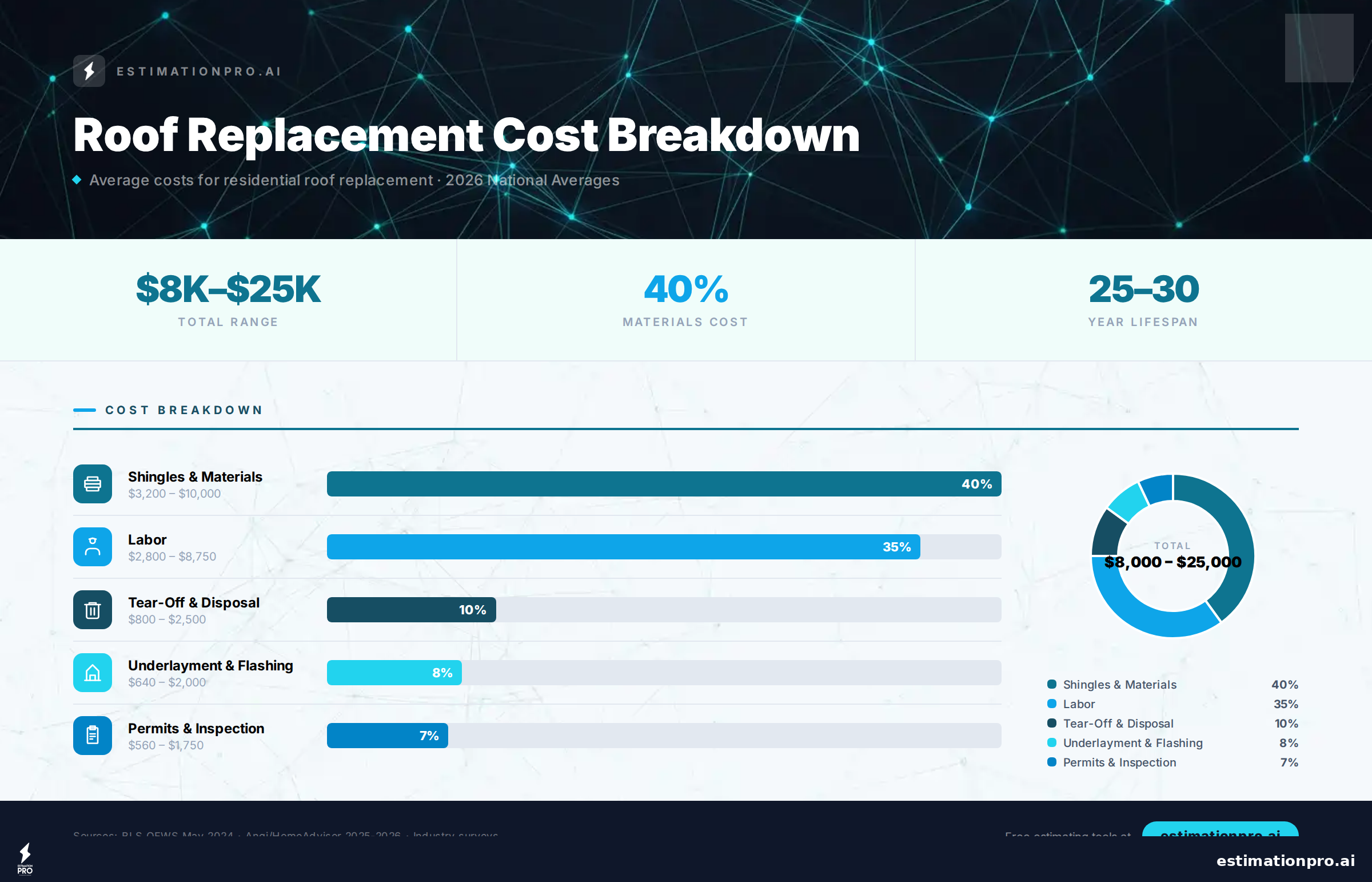
Share This Infographic
Feel free to share this infographic on your website. Just copy the embed code below:
Copy this embed code:
<a href="https://estimationpro.ai/tools/blog/cost-of-new-roof-estimate" target="_blank" rel="noopener">
  <img src="https://estimationpro.ai/tools/blog/infographics/cost-of-new-roof-estimate-infographic.png" alt="cost of new roof estimate infographic by EstimationPro.AI" style="max-width:100%;height:auto" loading="lazy" />
</a>
<p style="font-size:12px;color:#64748B;margin-top:8px">Source: <a href="https://estimationpro.ai/tools/blog/cost-of-new-roof-estimate">EstimationPro.AI</a></p>
What Drives the Price Up
Not every roof costs $10,000. Here’s what pushes the number higher.
Roof pitch matters more than most people realize. Anything above 8/12 requires additional safety equipment, harnesses, and slower production rates. A steep roof can add 20-40% to labor costs. I’ve seen crew productivity drop by half on a 12/12 pitch compared to a walkable 4/12.
Multiple layers of old shingles. Some homes have two or even three layers. Code in most areas limits you to two layers, so if there are already two up there, everything comes off. More layers means more labor, more dumpster weight, and more disposal fees.
Roof complexity. Dormers, valleys, skylights, chimneys, and multiple hip lines all slow the crew down and add flashing details. A simple gable roof with one ridge is the fastest job. A cut-up roof with six valleys and three dormers takes twice the labor.
Decking replacement. Rotten or damaged plywood sheathing runs $50-$100 per sheet installed (roughly $1.50-$3.00 per square foot). You won’t know the full extent until tear-off day. Budget for at least a few sheets.
Access and height. Two-story homes, tight lot lines, and landscaping that prevents equipment staging all add cost. If the crew can’t park the dump trailer next to the house, they’re carrying bundles farther and hauling debris by hand.
Worked Example 2: Two-Story Colonial (3,200 SF Roof, Metal)
This is a bigger job. Two stories, steeper pitch (8/12), and the homeowner wants standing seam metal. Premium material, premium labor.
| Line Item | Cost |
|---|---|
| Standing seam metal panels (32 sq × $400/sq) | $12,800 |
| Synthetic underlayment (32 squares × $35/sq) | $1,120 |
| Ice & water shield (valleys + eaves, 8 squares) | $480 |
| Metal roofing labor (32 squares × $350/sq) | $11,200 |
| Tear-off & disposal (32 squares × $130/sq) | $4,160 |
| Dumpster rental (2 loads) | $900 |
| Custom flashing, ridge caps, trim | $1,800 |
| Ridge vent (50 LF × $10/LF) | $500 |
| Pipe boots & penetration flashing | $350 |
| Permit | $400 |
| Total | $33,710 |
That’s $10.53 per square foot. Steep? Yes. But standing seam metal lasts 50+ years with almost zero maintenance, handles 150+ mph winds, and carries a Class A fire rating. Over the life of the roof, the cost per year is actually lower than asphalt.
Use our Shingle Calculator to compare asphalt material quantities, or check the Roof Square Footage Calculator if you need to measure before you bid.
Mistakes That Blow Up Your Roofing Budget
Skipping the roof inspection before bidding. Get up there. Walk it if the pitch allows. Check for soft spots, look at the flashing condition, count the existing layers. I’ve watched contractors bid from the driveway and regret it every time.
Ignoring ventilation. Proper intake and exhaust ventilation extends shingle life and prevents ice dams. Skipping ridge vent or soffit vents to save $300 is a false economy that voids most manufacturer warranties. Shingle manufacturers require specific ventilation ratios, and they will deny a claim if the attic doesn’t meet spec.
Forgetting the extras. Gutters ($7-$20/LF for aluminum), soffit and fascia repair ($6-$20/LF), and chimney flashing ($500-$1,800 per project) all add up. These aren’t optional if the existing components are failing. Putting new shingles over rotted fascia is like painting over rust.
Not matching the waste factor to the roof. Simple gable roofs need 10-12% waste. Cut-up roofs with valleys and hips need 15-20%. I’ve seen new contractors short-order material and then pay retail for the last 3 squares at the supply house. That eats your margin fast.
Bidding without a written scope. Every roofing estimate should list the material brand and line, the number of squares, what’s included in tear-off, disposal method, and warranty terms. Vague bids lead to disputes. Always.
Regional Pricing: Why Your Neighbor’s Quote Doesn’t Apply
Roofing costs vary by 25-40% depending on where you live. Labor is the biggest variable.
| Region | Typical Range (2,000 SF, Architectural) |
|---|---|
| Southeast | $7,000 - $11,000 |
| Midwest | $8,000 - $12,000 |
| Pacific Northwest | $9,000 - $14,000 |
| Northeast | $10,000 - $16,000 |
| West Coast (CA, HI) | $12,000 - $18,000 |
Based on BLS regional wage data for roofers (47-2181) and Angi 2026 project cost data. Actual costs depend on local material availability, permit fees, and demand.
These ranges assume a single tear-off layer and standard complexity. Add 15-25% for steep pitch, multiple layers, or complex roof geometry.
When to Repair Instead of Replace
Not every roof problem needs a full replacement. Here’s a quick decision framework.
Repair makes sense when:
- Damage is isolated to one section (storm, fallen branch)
- The roof is less than 15 years old with no widespread issues
- You’re patching fewer than 2-3 squares
- Repair cost is under 30% of full replacement cost
Replace makes sense when:
- Shingles are curling, cracking, or losing granules across the whole roof
- The roof is past 80% of its expected lifespan
- You’ve already done multiple patch repairs
- You’re selling the home and need full value from the inspection
Roof repair patches run $5-$20 per square foot depending on the scope. A small repair might cost $350-$1,500 total, which is a lot better than $10,000+ for a full replacement if the rest of the roof is solid.
Frequently Asked Questions
How long does a roof replacement take?
Most asphalt shingle roofs on a standard home take 1-3 days with a full crew (4-6 workers). Metal roofs take longer, typically 3-5 days, because the panel fabrication and fastening is more precise. Weather delays, steep pitch, and complex layouts add time.
Can I put new shingles over old ones?
Technically yes, if there’s only one existing layer and the decking is in good condition. But most contractors, myself included, recommend full tear-off. Layering hides problems, adds weight to the structure, and shortens the new shingle lifespan. The savings from skipping tear-off ($2,000-$3,000) rarely justify the trade-offs.
What’s the best roofing material for the money?
Architectural asphalt shingles offer the best balance of cost, durability, and appearance for most homeowners. They cost 15-25% more than 3-tab but last nearly twice as long, look better from the street, and carry stronger wind warranties. For long-term value and zero-maintenance goals, standing seam metal is hard to beat, but the upfront cost is 2-3x higher.
How many quotes should I get for a new roof?
Get at least 3 written estimates and compare them line by line. Make sure every bid covers the same scope: same material, same tear-off plan, same warranty terms. The cheapest bid usually leaves something out. My advice is to throw out the highest and lowest and look hard at the middle bids. Check licenses, insurance, and references before signing anything.
Does homeowner’s insurance cover a new roof?
Insurance typically covers roof damage from sudden events like storms, hail, or falling trees. It does not cover wear and tear, aging, or deferred maintenance. If a windstorm rips shingles off a 25-year-old roof, insurance might pay for the damaged section but not a full upgrade. File the claim before you start work, and get the adjuster out to inspect before any tear-off.
Get Your Roofing Estimate Right the First Time
A roof replacement is one of the biggest line items on any residential project. Getting the estimate wrong costs you money whether you’re the contractor or the homeowner. Use the numbers and examples in this guide to sanity-check any bid you’re writing or receiving.
Try EstimationPro free to build a complete roofing estimate with line items, labor rates, and material quantities. EstimationPro doesn’t just calculate the numbers - it generates a professional proposal and automatically follows up with the homeowner so you can win more of the bids you send out, instead of watching them go cold in someone’s inbox.
Average New Roof Cost (2,000 SF - Architectural Shingles)
New Roof Packages by Material
- 20-25 year warranty
- Basic wind rating
- Lowest upfront cost
- Standard flat appearance
- 30-50 year warranty
- Higher wind rating (130 mph)
- Dimensional look with better curb appeal
- Most popular choice nationwide
- 50+ year lifespan
- Class A fire rating
- Highest wind resistance
- Lowest long-term cost per year
Get Free Estimating Tips
Enter your email and we'll send you pro tips, cost data, and useful resources for contractors.
We'll send helpful resources and occasional tips. Unsubscribe anytime.
 EstimationPro AI For Contractors, By Contractors
 Price Every Job With Confidence
Stop second-guessing your numbers. EstimationPro AI builds accurate estimates from real cost data.