
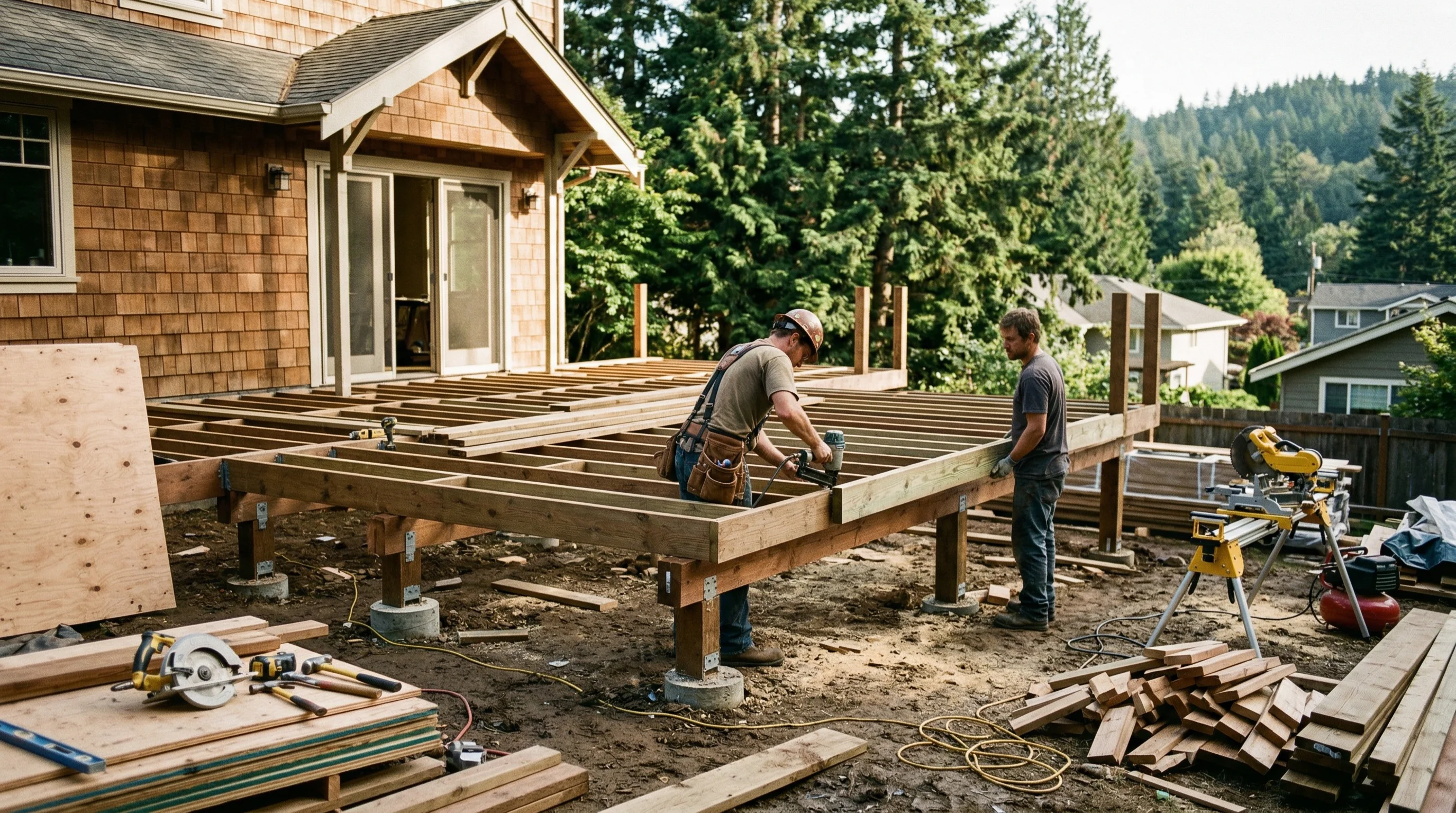
$4,200. That’s what I quoted last month to frame a basic 12x16 pressure-treated deck in the PNW. The homeowner expected half that number. He’d Googled “deck cost” and found prices for the whole project, not realizing that framing alone eats a huge chunk of the budget before a single deck board goes down.
Framing is the skeleton of your deck. Cut corners here and you’ll feel it every time someone walks across the surface. Get it right and the deck lasts 30 years without a bounce or a sag.
Quick Answer: What Does Deck Framing Cost?
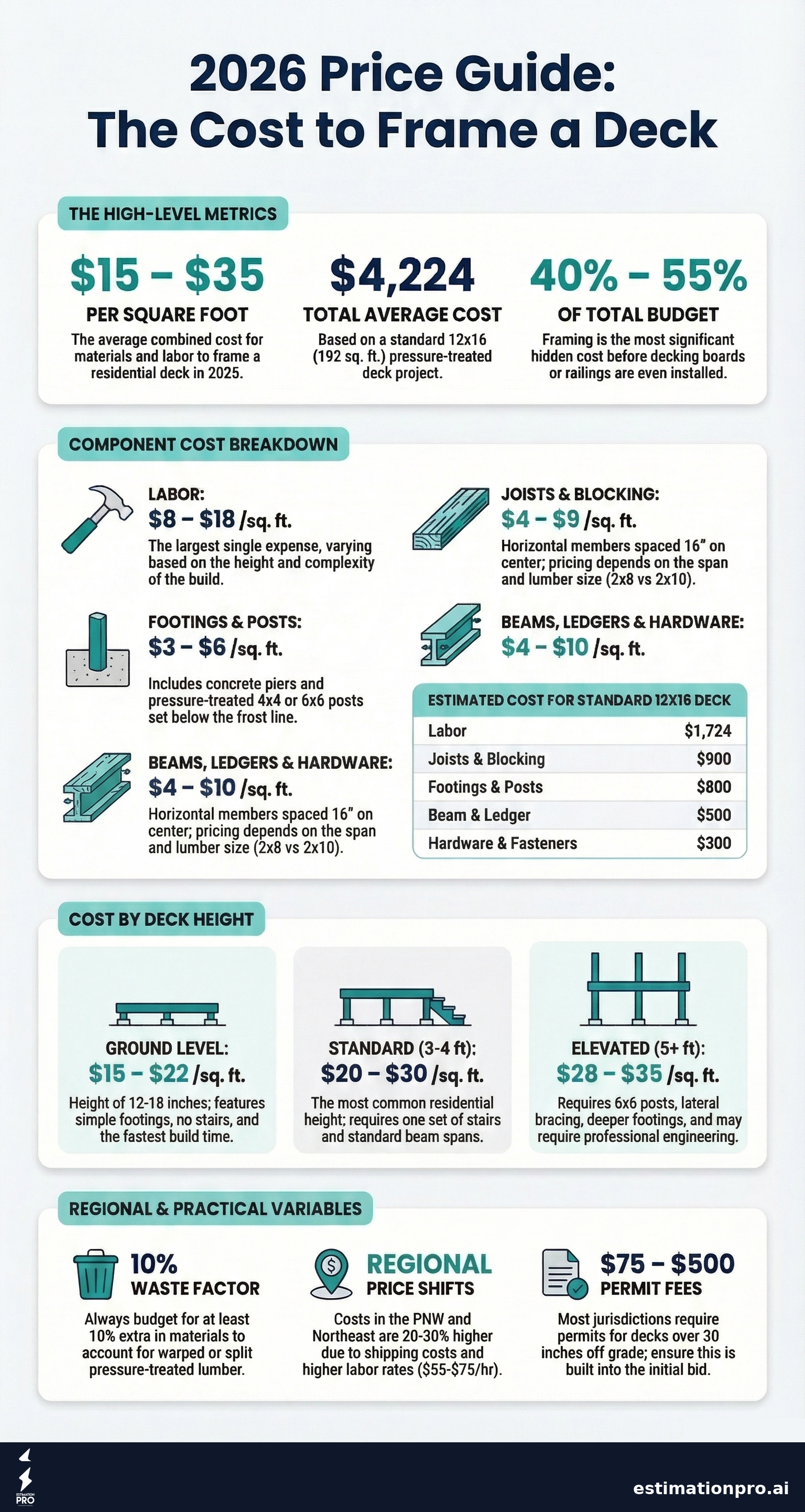
Deck framing runs $15-$35 per square foot for materials and labor combined. A standard 12x16 deck (192 sq ft) costs $2,880-$6,720 to frame, with most projects landing around $4,200. Height, soil conditions, and local lumber prices are the biggest variables. Ground-level decks sit at the low end. Elevated decks with deep footings push toward the top.
Use our Deck Cost Calculator to plug in your exact dimensions and get a full project estimate in minutes. Or Try EstimationPro free to build a detailed line-item bid you can hand to a client.
What Actually Goes Into a Deck Frame
Before you can price framing, you need to know what you’re building. A deck frame has five main components, and each one carries its own material and labor cost.
Footings and posts are your foundation. Concrete piers or Sonotubes set below the frost line, with post brackets and pressure-treated 4x4 or 6x6 posts. Footing depth depends on your local code - 12 inches in mild climates, 36-48 inches where the ground freezes hard.
The beam (or girder) sits on top of the posts and carries the load of the entire joist system. Most residential decks use doubled or tripled 2x10s or 2x12s, sometimes an LVL for longer spans.
The ledger board attaches the deck to the house. This connection is the single most failure-prone part of any deck. I’ve pulled off ledger boards that were lag-bolted into vinyl siding with no flashing behind them. Water gets in, the rim joist rots, and the whole deck eventually pulls away from the house. Proper ledger attachment with through-bolts or structural screws and Z-flashing is not optional.
Joists are the horizontal framing members that span from the ledger to the beam. Typically 2x8 or 2x10 pressure-treated lumber, spaced 16 inches on center. Wider joist spacing saves money but limits your decking options - composite boards usually need 12-inch or 16-inch spacing depending on the product. Use a Lumber Calculator to estimate board feet before you place your order.
Blocking, bridging, and hardware round it out. Joist hangers, post caps, rim board, and blocking at the beam connection. The hardware cost surprises a lot of DIYers. Simpson Strong-Tie connectors add up fast.
Framing Cost Per Square Foot: Full Breakdown
| Component | Cost Per Sq Ft | Notes |
|---|---|---|
| Footings & posts | $3 - $6 | Deeper footings = higher cost |
| Beam / girder | $2 - $4 | LVL beams cost more than built-up lumber |
| Ledger board + flashing | $1 - $3 | Includes hardware and lag screws |
| Joists (16” OC) | $4 - $9 | 2x8 vs 2x10, span determines size |
| Hardware & fasteners | $1 - $3 | Joist hangers, post caps, structural screws |
| Labor | $8 - $18 | Varies by height and complexity |
| Total | $15 - $35 | Materials + labor, no decking |
Sources: HomeGuide 2026 deck framing data, Angi 2026 deck cost guide, BLS 47-2031 carpenter wage data. For a broader framing estimate, try the Framing Cost Calculator.
Share This Infographic
Feel free to share this infographic on your website. Just copy the embed code below:
Copy this embed code:
<a href="https://estimationpro.ai/tools/blog/cost-to-frame-a-deck" target="_blank" rel="noopener">
  <img src="https://estimationpro.ai/tools/blog/infographics/cost-to-frame-a-deck-infographic.png" alt="cost to frame a deck infographic by EstimationPro.AI" style="max-width:100%;height:auto" loading="lazy" />
</a>
<p style="font-size:12px;color:#64748B;margin-top:8px">Source: <a href="https://estimationpro.ai/tools/blog/cost-to-frame-a-deck">EstimationPro.AI</a></p>
Worked Example #1: Ground-Level 12x16 Deck
This is the bread-and-butter residential deck. Attached to the house, 18 inches off the ground, pressure-treated framing.
| Line Item | Qty | Unit Cost | Total |
|---|---|---|---|
| Concrete footings (Sonotube, 12” dia) | 6 | $85 | $510 |
| 4x4 PT posts + post bases | 6 | $48 | $288 |
| 2x10 beam (doubled, 16 ft) | 2 | $62 | $124 |
| Ledger board (2x10 PT, 16 ft) | 1 | $38 | $38 |
| 2x10 PT joists, 12 ft @ 16” OC | 12 | $32 | $384 |
| Rim joist (2x10 PT, 16 ft) | 1 | $38 | $38 |
| Blocking (2x10 cutoffs) | - | - | $65 |
| Joist hangers + post caps + hardware | lot | - | $220 |
| Lag screws, bolts, flashing | lot | - | $95 |
| Materials subtotal | $1,762 | ||
| Labor (2 carpenters, 1.5 days) | 24 hrs | $65/hr | $1,560 |
| Waste factor (10%) | $176 | ||
| Total framing cost | $3,498 |
That’s about $18 per square foot. Ground-level is the cheapest because post heights are short, footings are shallow, and there’s no stair framing.
Worked Example #2: Elevated 16x20 Deck (4 ft Off Grade)
Now we’re talking real money. Bigger deck, taller posts, deeper footings, and a set of stairs.
| Line Item | Qty | Unit Cost | Total |
|---|---|---|---|
| Concrete footings (Sonotube, 12” dia, 36” deep) | 9 | $120 | $1,080 |
| 6x6 PT posts, 6 ft + post bases | 9 | $78 | $702 |
| 2x12 beam (doubled, 20 ft spans) | 2 | $95 | $190 |
| Ledger board (2x12 PT, 20 ft) | 1 | $58 | $58 |
| 2x10 PT joists, 16 ft @ 16” OC | 16 | $52 | $832 |
| Rim joist + blocking | - | - | $185 |
| Stair stringers (3 stringers, 4 ft rise) | 3 | $45 | $135 |
| All hardware (hangers, caps, brackets, bracing) | lot | - | $420 |
| Lag screws, bolts, flashing, misc | lot | - | $145 |
| Materials subtotal | $3,747 | ||
| Labor (2 carpenters, 3 days) | 48 hrs | $65/hr | $3,120 |
| Waste factor (10%) | $375 | ||
| Total framing cost | $7,242 |
That’s roughly $23 per square foot for 320 sq ft. The elevation adds cost at every step: deeper holes, taller posts, heavier beams, and more time on ladders.
5 Mistakes That Blow Your Deck Framing Budget
1. Skipping the soil test. I’ve dug footings in what looked like solid ground only to hit pure sand 18 inches down. One job in the PNW, we hit water at 24 inches after a week of rain. Had to switch from standard Sonotubes to helical piers. That change order was $2,800 the homeowner didn’t see coming.
2. Undersizing the beam. A beam that’s too small for the span will sag over time. I’ve seen decks where the builder used a single 2x8 to span 12 feet. It was bouncy the day it was built and worse five years later. The Joist Span Calculator helps you size members correctly before you order.
3. Ignoring the ledger connection. This is where decks fail. Lag bolts into rotted rim joist, no flashing, no through-bolts. The International Residential Code (IRC Section R507.9.1) requires either 1/2-inch lag screws or through-bolts in a specific pattern. Skipping this step doesn’t save money - it creates a liability.
4. Not accounting for waste and overage. Pressure-treated lumber comes with crowns, twists, and splits. Budget 10% waste for framing lumber. On longer joists (14 ft and up), I bump that to 12-15% because the longer the board, the more likely it’s warped.
5. Forgetting permit costs. Most jurisdictions require a permit for any deck over 30 inches off grade. Permit fees run $75-$500 depending on your area. The inspection adds a day to the schedule. Build it into the bid, not as a surprise.
What Drives Regional Price Differences
Deck framing costs vary by 20-30% across the country. The two biggest factors are lumber prices and labor rates.
According to Robert Dietz, Chief Economist at the National Association of Home Builders, labor shortages continue to push residential construction costs higher even as lumber futures have stabilized. The Bureau of Labor Statistics reports the median hourly wage for carpenters was $26.80 nationally in 2024, but that’s the base wage before burden. Once you add workers’ comp, FICA, insurance, and overhead, the fully burdened rate a contractor charges is typically $55-$75/hr.
Pacific Northwest and Northeast: Pressure-treated lumber is more expensive here because most PT lumber is Southern Yellow Pine shipped from the Southeast. Carpenter wages run $55-$75/hr. Expect $20-$35/sf for framing.
Southeast and Midwest: Lumber is cheaper because the mills are closer. Labor rates are lower. Framing runs $15-$25/sf.
Mountain West and High Altitude: Frost depth requirements push footing costs up. Some areas require 48-inch footings. Add $2-$5/sf just for the foundation work.
All pricing in this guide reflects 2026 national averages and may vary by location. Get local quotes for your specific project.
FAQ
How long does it take to frame a deck?
A two-person crew can frame a standard 12x16 ground-level deck in 1.5-2 days. Elevated decks (4+ ft) with stairs take 2.5-4 days depending on footing complexity and height. Add a day if the site needs grading or vegetation clearing before you start.
Can I frame a deck myself to save money?
You can, and plenty of homeowners do. Material cost runs $8-$15 per square foot without labor. But understand that the framing has to be square, level, and built to code. A failed inspection means rework. If you’re comfortable reading span tables and pulling permits, a DIY frame saves 40-50% of the total. If this is your first build, at minimum have a contractor review your plan.
What’s the difference between deck framing and deck building cost?
Framing is just the structural skeleton: footings, posts, beams, joists, ledger. The full “deck building” cost adds decking boards, railing, stairs with treads, and finish work on top. Framing typically represents 40-55% of the total deck project cost. A deck that costs $45/sf installed might have $22/sf in framing and $23/sf in decking, railing, and finishing.
Do I need engineered plans for a deck frame?
Most building departments require engineered plans for decks over a certain size or height. In many jurisdictions, any deck over 200 sq ft or 30 inches above grade needs a permit at minimum. Some require an engineer’s stamp for decks attached to the house. Check with your local building department before you dig.
Is pressure-treated lumber the only option for deck framing?
For most residential decks, yes. Pressure-treated Southern Yellow Pine or Doug Fir is the standard because it’s rated for ground contact and insect resistance. Cedar and redwood work but cost 2-3x more for framing members. Steel framing exists but is niche and runs $30-$50/sf for materials alone.
Build Your Next Deck Estimate in Minutes
Framing is where the structure lives or dies. Bid it right and you protect your margin. Bid it wrong and you’re eating costs on every joist hanger you forgot to include.
I built EstimationPro because I was tired of spending my evenings building estimates in spreadsheets when I could be with my family. It doesn’t just generate the estimate - it sends a professional proposal to the homeowner and automatically follows up so you don’t lose the job to a faster reply. Try EstimationPro free and see how fast you can turn a deck bid into a signed contract.
Pricing a job like this?
Get every line item priced for your area in a full estimate
Describe the job or snap a few photos. Send it from EstimationPro and it follows up with your client for you.
3 free estimates in the first 7 days. No credit card.
12x16 Deck Framing Cost Breakdown
Deck Framing Cost by Height
- Minimal post height (12-18 in.)
- Simple footing layout
- No stairs required
- Fastest build time
- 4x4 or 6x6 posts
- Standard beam span
- One set of stairs
- Most common residential height
- 6x6 posts required
- Deeper footings
- Lateral bracing needed
- Longer stair runs
- May require engineering
Get Free Estimating Tips
Enter your email and we'll send you pro tips, cost data, and useful resources for contractors.
We'll send helpful resources and occasional tips. Unsubscribe anytime.
 EstimationPro AI For Contractors, By Contractors
 Price Every Job With Confidence
Stop second-guessing your numbers. EstimationPro prices every line with labor and material rates adjusted for your region.