
I underbid a bathroom remodel by $4,200 in my third year. Missed the plumbing rough-in, forgot the dumpster, and priced labor like I was paying day-one helpers instead of licensed tradesmen. That job taught me more about estimating than any class ever could.
If you’re still winging estimates from memory or scratching numbers on the back of an envelope, you’re leaving money on the table. Here’s the process I use after 20 years of quoting residential work.
Quick Answer
Estimating a construction job means breaking the project into individual tasks, calculating materials and labor for each one, then adding overhead, profit, permits, and contingency on top. A solid residential estimate typically adds 15-35% for overhead and profit on top of direct costs, plus 10-15% contingency for unknowns. The process takes 30 minutes to several hours depending on project size.
Try EstimationPro free to build detailed, line-item estimates faster than spreadsheets.
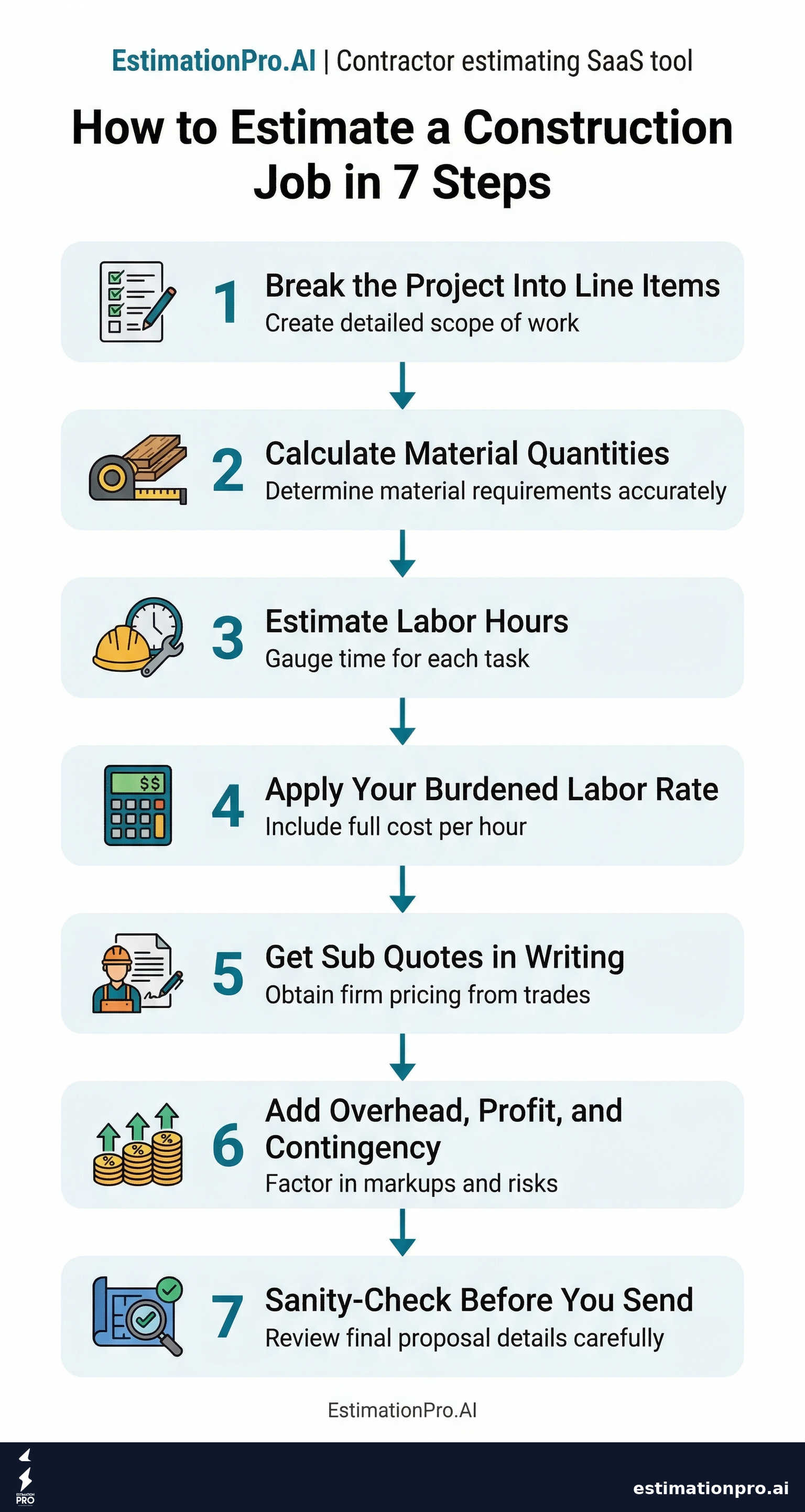
Share This Infographic
Feel free to share this infographic on your website. Just copy the embed code below:
Copy this embed code:
<a href="https://estimationpro.ai/tools/blog/estimate-construction-job" target="_blank" rel="noopener">
  <img src="https://estimationpro.ai/tools/blog/infographics/estimate-construction-job-infographic.png" alt="How to Estimate a Construction Job in 7 Steps infographic by EstimationPro.AI" style="max-width:100%;height:auto" loading="lazy" />
</a>
<p style="font-size:12px;color:#64748B;margin-top:8px">Source: <a href="https://estimationpro.ai/tools/blog/estimate-construction-job">EstimationPro.AI</a></p>
Walk the Job First. Always.
Never estimate from photos alone. Walk the site. Measure twice. Take photos of every wall, corner, transition, and potential problem area. Note the age of the house, condition of existing systems, and access issues that’ll slow down your crew.
I carry a voice recorder on every walkthrough now. Details you think you’ll remember, you won’t. That junction box behind the water heater? The uneven subfloor in the hallway? Record it or write it down.
The 7-Step Estimating Process
1. Break the Project Into Line Items
Don’t estimate “a bathroom remodel.” Estimate demo, plumbing rough-in, electrical rough-in, subfloor prep, waterproofing, tile installation, vanity install, painting, trim, and cleanup. Separately.
Each task gets its own line item with its own materials and labor. This is where most contractors go wrong - they lump things together and miss scope. A construction bid template can help you standardize your task breakdown so nothing slips through.
2. Calculate Material Quantities
For every line item, figure out what you need and how much:
- Measure the actual area. Don’t eyeball it.
- Add waste factor. 10% for standard cuts, 15% for diagonal or pattern work.
- Price at current supplier rates. Not last year’s numbers.
- Include fasteners, adhesives, and consumables. They add up faster than you’d expect.
Get actual supplier quotes for anything over $500. Material prices swing month to month, especially lumber and steel.
3. Estimate Labor Hours
Two approaches work here:
Production rate method: A two-man crew hanging drywall typically covers 40-60 sheets per day (about 1,920-2,880 sq ft). A tile setter might install 100-150 sq ft per day depending on tile size and layout. Know your crew’s production rates and calculate hours from there.
Historical method: Track actual hours on every job. After 5-10 jobs of the same type, you’ll have reliable data that no estimating book can match.
4. Apply Your Burdened Labor Rate
Here’s where new contractors bleed money. That $30/hr carpenter doesn’t cost you $30/hr. According to BLS employer cost data for construction workers, benefits and taxes add roughly 30% on top of base wages. FICA alone takes 7.65%. Workers comp in construction runs 10-25% depending on trade and claims history.
Your $30/hr carpenter actually costs $39-45/hr when fully burdened. Use the burdened labor rate calculator to get your real number.
5. Get Sub Quotes in Writing
For trades you don’t self-perform - plumbing, electrical, HVAC - get written quotes. Not verbal ballpark numbers. Written quotes with scope spelled out.
Mark up sub costs by 10-20% for your coordination, scheduling, and warranty liability. This is standard practice. Your subs expect it.
6. Add Overhead, Profit, and Contingency
Direct costs are just the starting point. You still need to cover the cost of running your business:
| Category | Typical Range | What It Covers |
|---|---|---|
| Overhead | 10-20% | Truck, insurance, office, tools, phone, license, accounting |
| Profit | 8-15% | Your actual take-home after all expenses |
| Permits | $500-$3,000 | Varies by project value and jurisdiction |
| Dumpster | $300-$700/week | 10-20 yard roll-off for demo and debris |
| Contingency | 10-15% | Unknown conditions, scope changes, price shifts |
According to Robert Dietz, Chief Economist at NAHB, builder overhead typically runs 18-22% of revenue based on their annual cost-of-doing-business surveys. If you’re not charging overhead, you’re subsidizing every job from your own pocket.
7. Sanity-Check Before You Send
Before handing over the estimate:
- Compare your total to similar past jobs
- Check your math on every line item
- Make sure you haven’t double-counted materials or labor
- Read the scope description from the homeowner’s perspective
- Calculate your effective hourly rate - if it comes out under $50/hr as a GC, something’s off
Worked Example: 12x12 Composite Deck
Here’s what a real estimate looks like with individual line items:
| Line Item | Materials | Labor (hrs) | Labor Cost | Total |
|---|---|---|---|---|
| Footings (6 piers) | $180 | 4 | $120 | $300 |
| Framing (joists, beam, ledger) | $1,400 | 12 | $360 | $1,760 |
| Decking (composite, 144 sq ft) | $1,800 | 8 | $240 | $2,040 |
| Railing (36 linear ft) | $720 | 6 | $180 | $900 |
| Hardware and fasteners | $285 | - | - | $285 |
| Direct costs | $5,285 | |||
| Overhead (18%) | $951 | |||
| Profit (12%) | $634 | |||
| Permit | $350 | |||
| Contingency (10%) | $529 | |||
| Total Estimate | $7,749 |
Labor priced at $30/hr burdened rate for a two-man crew. The $7,749 total comes out to about $53.80 per square foot for composite decking, which tracks with typical pricing in the Pacific Northwest.
Notice how overhead and profit alone add $1,585. Skip those line items and you’re working for free.
5 Estimating Mistakes That Eat Your Profit
1. Forgetting labor burden. This is the single most common mistake I see from newer contractors. A $25/hr worker costs $32-38/hr after taxes, insurance, and benefits. Miss that on a 200-hour job and you just gave away $1,400-$2,600 in profit.
2. Skipping the site visit. I’ve opened up “simple” bathroom walls and found knob-and-tube wiring, galvanized pipes, and zero insulation. Each one is a line item you didn’t quote.
3. Using old material prices. Lumber swung 40% in 18 months during the post-COVID supply chain mess. Get fresh quotes. Every time.
4. Not charging overhead. Your truck payment, insurance, tools, gas, phone, accounting, and license are real costs. They need to be in every single bid.
5. Pricing to win instead of pricing to profit. Lowballing to beat a competitor is a race to the bottom. Better to lose a bid than lose your shirt.
Worked Example: Bathroom Remodel Labor Breakdown
For a mid-range bathroom remodel, here’s how labor hours typically break down:
| Task | Hours | Rate | Cost |
|---|---|---|---|
| Demo (gut to studs) | 8 | $30/hr | $240 |
| Plumbing rough-in (sub) | - | flat bid | $2,800 |
| Electrical rough-in (sub) | - | flat bid | $1,200 |
| Subfloor and waterproofing | 6 | $30/hr | $180 |
| Tile (floor + shower, 120 sq ft) | 16 | $35/hr | $560 |
| Vanity and fixture install | 4 | $30/hr | $120 |
| Drywall and paint | 10 | $28/hr | $280 |
| Trim and finish | 6 | $30/hr | $180 |
| Total labor and subs | 50 hrs self-performed | $5,560 |
Add materials ($4,500-$8,000 depending on finish level), overhead, profit, permit, and contingency. A mid-range bathroom remodel typically lands between $15,000 and $30,000 total, consistent with NAHB remodeling cost surveys for a full gut-and-rebuild.
Fifty hours of self-performed labor plus two sub trades. Miss even one line item and you’re eating the cost yourself.
Frequently Asked Questions
How long does it take to estimate a construction job?
A single-trade job with small scope takes 30-60 minutes once you know your production rates. A full remodel with multiple trades runs 2-4 hours. If you’re spending longer than that, you need a better system or a standardized template.
What markup should a contractor charge?
Work it out from your own overhead rather than a rule of thumb: markup = 1 / (1 - (overhead % + profit %)), with both percentages taken of sales, not cost. That is why “10% overhead plus 10% profit” added to cost falls short. Michael Stone’s Markup & Profit gives minimum markups of 50-70% for remodeling, 35-50% for specialty trades and 26-40% for new homes. The markup calculator does the math from your numbers in about two minutes.
How do I handle unknown conditions?
Include a contingency line item of 10-15% on remodel work. New construction on a clean site, 5-8% is usually enough. Spell out in your contract what happens when surprises show up. A solid change order template keeps everyone on the same page when scope changes.
Should I show the client my line-item breakdown?
Yes. Detailed estimates build trust. When a homeowner sees exactly where every dollar goes, they stop comparing you to the lowball bid that leaves half the scope out. Transparency wins more jobs than a cheaper price.
What’s the fastest way to build accurate estimates?
Use a system. Whether that’s a spreadsheet with saved templates, estimating software, or an AI tool that generates line items from your project notes, anything beats starting from scratch every time.
Stop Spending Evenings on Estimates
Every hour you spend building bids is an hour you’re not on the jobsite or with your family. I built EstimationPro because I was tired of spending my evenings hunched over a laptop doing takeoffs.
EstimationPro doesn’t just build the estimate. It generates a professional proposal, sends it to the client, and follows up automatically so your leads don’t ghost you. Estimate, proposal, follow-up, invoice, paid. One platform. Try EstimationPro free and see how fast your next bid comes together.
Regional pricing note: All costs in this guide reflect 2026 national averages. Your actual costs will vary by region, material availability, and local labor markets. Get local quotes for accurate pricing in your area.
Pricing a job like this?
Get every line item priced for your area in a full estimate
Describe the job or snap a few photos. Send it from EstimationPro and it follows up with your client for you.
3 free estimates in the first 7 days. No credit card.
12x12 Composite Deck Estimate Breakdown
Get Free Estimating Tips
Enter your email and we'll send you pro tips, cost data, and useful resources for contractors.
We'll send helpful resources and occasional tips. Unsubscribe anytime.
 EstimationPro AI For Contractors, By Contractors
 Save 2+ Hours on Every Estimate
Upload photos, record voice notes, and get AI-powered estimates with line items, material lists, and regional pricing.