

$8,500. That’s what a 1,500 square foot flat roof replacement ran me last year on a small commercial building in the PNW - and the owner thought it would be half that.
Flat roofs are a different animal than pitched roofs. The materials, labor, failure modes, and drainage systems are nothing like what you deal with on a standard shingle job. I’ve seen contractors who do great work on pitched roofs completely underbid flat roof replacements because they don’t account for the differences.
This guide covers real costs for every major flat roof membrane type, with line-item breakdowns you can use to build your own estimates.
Quick Answer: What Does Flat Roof Replacement Cost?
A full flat roof replacement runs $4 to $12 per square foot installed, depending on the membrane type and your local market. For a typical 1,500 sq ft flat roof, expect to pay $6,000 to $18,000 total. TPO and EPDM sit at the lower end. PVC and multi-layer built-up systems push toward the top. Tear-off, disposal, insulation, and flashing add 30-40% beyond raw material and labor costs.
Try EstimationPro free to build a complete flat roof estimate with materials, labor, and overhead calculated automatically.
Why Flat Roofs Cost Different Than Pitched Roofs
Contractors who only quote pitched roofs sometimes assume flat roof work is simpler. It’s not. Here’s what changes:
- Drainage is everything. A pitched roof sheds water by gravity. A flat roof relies on tapered insulation, scuppers, or internal drains. If the drainage design is wrong, you get ponding water - and that voids most manufacturer warranties within the first year.
- Membrane seams are the weak point. Shingle overlaps are forgiving. Flat roof membrane seams need to be perfect. Heat-welded TPO and PVC seams are stronger than the membrane itself. Glued EPDM seams are not - and that’s where most leaks start.
- Insulation is part of the system. On a flat roof, rigid insulation board sits between the deck and the membrane. It provides R-value and creates the slope for drainage. You can’t skip it.
- Penetrations multiply risk. Every pipe, HVAC unit, vent, and curb on a flat roof needs custom flashing. More penetrations = more labor = more potential leak points.
Flat Roof Materials: Head-to-Head Cost Comparison
| Material | Cost Per Sq Ft (Installed) | Lifespan | Best For |
|---|---|---|---|
| EPDM (rubber) | $4 - $8 | 20-30 years | Budget projects, simple roofs |
| TPO | $5 - $10 | 20-30 years | Energy efficiency, commercial |
| Modified bitumen | $4 - $8 | 15-25 years | Cold climates, DIY-friendly |
| PVC | $6 - $12 | 25-35 years | Chemical exposure, restaurants |
| Built-up (BUR) | $5 - $10 | 20-30 years | Heavy foot traffic, mechanical loads |
Sources: HomeAdvisor 2025-2026 flat roof cost guide, Angi 2026 commercial roofing data, RSMeans 2026 commercial roofing section.
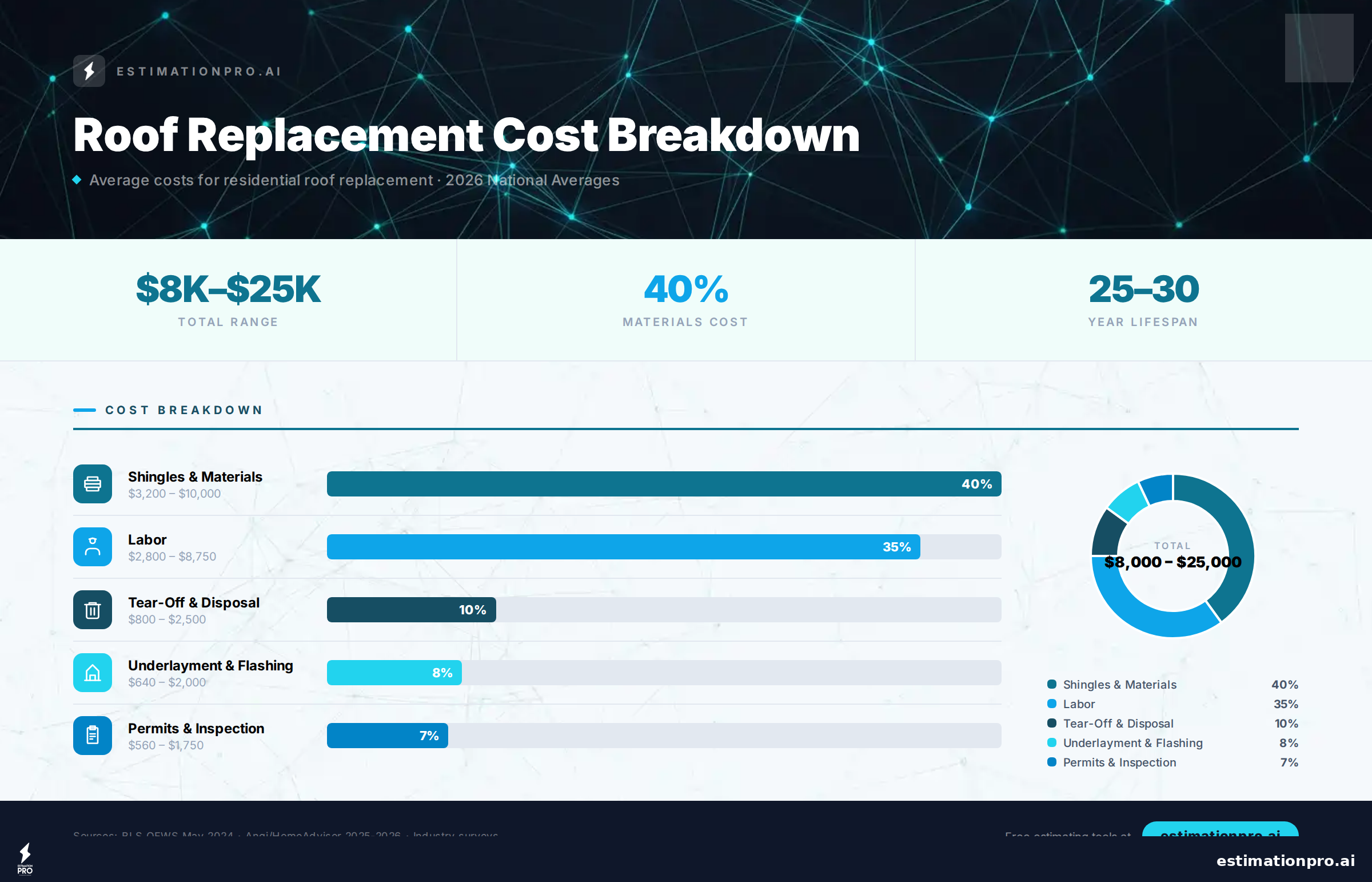
Share This Infographic
Feel free to share this infographic on your website. Just copy the embed code below:
Copy this embed code:
<a href="https://estimationpro.ai/tools/blog/flat-roof-replacement-estimate" target="_blank" rel="noopener">
  <img src="https://estimationpro.ai/tools/blog/infographics/flat-roof-replacement-estimate-infographic.png" alt="flat roof replacement estimate infographic by EstimationPro.AI" style="max-width:100%;height:auto" loading="lazy" />
</a>
<p style="font-size:12px;color:#64748B;margin-top:8px">Source: <a href="https://estimationpro.ai/tools/blog/flat-roof-replacement-estimate">EstimationPro.AI</a></p>
TPO has become the default for most commercial and residential flat roofs in the last decade. The heat-welded seams are the main reason. A properly welded TPO seam is stronger than the sheet itself. That’s not something you can say about glued EPDM seams.
Worked Example 1: Small Commercial Building (1,500 Sq Ft TPO)
Here’s a real breakdown for a 1,500 square foot flat roof on a single-story commercial building. One layer of existing membrane, no structural issues, standard number of penetrations.
| Line Item | Cost |
|---|---|
| Tear-off existing membrane + disposal | $2,250 |
| 60-mil TPO membrane (material) | $4,500 |
| Polyiso insulation board (R-20) | $3,000 |
| Edge metal, flashing, and termination bars | $1,500 |
| Installation labor (3-person crew, 3 days) | $5,250 |
| Permits and inspection | $500 |
| Total | $17,000 |
| Per square foot | $11.33 |
That $11.33 per square foot is on the higher end of the TPO range because this includes full insulation replacement and a clean tear-off. If the existing insulation is dry and in good shape, you can overlay and save $2,000-$3,000 on that line item.
Waste factor: I always figure 10-15% material overage on flat roofs. Membrane comes in rolls, and you lose footage to overlaps, corners, and penetration details. Order tight and you’ll be making a supply run mid-job. Not worth it.
Use the Roofing Calculator to dial in your square footage and material quantities before you start pricing.
Worked Example 2: Residential Garage With Flat Section (500 Sq Ft EPDM)
Not every flat roof job is a big commercial building. Residential flat sections over garages, additions, and porches are common - especially in older homes.
| Line Item | Cost |
|---|---|
| Tear-off existing rolled roofing + disposal | $500 |
| 45-mil EPDM membrane (material) | $1,250 |
| Polyiso insulation board (R-15) | $750 |
| Drip edge and termination | $400 |
| Installation labor (2-person crew, 1 day) | $1,600 |
| Caulking and sealant for 3 penetrations | $150 |
| Total | $4,650 |
| Per square foot | $9.30 |
Smaller flat roof sections have a higher per-square-foot cost than larger ones. The mobilization, setup, and edge detail work eat up a bigger percentage of the total. That’s normal and something to explain to the homeowner upfront so they don’t compare your per-foot price to a 10,000 sq ft commercial bid they saw online.
The Tear-Off Question: Overlay vs. Full Replacement
This decision affects cost by 20-30%, so it matters.
When to overlay (install new membrane over existing):
- Existing membrane is a single layer
- Deck sheathing and insulation are dry and solid
- No ponding water issues
- Local code allows it (most limit to 2 layers)
When to tear off completely:
- Multiple existing layers
- Wet or compressed insulation (check with a core cut or moisture scan)
- Ponding water problems that need slope correction
- Structural concerns with added weight
A full tear-off on a 1,500 sq ft roof adds $1,500 to $3,000 in labor and disposal costs. But if the insulation underneath is wet, overlaying is a waste. You’re trapping moisture between two membranes. I’ve pulled back overlays and found the insulation underneath was basically a sponge. That’s a callback you don’t want.
What Most Contractors Get Wrong on Flat Roof Bids
I’ve reviewed enough flat roof bids - both my own early ones and from other contractors - to know where the mistakes happen:
-
Forgetting tapered insulation. If the existing roof ponds water, the new membrane will too unless you add tapered insulation to create slope. This adds $1.50-$3.00 per square foot that wasn’t in the original estimate. Factor it in or call it out as an allowance.
-
Underestimating penetration flashing time. Every HVAC unit, pipe, and vent needs custom flashing boots or field-fabricated details. On a commercial roof with 15+ penetrations, this can add a full day of labor. Budget 30-60 minutes per penetration for a two-person crew.
-
Not accounting for edge detail. Flat roofs need proper termination at every edge - coping caps, drip edge, or termination bars with sealant. This isn’t optional. It’s where wind uplift pulls the membrane loose first.
-
Bidding material only. A homeowner sees “$5 per square foot for TPO” online and thinks that’s the total cost. The material is maybe 30% of the installed price. Make sure your estimate shows every line item so the client understands what they’re paying for.
-
Skipping the moisture scan. Before you bid a re-roof, you need to know the condition of what’s underneath. An infrared moisture scan or core samples cost $200-$500 but can save you from discovering a soaked deck after you’ve already torn off the membrane.
Regional Pricing Differences
Flat roof costs vary significantly by region. Labor rates, material availability, and climate requirements all play a role.
| Region | Typical Cost Per Sq Ft (Installed) | Notes |
|---|---|---|
| Pacific Northwest | $6 - $12 | High moisture requirements, vapor barriers critical |
| Southeast | $4 - $9 | Lower labor, less insulation needed |
| Northeast | $7 - $13 | Freeze-thaw demands, higher R-value requirements |
| Southwest | $5 - $10 | UV degradation is the main enemy, reflective membranes preferred |
| Midwest | $5 - $11 | Wide temperature swings, expansion/contraction stress |
These are general ranges based on BLS regional wage data and HomeAdvisor 2025-2026 regional cost indices. Your local market may differ. Always verify with local suppliers and subs.
Energy code requirements also vary. In the PNW, I need at least R-30 in the roof assembly for most commercial applications. That means more insulation board, which adds $1-$2 per square foot compared to a region that only requires R-20.
Check the Roof Replacement Cost Guide for a more detailed breakdown by your specific roof type and region.
When to Replace vs. Repair a Flat Roof
Not every flat roof needs full replacement. Here’s my rule of thumb:
- Repair if the damage is localized (less than 25% of the roof area), the membrane is under 15 years old, and the insulation is dry. Budget $5-$20 per square foot for repairs, according to Angi’s 2026 roof repair cost guide.
- Replace if you’re seeing widespread blistering, multiple active leaks, ponding in more than one area, or the membrane is past its expected lifespan. Patching a failing roof is throwing money away.
- Coat as a mid-life option. Elastomeric roof coatings ($2-$4 per sq ft applied) can extend an existing flat roof by 8-12 years if the substrate is sound. Good option when the membrane still has life but needs UV protection.
FAQ
How long does a flat roof replacement take?
A 1,500 sq ft flat roof typically takes 2-4 days with a 3-person crew. Tear-off is usually day one, insulation and membrane go down on days two and three, and detail work finishes on day three or four. Weather delays are the biggest variable - you cannot install most flat roof membranes in rain or below 40°F.
Is TPO or EPDM better for a flat roof?
TPO is the better choice for most projects in 2026. The heat-welded seams are significantly more reliable than EPDM’s glued seams, and the white reflective surface reduces cooling costs. EPDM still makes sense for budget-constrained projects or roofs where aesthetics don’t matter, since it runs $1-$2 per square foot less than TPO installed.
Can I install a flat roof membrane myself?
EPDM and modified bitumen are the most DIY-friendly options since they use adhesive or torch application. TPO and PVC require a hot-air welder ($3,000-$5,000 to buy, or $200-$400/week to rent) and significant practice to weld properly. Bad welds are the number one cause of flat roof leaks. For anything over a small porch or shed roof, hire a qualified commercial roofer.
Does insurance cover flat roof replacement?
Insurance typically covers damage from specific events - hail, wind, fallen trees - but not wear and tear or neglect. If your flat roof failed due to age, ponding, or deferred maintenance, that’s on you. Document storm damage with photos and file the claim promptly. Most policies have a depreciation schedule, so an older roof gets a smaller payout.
How often should a flat roof be inspected?
Twice a year minimum - spring and fall. After any major storm. And before winter in cold climates. Catching a small seam separation early costs $200 to fix. Ignoring it until water reaches the interior can cost $5,000-$10,000 in roof repairs plus interior damage. Regular inspections are the cheapest maintenance you can do.
Build Your Flat Roof Estimate the Right Way
If you’re also bidding pitched roof work alongside flat sections, check out our guide on roofing labor cost per square for shingle pricing benchmarks.
Flat roofs reward detailed estimating more than any other roof type. The material choices, insulation requirements, drainage design, and penetration details all affect the final number. Miss one line item and you’re eating the cost.
EstimationPro handles flat roof estimates the same way it handles everything else - you feed in the project details, and it builds the full estimate with materials, labor, overhead, and profit already calculated. Then it generates a professional proposal and sends automated follow-up sequences to the homeowner so you’re not chasing callbacks. The whole workflow from estimate to signed contract happens without you spending your evening on spreadsheets. Try EstimationPro free and see how fast you can turn a flat roof bid around.
Pricing a job like this?
Get every line item priced for your area in a full estimate
Describe the job or snap a few photos. Send it from EstimationPro and it follows up with your client for you.
3 free estimates in the first 7 days. No credit card.
1,500 Sq Ft Flat Roof Replacement (TPO)
Flat Roof Material Comparison
- 20-30 year lifespan
- Lowest upfront cost
- Black membrane absorbs heat
- Seams glued or taped
- Best for budget-conscious projects
- 20-30 year lifespan
- White membrane reflects heat
- Heat-welded seams (strongest)
- Energy Star rated
- Most popular for commercial
- 25-35 year lifespan
- Chemical and grease resistant
- Heat-welded seams
- Best near restaurants or kitchens
- Highest material cost
Get Free Estimating Tips
Enter your email and we'll send you pro tips, cost data, and useful resources for contractors.
We'll send helpful resources and occasional tips. Unsubscribe anytime.
 EstimationPro AI For Contractors, By Contractors
 Price Every Job With Confidence
Stop second-guessing your numbers. EstimationPro prices every line with labor and material rates adjusted for your region.