
Most homeowners get one, maybe two roofing quotes and have no real idea if the numbers are fair. Roofing contractors know this. Some use it to their advantage.
After 20 years in the trades, I’ve seen the full spectrum. I’ve looked at jobs where the low bid was missing half the scope, and I’ve watched homeowners get taken for a ride because they couldn’t read an estimate. This guide gives you the real numbers, the line items that matter, and the questions you should be asking before anyone gets on your roof.
Quick Answer
Shingle roof replacement costs between $8,000 and $25,000 for a typical 1,500-2,500 sq ft home in 2026. Architectural asphalt shingles on a standard pitch roof run $1.50-$3.50 per sq ft installed, all-in. Add $0.50-$1.50/sq ft for tear-off. Labor is 40-60% of the total. Regional pricing, pitch, and number of layers being torn off move that number significantly.
Shingle Type Cost Breakdown
The biggest variable is the shingle itself. There’s a wide range, and the middle option is what most residential roofers actually install day-to-day.
| Shingle Type | Material Cost | Installed Cost | Expected Lifespan |
|---|---|---|---|
| 3-Tab Asphalt | $0.60-$1.20/sq ft | $1.00-$2.00/sq ft | 15-20 years |
| Architectural (Dimensional) | $0.90-$1.80/sq ft | $1.50-$3.50/sq ft | 25-30 years |
| Impact-Resistant Architectural | $1.40-$2.20/sq ft | $2.00-$4.00/sq ft | 25-30 years |
| Premium/Designer | $2.00-$4.00/sq ft | $3.00-$6.00/sq ft | 30-50 years |
Architectural shingles are the standard now. Most contractors won’t bid 3-tab anymore because the manufacturer warranties are weaker and they don’t hold up as well. The upgrade from 3-tab to architectural is usually $1,500-$3,000 on a whole-roof replacement, and the lifespan difference makes it worth it almost every time.
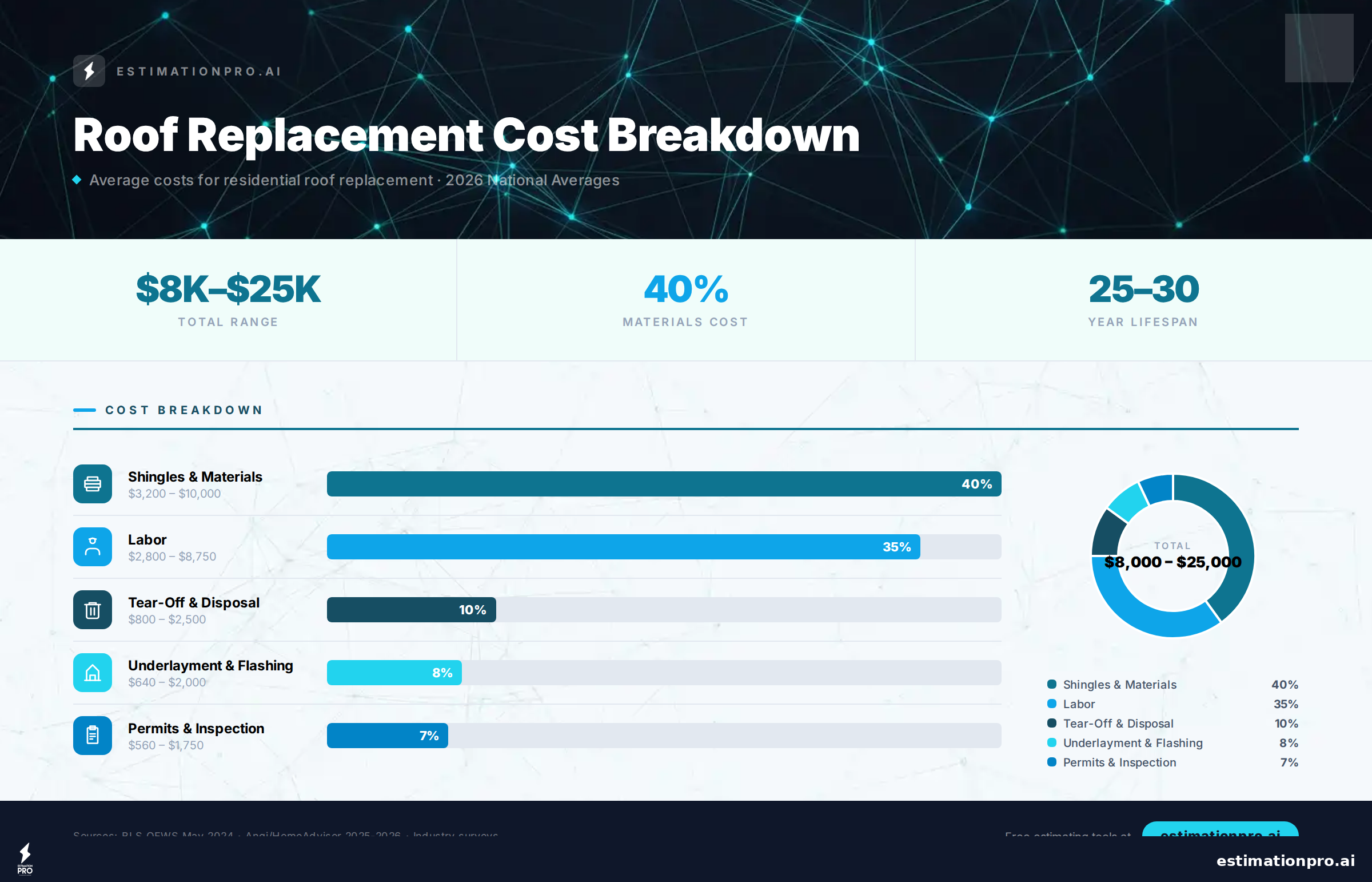
Share This Infographic
Feel free to share this infographic on your website. Just copy the embed code below:
Copy this embed code:
<a href="https://estimationpro.ai/tools/blog/shingle-roof-cost" target="_blank" rel="noopener">
  <img src="https://estimationpro.ai/tools/blog/infographics/shingle-roof-cost-infographic.png" alt="shingle roof cost infographic by EstimationPro.AI" style="max-width:100%;height:auto" loading="lazy" />
</a>
<p style="font-size:12px;color:#64748B;margin-top:8px">Source: <a href="https://estimationpro.ai/tools/blog/shingle-roof-cost">EstimationPro.AI</a></p>
What Goes Into the Full Cost
Shingles are only part of the bill. A properly scoped roof replacement includes all of this:
Tear-off and disposal
- Single layer: $0.50-$0.80/sq ft
- Two layers: $0.85-$1.20/sq ft
- Three layers (often illegal to add a fourth): $1.20-$1.50/sq ft
Underlayment
- #15 or #30 felt: $0.15-$0.25/sq ft
- Synthetic underlayment: $0.25-$0.50/sq ft
- Ice and water shield (eaves, valleys, penetrations): $1.00-$2.00/linear ft
Decking repairs
- Replacing damaged sheathing: $60-$90 per sheet installed (4x8)
- This is one you can’t price without seeing it. Budget a contingency.
Flashing
- Step flashing (chimney, dormers): $15-$25/linear ft
- Valley flashing: $10-$18/linear ft
- Pipe boots: $50-$150 each
Ventilation
- Ridge vent: $3-$6/linear ft installed
- Box vents: $50-$100 each installed
Waste factor and overage Standard waste factor for a simple gable roof is 10%. Hip roofs, roofs with dormers, lots of valleys and penetrations - plan for 15-20% waste. Some contractors order at 12% as a default. If they’re ordering short to save a few bucks on materials, you’ll find out when they run out on day two.
Worked Example 1: Standard 2,000 Sq Ft Ranch
Take a single-story ranch with a 2,000 sq ft footprint, 4/12 pitch, single-layer tear-off, architectural shingles. Here’s how the bid breaks down:
Roof area (with 1.1 pitch factor at 4/12): ~2,200 sq ft Add 10% waste: 2,420 sq ft ordered
| Line Item | Unit Cost | Total |
|---|---|---|
| Architectural shingles (materials) | $1.20/sq ft | $2,904 |
| Underlayment (synthetic) | $0.35/sq ft | $847 |
| Ice and water shield (60 LF eaves) | $1.50/LF | $90 |
| Tear-off, single layer | $0.65/sq ft | $1,430 |
| Flashing (valley + 2 pipe boots) | allowance | $450 |
| Ridge vent (60 LF) | $4.50/LF | $270 |
| Dump fees | flat | $350 |
| Labor (install) | $70/square x 22 sq | $1,540 |
| Total | $7,881 |
Real-world total for this job: $8,000-$10,500 depending on market, contractor overhead, and any deck repairs found during tear-off. That “contingency” for deck repairs is real - I’ve pulled shingles on what looked like a straightforward job and found three sheets of rotted OSB hiding underneath. Budget it.
Worked Example 2: Steeper Pitch with Multiple Layers
Now take a two-story colonial with a 2,400 sq ft footprint, 8/12 pitch, two layers being torn off, and a chimney. Pitch factor at 8/12 is 1.30. Things get more expensive.
Roof area (with 1.30 pitch factor): ~3,120 sq ft Add 15% waste (hips, chimney): 3,588 sq ft ordered
| Line Item | Unit Cost | Total |
|---|---|---|
| Architectural shingles (materials) | $1.20/sq ft | $4,306 |
| Underlayment (synthetic) | $0.35/sq ft | $1,256 |
| Ice and water shield (80 LF) | $1.50/LF | $120 |
| Two-layer tear-off | $1.00/sq ft | $3,120 |
| Chimney flashing (step + counter) | allowance | $850 |
| Pipe boots (3) | $90 each | $270 |
| Ridge vent (70 LF) | $4.50/LF | $315 |
| Dump fees (two loads) | flat | $600 |
| Labor - steep pitch adder (+30%) | $91/sq x 31 sq | $2,821 |
| Contingency - deck repairs (est.) | allowance | $500 |
| Total | $14,158 |
This job realistically prices out at $14,000-$18,000. That two-layer tear-off and the pitch are what push it. Steep roofs take longer, are harder on crews, and need more safety rigging. The dump fees on a two-layer tear-off are no joke either - you’re hauling off a lot of dead weight.
For a quick gut-check on your own project, the roofing calculator will get you a ballpark based on your square footage and shingle choice.
Where Contractors Cut Corners (And How to Spot It)
This is where I’ll tell you what some contractors won’t.
Short-loading shingles. A job calls for 36 squares of material. Contractor orders 33, hoping the math works out. It doesn’t. You end up with mismatched shingles from a second order or seams in wrong spots. Always ask: how many squares did you order and what’s your waste factor?
Skipping ice and water shield. In warmer climates some contractors skip it entirely, or only run one course at the eaves. Per code in most markets, you need it at eaves, in valleys, and around all penetrations. If it’s not in the bid, ask why.
Reusing old flashing. Old step flashing around a chimney should come off with the old roof. Some contractors just shingle over it. That’s a future leak waiting to happen, and when it leaks, you can’t prove it was their fault.
Skinny dump fees. If the quote shows $150 for dump fees on a full tear-off, something is off. A single-layer tear-off on a 2,000 sq ft roof generates 4,000-6,000 lbs of debris. Legitimate disposal on that is $300-$600+, sometimes more if they’re hauling to a landfill charging by weight.
Short-load fees. If the job needs a partial delivery - say you’re 5 squares short - some distributors charge a short-load fee of $75-$200. You won’t hear about it unless you ask. Good contractors bake this into their contingency.
Regional Pricing Disclaimer
These numbers reflect national averages based on 2026 material and labor costs. What you actually pay depends heavily on where you live. Labor markets in Seattle, San Francisco, and New York run significantly higher than rural markets in the Midwest or South. Material costs also vary by region and by how far the distributor has to haul.
If you’re in the Pacific Northwest, expect pricing at the higher end of these ranges. Our labor market, disposal costs, and material freight all push things up. A job that quotes $10,000 in Kansas might be $14,000 here for the exact same scope.
Get local bids. These numbers tell you if a bid is in the ballpark. Local contractors set the actual floor.
What Actually Drives Your Final Number
In order of impact:
- Pitch - Low-slope (4/12 and under) is the easiest to work. Above 8/12, expect a 25-40% labor premium. Above 12/12, some crews won’t touch it without specialized rigging.
- Number of layers being torn off - One layer is standard. Two layers roughly doubles tear-off cost. Three layers (if even allowed by code) is a big job.
- Roof complexity - Lots of hips, valleys, dormers, skylights, and chimneys add time, material waste, and flashing labor.
- Shingle choice - Architectural over 3-tab is the jump most people make. Premium designer shingles are a different category entirely.
- Deck condition - You won’t know until tear-off. Budget a deck repair contingency.
- Accessibility - Second story, steep grade around the house, tight lot. Anything that makes it harder to stage materials and move a crew costs more.
For a detailed breakdown of roofing material quantities and how to calculate what you need before you call a contractor, see how to estimate a roofing job.
Frequently Asked Questions
How much does a shingle roof cost per square foot?
Architectural asphalt shingles run $1.50-$3.50 per sq ft installed, including tear-off and underlayment. A simple low-pitch job lands near the bottom of that range. A steep, complex roof with multiple tear-off layers pushes toward the top or past it.
What’s the difference between 3-tab and architectural shingles in terms of cost?
Architectural shingles add roughly $0.50-$1.50 per sq ft over 3-tab, all-in. On a 2,000 sq ft roof, that’s an $1,000-$3,000 upgrade. Given the lifespan difference (15-20 years vs 25-30 years) and the stronger manufacturer warranties, it’s a worthwhile spend on most re-roofs.
Does tear-off always cost extra?
Yes. Tear-off and disposal is priced separately from installation. Expect $0.50-$0.80/sq ft for a single-layer tear-off, $0.85-$1.20 for two layers. Some contractor bids bundle it in - that’s fine, but make sure it’s actually in the scope. Ask directly: is tear-off and dump fees included in this number?
How many layers of shingles can you have?
Most building codes allow two layers maximum. Some older homes already have two layers, which means the next re-roof requires a full tear-off to bare deck before anything new goes on. Three-layer installs are generally not code-compliant, and some insurers won’t cover a roof with multiple layers.
Why do roofing bids vary so much?
Scope differences, mostly. One bid might include new flashing throughout; another assumes you keep the old. One contractor factors in a deck repair contingency; another ignores it and hits you with a change order later. When bids are far apart, ask each contractor to walk through their line items. The gap usually becomes obvious fast.
Getting Your Estimate Right
Roofing is one of those trades where the gap between a cheap bid and an honest bid can look like $3,000-$5,000 but actually represent tens of thousands in future repairs if the cheaper job cuts corners on flashing, underlayment, or disposal.
I built EstimationPro because contractors needed a faster way to produce accurate bids, and homeowners needed a way to understand what they were looking at. You can take photos of your roof, add notes, and get a professional-grade estimate in minutes at estimationpro.ai. It won’t replace a site visit and a signed contract, but it’ll tell you fast if the quote on your kitchen table is reasonable or way off.
Measure twice, cut once. Same applies to roofing bids.
Get Free Estimating Tips
Enter your email and we'll send you pro tips, cost data, and useful resources for contractors.
We'll send helpful resources and occasional tips. Unsubscribe anytime.
 EstimationPro AI For Contractors, By Contractors
 Create Detailed Estimates in Minutes, Not Hours
Upload photos, record voice notes, and get AI-powered estimates with line items, material lists, and regional pricing.