
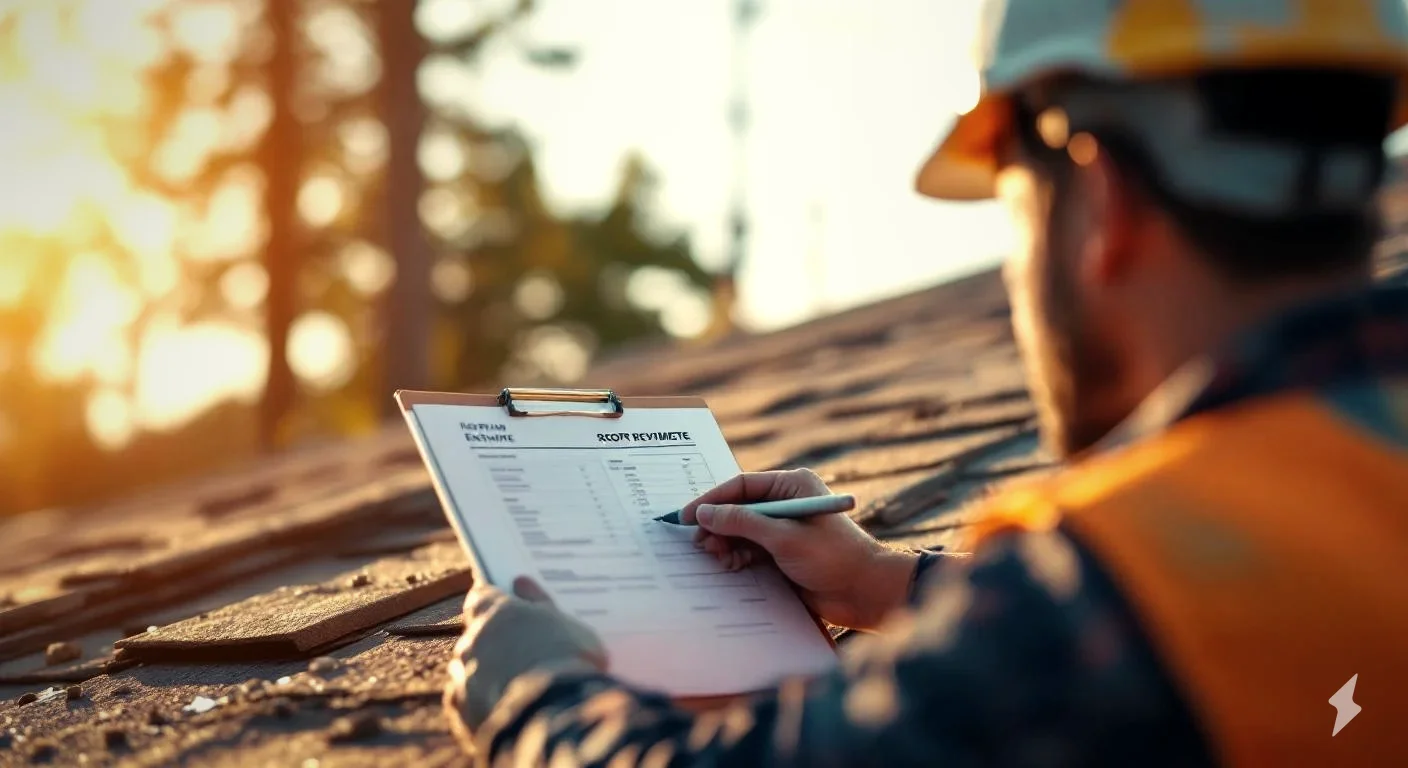
$1,400. That’s what I quoted last month for a roof leak repair on a 1990s split-level in Tacoma. The homeowner had gotten three other bids ranging from $600 to $3,200. She was confused, and honestly, I don’t blame her. The spread was that wide because two of those contractors never got on the roof.
A good roof repair estimate starts with boots on the roof, not a guess from the driveway. If you’re a contractor building estimates for repair work, getting the scope right is the difference between profit and a callback that eats your margin. If you’re a homeowner trying to understand what you’re paying for, this guide shows you exactly what should be in that estimate.
Quick Answer
A typical roof repair estimate covers inspection, material costs ($5-$20 per square foot for patches), labor ($150-$500 per roofing square), and overhead. Most minor repairs land between $350 and $1,500. The estimation process itself takes 30-60 minutes on site when done right, including the roof inspection, measurements, and scope documentation.
Try EstimationPro free to build detailed roof repair estimates in minutes instead of hours.
What Makes Roof Repair Estimates Tricky
Roof repairs are not like full replacements. A replacement is mostly math - measure the roof, pick the material, calculate squares, add labor. Repairs are detective work. You’re trying to figure out where water is getting in, how far the damage has spread, and what it’ll take to stop it permanently.
Here’s what catches contractors off guard:
- Water travels. The leak in the ceiling is almost never directly below the entry point on the roof. Water follows rafters, sheathing seams, and nail holes before it drips through drywall. I’ve traced leaks 15 feet from where the homeowner pointed.
- Hidden damage. You won’t know the full scope until you pull shingles back. Rotten decking, compromised underlayment, rusted flashing - all invisible from the surface.
- Code triggers. In some jurisdictions, repairing more than a certain percentage of the roof triggers a permit or even a full re-roof requirement. Know your local codes before you quote.
Step 1: Roof Inspection and Damage Assessment
Get on the roof. No exceptions. A ground-level inspection with binoculars misses half the problems.
What to check and document:
- Damaged shingles - Count them. Note whether they’re cracked, curled, missing, or wind-lifted. Take photos of each area.
- Flashing condition - Check every penetration: chimney, vents, pipes, skylights, valleys. Flashing failure causes more leaks than shingle damage.
- Decking condition - Walk the area carefully. Soft spots mean rotten sheathing underneath.
- Gutter and drip edge - Damaged gutters and missing drip edge let water back up under the starter course.
- Interior damage - Check the attic from inside. Water stains on sheathing or rafters tell you the real story.
Measurement tip: Sketch the damaged area with dimensions. For patch work, measure in square feet. For sections, measure in roofing squares (1 square = 100 sf). Use a roof area calculator if you need to convert pitch-adjusted measurements.
Step 2: Define the Scope of Work
This is where most bad estimates go wrong. Write down every task, not just “fix the leak.”
A proper scope for a standard shingle repair includes:
- Remove damaged shingles and underlayment in the affected area
- Inspect and replace damaged decking (if found)
- Install new underlayment (ice and water shield in leak-prone areas)
- Install matching shingles
- Repair or replace flashing at any penetrations in the repair zone
- Seal all exposed nail heads
- Clean up debris and haul off old materials
If you skip the scope document, you’ll end up doing work you didn’t price. Every experienced roofer has eaten a $300 decking repair because they assumed the sheathing was fine and didn’t include a contingency line.
Step 3: Price Out Materials
Material costs depend on what you’re replacing. Here are 2026 material ranges from industry data:
| Material | Unit | Price Range | Typical |
|---|---|---|---|
| 3-tab shingles | per square | $70 - $200 | $100 |
| Architectural shingles | per square | $100 - $250 | $150 |
| Roof patch (shingles + underlayment) | per sq ft | $5 - $20 | $11 |
| Chimney flashing (step + counter) | per project | $500 - $1,800 | $950 |
| Ridge vent | per linear foot | $4 - $12 | $7 |
| Soffit/fascia replacement | per linear foot | $6 - $20 | $12 |
Sources: Angi 2026 roofing guides, HomeAdvisor 2025-2026, HomeGuide 2026. Prices vary by region.
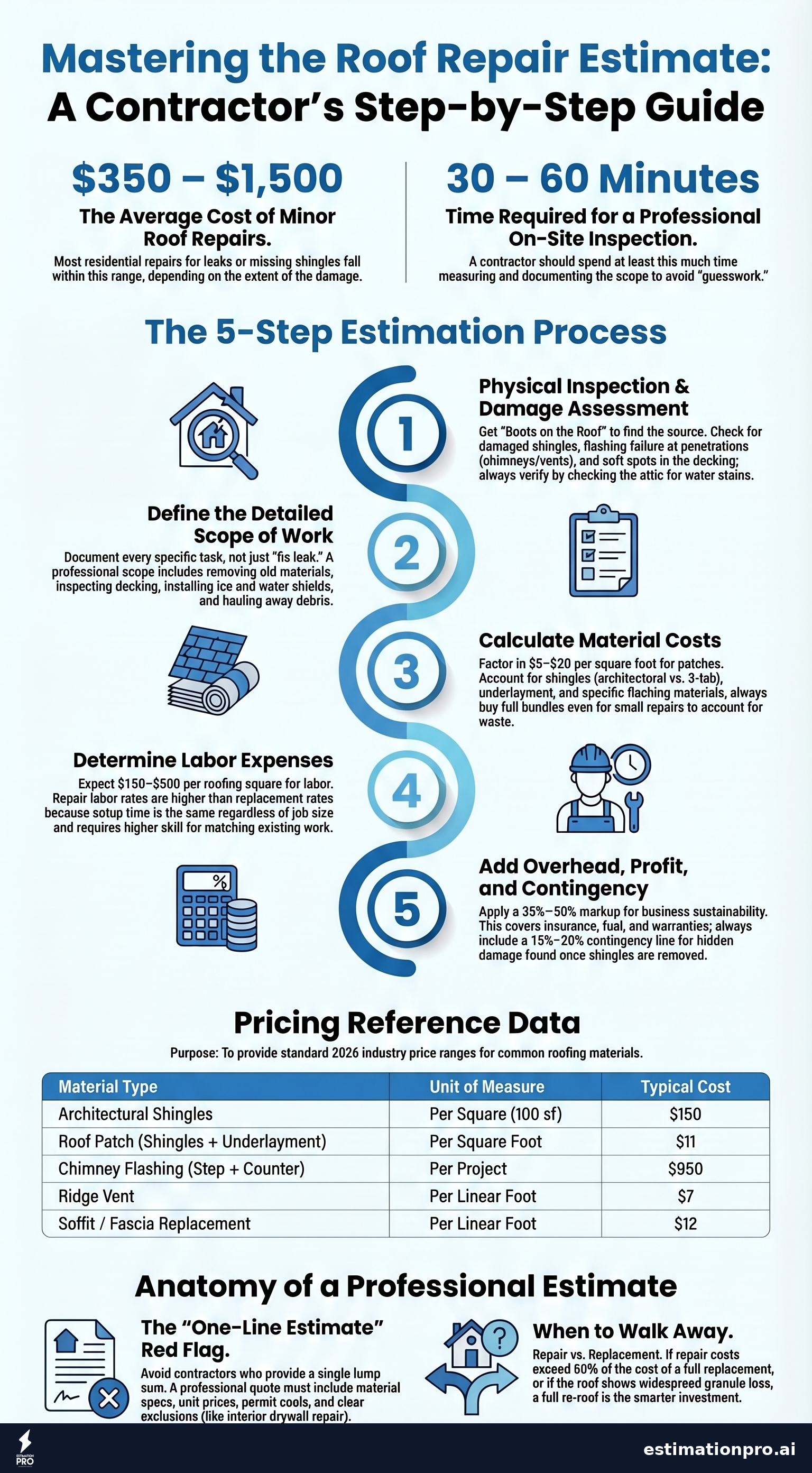
Share This Infographic
Feel free to share this infographic on your website. Just copy the embed code below:
Copy this embed code:
<a href="https://estimationpro.ai/tools/blog/roof-repair-estimate" target="_blank" rel="noopener">
  <img src="https://estimationpro.ai/tools/blog/infographics/roof-repair-estimate-infographic.png" alt="roof repair estimate infographic by EstimationPro.AI" style="max-width:100%;height:auto" loading="lazy" />
</a>
<p style="font-size:12px;color:#64748B;margin-top:8px">Source: <a href="https://estimationpro.ai/tools/blog/roof-repair-estimate">EstimationPro.AI</a></p>
Matching matters. Homeowners care about color and style match. If the existing roof uses discontinued shingles, you may need to source close alternatives or replace a larger section to blend the repair. Factor this into your material quantity.
For small repairs, you’ll often buy a full bundle when you only need part of it. Don’t eat that cost - include the full bundle price and factor waste into your estimate.
Step 4: Calculate Labor
Roofing labor for repair work typically runs $150-$500 per square, according to HomeAdvisor and BLS data for roofers (SOC 47-2181). Repair labor rates tend to be higher per square foot than replacement work because:
- Setup and teardown time is the same whether you’re fixing 20 square feet or 200
- Matching existing work takes more skill and care than new installation
- Smaller jobs still require a crew minimum (usually 2 workers for safety)
Worked Example 1: Small Shingle Repair
A 50-square-foot section of damaged architectural shingles on a walkable 6/12 pitch roof:
| Line Item | Calculation | Cost |
|---|---|---|
| Architectural shingles (1 bundle) | 1 bundle covers ~33 sf | $50 |
| Underlayment patch | 50 sf of synthetic felt | $25 |
| Ice & water shield | 1 roll, self-adhering | $100 |
| Roofing nails and sealant | flat rate | $20 |
| Labor (2 workers, 3 hours) | $60/hr x 2 x 3 | $360 |
| Debris removal | included in labor | $0 |
| Total | $555 |
That’s a straightforward repair with no surprises. In reality, I’d add 15-20% contingency because once those shingles come up, you might find rotten decking or compromised underlayment underneath.
Worked Example 2: Flashing Repair with Partial Re-Shingle
Chimney flashing failure with water damage to the surrounding 80 square feet of roof. Decking replacement needed on roughly 30 sf:
| Line Item | Calculation | Cost |
|---|---|---|
| Step flashing (aluminum) | 15 pieces | $75 |
| Counter flashing + sealant | project | $120 |
| Architectural shingles (3 bundles) | 80 sf coverage + waste | $150 |
| Underlayment | 80 sf synthetic | $40 |
| Decking replacement (30 sf) | 3/4” OSB panels | $85 |
| Ice & water shield at chimney | 1 roll | $100 |
| Labor (2 workers, 6 hours) | $60/hr x 2 x 6 | $720 |
| Debris removal | dumpster share | $75 |
| Permit | municipal fee | $125 |
| Total | $1,490 |
That’s a real-world chimney flashing repair. The pricing reference shows chimney flashing projects typically run $500-$1,800 total, and this estimate falls right in that range.
Step 5: Add Overhead and Profit
Your estimate isn’t done after materials and labor. Every legitimate roofing contractor has overhead:
- Insurance (general liability + workers comp)
- Vehicle and fuel costs
- Tool wear and replacement
- Office/admin time (writing the estimate, follow-up, scheduling)
- Warranty coverage
I’ve seen new contractors price jobs at materials + labor and wonder why they’re broke by year two. Your overhead is real. A standard markup for roofing repair work runs 35-50% on top of direct costs, depending on your market and business structure. Use a roofing calculator to cross-check your numbers.
Mistakes That Kill Your Roof Repair Estimates
Not including a contingency line. Hidden damage is the norm, not the exception, on roof repairs. Build 15-20% contingency into every repair estimate. If you don’t need it, the homeowner is pleasantly surprised. If you do, you’re covered.
Underpricing small jobs. A $400 repair still takes truck time, setup, tear-off, and cleanup. Your minimum trip charge should cover at least 2-3 hours of crew time plus materials. If the math doesn’t work below $500, don’t take the job at $350 just to stay busy.
Forgetting the interior. If the leak caused drywall damage, ceiling stains, or insulation contamination inside the house, that’s additional scope. Either include it or clearly note it as excluded. Homeowners assume “fix the leak” means “fix everything the leak damaged.”
Skipping the attic inspection. The attic shows you things the roof surface doesn’t. Water stains, mold, daylight through the decking, inadequate ventilation. Fifteen minutes in the attic saves you from writing a bad estimate.
Not photographing everything. Before, during, and after. Photos protect you from disputes, support warranty claims, and help you write more accurate estimates on similar jobs next time.
What Homeowners Should See in a Roof Repair Estimate
If you’re a homeowner reading this, here’s what a professional estimate should include. If any of these are missing, ask about it:
- Detailed scope of work - specific tasks, not just “roof repair”
- Material specs - shingle brand/style, underlayment type, flashing material
- Quantities and unit prices - not just a lump sum total
- Labor breakdown - crew size, estimated hours
- Contingency allowance - for hidden damage found during repair
- Permit costs - if required by your jurisdiction
- Warranty terms - workmanship warranty length and material manufacturer warranty
- Payment schedule - when deposits and final payments are due
- Exclusions - what’s NOT included (interior repair, painting, etc.)
A contractor who sends you a one-line estimate for “Roof repair - $1,200” hasn’t done the work to give you an accurate number. That’s a guess, not an estimate. Compare that to a line-item breakdown where you can see exactly what you’re paying for.
How Long Should a Roof Repair Estimate Take?
For a standard repair, figure 30-60 minutes on site for inspection and measurements, plus another 30-60 minutes back at the office to write it up and price it out. That’s 1-2 hours per estimate.
If you’re doing 3-4 roof repair estimates per week, that’s 4-8 hours just on bidding. And that doesn’t count the follow-up calls, scheduling, or revisions.
I built EstimationPro specifically to cut that time down. You do the inspection, punch in the scope, and the estimate builds itself with accurate pricing. What used to take an hour of desk time takes about 10 minutes.
When to Walk Away from a Roof Repair
Not every repair is worth bidding. Walk away when:
- The homeowner wants a band-aid fix on a roof that needs full replacement. You’ll be back in 6 months and they’ll blame you.
- The damage is so extensive that repair costs approach 50% of replacement cost. At that point, a full re-roof is the better investment for the homeowner.
- Access is dangerous and the homeowner won’t approve proper safety equipment costs.
- The client is shopping purely on price. They’ll find someone cheaper, and that someone will do $400 worth of work on a $1,200 problem.
Good, fast, or cheap. Pick two. That applies to roof repairs as much as anything else.
Regional Pricing Differences
Roof repair costs vary significantly by region. Labor rates in Seattle or Portland run 20-30% higher than rural markets. Snow-load regions require different underlayment and flashing details. Hurricane-prone areas have stricter building codes and material requirements.
Always check your local BLS wage data for roofers and adjust your labor rates accordingly. A roofing estimate template can help you standardize pricing while accounting for regional differences.
All prices in this guide reflect 2026 national averages. Your local costs may be higher or lower depending on market conditions, labor availability, and material supply.
Frequently Asked Questions
How much does a typical roof repair cost?
Most residential roof repairs cost between $350 and $1,500 for common issues like missing shingles, minor flashing repairs, and small leaks. Major repairs involving decking replacement, extensive flashing work, or structural issues can run $1,500 to $5,000 or more. The key factor is how much area needs repair and whether hidden damage is found once work begins.
Should I get multiple roof repair estimates?
Yes. Get at least three written estimates from licensed, insured contractors. Make sure each estimate covers the same scope of work so you’re comparing apples to apples. The cheapest bid often leaves out contingency or uses lower-grade materials. Look at the line items, not just the bottom number.
How do I know if I need a repair or a full replacement?
If the damage is isolated to one area and the rest of the roof is in good condition with 10+ years of life remaining, repair makes sense. If you’re seeing widespread issues - cracking, curling, granule loss across the entire roof, or if the repair estimate exceeds 40-50% of replacement cost - a full replacement is the smarter investment. Use a roof replacement cost guide to compare your options.
What’s included in a roofing contractor’s labor rate?
The labor rate covers crew wages, workers compensation insurance, payroll taxes, general liability insurance, equipment, and the contractor’s overhead and profit. When a contractor quotes $150-$500 per roofing square for labor, that’s not what the worker takes home. Roughly 30-40% covers insurance and taxes alone.
Do I need a permit for a roof repair?
It depends on your local jurisdiction and the extent of the repair. Many cities allow minor repairs (under a certain square footage or percentage of the total roof area) without a permit. Larger repairs, structural work, or full section replacements typically require a permit and inspection. Always check with your local building department before starting work. Permit fees typically run $50-$200 for roof repair projects.
Build Better Estimates, Win More Jobs
Writing accurate roof repair estimates is a skill that separates profitable contractors from ones who are always chasing the next job to cover the last one. Get the inspection right, document everything, price your materials and labor honestly, and don’t forget your overhead.
Contractors using EstimationPro report cutting estimate time by 60% or more. EstimationPro doesn’t just build the estimate - it generates a professional proposal, then automatically follows up with the homeowner so you win more of the bids you already send. Try EstimationPro free and see what your next roof repair estimate looks like when it only takes 10 minutes.
Pricing a job like this?
Get every line item priced for your area in a full estimate
Describe the job or snap a few photos. Send it from EstimationPro and it follows up with your client for you.
3 free estimates in the first 7 days. No credit card.
Typical Roof Leak Repair Estimate
Get Free Estimating Tips
Enter your email and we'll send you pro tips, cost data, and useful resources for contractors.
We'll send helpful resources and occasional tips. Unsubscribe anytime.
 EstimationPro AI For Contractors, By Contractors
 Save 2+ Hours on Every Estimate
Upload photos, record voice notes, and get AI-powered estimates with line items, material lists, and regional pricing.